

Disaster planning and ‘Supply Chain Agility’
Many organisations are yet to navigate through the digital transformation pathway. Ashley Naughton, Director of Supply Chain Transformation at Capgemini, and Shaun Plunkett, Vice President of Global Physical Supply Chain at Macmillan Education, discussed the ways in which businesses can leverage partnerships to succeed in their digital transformations.
During the ‘Supply Chain Agility’ panel, the pair highlighted some of the key aspects of a good partnership and the opportunities they can bring in times of natural disaster and unprecedented events. However, Blaise Hope, Editor-in-Chief of Sustainability Magazine and presenter on the stage provokes the thought that data on such events has been accessible and the mindset must change to accept that events will take place—as opposed to speculating.
Naughton also points out that businesses, particularly those with limited investment capabilities, should look at the important aspects of their supply chains. “It’s a tricky one for a lot of organisations to see past their immediate first tier,” says Naughton.
“Different sectors have slightly different challenges, but that insight is quite limited right now and I think there is an investment from both the financial perspective and a resource perspective that will be needed to decide what you actually want to focus on within your supply chain.”
When asked how organisations can build new working relationships with suppliers, Plunkett outlined the importance of face-to-face communications and gave a great example of how initial interaction led to receiving 50% of a supplier’s capacity. He also explains the position of empathy in this and says that firms should incentivise their critical suppliers to encourage loyalty.
Procurement for the Commonwealth Games
Procurement & Supply Chain LIVE also welcomed Alexia Binns, Head of Legal Procurement at Birmingham 2022 Commonwealth Games, to talk about how the organisation carries out its procurement function. With around 60+ procurement contracts at more than £217,477, the group is subject to legislation governing public procurement and Binns talks the viewers through some of the key criteria, which include having a legal personality, meeting set financial obligations, and meeting the needs of general interest with no industrial character.
The team is committed to sustainability, social value, and health and wellness, achieving this across its operations as its takes care of solutions before and after the event, leveraging electronic procurement systems—which are mandatory in the UK for these events—and managing suppliers both large and small.
“We look at the quality and price split. It would never be the price only and social value would come in at 10 to 20% and different [there are] different things within the quality that we would be looking at. Health and safety is another aspect we would look at as well,” says Binns.
“There is really a lot of flexibility within each procurement to tailor it as long as we’ve got our part price, part quality, and our social value, sometimes when you take out the social value you’re at around 50% quality.”
Negotiation is a complex procurement skill
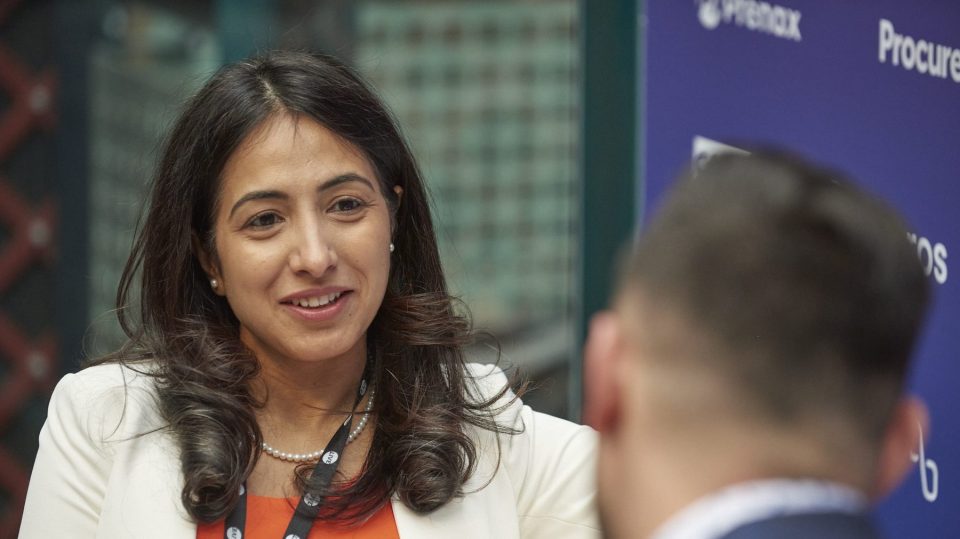
After the first networking break, Deepti Malhotra, Director of Procurement and Vendor Management at Symcor, spoke to the hybrid audience about negotiations and how to improve tactics as part of the procurement process.
Malhotra provided some great insights and tactics from her career that have led her to achieve the right outcomes in negotiations with global corporations. One of the points she highlighted was that negotiators are not necessarily looking to make a profit and the secret to great communication within this stage is to know the goals and objectives of the organisation—and why the supplier is so critical to achieving them—and tailor negotiations to meet the company’s targets.
She also believes that great negotiation skills result from practice and should not be affiliated to a particular group, such as gender.
“As per studies, women negotiators are much more successful than the other, and that brings another type of discussion altogether. But, if you do the right level of practice in advance and you know who you’re dealing with, you can actually come over that,” says Malhotra.
“If you’re clear about your goals, you understand where you’re heading, and have the right level of trust from your stakeholders, it’s helpful. Because, when you’re at the negotiating table, it doesn’t matter who you’re negotiating with—man or woman—if you know your goal and you know the individual’s past reactions and behaviours, you can be flexible in your approach.”
The difficulties of digital adoption
Andy Chivers, Head of Procurement at Wallgreens Boots Alliance, Martin McKie, Principal Advisor, Supply Chain at AWS, and Soroosh Saghiri, Program Director at Cranfield School of Management, joined the stage for the final stage two session of the day — ’Digital Ecosystems’
In particular, the trio discussed some of the important factors of adopting digital technologies and how these are critical for corporations to succeed, and gave examples of scenarios from all organisations where digital ecosystems have been critical.
The panel also discussed the query or ‘buy or build?’ and talks about the benefits and drawbacks of both applications to provide insight into in-house digital ecosystem development and what this may look like when outsourced.
The main takeaway from the talk is that digital ecosystems—and technology across all applications—supports an agile approach to planning and helps business manage risk and become resilient.
Transforming procurement with dynamic supplier data
End Day 2 of Procurement & Supply Chain LIVE: The Risk & Resilience Conference, Stephany Lapierre, CEO and Founder, Tealbook took to the stage to discuss: Transforming procurement with dynamic supplier data.
“We all have a big data problem,” she begins. “It’s a complex challenge that is hard to manage and maintain.”
In the last few years, organisations have moved to the cloud with the promise of digital transformation. “But software doesn’t fix data,” says Lapierre. “Just because you have implemented a technology doesn’t mean you will have clean data. You are still dependent on humans maintaining information.”
No matter how much AI and ML you throw at data if it’s incomplete or unclean you won’t be able to gain high-quality insights, which leads to narrow visibility.
It is this poor data quality that leads to failed digital transformation.
“The supplier base is the biggest untapped asset, if optimised properly, it can deliver hundreds of millions of dollars in value, provided that supplier data is dynamic and available across systems and people.”
Concluding the ‘Risk & Resilience’ conference
The two-day event was the first Procurement and Supply Chain of BizClik Media Group’s agenda for 2022. Both the in-person and virtual attendees witness a whole host of different insights from business supply chain and procurement leaders from across the globe, which they will have access to on-demand. Both the networking and lunch arrangements and co-working spaces, provided in-person visitors with a comprehensive experience and contact with new connections from multiple industries.
Visit the BizClik Media Group website and socials to see the full lineup of events for 2022 and catch up on the latest sessions at Supply Chain Digital Magazine and Procurement Magazine.
