

Additional Capabilities
Finally, and most importantly, vision-based perception can enable capabilities that other types of sensors are fundamentally incapable of. Ultimately, to achieve truly intelligent autonomous behavior, navigation systems must deliver human-level, 3D perception. For example, since they can detect texture and color, cameras are able to distinguish between the edge of a sidewalk and the edge of the road. This can create significant safety advantages for delivery robots because the robot can use this visual information to precisely navigate along its edge, just the way a human would.
This capability is useful in warehouses and manufacturing facilities where pedestrian paths are defined with lines and floor markers. Camera-based systems can even read signs and symbols that can alert both humans and robots to temporary closures, wet floors, and detours. Vision-based navigation systems are also able to work in both indoor and outdoor environments – opening up new use cases and applications.
 Low Cost, 3D Perception
Converting the large volume of data from cameras into 3D perception on low-cost hardware is a monumental technology and engineering challenge. The process requires a significant AI, computer vision, and sensor fusion expertise on the part of engineers, along with the availability of enabling technologies.
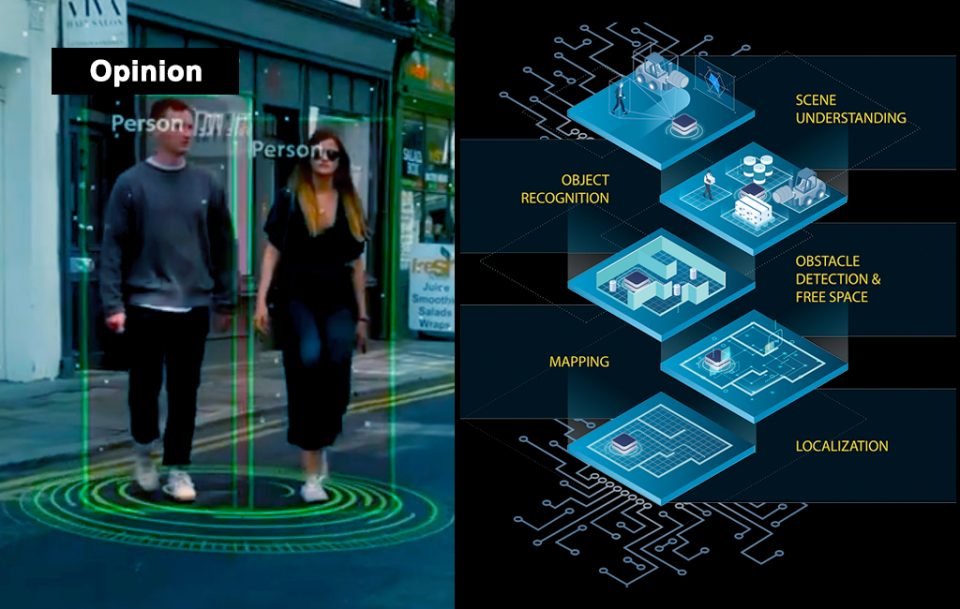
Thankfully, robust, performative solutions for camera-based 3D perception is now to robotics engineers. For example, RGo Robotics’ solution, Perception Engine, is a full-stack software solution that enables manufacturers to deliver next-generation capabilities rapidly. It is able to utilize just a single camera in some applications to achieve precise 3D localization and perception. Its wide field of view camera is also able to recognize humans and other obstacles around it. This level of scene understanding allows mobile robots to behave more naturally and collaboratively around humans.
Cameras and Computer Vision Critical
All said, there remains significant value in traditional sensor modalities including LiDAR. Recent advancements in low-cost MEMS 3D LiDARs is encouraging and, when combined with cameras, could add cost effective robustness and rich 3D mapping capabilities to robotics systems.
But Musk was correct in saying that cameras and computer vision should serve as the foundation of any mobile robot navigation system. The next few years will certainly see dynamic changes as the state-of-the-art evolves with advances in both the AV and robotics industries.
About the Author As SVP Marketing & Business Development, Peter Secor is responsible for building RGo Robotics’ brand and identifying new customer and market opportunities for the company. Prior to RGo, he held transformative positions with companies at the leading edge and intersection of IoT, industrial automation, robotics and 3D printing including iRobot and Stratasys. Secor started his career as a management consultant where he specialized in corporate strategy development and M&A for Fortune 500 companies in the industrial automation market including Rockwell Automation, Siemens and Honeywell. He holds a BS in Mechanical Engineering from the University of New Hampshire and an MBA from Columbia University’s Columbia Business School with a concentration in technology growth marketing.
