

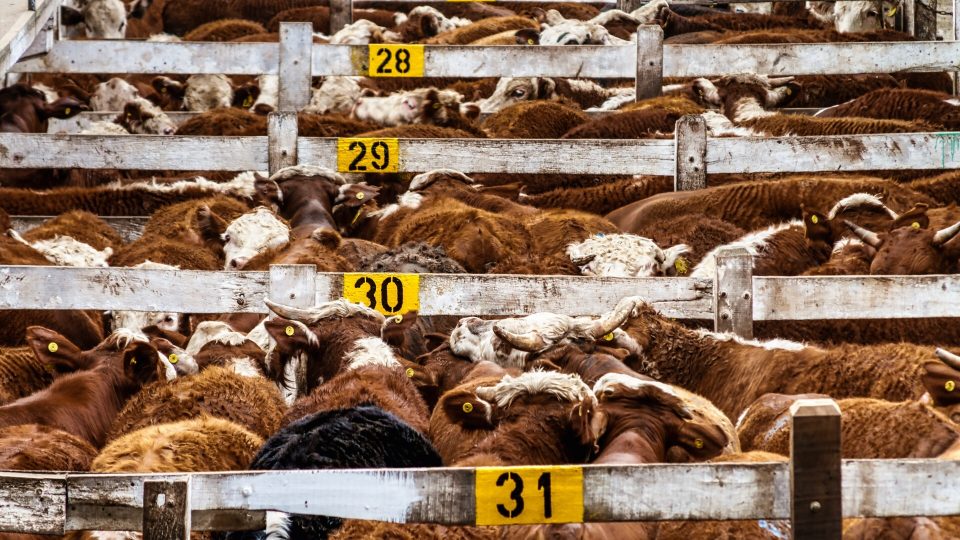
24-hour control over the activity of slaughterhouses, Spanish livestock will rely on technology to ensure the welfare of cows, pigs, poultry, lambs and other animals, which the new law requires Install video surveillance cameras.
but black on white, some abattoirs and ranchers find The order of the Ministry of Consumption can be improved. “We think that not enough guarantee as a sensitive subject that a Animal welfare offenses or offenses against public health.Sorry to the animal NGO Equalia, which promoted the proposal.
The main problem for the organization is See and treatment of recorded images. “It falls on the workers of the slaughterhouse and not on them” in the Official Veterinary Service of the Autonomous Community, as we requested”, explains its campaign manager, Julia Elisalde, who believes that this task could also have been assigned to an independent unit.
The operator in charge, who should be trained in animal welfare, shall a report In which it is recorded whether the events have been detected or not. but When 30 days have passed, the recording can be deleted. “In the event that more than a month has passed since the possible irregularity, we will not have access to the images due to data security issues. In the case of the United Kingdom, you have up to three months,” he lamented. .
In this sense, a practitioner of the sector also suggests what he believes is the trap of a regulated system: where impunity exists, it can exist with or without cameras. “The decree is incomplete and Lends itself to continue as we are”Agree with those who prefer anonymity.
Thus, change is less rapid than it may seem. Most regions have been implementing this measure for a long timeBecause that is the demand of some big distribution companies. “I don’t see it as a cost, I see it as an investment”, commented meat wholesaler Groupe Venus, which values quality control and staff improvement. Since cameras were installed in their facilities.
a useful cost?
Regulations require the availability of video surveillance cameras In unloading areas and driving aisles, as well as in surprise and bleeding areas, No blind spots and ensuring good quality even in low light.
“This point is being given great importance” sacrifice And that won’t worry me much. This is the least sensitive point, because everything is already highly mechanized and protocolized”, says Hector Palatsi, president of the College of Veterinarians in Teruel, who points to other areas of improvement, such as transportation from farm to slaughterhouse.
But the text focuses only on slaughterhouses, for which it details the technical requirements for video surveillance systems. It should be up and running on the latest. Within a year, two years for the “little ones”Although it is not specified what this means.
in any case, camera installation cost That’s not among the criticisms of the smaller company RTVE has spoken with. First, because those who are devoted to this stage of meat production usually already have a certain size. Sanitation, quality and hygiene controls were already stricter than this new law and good facilities, veterinarians etc. are essential. To be in the market, they tell us.
However, they do not rule out an additional cost for complying with the law and inspectors’ requirements to the letter – that the camera up, sharper images, more data storage…
An aid to quality control… and workers
Meanwhile, the General Council of Veterinary Associations welcomes slaughterhouses with optimism video surveillance will help more comprehensive public health oversight Meat farms. And that is, up to 58.3 million pigs were slaughtered in Spain in 2021 alone.
“Everything helps, but I’m also sure that to this day This was already done with maximum responsibility”, explains Palatsi from the College of Veterinarians in Teruel. “People have become very aware and I will repeat a thousand times that the last person who is interested” [el maltrato animal] It is the owner of the slaughterhouse, as it greatly affects the quality of the meat”.
Frimancha industrial slaughterhouses confirm cameras have been installed How to gain trust with customers -National and International- over the years. “When they visit facilities, you teach them that there are cameras and it is guaranteed to be detected. We don’t have to hide from anything,” he says, because nobody’s interested. food security.
Animal welfare and quality control issues aside, Recording has another counterpart to these companies: the worker monitoring. “It allows us to see from afar what’s going on and 24 hours are many eyes. We can control how animals are cleaned or unloaded according to instructions in terms of animal welfare”, he explains from Group Venus. And this has an effect on the blueprint: “If we look for an analogy We do, It’s like a speed camera on the highway. They are not looking at me, but they are looking at me.”
An animalistic initiative against impunity
With the move, Spain is already the first country in the European Union to require cameras in slaughterhouses, although England has been doing so since 2018 and Scotland recently joined. Equalia properly saw the English example to launch a campaign, which ended in denouncement. “Impunity for cases of alleged offenses against animal abuse and public health”With six reports published before 2020.
“We sought to reflect the lack of regulation in slaughterhouses that led to conditions that wereOr the operators are chopping off the legs of cows that are still conscious and alive. Operators entering batches of approximately 300 unidentified lambs pose a public health risk due to the traceability of consumption…”, explains Elisalde.
and they got down to work with a proposal to install cameras in slaughterhouses, which in the end attracted the agreement of large operators such as El Pojo or Carrefour, And it reached the autonomous parliaments of the Balearic Islands, Navarra, La Rioja, Madrid and the Valencian Community as an illegal proposal. That is why it is already a “fairly accepted” measure by the sector. But they wanted to take it further.
“There are many Reinforcement and harassment problems so that the current law can be followed”In , Elisalde explains the motives behind the campaign. “All measures that lead to better and more inspections on a regular basis will be beneficial to both the consumer, the companies, and the animals.” And this, we’re told, is only a first step.
