

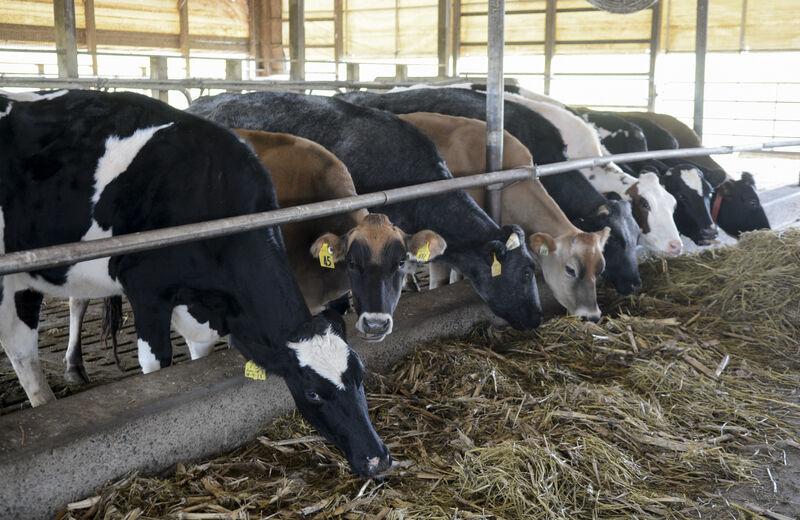
LEWISBURG — Dairy farming wasn’t cutting it for Holden Midkiff.
He said he knew he needed to change directions if he wanted to make his career in agriculture viable.
Amazon’s acquisition of Whole Foods in 2019, in part, inspired Midkiff and his significant other Alison Steibe to develop Crossroad Farms. The idea was to create a virtual farmers market offering only locally sourced products and deliver goods direct to customers within a 60-mile radius.
It’s now a full-go for Crossroad Farms. Midkiff’s only lament is that it wasn’t up and running when the coronavirus pandemic began in the United States.
“We don’t have a supply problem, we have a distribution problem. That was key to me,” Midkiff said, adding that farmers had product but disruptions in processing and shipping kept it from consumers. “You can buy from us and not depend on the grocery store.”
Midkiff said he struggled in dairy farming for eight years, describing the industry as one of hard work with little control of the marketplace. Transitioning to a delivery service provides independence but no less risk. Midkiff and Steibe are excited, though, by the potential prospects of Crossroad Farms.
They still milk cows. Crossroad Farms has 35 of its own — jerseys and crossbreeds. They process and bottle their own milk sold by the half-gallon and quart — a2 protein tested; pasteurized, not homogenized. A cheesemaker uses the milk to make the farm’s own cheese.
The couple sources beef and pork, eggs, fresh produce and more from nine different farms in Union, Snyder, Northumberland, Perry and Columbia counties. Products are fresher and of higher quality, they say, and by spending with Crossroad Farms, customers keep their cash circulating in the hyper-local economy.
“People, especially in this area, are so close to agriculture but so far removed,” Steibe said of massive supply chains that separate consumers from farmers.
Customers use the online shop at www.crossroadfarms.farm to choose among the offerings and are asked to leave a cooler out for the delivery. The shop went live in June. Their own milk wasn’t added until September due to delays in licensing and sourcing glass bottles, which Midkiff attributed to the pandemic.
“This morning we were up at 2 and back in bed by 6 and slept for another hour. We do all the deliveries every morning. When you order from us, it’s us. It’s just us,” Steibe said.
There’s a three-day turnaround on orders at the moment. Midkiff hopes to build out his customer base and service area, which he said will allow him to reduce the turnaround. He hopes, too, to find more farms to work with.
“Shortening the supply chain not only helps the farmer but it lets us control our own destiny. That’s been life-changing,” Midkiff said.
