

Photo: UBCO
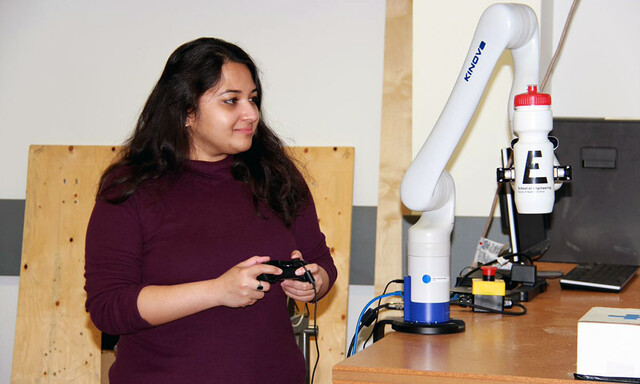
UBCO doctoral student Debasmita Mukherjee, with the School of Engineering?s Advanced Control and Intelligent Systems Laboratory
The University of British Columbia is at the forefront of human and robot interaction.
The UBCO Advanced Control and Intelligent Systems Laboratory is looking at ways to program robots so they can work safely alongside people.
The team used autonomous vehicle guidelines, artificial intelligence, and machine learning to help guide the machines and their research.
Debasmita Mukherjee, a doctoral student and lead author of a recent study says, “it is incredibly important for robots in manufacturing to perform their tasks in the safest and most efficient method possible.”
Mukherjee says the research team is looking at ways for automated machines to perceive their environments and carry out tasks in a similar manner as their human partners.
Mechanical Engineering Professor Homayoun Najjaran says the process is not as straightforward as it seems.
“Robots don’t think or feel, so they need systems that capture and analyze their environment enabling them to respond,” says Dr. Najjaran. “Often those responses need to be in hundredths of a second to ensure the safety of humans in their vicinity.”
Industrial robots are programmed and equipped with the ability to operate at high speeds and perform tasks like welding, painting, assembly, pick-and-place and material handling. Social robots, are built to assist people in service industries and typically need to be mobile, lightweight and programmed to work in a variety of different environments.
UBCO’s School of Engineering is at the forefront of human-robot collaboration, a relatively new field of study but one that is gaining interest as employers struggle to attract workers in some fields, including the hospitality industry.
Researchers are now turning their attention to developing systems that can enable robots to function and respond outside of factory environments. The ultimate goal is to achieve similiar team dynamics and communication of all-human teams.
“In an ‘open-world,’ robots will need to deal with unexpected variables like people, structures, machines, and wildlife,” she adds. “We need to ensure they can do this correctly, efficiently and safely.”
