

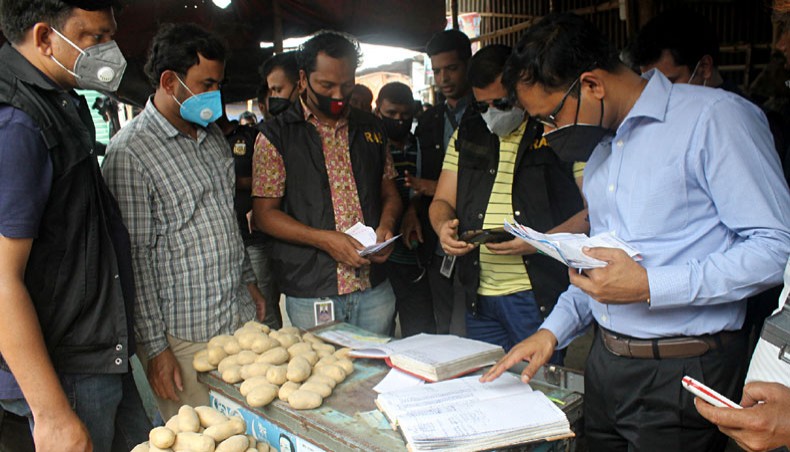
A team of the Directorate of National Consumer Rights Protection led by executive magistrate Sarwoer Alam conducts at drive at Jatrabari wholesale market over increase of prices of essential commodities on Saturday. — New Age photo
The government struggled to get traders abide by its instructions of not to artificially rise prices of essential commodities as the panicked nation stocked up on them in apprehension of an imminent lockdown of the country.
Reports of people rushing to groceries and kitchen markets across Bangladesh to stock up on food came pouring as the country announced its second coronavirus death on Saturday and new coronavirus cases.
Rumours that the country might be put in lockdown because of COVID-19 outbreak sparked panic buying among the people as they witnessed other infected countries follow the same path in order to contain the outbreak.
Authorities on Saturday fined 73 traders, three dozen of them wholesalers, in the capital, Munshiganj and Khulna for artificially rising prices of the staple rice and other essentials over the last three days.
‘What traders are doing at this moment of crisis is hard to believe,’ executive magistrate Sarwoer Alam told New Age.
Almost all traders in the Jatrabari wholesale kitchen market had increased prices of almost all items by the time Sarwoer had arrived there on Saturday morning.
The wholesalers increased the price of a kilogram of onion to Tk 70 from Tk 28 and in the retail market per kilogram of onion was sold up to Tk 85, said Sarwoer.
He fined 31 wholesalers Tk 50.75 lakh and sent five of them to jail on different terms for illegally raising prices of the commodities.
The price of a kilogram of potato was increased to Tk 30 from Tk 12, he said.
‘The situation is like traders increased prices whimsically several times a day,’ said Monjur Mohammad Shariar, deputy director, Directorate of National Consumer Rights Protection.
Five teams of the directorate inspected 16 kitchen and wholesale markets in the capital, including New Market, Lalbagh, Babu Bazar, Karwan Bazar, Gulshan, Banashree, Shantinagar, Khilgaon, Hazaribagh, Jigatala, Mirpur, and Motijheel.
The inspection teams fined 31 traders Tk 4.28 lakh for increasing prices of food whimsically.
Shariar said that traders at a wholesale rice market in Lalbagh increased the price of a 50-kg sack of rice by Tk 400.
The price of isopropyl alcohol, the key ingredient of hand sanitiser, has been increased almost three times its usual price, to Tk 450 per litre from Tk 182, in the gap of 24 hours, said Shariar.
Khulna deputy commissioner Mohammad Helal Hossain said that four traders were fined Tk 23,000 for selling lemon, ginger, garlic and onion at artificially increased prices.
Two community centres were also fined Tk 15,000 for allowing social gatherings on their premises in violation of the government’s ban on such events in wake of the spread of novel coronavirus.
Guests invited to the events were sent back home, said an announcement posted on Facebook page of Khulna deputy commissioner.
New Age correspondent in Munshiganj reported that five retailers were fined Tk 75,000 for whimsically increasing prices of rice and commodities.
New Age correspondent in Mymensingh said that traders continued to charge artificially increased prices on food items in the district despite government’s effort to control it.
Retailers in Mymensingh said that fining them would not help the situation when they were buying products at increased prices from wholesalers.
Panic buying is not a consumer behaviour isolated to Bangladesh but rather shared by countries swept by coronavirus outbreak since it emerged in China in December 2019.
Shelves have turned bare in matter of hours in countries such as the US, the UK, Australia and many other European countries after the news of the outbreak of the virus broke in the nations.
Studies described panic buying as a means to which people resort to while dealing with a situation out of their control.
The novel coronavirus, later named as SARS-CoV-2 which causes the disease COVID-19, is not only invisible to eyes but its nature is unknown to humans who are trying to get a control over it by cleaning homes and staying indoors with stocked up foods, observed global media.
