


Text size
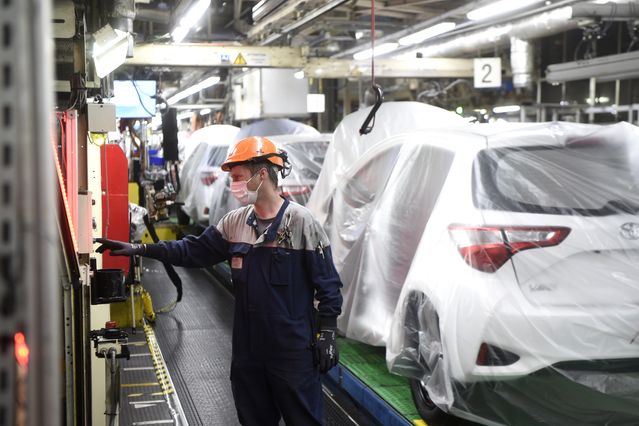
A Toyota assembly line
Francois Lo Presti/AFP via Getty Images
Whether due to shortages of semiconductors and parts, and protests, for the car business, supply-chain problems just won’t go away.
Deutsche Bank analyst Emmanuel Rosner wrote Friday that
Honda Motor (ticker: HMC) and
Toyota Motor (TM) have both recently announced production curtailments due to a lack of parts. Toyota is pausing to let struggling suppliers catch up. Honda is still suffering from a lack of semiconductors and will lose about 10% of planned production at a couple of facilities through the end of March, according to Rosner. He points out Toyota’s April production will be 20% lower than originally planned, and May and June will be 10% and 5% lower.
Toyota and Honda didn’t immediately respond to requests for comment.
Friday’s report from Deutsche Bank follows
Rivian Automotive (RIVN) report from Thursday evening. Rivian said it planned to make about 25,000 vehicles in 2022, while Wall Street had been hoping for closer to 40,000.
A lack of semiconductors has constrained automotive production for months, costing the industry millions of units in lost sales in 2021. Production curtailments have continued in 2022 for a host of supply chain reasons, beyond just the continuing chip shortage.
Ford Motor (F) and
General Motors (GM) were recently forced to take some downtime in Canada because truckers disrupted the flow of parts between the U.S. and Canada to protest Covid-vaccine mandates.
Even though supply-chain problems have been with auto investors for more than a year, they still have the ability to impact stocks. Rivian shares are down about 3.8% in Friday morning trading. The
S&P 500
and
Dow Jones Industrial Average
are up about 0.8% and 0.6%, respectively.
Toyota and Honda’s U.S.-listed American depositary receipts are down 2.3% and 0.7%, respectively. Ford and GM shares are also lower, down 0.5% and 0.1%, respectively.
Lower production has also led to low inventories of new cars, resulting in record prices for new and used cars. They will likely remain elevated for longer than expected as the industry keeps playing catch-up.
Write to Al Root at [email protected]
