

Amid the ongoing debate over the trillion-dollar Health,
Economic Assistance, Liability Protection and Schools (HEALS) Act proposed by
Senate Republicans, aspects of China policy, intellectual property, and
coronavirus have begun to intersect.
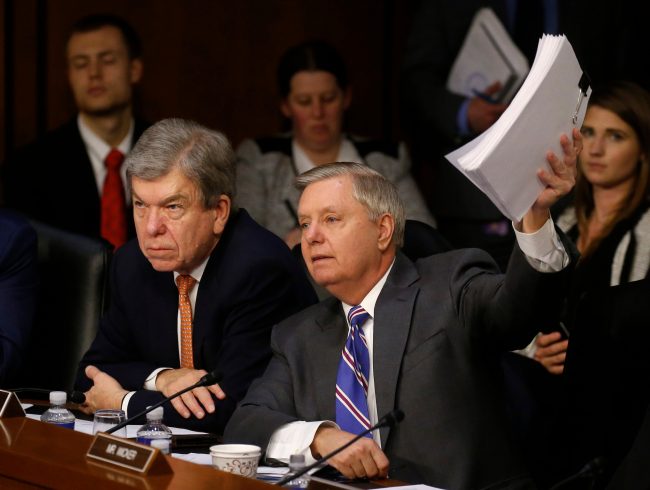
Aiming to “bring back the medical supply chain into the United States,” Sen. Lindsey Graham (R-SC) earlier this week introduced his Restoring Critical Supply Chains and Intellectual Property Act as a component of HEALS. The Graham measure seeks to restore American production of critical personal protective equipment (PPE), especially given that up to 90 percent of this production currently takes place in China. Specifically, the measure calls on the Department of Health and Human Services to increase domestic PPE procurement (defined to include sanitizing supplies and accessories as well) with targets of 50 percent domestic sourcing within a year, 75 percent within 18 months, and 100 percent within five years.
The bill also includes a $7.5 billion tax credit for PPE
“manufacturing projects” that seek to expand and retrofit factories to satisfy
demand for PPE. These credits will be assigned to projects that “have the
greatest potential to help achieve medical manufacturing independence for the
United States” and ‘‘have the greatest potential to meet current demand or
sudden surges in demand for personal protective equipment.”
“The goal,” Graham said in a press release earlier in the week, “is to have one hundred percent American-made in the strategic stockpile of PPE within five years. I made a promise to the state of South Carolina that I would work to end our dependency on China for PPE. This bill is fulfilling that promise.”
In addition, under the Graham bill, “qualified intangible
property” such as patents, trade secrets, formulas, or other know-how related
to the production of PPE will be eligible for tax-free treatment. “This tax
credit,” Graham said, “will help revitalize an industry and bring it back to
the United States. No longer will we be beholden to China.”
In addition, the measure seeks to “safeguard American
innovation” by establishing a Federal Research Security Council within the
Office of Management and Budget. This new council would be charged with
securing and standardizing the grant-awarding process throughout the federal
government. Specifically, this council would ensure that federal science
agencies, defined as United States departments or agencies receiving more than
$100 million in research and development funds, adopt the best practices to
reduce the risk of any idea theft, develop conflict-of-interest mitigation
policies, and generally remain on the lookout for the malign influences of
foreign governments seeking to infiltrate basic science research in the United
States.
Graham’s bill would also increase monitoring of exchange
students, especially over any export-controlled technology they access during
their time in the United States, and would outright bar entry into the United States
for any foreign national who seeks to improperly access or misappropriate
export-controlled tech.
Finally, the measure would provide additional funding of up
to $3 billion per project for the production of advanced semiconductor chips,
styled as the Creating Helpful Incentives to Produce Semiconductors for America
(CHIPS) Act.
The funds are intended to “finance the construction,
expansion, or modernization” of semiconductor manufacturing facilities and will
be awarded “as determined necessary by the Secretary [of Commerce] for purposes
relating to the national security and economic competitiveness of the United
States.”
The prospects for passage of Graham’s bill remain as uncertain as those of the larger HEALS Act, as Congress finds itself tied in knots over the latest round of COVID-related economic relief. But the measure’s focus on intellectual property, innovation, research and development, semiconductors, and national security, especially with respect to China, speaks volumes about the current moment in policy and geopolitics.
