

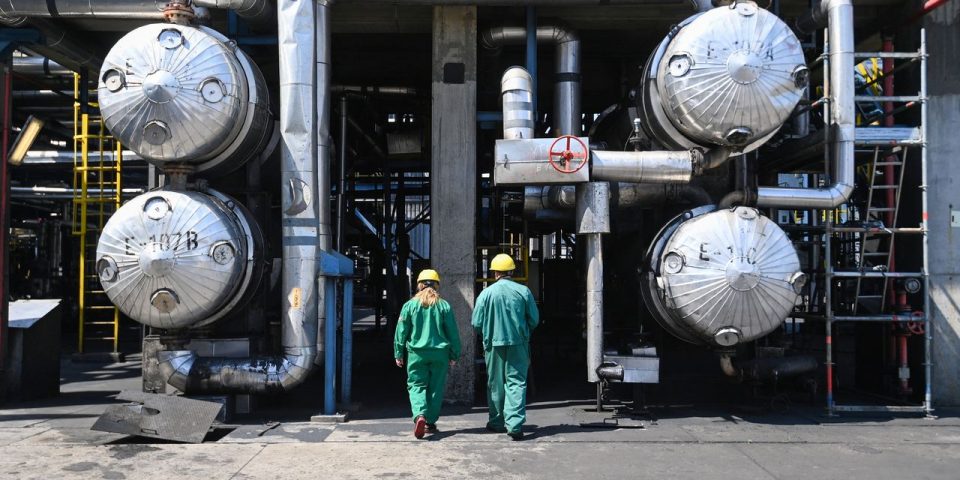
The European Union is considering banning insurance for tankers carrying Russian oil.
Attila Kisbenedek/AFP via Getty Images
Text size
The European Union has one weird trick that could body slam Russia’s global oil sales: insurance. Blue-suited underwriters in Germany and Scandinavia might be as effective as tanks and missiles in the struggle for Ukraine. As usual with the EU, however, deploying them is not simple.
Three months into Vladimir Putin’s war, Russian oil sales are substantially dodging the Western banking sanctions intended to constrict them. Moscow exported record crude volumes in April, says Jim Mitchell, head of Americas oil analysis at Refinitiv. “Divert is a better term than constrict for what’s happening,” he says.
The EU set a de facto deadline for itself to do better: a continental summit slated for May 30-31. Attention has focused on the bloc itself stopping oil purchases from Russia. Putin could divert much of those flows to willing customers in India or China.
That’s where insurance comes in, or could. You can’t float a $120 million oil tanker carrying two million barrels across the high seas without insurance, not if you’re in your right mind.
Europe, along with the aligned (for this purpose) U.K., has a hammerlock on that business. Global nexus for “hull and machinery,” or
H&M
,
insurance is the hoary halls of Lloyd’s of London, where heavyweight reinsurers like
Swiss Re
(ticker: SREN. Switzerland),
Hannover Rueck
(HNR1.Germany), and
SCOR
(SCR. France) pool and parcel enormous risks.
The real trump card is protection and indemnity insurance, which covers God-forbid liabilities like the Deepwater Horizon rig disaster off the U.S. Gulf Coast. That episode cost operator
BP
(BP) north of $60 billion over a decade. Shipowners pool their own resources for this protection through “P&I clubs” concentrated in the U.K. and subject to EU statute. They cover more than 90% of oil shipments around the world.
Brussels even has experience cutting this lifeline to a rogue oil exporter: Iran, during the squeeze that produced the nuclear agreement of 2015. “Broadly speaking, the Iran sanctions were effective,” says Daniel Martin, a London-based shipping attorney at law firm HFW.
That doesn’t mean a repeat with Russia is a done deal. The EU famously needs unanimous consent from its 27 members to impose sanctions. Hungary, dependent on Russian oil economically and Putin-friendly politically, is famously resisting an oil embargo.
Grabbing less ink is Greece’s stand against any measure that would threaten global shipping. Greeks own a quarter of the world’s oil tankers. They are finding allies in fellow maritime EU members Cyprus and Malta.
That all looks like too many arms for Brussels to twist over the next 10 days, says Eoin Drea, senior research officer at the Martens Centre for European Studies. Priority will go to halting direct oil imports.
“The EU is desperate for some sort of agreement, and it isn’t impossible that the insurance issue will be postponed or dropped,” he says.
Russia may be helping the EU cause itself. Its busiest port by far is Novorossiysk on the Black Sea, that same Black Sea where Russian war ships have been busy sowing mines and occasionally shelling neutral oil tankers.
Insurance premiums soared tenfold in the early days of the war after at least two commercial vessels were damaged. “If they just let it work out economically, insurance may end up as 70% of the cost,” Refinitiv’s Mitchell remarks.
The arcana of oil tanker insurance may yet move toward center stage.
