

Significance
Ship movements related to fishing, tourism, research, and supply expose the Antarctic continent to human impacts. Until now, only rough estimates or industry-specific information have been available to inform evidence-based policy to mitigate the introduction of nonnative marine species. Antarctica’s Southern Ocean supports a unique biota and represents the only global marine region without any known biological invasions. However, climate change is removing physiological barriers to potential invasive nonnative species and increasing ship activities are raising propagule pressure. The successful conservation of iconic Antarctic species and environments relies on addressing both climate change and direct, localized human impact. We have identified high-risk areas for introduced species and provide essential data that will underpin better evidence-based management in the region.
Abstract
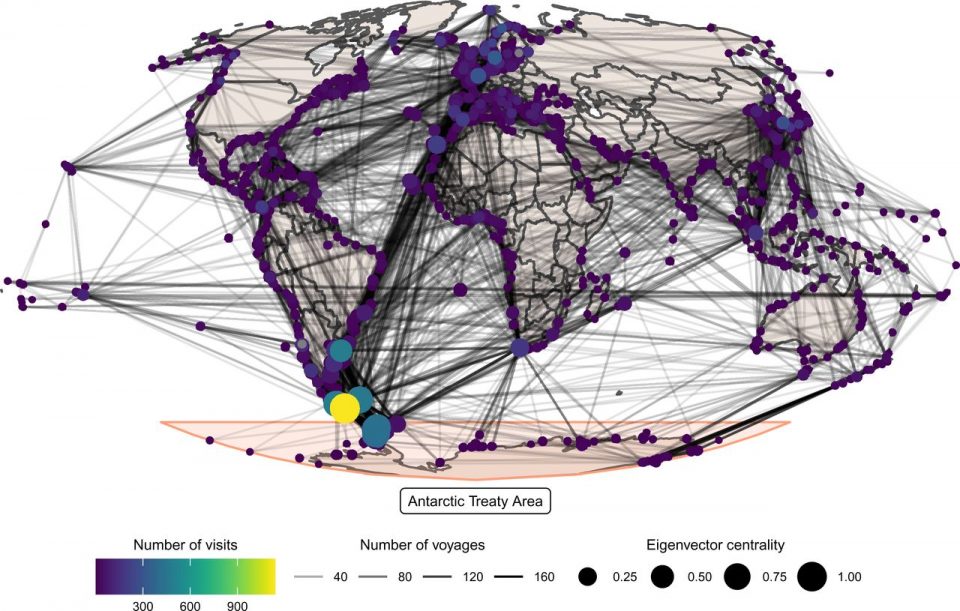
Antarctica, an isolated and long considered pristine wilderness, is becoming increasingly exposed to the negative effects of ship-borne human activity, and especially the introduction of invasive species. Here, we provide a comprehensive quantitative analysis of ship movements into Antarctic waters and a spatially explicit assessment of introduction risk for nonnative marine species in all Antarctic waters. We show that vessels traverse Antarctica’s isolating natural barriers, connecting it directly via an extensive network of ship activity to all global regions, especially South Atlantic and European ports. Ship visits are more than seven times higher to the Antarctic Peninsula (especially east of Anvers Island) and the South Shetland Islands than elsewhere around Antarctica, together accounting for 88% of visits to Southern Ocean ecoregions. Contrary to expectations, we show that while the five recognized “Antarctic Gateway cities” are important last ports of call, especially for research and tourism vessels, an additional 53 ports had vessels directly departing to Antarctica from 2014 to 2018. We identify ports outside Antarctica where biosecurity interventions could be most effectively implemented and the most vulnerable Antarctic locations where monitoring programs for high-risk invaders should be established.
Footnotes
- Accepted November 1, 2021.
-
Author contributions: A.H.M., L.S.P., and D.C.A. designed research; A.H.M. performed research; A.H.M. analyzed data; and A.H.M., L.S.P., and D.C.A. wrote the paper.
-
The authors declare no competing interest.
-
This article is a PNAS Direct Submission.
-
This article contains supporting information online at https://www.pnas.org/lookup/suppl/doi:10.1073/pnas.2110303118/-/DCSupplemental.
Data Availability
The data that support the findings of this study are available from LLI, but restrictions apply. The data were used under license for the current study and so are not publicly available. Processed, summarized data may be available from the authors upon reasonable request and with permission of LLI. Code used to analyze data in this study is maintained in a GitHub repository; access and code are available on request.
- Copyright © 2022 the Author(s). Published by PNAS.
