

As anyone who’s read the news, tried to buy a car or scanned empty shelves at the grocery store, the global supply chain is a bit of a mess.
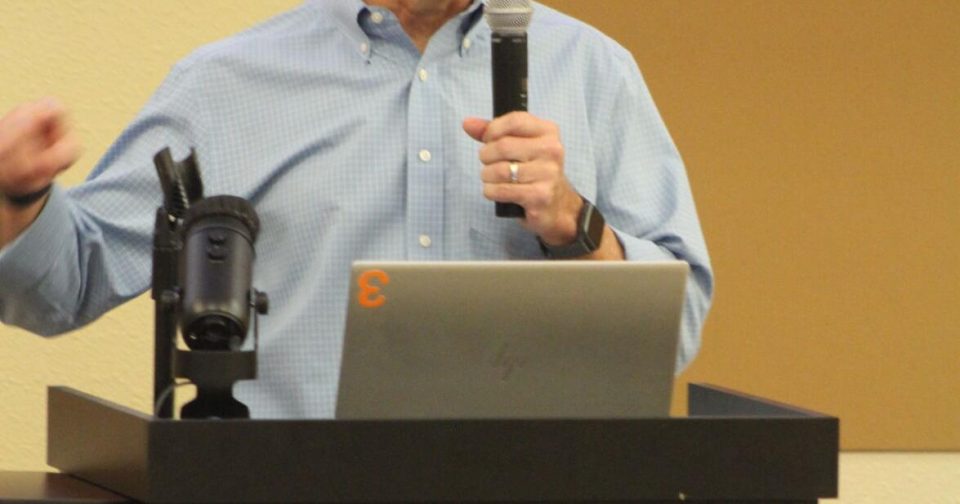
Cleburne Rotarian Hidde van Assendelft, who also serves as Sachem Inc.’s director of global supply chain, ran down the reasons behind that very situation during the Cleburne Rotary Club’s Thursday luncheon.
Born in the Netherlands, van Assendelft moved to Georgia at the age of 12 and later to Cleburne where he has worked for Cleburne’s Sachem plant since 1999.
van Assendelft received his degree in chemical engineering from Georgia Tech University and went on to earn his MBA from the University of Texas at Dallas.
“When I was getting my MBA I had a class called supply chain, and I was interested in it,” van Assendelft said. “I remember being at one of [Sachem’s] quarterly meetings in Europe and saying, ‘I’m taking a class in supply chain and think it’s a concept we need to look at.’ I remember the CEO saying, ‘Supply chain, what do you mean supply chain?’
“Here I am 15 years later as director of supply chain. It’s kind of funny how things go.”
Given that Sachem has facilities in Europe, Asia and America, van Assendelft discussed supply chain issues in general and as they relate to Sachem.
Supply chain as broadly defined involves the networks between a company and its customers from suppliers all the way through the end of the process, van Assendelft said.
Supply chain management, he added, entails overseeing all those details and steps from raw material procurement to end customer purchase. But there’s more.
“Then you have this feedback loop called demand not to mention other things like trends to take into consideration,” van Assendelft said. “So all those things that happen from the materials you need coming out of the ground to being grown to the customer actually buying your product.”
Even something as simple as a T-shirt involves multiple steps and planning phases, van Assendelft said in illustrating his point.
Cotton has to be grown, usually in America. That cotton is then harvested, turned into fiber, which is woven into fabric, which is then made into T-shirts that are distributed to be sold to end users throughout the world.
“So cotton grown here, shipped to the Asia/Pacific area then back to Europe, the USA and other areas to be sold,” van Assendelft said. “So just a simple T-shirt goes quite a ways around the globe before it comes back here.”
More complex goods, such as automobiles, involve procurement of multiple raw materials, numerous suppliers, various manufacturers, different stages of production and a complex web of transportation and shipping issues.
The chip shortage in the news these past months affects car production in addition to many more products.
“Almost every car made now has four to five kilograms of silicon in it,” van Assendelft said. “ Chips to start the car, the digital dashboard, sensors, cameras. There’s a lot of computerization happening in cars.”
The chip shortage plays a big reason into why auto dealerships are light on inventory and selling what cars they can get as fast as they come in, van Assendelft said.
“Because the manufacture of many products involves very long global supply chains and a lot of interdependency between different suppliers, companies and nations,” van Assendelft said.
Such issues include competing national policies, protectionist policies such as tariffs, trade imbalances, weather issues, worker shortages and other factors.
“Any little bitty upset in that process ripples throughout the entire chain,” van Assendelft said.
Unexpected developments — a global pandemic, for example — may further frustrate things and affect other areas of social life and the economy in the process, such as a country’s gross domestic product.
“[America’s] GDP had been increasing at a steady rate of 2 percent to 2.5 percent the last few years,” van Assendelft said. “Then the pandemic came and the bottom fell out. But once the pandemic changed course the economy quickly rebounded.”
Rebounded way more than 2.5 percent, van Assendelft said, swinging from negative 31 percent to 32 percent to 33 percent on the positive side in a very short time.
“So, it’s not just long supply chains that have to be dealt with all the time, but also the fact that demand for goods is just way out of whack right now,” van Assendelft said. “Going from 31 percent down to 33 percent up that quickly is, well, that’s hard to plan for.
All of that, planning for raw materials through the end-user stage topped by the economic, social, trends and demand issues of the day makes for a delicate balancing act, he said.
For now, more than 100 ships remained docked in Los Angeles waiting to be unloaded and shipping rates have skyrocketed. Shipping a full container of goods from China to America cost about $4,000 not long ago but costs about $20,000 now.
Turning to his duties at Sachem, van Assendelft discussed the many issues of planning, delivery and selling involved adding that, since Sachem sells business to business rather than the general public, the quality control issues of those companies also need be taken into consideration. Production of one of their products, for example, requires stops in China, the Netherlands, Houston and Cleburne and then on to Germany before it results in the final product.”
“That product travels about 27,000 miles before it gets to the end customer,” van Assendelft said. “And the lead time on it is four to six months so you can see why forecasting is important.”
Important but problematic at best the past couple years.
“Talking about what’s going on in the supply chain going forward there’s a saying, ‘Prepare for the unforeseeable uncertainties.’’ van Assendelft said. “But if they’re unforeseeable, how can you prepare for them? So lots of planning and lots of changes going on.”
Each component of supply chain oversight involves multiple challenges.
“Like lead time on delivery of raw materials,” van Assendelft said. “Sometimes you have multiple raw materials needed for a product so you have to schedule them all at the same time, and they may be coming from all over the globe.”
Cleburne Rotarian Dan Taylor asked whether lessening our dependence on Asia would mitigate supply chain and other economic issues. It would, van Assendelft said. The challenge is how to accomplish that given the issues of employee pay, U.S. consumer behavior, educational and environmental needs and other logistics.
The future of supply-chain challenges remains to be determined, van Assendelft concluded.
“I hesitate to say get back to normal because what is normal?” van Assendelft said. “I think we just have to find a new spot, a new level.”
