


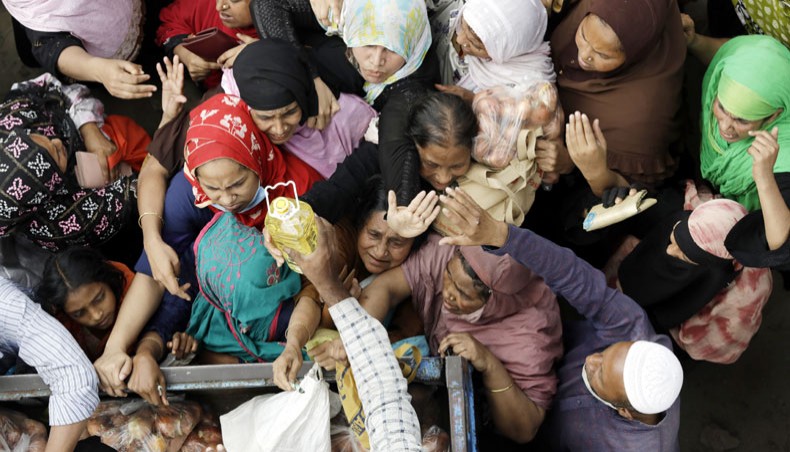
People push and shove to buy essential commodities at a subsidised price at an open market sales outlet at Shanir Akhra in Dhaka on Tuesday. — Sony Ramany
Retailers on Tuesday blamed refiners and wholesalers for the spiralling prices of essential commodities on the city market.
They demanded an effective monitoring at mill gates and on the wholesale market to ensure reasonable prices of essentials at the retail level.

They made the remarks at a view-exchange session with the Directorate of National Consumer Rights Protection on the essential commodities price situation ahead of Ramadan, the month of fasting for the Muslims, which will begin in the first week of April.
At the meeting, DNCRP director general AHM Shafiquzzaman mentioned that that the government had imposed a cap on the price of edible oil until the next Eid-ul-Fitr.
Retailers complained that the government had set the prices of edible oil but the decision was not being complied with fully at the mill and wholesale levels.
‘Retailers maintain humanity while conducting their business as they have to face all segments of people in society, but when they [retailers] go to the wholesale market to procure their merchandise they face harsh treatment,’ said Mosharraf Hossain, secretary of Uttara Zohura Market Traders Association.
The prices of all products have increased on the market but only retailers face punishment from the administration, he said.
‘Retailers want to sell edible oil at the rate set by the commerce ministry but the government will have to control the prices of the item at the mill gate and on the wholesale market,’ Mosharraf said.
Echoing what Mosharraf said, Mohammadpur Town Hall Kitchen Market Traders Association secretary Md Lutfor Rahman said that the government would have to bring the wholesale market under control first.
Wholesalers are not willing to provide receipts
to the retailers, he complained.
When the prices of commodities go up on the market, wholesalers never provide receipts while the retailers have to face the blame for charging higher prices of essentials, Lutfor said.
Azmol Hossain Babul, general secretary of Moulvibazar Byabosayee Samity, denied the allegation of increasing prices of essential commodities.
‘Every day, we learn from the refiners the prices of edible oil and sugar before starting our business. We have no scope to increase the prices of essential commodities. The government should monitor the daily prices of some of the commodities at the mill gate,’ he said.
DNCRP DG Shafiquzzaman said that there was no doubt that consumers were passing through a tough time due to the rising prices of essential commodities.
‘The prices of some of the commodities have indeed increased on the international market but some other commodities are becoming costlier due to the manipulation by a quarter of traders,’ he said.
Shafiquzzaman urged the businesses not to extract excessive profit and to keep the prices of essentials stable during Ramadan.
As per a commerce ministry decision, he said, the prices of edible oil as set on February 6 would continue until Eid-ul-Fitr.
DNCRP director Monjur Mohammad Shahriar said that consumers were being cheated by a section of traders at city markets as a litre of unpackaged soya bean oil was selling for up to Tk 170 whereas the government has set the maximum retail price at Tk 143.
Six DNCRP teams would be active at markets from March, Monjur said, adding that if any trading house is found unwilling to provide receipts to the retailers they will be shut.
Omar Faruque, president of Kawran Bazar Kanchamal Arat Byabosayee Malik Samity, said that the prices of most of the commodities remained high on the kitchen market due to a mismatch between the supply and the demand.
‘The government would have to conduct an acceptable study on the demand of essential commodities, including rice, sugar, edible oil, onions and red lentil,’ he offered.
Omar Faruque demanded tax waiver on the import of essential commodities, including soya bean oil.
