

Palm oil is an extremely versatile product that has many different properties and functions, which makes it useful and widely used. It is semi-solid at room temperature so it remains spreadable; it is resistant to oxidation and so can give products a longer shelf-life; it’s stable at high temperatures and so helps to give fried products a crispy and crunchy texture; it’s also odourless and colourless so does not alter the look or smell of food products. In Asian and African countries, palm oil is used widely as cooking oil, just like Europeans might use sunflower or olive oil. Khmer Times’ Sok Chan spoke to Dwinanto Sahputra, director of Indo Global Success (IGS) Co Ltd, an importer and supplier of Tropical cooking oil in Cambodia, about the impact of COVID-19 on the imported cooking oil to the country and how the company is struggling with this situation as well as the marketing of its TROPICAL brand palm cooking oil, its benefits compared with other cooking oils and the trend of palm cooking oil in Cambodia
KT: Could you talk briefly about the TROPICAL brand cooking oil and its benefits?
Sahputra: The oil is known for its tagline “care for your heart” because of its high content of monounsaturated fatty acids. The colour of the oil naturally comes from the palm fruit. This oil is very rich with beta carotene pro-vitamin A and natural antioxidant vitamin E which our bodies need to strengthen the immune system. TROPICAL palm oil consists of a good balance between saturated fatty acids and unsaturated fatty acids. It has no cholesterol because it is a vegetable oil. Hence TROPICAL is a really good choice for all kinds of cooking, whether for stir frying, deep frying, baking and even for making your own mayonnaise.
KT: How have you observed the pandemic impact your business and how do you overcome this effect?
Sahputra: Of course, it does affect us. COVID-19 affects everyone and in every sector in every country globally. Thus, when the people are affected, the economy slows down. The market and production also slow down. For us, in the cooking oil sector in which most of our business is serving restaurants, hotels, those businesses right now are closed down because no international tourists are coming to Cambodia, so some of them closed temporarily and some of them close permanently. Thus, it has affected our business. However, on the retail side, people are still using cooking oil at home.
KT: How is your import of the cooking oil to the Cambodian market affected so far because there is a temporary ban onflights from Indonesia and Malaysia (the biggest suppliers) to Cambodia?
Sahputra: On the transportation of the import, it has not been affected: The restriction is more on passengers. The way we imported the cooking oil is through sea freight because there is no restriction on goods coming inside and going outside Cambodia. There is no impact at all. We are still moving. However, from the supply and demand side, I do agree not only COVID-19 but a lot of factors are playing an important role in maintaining supply and demand, especially in the palm cooking oil sector. Palm cooking oil is a very sensitive subject in certain countries. This is not because of the effect of the oil, but it is more environmental concerns that are faced by a certain country. But, putting that aside, supply and demand is still there.
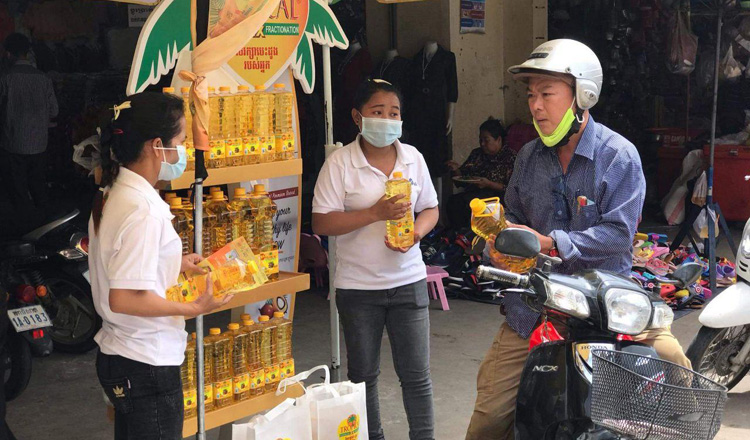 TROPICAL palm cooking oil on sale at Phnom Penh’s Wet Market. KT/Sok Chan
KT: What is the sales volume in the Cambodian market in terms of your TROPICAL palm cooking oil and what percentage have you lost during the pandemic?
Sahputra: The sale volumes I would say it is still low compared with soybeans, olive and sunflower cooking oils. We are down almost more than 50 per cent in [annual] sales right now. We maintain about 40 percent-plus and this month we hope to grow the market a little bit because some restaurants and cafes are reopening, as the owners [feel they] can sustain their businesses. But if they cannot, we will deal the issue.
The Cambodian market is very unique. In terms of cooking oil, we see that the people here tend to follow the trends of the US or EU. Thus, we have seen that soybean and sunflower cooking oil dominate the market in Cambodia. This is very different from other countries in Southeast Asia, where they are familiar with palm cooking oil. This is the challenging part: to educate the Cambodian people to understand more about palm cooking oil. How they can benefit from palm cooking oil. What is different about palm cooking oil and other non-palm cooking oils.
KT: What are your distribution areas in the Kingdom?
Sahputra: We currently distribute to seven provinces and cities. In addition to Siem Reap and Phnom Penh, we arepresent in Kampot, Kampong Cham, Tboung Khmum, Kandal and Kampong Thom provinces. We will be at Banteay Meanchey and Battambang. We imported about 25 tonnes a month of our brands, which is still low. Estimating consumption is difficult to work out, but we believe that it is about 1,000 tonnes per month for all cooking oil and possibly more.
KT: What are the differences between palm cooking oil and other cooking oils? How can they be distinguished?
Sahputra: TROPICAL is a palm cooking oil with two-times fractionation process. This gives TROPICAL a clearer quality compared with other single fractionation process palm cooking oils. Also, it results in a higher content of unsaturated fatty acids which is important for a healthy heart. Another difference is it allows TROPICAL to stay liquid longer in cold temperatures before turning cloudy than other palm cooking oils.
TROPICAL also has a high smoke point which makes this oil able to stand high-temperature cooking. It does not turn black fast and has no rancidity. It is a very good oil for those who like cooking deep-fried foods. It will not make the foods greasy.
Compared with other non-palm cooking oils in the market, TROPICAL has advantages over them because of its well-balanced contents of saturated and unsaturated fatty acids. Oils with high polyunsaturated fatty acids and low saturated fatty acids have been proven by scientific testing that they cannot stand high-temperature cooking. Studies showed that these kinds of oils oxidised and turned rancid. Not to mention potential health issues in the long run which derives from using these kinds of oil in high-temperature cooking.
KT: Your company imported only TROPICAL palm cooking oil to the Cambodian market. what is your market share?
Sahputra: The market share of the palm cooking oil is very small among the other cooking oils, but we are now catching up the market here. We have the leading market share in Indonesia for palm cooking oils. We need time to raise awareness of the people. We keep educating the market and people on the benefits of palm cooking oil. We cannot force them to trust us, but we always encourage them to give them a try and test and use it. TROPICAL has gained more popularity in the Cambodia market. Those who have tried this oil gave their feedbacks such as “good oil”, “foods not greasy”, “foods taste delicious”, “needs only a little oil compared with other brands”, “no turning back”, “no bad smell” etc and they have started living a healthier life without realising it.
The challenges are how to make people see that palm oil is a good oil, so we are not choosing the oil based on its colour because we know people are unaware it is a good oil and beneficial. It’s wrong to think the colour of the oil matters. Right now, we interact with the retailers, local markets and restaurants and hotel. Next year, we will double our market.
- Tags: Dwinanto Sahputra, palm oil
