


Advertisement
The legendary platypus is at risk of extinction in part due to climate change, warned scientists.
Australia’s devastating drought has had a profound impact on the world’s most unique creature, a poisonous egg-laying mammal.
Advertisement
According to new research, more and more people are stranded when rivers dry up.
The main author Dr. Gilad Bino of New South Wales University (UNSW) says measures must be taken to save the extraordinary animal.
The conservation biologist said: “It is imperative to undertake a national risk assessment of the platypus to assess its conservation status, assess risks and impacts, and prioritize management to minimize the risk of extinction.”
When settlers sent one to Britain over 200 years ago, people thought it was a fake, and a fraudster sewed two animals together.
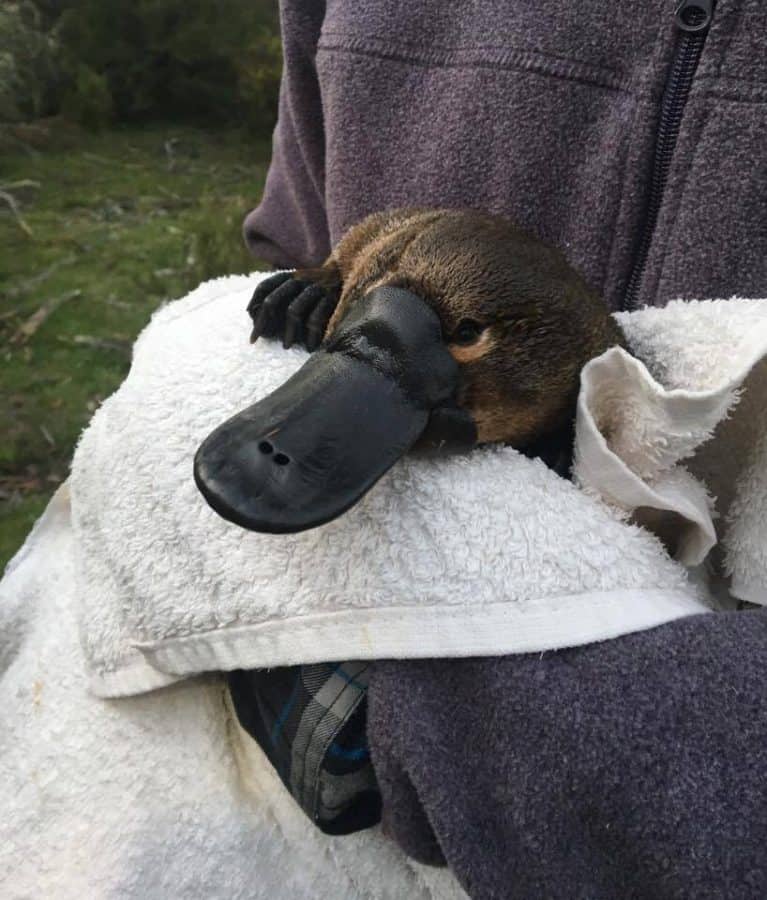
You couldn’t blame them. It has a paddle-shaped tail like a beaver, a slim and furry body like an otter, and a flat beak and webbed skin like a duck.
Although platypuses were secret and nocturnal, they were once considered widespread in eastern Australia and Tasmania.
The most extensive analysis to date has now shown for the first time that they are almost completely extinguished.
The species is exposed to a combination of four threats, including water resource development, land clearing, global warming, and increasingly severe droughts.
Concerning the current climatic conditions, the clearing and fragmentation by dams, the numbers have almost halved.
As a result, the local population has completely disappeared in around 40 percent of their range – reflecting the continuing decline since European colonization.
What means more losses will be much larger in predicted climate change models due to more frequent and longer extreme periods of drought – like the current one.
Dr. Bino said, “These dangers expose the platypus to an even worse local extinction because it is unable to repopulate areas.”
The study published in Biological Conservation shows that it will decrease by around three quarters in the next 50 years.
It has already been classified as “almost threatened” by the International Union for Nature Conservation (IUCN). In South Australia it is considered endangered.
Co-author Professor Richard Kingsford, director of the UNSW Center for Ecosystem Sciences, said it was unfortunate that platypus lived in areas that had undergone extensive human development that threatened their lives and long-term viability.
He said, “These include dams that stop their movements, agriculture that can destroy their caves, fishing gear and yabby (crayfish) traps that can drown them, and invasive foxes that can kill them.”
Melbourne University
Melbourne University co-author Prof. Brendan Wintle said it was important that preventive measures were taken now.
He said, “Even for a supposedly” safe “species like the platypus, it is probably more effective to mitigate or even stop threats like new dams than to wait for the risk of extinction and possible failure to increase.
“We should learn from the danger facing the koala to understand what happens if we ignore the warning signs.”
Dr. Bino said the results complement the growing body of evidence showing that the platypus, like many other native Australian species, was on the way to extinction.
He said, “There is an urgent need to undertake national conservation efforts for this unique mammal and other species through increased surveillance, trend tracking, mitigation, and protection and improvement of freshwater habitat management.”
His team continues to research the ecology and protection of this enigmatic animal and works with the Taronga Conservation Society to ensure its future by providing information for effective policies and management.
Credit; SWNS
Platypus are among the few poisonous mammals. Men have a spur on the back of their hind feet, which is connected to a poisonous gland.
During the mating season, more poison is excreted – according to the Australian Platypus Conservatory, the spores and the poison indicate that the males are competing for partners.
The poison is not life-threatening for humans – but can cause severe swelling and “excruciating pain”.
A typical platypus is 15 inches from its head to the end of its rump. His tail increases the length of the animal by an additional 5 inches. A person weighs approximately 3 pounds.
Fossils
Scientists have found fossils that suggest that old platypus were twice the size of the modern variety – 1 meter long.
Platypus have a thick, thick fur that helps them stay warm underwater. Most of the fur is dark brown, with the exception of a lighter fur next to each eye and a lighter fur at the bottom.
Your front feet have an extra skin that behaves like a paddle when the animals swim.
When platypus are on land, the webbing retracts, making the claws more pronounced. The animals run awkwardly on their ankles to protect the webbing.
Although they have no teeth, they are carnivores and use their grinding plates to eat shellfish and other marine animals that they catch.
The platypus platypus platypus platypus platypus platypus platypus platypus platypus platypus platypus platypus platypus platypus platypus platypus platypus platypus platypus It is also flexible and rubbery.
There are thousands of receptors in the skin of the bill that allow the platypus to navigate underwater and detect the movement of potential foods such as shrimp.
All monotreme or egg-laying mammals such as platypus and echidna lost their stomach in the course of evolution.
Connected – The moment of the climate crisis has come, warns Sir David Attenborough
Advertisement
