

Alan Greene operates Greene Maple Farm in Sebago, the sixth generation in his family to do so. He thought he had seen it all through the years, but the current economic situation has put him in uncharted waters.“We’ve already ordered next year’s containers,” Greene said. “That is in question, whether or not we will receive them in time for next year. So we’re a little bit concerned about that.”Deliveries of plastic syrup jugs have been delayed for over a year in some cases, leaving smaller producers more reliant on plastic in a sticky situation.“Last I talked to my dealer, they wouldn’t give me a delivery time,” Greene said. “We tried to order our own custom printed jugs two years ago, and they wouldn’t even entertain the order.”One problem for producers is the fact that only one company, Hillside Plastics of Massachusetts, produces the jugs used by maple producers, and owns a trademark of the jug’s design. The Maine Maple Producer’s Association has been looking for alternative solutions.”Everything’s on the table,” said Scott Dunn, the president of the MMPA. “To swapping designs, potentially have the producing states come up with their own jug design that is owned by the producers themselves so that we can go to any manufacturer and have them produce our containers. All the options are on the table looking forward, but we just need to get through maple season this year.”Dunn says small producers may have nowhere else to turn for containers.”Plastic for a lot of the small producers is what they use exclusively,” Dunn said. “They’re not able to buy glass. So it’s it really puts a squeeze on them. And if they’re not thinking forward enough to look for next year, and the year after that, it could cause problems down the road.”Greene says he has enough containers to make it through Maple Weekend this weekend, and Dunn says that will be the case for most producers. But Greene says that, going forward, he may have to get creative.”We ended up creating our own label so we could buy blank jugs, because those were more readily available,” Greene said. “Like anything in farming, you have to be creative and that’s that’s a bridge we’re going to have to cross, and we won’t be waiting till February to cross that bridge either.”
Alan Greene operates Greene Maple Farm in Sebago, the sixth generation in his family to do so. He thought he had seen it all through the years, but the current economic situation has put him in uncharted waters.
“We’ve already ordered next year’s containers,” Greene said. “That is in question, whether or not we will receive them in time for next year. So we’re a little bit concerned about that.”
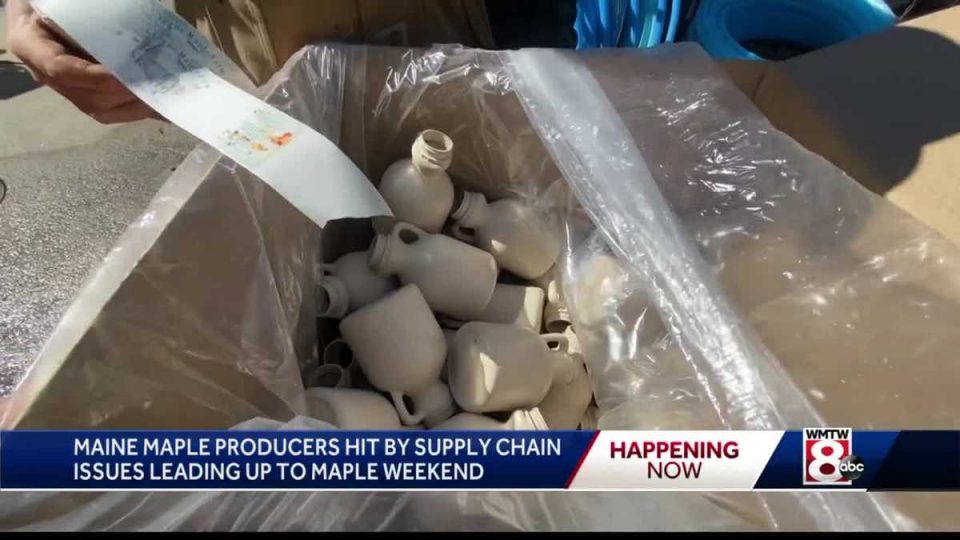
Deliveries of plastic syrup jugs have been delayed for over a year in some cases, leaving smaller producers more reliant on plastic in a sticky situation.
“Last I talked to my dealer, they wouldn’t give me a delivery time,” Greene said. “We tried to order our own custom printed jugs two years ago, and they wouldn’t even entertain the order.”
One problem for producers is the fact that only one company, Hillside Plastics of Massachusetts, produces the jugs used by maple producers, and owns a trademark of the jug’s design. The Maine Maple Producer’s Association has been looking for alternative solutions.
“Everything’s on the table,” said Scott Dunn, the president of the MMPA. “To swapping designs, potentially have the producing states come up with their own jug design that is owned by the producers themselves so that we can go to any manufacturer and have them produce our containers. All the options are on the table looking forward, but we just need to get through maple season this year.”
Dunn says small producers may have nowhere else to turn for containers.
“Plastic for a lot of the small producers is what they use exclusively,” Dunn said. “They’re not able to buy glass. So it’s it really puts a squeeze on them. And if they’re not thinking forward enough to look for next year, and the year after that, it could cause problems down the road.”
Greene says he has enough containers to make it through Maple Weekend this weekend, and Dunn says that will be the case for most producers. But Greene says that, going forward, he may have to get creative.
“We ended up creating our own label so we could buy blank jugs, because those were more readily available,” Greene said. “Like anything in farming, you have to be creative and that’s that’s a bridge we’re going to have to cross, and we won’t be waiting till February to cross that bridge either.”
