

Updated 5:18 p.m.
Interstate 70 at Glenwood Canyon could reopen in “days, not weeks,” Colorado Department of Transportation executive director Shoshana Lew announced at a press conference Thursday evening.
It’s still too early to estimate the cost of damages to the interstate caused by the Grizzly Creek fire, regional CDOT director Michael Goolsby said.
The decision to open will be made with other relevant agencies.
Earlier in the day, Lew told the state transportation commission that engineers are assessing damage to the road and the canyon above. She hoped to have news on a possible reopening date “very soon.”
“Our team is doing everything that they possibly can to get it open,” Lew said.
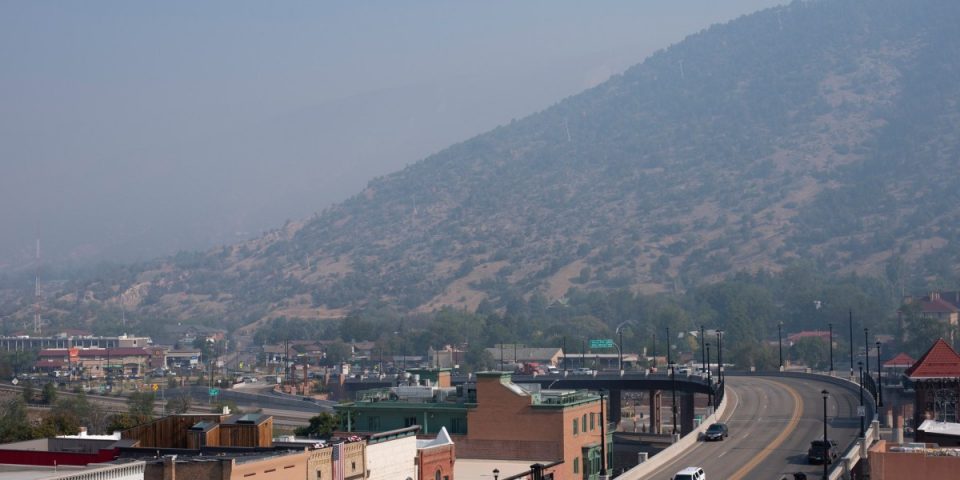
Grizzly Creek fire public information officer Brian Scott said Wednesday the fire has “pretty much burned the whole canyon” since it started Aug. 10. Depending on the fire’s severity, that could mean a years-long ecological recovery and millions of dollars in repairs.
The fire will lead to more rock falls, said Paul Santi, a professor of geology and geological engineering at the Colorado School of Mines.
Trees and other vegetation that helps stabilize the rocks that line the canyon’s 2,000-foot high walls are likely mostly gone. Roots that used to soak up water during rain storms will take a few years to regrow. So rain can now run freely toward the Colorado River below, which could cause water quality issues for millions and also take some rocks and sediment along with it.
“For the next year or two, I’d be pretty wary of driving through there during a rainstorm,” Santi said.
Heat from the fire is another factor. It causes cracks in rocks that can send them tumbling down, Santi said. Already, a boulder the size of a Volkswagen has fallen across the highway and broken a piece of a guard rail, Scott said.
“There’s constantly rocks and other debris and such falling down onto the road deck,” Scott said. “You certainly wouldn’t want to be driving through there.”
But many people are waiting to do just that. I-70 through Glenwood Canyon is a vital link for communities on both sides of it, not to mention tourists who found themselves on sketchy backroads. Without it, commercial haulers and drivers must make hours-long detours to the north or south.
Experts are looking at about 12 miles of intricately constructed roadway.
It took decades to plan and build Interstate 70 through the canyon. CDOT built 40 bridges and viaducts to carry the roadway over difficult terrain and to protect sensitive vegetation, said Ralph Trapani, who was CDOT’s project manager for Glenwood Canyon from 1980 to 1992.
Those structures, as well as big retaining walls, are made out of concrete.
“Concrete doesn’t hold up well in fire,” Trapani said. “That’s my big concern. Because if one of those bridges has to be repaired or replaced, it’s going to probably create a long-term closure.”
Trapani is now retired from CDOT and said he doesn’t know the extent of the damage. CDOT spokeswoman Elise Thatcher said it has “significantly” exceeded a $700,000 threshold needed for federal aid. The agency has requested that aid that could cover 80 percent of the total repair cost.
All of those viaducts and bridges could turn out to be a blessing, precisely because they lift the road about the ground below. In many stretches through the canyon, rock may slide beneath the road — not over it.
“I think that’s going to help,” said Santi, the School of Mines geologist.
Trapani said CDOT had rockslides in mind when designing those structures, but not necessarily fires that could cause them. Wildfires weren’t much an issue at the time, because for decades prior, the federal government had aggressively suppressed them.
“When I started on the project in 1980, we weren’t getting the kind of wildfires that we’re getting nowadays up here,” Trapani said.
Those decades of fire suppression led to overgrowth that is now contributing to today’s megafires.
Climate change exacerbates CDOT’s woes.
The other big factor is rising temperatures. Western Colorado has seen temperatures rise by more than two degrees Celsius in the last century, contributing to drought that exacerbates the problem.
Trapani said he’s now keenly aware of the threat climate change poses to Western Colorado. He even helped start an environmental non-profit focused on clean energy.
“We’re enduring 100 degree days up here in Glenwood Springs now. I’ve never seen that after 45 years. I’ve personally witnessed a change of the climate in this area,” he said.
CDOT itself has since recognized the importance of a changing climate. It’s developing a broad set of strategies to reduce greenhouse gas emissions, including new infrastructure for electric vehicles, replacing its own fleet with more efficient vehicles, and building more toll lanes to discourage driving and encourage transit use.
