

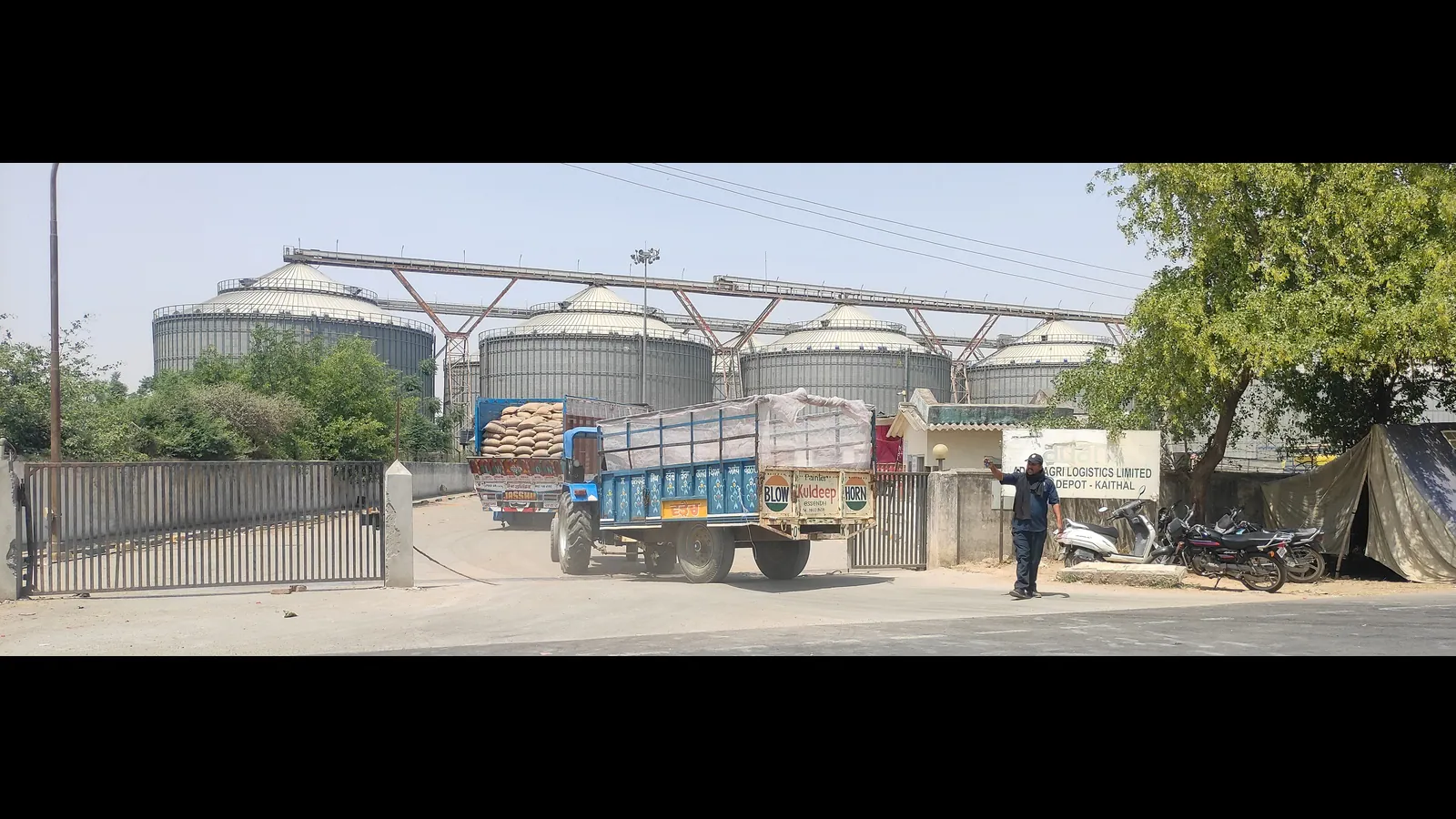
Weighing, unloading, moisture measurement and online billing – the entire thing takes nearly two hours, providing hassle-free procurement to farmers who bring their produce at the silos of Adani Agri Logistics at Solumajra village in Kaithal.
The process is done using machines and nearly 50 people monitor procurement to unloading operations at the silos where on an average, 1,000 to 1,200 farmers sell their produce directly to the procurement agencies of the government.
Long queues of tractor-trolleys can be seen inside and outside the facility, showing that it evokes good response from farmers as they spend the entire day selling their produce in the APMCs or mandis which remains flooded with grains during the harvest season.
At the silos, procurement is being done by government agencies as the Food Corporation of India (FCI) has hired this facility for storage and transportation under a contract inked in 2007, for 20 years.
This year, farmers associated with nearby 18 mandis of Kaithal and Kurukshetra districts were given this alternate facility to sell their produce directly at the silos as the government has set a target of procuring 2.12 lakh MT directly. But farmers of Dhand and Pundri grain markets are bringing their produce to silos as there is no procurement in these mandis.
Mandis in Haryana are wearing a deserted look, but movement of farmers from mandis to the silos will not impact the earnings of arhtiyas as they will get their commission while sitting at their shops, said an official of the state agriculture marketing board.
Most farmers praised the arrangements at the silos and knew that the procurement here was being done by government agencies. But they are still under the impression that the government is involving private companies in procurement to do away with the mandi system – as predicted by farmer leaders during the farm agitation.
“No doubt they are providing better facilities but we cannot completely rely on the private sector. The mandi system should also be there as an alternate support to farmers if the private buyers reject our produce,” said Vikrant Rana, a young farmer waiting for his turn to unload his wheat at the silos.
Charanjit Singh, of Faral village, said, “We know the silos are procuring for the government. But everyday, farmers are told to take their produce back due to poor quality.”
On the other hand, direct sale of foodgrains to the silos has taken away jobs of thousands of migrant labourers and the local ones associated with these mandis, especially in Dhand and Pundri.
“Around 3,000 labourers used to get jobs for nearly two months during the harvest season in Dhand grain market but now, the mandi is wearing a deserted look as there is no procurement of wheat going on here,” said Kuldeep Singh, a bookkeeper at Dhand mandi.
“We need to see the other side as well. It has increased the burden of arhtiyas and farmers to send our accountants with every trolley as the FCI has also allowed farmers to sell directly to avoid payment of commission to arhtiyas,” said a commission agent from Pundri mandi, pleading anonymity.
The silos has also helped the government to cut expenses on transportation and handling of foodgrains from mandi to godowns. Last year, 1.02 lakh MT wheat was directly brought to the silos which has a capacity of 2 lakh MT and this year, the government decided to buy 1.12 lakh MT.
Officials monitoring the procurement said 77 lakh MT wheat has already arrived this year and they are expecting that it will easily cross 1 lakh MT as the arrival is still on. Besides avoiding expenditure of lakhs on transportation, the government need not spend crores on gunny bags.
Amit Bhushan, general manager (region) FCI, said, “We have provided a facility to help farmers sell their produce directly to the godowns. Earlier, there was some misunderstanding among farmers but now the response is good. More such facilities are being created in state to avoid damages of grains and easy transportation, and there will be no need to store foodgrains in open plinths.”

