

CGLR also wants to make sure consumers are engaged in their recycling programs. It wants to focus on educating people about what they are throwing out and where it is ending up and the impact that litter has on the Great Lakes. The Great Lakes Circular Economy Institute wants to develop a curriculum and training for all businesses and policymakers to educate themselves further.
The third priority is to work with communities to clean up existing waste and plastic that is ending up in the environment. The group wants to make sure the existing pollution doesn’t end up in the wildlife or into the waterways.
“Forty million Americans and Canadians use the Great Lakes for drinking water,” Fisher said. “So, making sure that the material that has found its way into the environmental already is being captured and cleaned up as quickly as possible and if the material that is recyclable, getting it back into the right material management stream.”
CGLR is looking at many different policies that are being used around the world and trying to implement that into policies in the Great Lakes region.
One policy recommendation is a consistent container deposit policy and program, otherwise known as a bottle bill. This will provide a motivation for consumers of aluminum cans to recycle their cans and not to litter.
The group found that states with bottle bills have two to three times higher recycling rates than states that do not.
The group is also looking at moving towards extender producer responsibility, which would be give material producers the responsibility to manage recycling systems.
“All of these policies have to be right size for each community, each state,” Fisher said. “We are going to look at the region, look at each state, one by one, and see what makes sense for the broader Great Lakes region, but also for the individual states that make up this region.”
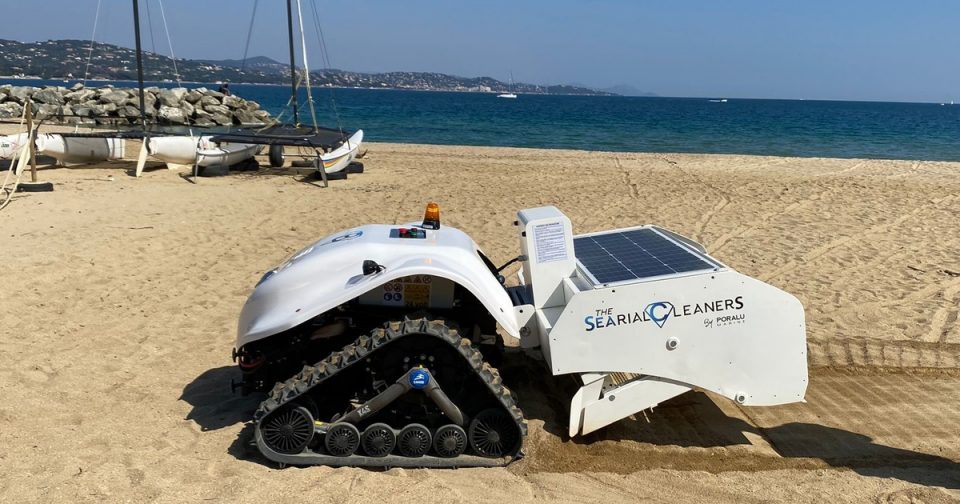
CGLR is also working with an organization called Pollution Probe, a Canada-based charity, to use innovative technologies. That includes using BeBots, a beach-cleaning robot, and developing optical sorting technology.
“This is a great program that allows us to use technology to help capture and clean up the problem,” Fisher said. “But they also capture a lot of attention, so it’s a great opportunity as well to educate passersby and beachgoers about the technology but also the litter problem that exists.”
The use of technology will also be helpful for collecting flexible packaging. CGLR wants to use technology to identify and sort plastic waste in order to recycle it better.
“We’re losing way too much material to our environment through litter,” Fisher said. “But more importantly, we’re just not managing valuable materials properly within our cities and communities. We’re sending way too much valuable material to our landfills and that material can be recovered and reused in the economy.”
CGLR has said that it wants to encourage systemic changes and shifting away from a linear, take-make-dispose economy and materials management mindset.
