


News and research before you hear about it on CNBC and others. Claim your 1-week free trial to StreetInsider Premium here.
Filed Pursuant to Rule 424(b)(4)
Registration No. 333-260540
1,500,000
Shares

Hour
Loop, Inc.
Common
Stock
We are offering 1,500,000
shares of our common stock (“Common Stock”). This is our initial public offering. Prior to the offering, there has
been no public market for our Common Stock. The initial public offering price is $4.00 per
share.
Our Common Stock has been approved for listing
on The Nasdaq Capital Market under the symbol “HOUR”.
We are also seeking to register the issuance of warrants
to purchase 75,000 shares of Common Stock (the “Representative’s Warrants”) to the underwriters as well as the
75,000 shares of Common Stock issuable upon exercise by the underwriters of the Representative’s Warrants at an exercise
price of $5.00 per share (125% of public offering price).
We
are an “emerging growth company” under the federal securities laws and, as such, we have elected to comply with certain reduced
public company reporting requirements for this prospectus and future filings. See “Prospectus Summary—Emerging Growth Company
and a Smaller Reporting Company Status.”
Investing
in our Common Stock involves a high degree of risk. Before buying any shares, you should carefully read the discussion of the material
risks of investing in our Common Stock under the heading “Risk Factors” beginning on page 16 of this prospectus.
Neither
the Securities and Exchange Commission nor any state securities commission has approved or disapproved of these securities or passed
on the adequacy or accuracy of this prospectus. Any representation to the contrary is a criminal offense.
| Per share | Total | |||||||
| Public offering price | $ | 4.00 | $ | 6,000,000 | ||||
| Underwriting discounts and commissions (1) | $ | 0.32 | $ | 480,000 | ||||
| Proceeds, before expenses, to us | $ | 3.68 | $ | 5,520,000 | ||||
| (1) | See “Underwriters” beginning on page 84 of this prospectus for additional information regarding the compensation payable to the underwriters. |
We
have granted a 45-day option to the underwriters to purchase up to 225,000 additional
shares of Common Stock solely to cover over-allotments, if any. If the underwriters exercise the option in full, the total underwriting
discounts and commissions payable by us will be $552,000, and the total proceeds
to us, before expenses, will be $6,348,000.
Delivery
of the shares of Common Stock is expected to be made on or about January 11,
2022.
EF
HUTTON
division
of Benchmark Investments, LLC
The
date of this prospectus is January 6, 2022
TABLE
OF CONTENTS
No
dealer, salesperson or other individual has been authorized to give any information or to make any representation other than those contained
in this prospectus in connection with the offer made by this prospectus and, if given or made, such information or representations must
not be relied upon as having been authorized by us. This prospectus does not constitute an offer to sell or a solicitation of an offer
to buy any securities in any jurisdiction in which such an offer or solicitation is not authorized or in which the person making such
offer or solicitation is not qualified to do so, or to any person to whom it is unlawful to make such offer or solicitation. Neither
the delivery of this prospectus nor any sale made hereunder shall, under any circumstances, create any implication that there has been
no change in our affairs or that information contained herein is correct as of any time subsequent to the date hereof.
For
investors outside the United States: We have not done anything that would permit this offering or possession or distribution of this
prospectus in any jurisdiction where action for that purpose is required, other than in the United States. Persons outside the United
States who come into possession of this prospectus must inform themselves, and observe any restrictions relating to, the offering of
the shares of our common stock and the distribution of this prospectus outside the United States.
Cautionary
Note Regarding Forward-Looking Statements
This
prospectus contains forward-looking statements. Specifically, forward-looking statements may include statements relating to:
| ● | our future financial performance; |
|
| ● | changes in the market for our products and services; |
|
| ● | our expansion plans and opportunities; and |
|
| ● | other statements preceded by, followed by or that include the words “estimate,” “plan,” “project,” “forecast,” “intend,” “expect,” “anticipate,” “believe,” “seek,” “target” or similar expressions. |
These
forward-looking statements are based on information available as of the date of this prospectus and current expectations, forecasts and
assumptions, and involve a number of judgments, risks and uncertainties. Accordingly, forward-looking statements should not be relied
upon as representing our views as of any subsequent date, and we do not undertake any obligation to update forward-looking statements
to reflect events or circumstances after the date they were made, whether as a result of new information, future events or otherwise,
except as may be required under applicable securities laws.
As
a result of a number of known and unknown risks and uncertainties, our actual results or performance may be materially different from
those expressed or implied by these forward-looking statements. Some factors that could cause actual results to differ include:
| ● | the level of demand for our products and services; |
|
| ● | competition in our markets; |
|
| ● | our ability to grow and manage growth profitably; |
|
| ● | our ability to access additional capital; |
|
| ● | changes in applicable laws or regulations; |
|
| ● | our ability to attract and retain qualified personnel; |
|
| ● | the possibility that we may be adversely affected by other economic, business, and/or competitive factors; and |
|
| ● | other risks and uncertainties indicated in this prospectus, including those under “Risk Factors.” |
We
are responsible for the disclosure in this prospectus. However, this prospectus includes industry data that we obtained from internal
surveys, market research, publicly available information and industry publications. The market research, publicly available information
and industry publications that we use generally state that the information contained therein has been obtained from sources believed
to be reliable. The information therein represents the most recently available data from the relevant sources and publications and we
believe remains reliable. We did not fund and are not otherwise affiliated with any of the sources cited in this prospectus. Forward-looking
information obtained from these sources is subject to the same qualifications and additional uncertainties regarding the other forward-looking
statements in this prospectus.
We
own or have rights to trademarks or trade names that we use in connection with the operation of our business, including our corporate
names, logos and website names. In addition, we own or have the rights to copyrights, trade secrets and other proprietary rights that
protect the content of our products and the formulations for such products. This prospectus may also contain trademarks, service marks
and trade names of other companies, which are the property of their respective owners. Our use or display of third parties’ trademarks,
service marks, trade names or products in this prospectus is not intended to, and should not be read to, imply a relationship with or
endorsement or sponsorship of us. Solely for convenience, some of the copyrights, trade names and trademarks referred to in this prospectus
are listed without their ©, ® and ™ symbols, but we will assert, to the fullest extent under applicable law, our rights
to our copyrights, trade names and trademarks. All other trademarks are the property of their respective owners.
This
summary highlights certain information about us, this offering, and selected information contained in this prospectus. This summary is
not complete and does not contain all of the information that you should consider before deciding whether to invest in our common stock.
For a more complete understanding of the Company and this offering, we encourage you to read and consider the more detailed information
in this prospectus, including “Risk Factors” and the financial statements and related notes. Unless the context otherwise
requires, “Hour Loop,” “we,” “us,” “our,” or “the Company” refers to “Hour
Loop, Inc.,” a Delaware corporation, and its consolidated subsidiaries.
Unless
otherwise noted, the share and per share information in this prospectus reflects (i) a forward stock split of the outstanding
common stock of the Company at a four point four-four for one (4.44-for-1) ratio, which was effected on September 27, 2021 and (ii)
a reverse stock split of the outstanding common stock of the Company at a zero point seventy-five for one (0.75-for-1) ratio, which was
effected on December 3, 2021.
Overview
Our
Business
We
are an online retailer engaged in e-commerce retailing in the U.S. market. We have operated as a third-party seller on www.amazon.com
since 2013. We have also sold merchandise on our website at www.hourloop.com since 2013. We expanded our operations to www.walmart.com
in October 2020. To date, we have generated practically all of our revenue as a third-party seller on www.amazon.com and only
a negligible amount of revenue from our operations on our website at www.hourloop.com and as a third-party seller on www.walmart.com.
We manage more than 100,000 stock-keeping units (“SKUs”). Product categories include home/garden décor, toys, kitchenware,
apparels, and electronics. Our primary strategy is to bring most of our vendors product selections to the customers. We have advanced
software that assists us in identifying product gaps so we can keep such products in stock year-round including the entirety of the last
quarter (holiday season) of the calendar year (“Q4”). In upcoming years, we plan to expand our business rapidly by increasing
the number of business managers, vendors and SKUs.
Our
Financial Position
For the fiscal years ended December
31, 2020 and 2019, we generated revenues of $38,655,264 and $26,564,693, respectively, and reported net income of $3,825,389 and
loss of $(424,583), respectively, and cash flow from operating activities of $3,824,729 and cash flow used by operating
activities of $(517,933), respectively. For the nine months ended September 30, 2021 and 2020, we generated revenues
of $31,391,254 and $17,466,081, respectively, and reported net income of $2,268,511 and $1,238,523, respectively,
and cash flow from operating activities of $1,664,907 and $910,956, respectively. As noted in our consolidated financial
statements, as of September 30, 2021, we had retained earnings of $139,434.
Business
Model
There
are three main types of business models on Amazon: wholesale, private label and retail arbitrage. Our business model is wholesale, also
known as reselling, which refers to buying products in bulk directly from the brand or manufacturer at a wholesale price and making a
profit by selling the product on Amazon. We sell merchandise on Amazon and the sales are fulfilled by Amazon. We pay Amazon fees for
allowing us to sell on their platform. Our relationship with Walmart is also similar. We pay Walmart fees for allowing us to sell our
merchandise on their platform. As stated above, to date, we have generated only a negligible amount of revenues as a third-party seller
on www.walmart.com.
The
advantages of selling via a wholesale model:
| – | Purchase lower unit quantities with wholesale orders than private label products. |
|
| – | Selling wholesale is less time intensive and easier to scale than sourcing products via retail arbitrage. |
|
| – | More brands will want to work with us because we can provide broader Amazon presence. |
The
challenges of selling via a wholesale model:
| – | Fierce competition on listing for Buy Box on amazon.com (as described below). |
|
| – | Developing and maintaining relationships with brand manufacturers. |
Market
description/opportunities
Total
retail sales increased 6.9% to $4.04 trillion in 2020 from $3.78 trillion in 2019. Consumers spent $861.12 billion online with U.S. merchants
in 2020, which is around 21.3% of total retail sales for 2020, compared to 15.8% for 2019.
Amazon
accounted for nearly a third of all e-commerce in the United States. With a more than 5% gain in e-commerce penetration for U.S. retail
sales in 2020, we anticipate a larger market in the upcoming years.
Formation
and Management
We
were originally incorporated under the laws of the State of Washington on January 13, 2015. However, we converted from a Washington corporation
to a Delaware corporation on April 7, 2021. The company
was founded in 2013 by Sam Lai and Maggie Yu. With their vision, leadership, and software development skills, the company grew rapidly.
From 2013 to 2020, sales grew from $0 to $38,655,264.
Competitive
advantage
Among
9.7 million sellers on Amazon, we believe we have two main competitive advantages. First, we have strong operations and sales teams experienced
in listing, shipment, advertising, reconciliation and sales. By delivering high quality results and enhancing procedures through the
process, our teams are competitive. Second, we believe our proprietary software system gives us an advantage over our competition. The
system is highly customized to our business model; it collects and processes large amounts of data every day to optimize our operation
and sales. Through advanced software, we can identify product gaps and keep them in stock all year round.
With
respect to our advertising strategy, we advertise those products that we estimate will have greater demand based on our experience. This
lets us allocate our advertising budget in a fashion that delivers positive value. We advertise our products on Amazon. We allocate our
advertising dollars prudently. This is accomplished by advertising items that deliver the most return for our advertising spending. We
monitor the items being advertised by our competitors. On the operations side, we constantly refine our processes based on learnings
from historical data. The combination of managing the business operations effectively along with allocating our advertising budget to
high value items allows us to grow profitably. In cases, where the advertising is fierce, we allocate the spending appropriately. Our
strategy for competing with larger competitors is to monitor their pricing and not compete with them when their pricing is low or at
a loss. Competitors sell at low prices or at a loss due to a variety of reasons, including, but not limited to, their desire to liquidate
inventory or achieve short term increase in revenue. During these times, we avoid matching their prices. This strategy allows us to stay
profitable.
Historical
Performance
Our
year end gross revenues and net profits from 2013 through 2020 is presented in the table below:
| Year-over- | Year-over | |||||||||||||||||||
| Year | Revenue | Year % |
Income | Net Income % |
-Year % |
|||||||||||||||
| 2013 | $ | 26,135 | – | $ | 4,682 | 18 | % | – | ||||||||||||
| 2014 | $ | 1,102,237 | 4117 | % | $ | 150,300 | 14 | % | 3110 | % | ||||||||||
| 2015 | $ | 2,567,267 | 133 | % | $ | 228,009 | 9 | % | 52 | % | ||||||||||
| 2016 | $ | 7,337,012 | 186 | % | $ | 77,752 | 1 | % | NA | |||||||||||
| 2017 | $ | 17,487,124 | 138 | % | $ | -122,176 | -1 | % | -257 | % | ||||||||||
| 2018 | $ | 24,402,144 | 40 | % | $ | 657,821 | 3 | % | NA | |||||||||||
| 2019 | $ | 26,564,693 | 9 | % | $ | -423,073 | -2 | % | -165 | % | ||||||||||
| 2020 | $ | 38,655,264 | 46 | % | $ | 3,820,698 | 10 | % | NA | |||||||||||
In
2019, approximately 100% of our revenue was through or with the Amazon sales platform and in 2020, 100% of our net revenue was through
or with the Amazon sales platform.
Pricing
Strategy and Policies
In
an ideal world, we would like to price our products at key stone pricing or double wholesale cost. However, we operate in a hyper competitive
environment and we must stay competitive. Therefore, we must draw a good balance between gross margin and revenue. Our main objectives
focus on increasing volume and maximizing profits, which is achieved with a customized auto pricing system we developed internally, in
combination with well-trained business managers’ judgment on pricing skills as well as constant monitoring. One principal feature
of the pricing system is that it automatically syncs public data of competing offers from Amazon regularly, so business managers can
make price settings and adjustments based on accurate data, and thus be able to set optimal selling prices for products. In addition,
the system is constantly improved with new features and optimizations.
At
a high level, our automated pricing tool helps us stay competitive while our business managers mainly focus on increasing gross margins.
Our proprietary repricing tool analyze sales trend, projected sales, inventory age, inventory cost, potential profits, FBA fees, competing
offers, and seasonality and determines an urgency level, then depending on the level of urgency, it automatically adjusts prices accordingly.
Business
managers, after establishing the bases for prices, begin to develop pricing strategies for each product while taking the current market
conditions, company goals (ex: increasing short-term or long-term profits) and strategies into consideration. Furthermore, business managers
consider different marketing segments such as costs and competitions in order to develop effective pricing strategies and policies.
The
following subsections provide more insight into various pricing strategies we have developed over the years. Our internal training mainly
focuses on competition-based pricing policy and value-based pricing policy.
| I. | Competition-Based Pricing Policy: 20% of our products are toys, which are extremely popular and competitive. In this type of environment where volume is high but gross margin is low, our main strategy is to purchase large quantities, so we can increase sales volume and price competitively while maintaining an average return on investment (“ROI”) of at least 15%. We are using the competition-based pricing policy to match competitor’s prices, which means constantly winning Buy Box (as described below). Our pricing system is capable of automatically matching all Buy Box. |
|
| II. | Promotional Pricing Policy: To boost lagging sales, we adapted our own promotional pricing policy, which involves offering modest discounts on products with inventory age over 45 days, which proves to be a cost-effective at reducing the number of low turn-over SKUs. |
|
| III. | Value-Based Pricing Policy: We incorporate a value-based pricing strategy when inventories are constrained, which can happen when customer demand suddenly spikes due to external factors, supply shortage, or seasonal spikes. We set prices to reflect the value perceived by customers, especially on products under gift categories when consumer demands are higher. Contrary to a typical seller, we opt to maintain high gross margin instead of marking down prices and running special deals during the high-demand season during Q4. Therefore, business managers can achieve increases in both sales and high average ROI of 40%. |
Buy
Box on amazon.com is the top right section on a product page where customers can directly add items to their shopping carts. Since many
sellers on amazon.com can sell the same product, they must compete to “win the Buy Box” for a certain product. Winning the
Amazon Buy Box simply means that you were chosen for the Buy Box placement. When you win this placement, customers have a button to directly
add your product to their carts, giving you an advantage over competing sellers. For a seller to be eligible for the Buy Box, they must
meet a set of performance-based requirements including order defect rate, customer shopping experience, time and experience on the Amazon
selling platform, and status as a professional seller.
Overview
of Market & Competition
According
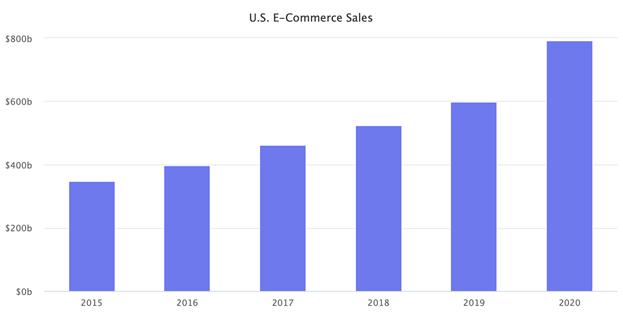
to Marketplace Pulse, U.S. e-commerce grew 32% in 2020 to reach $790 billion, up from $598 billion the year before. According to the
Department of Commerce, e-commerce represented 14% of total retail spending, a significant increase from 11.3% in 2019.
For
the past ten years, e-commerce in the U.S. grew, on average, 15% year-over-year. In 2020, the market reached a total sales figure it
would have otherwise gotten to in 2021. Thus, two years of e-commerce growth in one year.
According
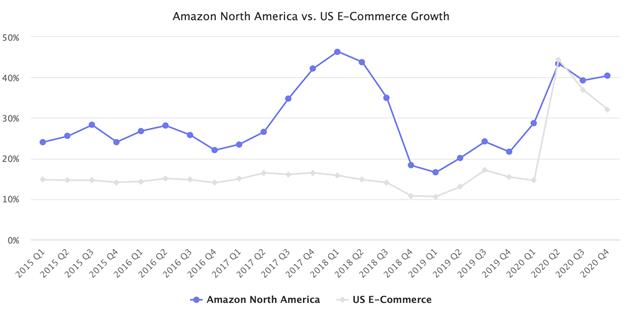
to Marketplace Pulse, Amazon was one of the big winners in the fourth quarter, a record quarter with nearly $250 billion in e-commerce
spending. While during the first two quarters boosted by the pandemic – Q2 and Q3 – it grew at or below the overall U.S. e-commerce growth
rate. In the fourth quarter, Amazon grew faster than the market (based on a naive comparison of its reported North America segment growth).
Its fulfillment capacity allowed the company to be more confident with deliveries than its main rivals.
Target
market size
Total
Addressable Market
As
an e-commerce company retailing in the U.S. market, our total addressable market covers all U.S. residents with Internet access, where
segmentally includes repeat customers and new customers to online shopping every year.
Growth
of E-commerce vs. Total Retail Sales
According
to the U.S. Department of Commerce data, the e-commerce’s share of total retail sales has steadily been on the rise, where total
volume increased by an incredible 44% of year-over-year growth. The total retail sales increased by 6.9% to $4.04 trillion from 2019
to 2020, and all growths came from the e-commerce sales. Consumers spent $861.12 billion online with U.S. merchants in 2020, which is
around 21.3% of total retail sales for the year compared to 15.8% in 2019. The strong growth of U.S. online spending shows the future
potential of our target market size. The U.S. e-commerce sales accounted for more than 20% of total retail sales in 2020, and Amazon
represented one-third of the total.
Growth
of Amazon Prime Members
In
2020, Amazon had over 140 million Prime Members in the U.S., and we were seeing continuous year-over-year growth over the past years.
The number of Amazon Prime users in the U.S. is forecasted to reach more than 153 million by 2022, with 3% annual growth.
Operational
advantages
According
to Marketplace Pulse, Hour Loop is one of the top 100 third-party sellers on U.S. Amazon. In 2019 there were only 18,000 sellers, out
of 2,700,000 (or 0.67%) that exceeded $1 million in annual sales. Our sales in 2019 were $26.6 million.
Automation
We
developed a proprietary software that is tailor made to all our operational needs. This includes managing order review process, shipment
managements, inventory management, accounting, and complete end-to-end third-party integrations. This allows us to scale, reduce cost,
and improve quality.
Profitability
Management
We
have experienced operations managers tracking team performances with key performance indicators. We have departments specializing in
logistic costs, advertising, marketing, and product management. We hold monthly process reviews to identify early red flags and look
for areas to optimize. Each quarter we set increasingly difficult bars both to grow gross margin and further reduce expenses.
Continuous
Process Optimization
In
order to improve operating efficiencies, we have effective process optimization adapting to the changing policies of the e-commerce marketplace.
We continuously analyze our performance based on data. We conduct pricing, inventory planning and profitability analysis using this data.
This analysis provides us with insights on the processes that add the most value. Using these insights, we develop guidelines that help
us improve our operations. These guidelines are incorporated into our operations which include (but are not limited to), identifying
and ordering at optimal inventory levels, managing merchandise storage costs, optimizing transit times, and pricing at appropriate levels.
Our operations staff follows these guidelines which help them perform optimally. By continuously analyzing data, we are able to find
insights for improving our business. This drives continuous process optimization and its implementation into our operations. In addition,
our proprietary software allows us to continually accelerate process effectiveness based on specific requirements. Over time, our system
eliminates unnecessary procedures that could be replaced by an advanced algorithm. For instance, we simplify Fulfillment by Amazon (“FBA”)
shipments process through application programming interface (“API”) integration. Our self-developed system also tracks insightful
analysis of our profitability, clearer visualizes the drivers and optimums to better manage operational costs. We monitor operational
parameters that drive our business and proactively try to optimize them. These include fine tuning our item selection, managing our inventory
levels, estimating demand and pricing to maximize our profitability.
Data-Driven
Approach
We
make decisions based on analysis and interpretation of the data sets rather than observations over the market trend. By standardizing
processes and combine data-driven management, we can ensure the organization maintains consistency that is high quality. Our business
managers use historical data and sales projection provided by our proprietary software to find potential product gaps and keep products
in stock all year round. This advantage enables powerful predictive insights in correlating real-time data with past sales patterns.
Training
Programs
Our
effective training programs accelerates employees’ professional development and enables the company to hire new graduates or people
without experience. Our training programs are very task-specific and we continually improve the materials in order to fit new industry
needs. Other than the training material, we assign mentors to evaluate and monitor trainees’ performance at each stage of the training
program.
Task
Generalization
By
generalizing each task with a standard process, we are able to shift assignments at regular intervals in order to find the most suitable
employee for each specific task. Moreover, business managers are also able to rotate the vendors they manage easily. This allows our
organization to effectively and consistently manage a vendor when a key employee who previously managed such vendor is no longer with
the company. In addition, the task generalization allows the company to hire remote teams to further reduce labor costs.
Multicultural
Management
We
have a multicultural management team that is linguistically and culturally diverse in order to make judgments from different perspectives.
Our remote teams in Taiwan and the Philippines provide diverse professional insights on specific tasks.
Technological
advantages
Our
software architecture was designed from the ground up to be scalable, secured, and easily extensible. By using JRuby on Rails, we can
make use the best parts of Java, Ruby, and Rails without paying for their disadvantages. For example, we can use the massive collections
of Java library, portability, speed, multi-threading, and maturity, but we do not have to be tied down with verbose code and strict typing.
Rails allow us to quickly build web pages and integrate both the frontend and the backend. The application runs on Amazon Web Services
(“AWS”) and can be easily scaled up to as many hosts as needed. It is accessible from a browser, so there is no need to setup
or install anything on the client-side.
Cost
advantage
Access
to Low Product Costs
We
lower our product average costs by direct import items that have high volume, purchasing in bulk with better prices, and negotiating
discounts or rebates over increased purchase volume every year. Our strong growth of purchase every year allows us to negotiate better
discounts than the rivals. Therefore, we have the cost advantages to compete at low prices.
Efficient
Processes and Technologies
Our
proprietary software allows us to tailor make tools based on our specific use cases and leverage technologies to greatly reduce manual
operations. We also saved the expense of using third-party software in managing inventory, orders, product listings, and especially the
advertising analytic tool. In fact, our search engine optimization allows us to have Advertising Cost of Sales (“ACoS”) significantly
lower than the industry average of 27.59% in 2020.
Low
Distribution and Logistic costs
We
saved the cost of managing the warehouse, shipping, and product distribution as we are enrolled in Amazon’s FBA program. The program
allows us to reduce fixed costs of the physical assets and quickly scale up the business without thinking much about infrastructure complexity.
Apart from using the FBA program, we also use FedEx, Amazon partnered carrier, Amazon Freight, and Amazon Global Logistics to reduce
expense. The competitive shipping rates we secured provide us a cost-efficient way to deliver shipments from overseas and domestic to
Amazon warehouse.
Efficiently
Managed Operations
We
have a good management structure within the firm and a data-driven system that allows employees to manage tasks quickly and cost-efficiently.
According to the CSI Market, the average annual revenue per employee of the retail industry in 2020 is $429,920, whereas in our company
it is $644,254. Our revenue per employee is also higher than the industry rivals, such as Amazon $483,789, Walmart $238,165, and Costco
$654,308. While our employees on average brought in higher revenues, our annual labor cost per employee is relatively low at less than
$30,000 per year.
Reduced
Labor Costs
Our
labor cost is below 5% of our revenue. We leverage third-party logistic companies to forward or prep our shipments to Amazon, which reduces
our logistic operation labor costs. We also worked with labor outsourcing partner located in Philippines. They provide virtual assistants
to help us with data entries and repetitive work, which is a very cost-effective way to do a lot of grunt work.
List
of key competitors by market size/share
Our
key competitor is Amazon Retail. Amazon Retail frequently buys from the same brands we sell and sells them at a loss. Amazon Retails
offers can be identified by the “Sold by Amazon” tag on Amazon’s site, and they are formed by the two components: 1)
Amazon Vendor Central and 2) Sold by Amazon program. We do not consider other third-party sellers as key competitors, because none of
them represent enough market share to influence sales outcome. The addressable market is incredibly vast, thus we believe there are plenty
of opportunities for everyone.
Amazon
Vendor Central
Amazon
Vendor Central allows manufacturers and brand owners to sell directly to Amazon as a first-party seller. This is one of the key competitive
factors as Amazon usually buys bulk from the brands and sells at a very low price, which leads to hyper-competitive pricing. On pricing
control, Amazon does not always follow the Minimum Advertised Pricing guidelines from manufacturers, which also puts us at a disadvantage
when selling the same products.
Sold
by Amazon Program
With
the rise of e-commerce platforms, Amazon is looking for opportunities to attract customers away from its retail store rivals. In 2019,
they rolled out a new program entitled Sold by Amazon (“SBA”) to help sellers grow their business. This program gives brand
owners the control of inventory management and listings with Amazon having the authority to constantly monitor and change the price to
make sure customers are getting the best deals. Once the products are enrolled in the SBA program, Amazon will set the Minimum Gross
Proceeds (“MGP”) to pay sellers the lowest possible amount on each unit sold. This new program is another threat to our company
as Amazon is the one taking control of pricing, and they set the price very low in order to compete with competitors’ low price
strategy.
Strengths
and weaknesses of each competitor
Strengths
of Sold by Amazon
First,
ship from and Sold by Amazon creates competition for potential customers who prefer to buy products from Amazon rather than a third-party
seller. Secondly, Amazon monitors and manages pricing which makes the product price range at a highly competitive level. In fact, the
chance of Amazon winning buy box is even higher as they have the best deal for customers. Finally, Amazon is not restricted by its policy
to third-party sellers. One of the critical policies is the restock limit. Amazon limits certain items restock quantities based on recent
sales activity, and this affects the in-stock rate of popular items that needs a greater volume.
Weaknesses
of Sold by Amazon
As
Amazon focuses on sales more than relationships with vendors, they do not follow vendors’ Minimum Advertised Pricing (“MAP”)
strictly. We believe this has led to the devaluation of brands and will have a negative impact on building a long-term relationship with
the vendors. Once the vendor hands over their price control to Amazon, we believe it is unlikely for them to sell at their original target
price further, and it influences their offline sales. And in fact, it makes a huge difference in profitability to both Amazon and the
vendor when reacts to the competitive pricing changes.
Apart
from the weaknesses of business relationships, we believe Amazon also has disadvantages in the niche marketplaces, where product offerings
are narrower and more personalized. As a third-party seller, we cooperate with vendors in developing custom projects that bring product
differentiation and scarcity effect. However, we believe Amazon only concentrates on the masses, which gives them the deficiency of having
products that are targeted in certain market segments.
List
potential substitute products that pose a credible threat to Company’s product
No
potential substitute products would pose a credible threat to our company as we have developed a wide product diversification.
As
a company that focus on reselling wholesale products, we have the resilience to find substitution of products or brands. We established
product diversification by managing wide range of SKUs and continually expand our product categories. Our business strategy allows us
to mitigate risk and generate significant profit by selling low volumes items diversified across a large variety of products.
In
contrast, private labels sellers manage small number of SKUs that have large volumes in return with higher profit per unit. However,
private labels have much higher risk when experiencing stagnant or declining sales as they would have lower capability to find sales
replacements that are already established.
Strength
of barriers to entry – risk of entry by additional competitors or alliances
Strength
of Barriers to Entry
Higher
Capital, Low Margin: Selling online is general low margin, but it requires high capital investment in order to purchase goods and
run advertising.
Product
Differentiation: Our proprietary software allows us to manage a huge number of SKUs. This allows us to participate in profitable
long-tail products in addition to well-known popular ones. The turnover rate for long-tail products is slow, so newcomers are not likely
to enter. It also requires a sophisticated system to manage. Furthermore, vendor relationships do not happen overnight.
Advanced
System: We have already developed a highly sophisticated system which has been refined over time to become highly effective. Even
if a new entrant has a team of the best software engineers in the world, it will still take them many years to refine their system. There
is a myriad of intricacies as to the effectiveness of a system. Even if the new entrants have the system built, it will still take them
years to collect historical sales data. By the time new entrants have done all that, our system would have continued to mature. This
means we would be able to manage more SKUs more profitably with lower costs.
Risk
of Entry- Potential Entrants
Vendor
Vertical Integration: A vendor may forward integrate into the e-commerce marketplace in order to directly engage with their online
customers.
Multichannel
E-commerce: There is a chance of established online retail firms such as sellers on eBay, Walmart, and Etsy expanding their business
to the Amazon marketplace.
Brick-and-Mortar:
As the online retail is growing and offline retail is contracting, there are more brick-and-mortar stores migrating from offline
to online.
Improving
Sales of Popular Items and Securing the Inventories Without Paying Higher Storage Fees By Engaging the Services of Third Party
Warehouses
As a retailer our success is
heavily influenced by the inventory control of our suppliers (vendors). However, many of our suppliers are having difficulties to maintain
their stock level due to various reasons, such as the shortage of shipping containers, lack of labor, or disruption in manufacturing.
The situation exacerbates during the pandemic and in peak season. In order to secure the inventories, we start to order large quantities
of popular items or buying them out to store in the Amazon fulfillment center (“FC”). However, the monthly storage fee of
Amazon FC in peak season (Q4) is 3.5 times higher than normal season, which puts pressure on our profits. To maintain the balance of
inventory level and margins, we are currently contracting the warehousing services of third-party warehouses, including, Rahl
Distribution, Inc., Rite Prep Shipping, 3Plzen, Carolina Prep & Ship, and West FBA to support our overall stock planning
process. By doing this, we can improve sales by preventing popular items from going out of stock, since we had secured adequate inventories
ahead of time. Furthermore, we can also avoid paying higher Amazon storage fees in Q4.
Growth
Objectives Outline
In
2021, we plan to grow the number of suppliers from 226 to 300, the number of business managers from 20 to 50, the number of active SKUs
from 42k to 60k, and the number of total employees from 60 to 120. In 2022, we plan to grow the number of suppliers to 650, the number
of business managers to 200, the number of active SKUs to130k, and the number of total employees to 250. In 2023, we plan to grow the
number of suppliers to 1,200, the number of business managers to 350, the number of active SKUs to 200k, and the number of total employees
to 500. In 2024, we plan to grow the number of suppliers to 2000, the number of business managers to 600, the number of active SKUs to
300k, and the number of total employees to 900. We believe in order to be successful in the long-term, we must invest in talents.
New
business managers are the key to growth, they are analogous to new stores in a traditional brick and mortar retail business. Although
the return on investment is extremely high over the long-term when investing in people, initially the return is very low or even negative.
Therefore, as we continue to fuel the rapid growth, we will need to increase the number of people faster than the growth. We anticipate
that ratio to improve when we reached critical mass of highly proficient business managers from the new hires.
Market
and Supplier Development – Establishing a Vendor Acquisition Team
In
order to continue growing at a rapid pace, we must onboard new vendors at scale. We anticipate establishing a vendor acquisition team
dedicated to onboarding new vendors would drastically improve our vendor acquisition success rate. This team would specialize in the
skills required to convince vendors to sell us their goods. Currently, this is being done by individual business managers with varying
skill levels. The success rate by the individual business managers varies. Establishing this new team should ensure more consistency,
so we can better plan for the future. The team would consist of three to five executive managers who are responsible for researching
and contacting potential vendors. Furthermore, on a monthly basis, the team would be reviewing the lists of potential vendors who are
not yet collaborating with us and reach out to them to reconnect. The objective of the vendor and supplier team is to on board 150 vendors
per year and increasing our product range as well as diversifying our product categories.
COVID-19
Our
business, results of operations, and financial condition may be materially adversely impacted if a public health outbreak, including
the recent COVID-19 pandemic, interferes with our ability, or the ability of our employees, contractors, suppliers, and other business
partners to perform our and their respective responsibilities and obligations relative to the conduct of our business.
The
COVID-19 pandemic has adversely affected and may continue to adversely affect the economies and financial markets worldwide, resulting
in an economic downturn that could impact our business, financial condition and results of operations. As a result, our ability to fund
through public or private equity offerings, debt financings, and through other means at acceptable terms, if at all, may be disrupted,
in the event our financing needs for the foreseeable future are not able to be met by our balances of cash, cash equivalents and cash
generated from operations.
In
addition, the continuation of the COVID-19 pandemic and various governmental responses in the United States has adversely affected and
may continue to adversely affect our business operations, including our ability to carry on business development activities, restrictions
in business-related travel, delays or disruptions in our on-going projects, and unavailability of the employees of the Company or third
parties with whom we conduct business, due to illness or quarantines, among others. Our business was negatively impacted by disruptions
in our supply chain, which limited our ability to source merchandise, and limits on products fulfillment placed by Amazon. For example,
we may be unable to launch new products, replenish inventory for existing products, ship into or receive inventory in our third-party
warehouses in each case on a timely basis or at all. The extent to which COVID-19 could impact our business will depend on future developments,
which are highly uncertain and cannot be predicted with confidence, and will depend on many factors, including the duration of the outbreak,
the effect of travel restrictions and social distancing efforts in the United States and other countries, the scope and length of business
closures or business disruptions, and the actions taken by governments to contain and treat the disease. As such, we cannot presently
predict the scope and extent of any potential business shutdowns or disruptions. Possible effects may include, but are not limited to,
disruption to our customers and revenue, absenteeism in our labor workforce, unavailability of products and supplies used in our operations,
shutdowns that may be mandated or requested by governmental authorities, and a decline in the value of our assets, including various
long-lived assets.
Bank
of America Loan
On June
18, 2019, the Company issued a Promissory Note (the “BofA Note”) in the amount of $785,000 to Bank of America (the “Lender”)
for a loan in the amount of $785,000. The BofA Note matures on June 18, 2024 and bears interest at a rate of 8.11% per annum. The monthly
payment is $15,963, consisting of $11,398 of principal and $4,565 of interest. As of July 23, 2021, the aggregate principal amount of
the BofA Note outstanding is $0. As of January 3, 2022, there is an outstanding balance of deferred interest of $27,996.
PPP
Loan
On
April 7, 2020, the Company issued a Promissory Note (the “Note”) in the amount of $27,012 under the Paycheck Protection Program
(“PPP”) to JP Morgan Chase Bank, N.A. (the “Lender”). The PPP, established as part of the Coronavirus Aid, Relief,
and Economic Security Act (the “CARES Act”), which was enacted March 27, 2020, provides for loans to qualifying businesses
for amounts up to 2.5 times of the average monthly payroll expenses of the qualifying business. The Note matures on April 7, 2022 and
bears interest at a rate of 0.98% per annum, payable monthly commencing October 5, 2020, following an initial deferral period as specified
under the PPP loan. The Note may be prepaid at any time prior to maturity with no prepayment penalties. The Paycheck Protection Program
Flexibility Act (the “Flexibility Act”), signed on June 5, 2020, amended certain provisions of the PPP, including the deferral
period and repayment terms. The Flexibility Act extends the deferral period of payments of PPP loan principal, interest, and fees to
the date when the SBA makes a final decision on the borrower’s application for forgiveness, or 10 months after the last day of
the covered period if a borrower has not applied for forgiveness (whichever is earlier). This extension applies regardless of the terms
of the PPP and does not require an amendment of the PPP. As such, the Company has not made any payments on the Note during 2020.
Under
the terms of the PPP loan, up to the entire amount of principal and accrued interest may be forgiven to the extent PPP loan proceeds
are used for qualifying expenses as described in the CARES Act and applicable implementing guidance issued by the U.S. Small Business
Administration under the PPP loan. On May 6, 2021, the entire amount of principal and accrued interest on the Note was forgiven.
Conversion
of S Corporation to C Corporation
On June 30, 2021, the Company
completed a corporate reorganization to convert its status from a S corporation to a C corporation with an effective date of July 27,
2021. Retained earnings in the amount of $4,170,418 were
distributed by the Company to the S corporation stockholders ($2,085,209 to each of Mr. Lai and Ms. Yu) on July 27, 2021.
Affiliated
Loans
December
2020 Loan
On
December 31, 2020, Sam Lai, our Chief Executive Officer, and Maggie Yu, our Senior Vice President, made a loan (“December 2020
Loan”) to us of $1,041,353 in a single payment ($520,676 attributable to each of Mr. Lai and Mrs. Yu). The loan is memorialized
in a Loan Agreement dated December 31, 2020. Pursuant to the terms of the Loan Agreement, the loan bore no interest and was payable on
demand.
On
September 16, 2021, Sam Lai, our Chief Executive Officer, and Maggie Yu, our Senior Vice President, and the Company amended and restated
the Loan Agreement to modify the terms of the December 2020 Loan, whereby the interest rate became 2% per annum (applied retroactively)
rather than non-interest bearing and maturity date became December 31, 2021 rather than payable on demand.
On
December 31, 2021, Sam Lai, our Chief Executive Officer, and Maggie Yu, our Senior Vice President, and the Company amended and restated
the Loan Agreement to modify the term of the December 2020 Loan, whereby the maturity date was extended from December 31, 2021 to January
31, 2022.
As
of January 3, 2022, the outstanding principal balance was $987,868 and accrued interest was $20,664 on the December 2020 Loan.
July 2021 Loan
On July
27, 2021, Sam Lai, our Chief Executive Officer, and Maggie Yu, our Senior Vice President, made a loan (“July 2021 Loan”)
to us of the outstanding retained earnings of approximately $4,170,418 in a single payment ($2,085,209 attributable to
each of Mr. Lai and Mrs. Yu). The loan is memorialized in a Loan Agreement dated October 15, 2021. Pursuant to the terms of the Loan
Agreement, the loan bears interest of 2% per annum and the principal of the loan ($4,170,418) and accrued interest becomes due
and payable on December 31, 2022.
As of
January 3, 2022, the outstanding principal balance was approximately $4,170,418 and accrued interest was $36,325 on the
July 2021 Loan.
Stock
Splits
On
September 22, 2021, our board of directors and shareholders approved a forward stock split in a ratio of 4.44-for-1 (“Forward
Stock Split”) and on September 27, 2021, we filed a certificate of amendment to our Certificate of Incorporation implementing
the Forward Stock Split in a ratio of 4.44-for-1, effective September 27, 2021. Therefore, on September 27, 2021, following the
Forward Stock Split, Sam Lai, our Chief Executive Officer, and Maggie Yu, our Senior Vice President, each held 22,200,000 shares of
common stock (for an aggregate of 44,400,000 shares of common stock).
On
November 29, 2021, our board of directors and shareholders approved a reverse stock split in a ratio of 0.75-for-1 (“Reverse Stock
Split”) and on December 1, 2021, we filed a certificate of amendment to our Certificate of Incorporation implementing the Reverse
Stock Split in a ratio of 0.75-for-1, effective December 3, 2021. Therefore, on December 3, 2021, following the Reverse Stock Split,
Sam Lai, our Chief Executive Officer, and Maggie Yu, our Senior Vice President, each held 16,650,000 shares of common stock (for
an aggregate of 33,300,000 shares of common stock).
Except
as otherwise indicated, all references to our common stock, share data, per share data and related information has been adjusted for
the Forward Stock Split ratio of 4.44-for-1 and Reverser Stock Split ratio of 0.75-for-1 as if they had occurred at the beginning
of the earliest period presented. The Forward Stock Split, divided each share of our outstanding common stock into 4.44 shares of common
stock, and the Reverse Stock Split, divided each share of our outstanding common stock into 0.75 shares of common stock, without
any change in the par value per share, and the Forward Stock Split and the Reverse Stock Split correspondingly adjusted, among
other things, the exercise rate of our warrants into our common stock. No fractional shares were issued in connection with the Forward
Stock Split and the Reverse Stock Split, and any fractional shares resulting from the Forward Stock Split and Reverse Stock Split
were rounded up to the nearest whole share.
Approval
of the Hour Loop, Inc. 2021 Equity Incentive Plan
On
June 27, 2021, our Board of Directors and shareholders holding a majority of our outstanding shares of common stock approved the Hour
Loop, Inc. 2021 Equity Incentive Plan (the “2021 Plan”). Under the 2021 Plan, a total of 4,995,000 (1,500,000 pre-stock splits) shares of common stock are authorized for issuance pursuant to the grant of stock options, stock appreciation rights,
restricted stock, restricted stock units, performance units, performance shares or other cash- or stock-based awards to officers, directors,
employees and eligible consultants to the Company or its subsidiaries. Subject to adjustment as provided in the 2021 Plan, the maximum
aggregate number of shares that may be issued under the 2021 Plan will be cumulatively increased on January 1, 2022 and on each subsequent
January 1, by a number of shares equal to the smaller of (i) 3% of the number of shares of common stock issued and outstanding on the
immediately preceding December 31, or (ii) an amount determined by our Board of Directors.
Summary
Risk Factors
Our
business is subject to numerous risks and uncertainties, including those in the section entitled “Risk Factors” and elsewhere
in this prospectus. These risks include, but are not limited to, the following:
| ● |
We face intense competition; |
| ● | Our business depends on our ability to build and maintain strong product listings on e-commerce platforms. We may not be able to maintain and enhance our product listings if we receive unfavorable customer complaints, negative publicity or otherwise fail to live up to consumers’ expectations, which could materially adversely affect our business, results of operations and growth prospects; |
|
| ● |
We experience significant fluctuations in our operating results and growth rate; |
|
| ● |
We face risks related to successfully optimizing and operating our fulfillment and customer service operations; |
|
| ● | The variability in our retail business places increased strain on our operations; |
|
| ● | Continued increases in Amazon Marketplace fulfillment and storage fees could have an adverse impact on our profit margin and results of operations; |
|
| ● | A change in one or more of the Company’s vendors’ policies or the Company’s relationship with those vendors could adversely affect the Company’s results of operations; |
|
| ● | Our revenue is dependent upon maintaining our relationship with Amazon and failure to do so, or any restrictions on our ability to offer products on the Amazon Marketplace, could have an adverse impact on our business, financial condition and results of operations; |
|
| ● | Loss of key personnel or the inability to attract, train and retain qualified employees could adversely affect the Company’s results of operations; |
|
| ● | We may face difficulties in meeting our labor needs to effectively operate our business; |
|
| ● | Our business could be adversely affected by increased labor costs, including costs related to an increase in minimum wage and health care; |
|
| ● | Breach of data security could harm our business and standing with our customers; |
|
| ● | Our hardware and software systems are vulnerable to damage, theft or intrusion that could harm our business; |
|
| ● | Our inability or failure to protect our intellectual property rights, or any claimed infringement by us of third-party intellectual rights, could have a negative impact on our operating results; |
|
| ● | The Company’s business is influenced by general economic conditions |
|
| ● | Disruption of global capital and credit markets may have a material adverse effect on the Company’s liquidity and capital resources; |
|
| ● |
The Company is dependent upon access to capital for its liquidity needs; |
|
| ● |
We may complete a future significant strategic transaction that may not achieve intended results or could increase the number of our outstanding shares or amount of outstanding debt or result in a change of control; |
|
| ● | Historically, we have experienced declines, and we may continue to experience fluctuation in our level of sales and results from operations; |
|
| ● | The ability of the Company to satisfy its liabilities and to continue as a going concern will continue to be dependent on the implementation of several items, the success of which is not certain; |
| ● | Parties with whom the Company does business may be subject to insolvency risks or may otherwise become unable or unwilling to perform their obligations to the Company; |
|
| ● | Failure to comply with legal and regulatory requirements could adversely affect the Company’s results of operations; |
|
| ● | Litigation may adversely affect our business, financial condition and results of operations; |
|
| ● | The effects of natural disasters, terrorism, acts of war, and public health issues may adversely affect our business; |
|
| ● | A pandemic, epidemic or outbreak of an infectious disease, such as COVID-19, may materially and adversely affect our business; |
|
| ● | The loss of key senior management personnel or the failure to hire and retain highly skilled and other key personnel could negatively affect our business; |
|
| ● | The ability of Sam Lai, our Chief Executive Officer, and Maggie Yu, our Senior Vice President, who are husband and wife, to control our business may limit or eliminate minority stockholders’ ability to influence corporate affairs; |
|
| ● | Government regulation is evolving and unfavorable changes could harm our business; |
|
| ● | We are subject to product liability claims when people or property are harmed by the products we sell; |
|
| ● | We could face prior period sales tax and corporate tax liabilities, penalties and collection obligations; |
|
| ● | Once our common stock is listed on Nasdaq Capital Market, there can be no assurance that we will be able to comply with Nasdaq Capital Market’s continued listing standards; |
|
| ● | High state income tax rates could impact our financials negatively; |
|
| ● | The market price of our common stock may be volatile, and you could lose all or part of your investment; |
|
| ● | Our current accounting and inventory tracking systems could impair our ability to file accurate and timely financial statements; and |
|
| ● | The possibility that we may be adversely affected by other economic, business, and/or competitive factors. |
Emerging
Growth Company and Smaller Reporting Company Status
As
a public reporting company with less than $1,070,000,000 in revenue during our last fiscal year, we qualify as an “emerging growth
company” under the Jumpstart our Business Startups Act of 2012 (the “JOBS Act”). An emerging growth company may take
advantage of certain reduced reporting requirements and is relieved of certain other significant requirements that are otherwise generally
applicable to public companies. In particular, as an emerging growth company we:
| ● | are not required to obtain an attestation and report from our auditors on our management’s assessment of our internal control over financial reporting pursuant to the Sarbanes-Oxley Act of 2002; |
|
| ● | are not required to provide a detailed narrative disclosure discussing our compensation principles, objectives and elements and analyzing how those elements fit with our principles and objectives (commonly referred to as “compensation discussion and analysis”); |
|
| ● | are not required to obtain a non-binding advisory vote from our stockholders on executive compensation or golden parachute arrangements (commonly referred to as the “say-on-pay,” “say-on-frequency” and “say-on-golden-parachute” votes); |
|
| ● | are exempt from certain executive compensation disclosure provisions requiring a pay-for-performance graph and CEO pay ratio disclosure; |
|
| ● | may present only two years of audited financial statements and only two years of related Management’s Discussion & Analysis of Financial Condition and Results of Operations (“MD&A”); and |
|
| ● | are eligible to claim longer phase-in periods for the adoption of new or revised financial accounting standards under §107 of the JOBS Act. |
We
intend to take advantage of all of these reduced reporting requirements and exemptions, including the longer phase-in periods for the
adoption of new or revised financial accounting standards under §107 of the JOBS Act. Our election to use the phase-in periods may
make it difficult to compare our financial statements to those of non-emerging growth companies and other emerging growth companies that
have opted out of the phase-in periods under §107 of the JOBS Act.
Certain
of these reduced reporting requirements and exemptions were already available to us due to the fact that we also qualify as a “smaller
reporting company” under SEC rules. For instance, smaller reporting companies are not required to obtain an auditor attestation
and report regarding management’s assessment of internal control over financial reporting; are not required to provide a compensation
discussion and analysis; are not required to provide a pay-for-performance graph or Chief Executive Officer pay ratio disclosure; and
may present only two years of audited financial statements and related MD&A disclosure.
Under
the JOBS Act, we may take advantage of the above-described reduced reporting requirements and exemptions for up to five years after our
initial sale of common equity pursuant to a registration statement declared effective under the Securities Act of 1933, as amended (the
“Securities Act”), or such earlier time that we no longer meet the definition of an emerging growth company. In this regard,
the JOBS Act provides that we would cease to be an “emerging growth company” if we have more than $1,070,000,000 in annual
revenues, have more than $700 million in market value of our Common stock held by non-affiliates, or issue more than $1.0 billion in
principal amount of non-convertible debt over a three-year period. We would cease to be an emerging growth company on the last day of
the fiscal year following the date of the fifth anniversary of our first sale of common equity securities under an effective registration
statement or a fiscal year in which we have $1 billion in gross revenues. Further, under current SEC rules we will continue to qualify
as a “smaller reporting company” for so long as we have a public float (i.e., the market value of common equity held by non-affiliates)
of less than $250 million as of the last business day of our most recently completed second fiscal quarter.
Corporate
Information
We
were originally incorporated under the laws of the State of Washington on January 13, 2015. However, we converted from a Washington corporation
to a Delaware corporation on April 7, 2021. Our principal
executive offices are located at 8201 164th Ave NE #200, Redmond, WA 98052-7615 and our telephone number at that location is (206) 385-0488.
Our wholly owned subsidiary Flywheel Consulting Limited also has an office in Kaohsiung City, Taiwan. The address of our website is www.hourloop.com.
The inclusion of our website address in this prospectus does not include or incorporate by reference the information on our website into
this prospectus.
The
name of the Company, the logos of the Company, and other trade names, trademarks or service marks of the Company appearing in this prospectus
are the property of the Company. Trade names, trademarks and service marks of other organizations appearing in this prospectus are the
property of their respective holders.
Nasdaq
Capital Market Listing
Our common stock has been
approved for listing on The Nasdaq Capital Market.
| The Offering | ||
| Issuer: | Hour Loop, Inc. | |
| Securities offered by us: | 1,500,000 shares of common stock (up to 1,725,000 shares if the underwriter exercises their over-allotment option in full). | |
| Public Offering Price: | $4.00 per share of common stock | |
| Over-allotment option: | We have granted to the Representative an option to purchase up to an additional 225,000 shares of common stock exercisable solely to cover over-allotments, if any, at the applicable public offering price less the underwriting discounts and commissions shown on the cover page of this prospectus. The Representative may exercise this option in full or in part at any time and from time to time until 45 days after the date of this prospectus. | |
| Common stock outstanding before this offering: | 33,307,753 shares of common stock (1) | |
| Common stock to be outstanding after this offering: | 34,807,753 shares of common stock. If the Underwriters’ over-allotment option is exercised in full, the total number of shares of common stock outstanding immediately after this offering would be 35,032,753. |
|
| Representative’s Warrant: | The registration statement of which this prospectus is a part also registers for sale warrants (the “Representative’s Warrants”) to purchase 75,000 shares of our common stock (5% of the shares of common stock sold in this offering) to the underwriters, as a portion of the underwriting compensation payable in connection with this offering. The Representative’s Warrants will be exercisable at any time, and from time to time, in whole or in part, during the four and a half year period commencing 180 days following the effective date of the registration statement of which this prospectus is a part at an exercise price of $5.00 (125% of the public offering price of the common stock). Please see “Underwriting—Representative’s Warrants” for a description of these warrants. | |
| Use of proceeds: | We expect to receive net proceeds from this offering of approximately $4,723,734 (or approximately $5,551,734 if the Representative exercises in full its over-allotment option) after deducting estimated underwriting discounts and commissions (8.00% of the gross proceeds of the offering) and after our offering expenses, estimated at $796,266. We intend to use a portion of the net proceeds from this offering to repay the loan from Sam Lai, our Chief Executive Officer, and Maggie Yu, our Senior Vice President, in the approximate amount of $1,008,532 (consisting of outstanding principal balance was $987,868 and accrued interest was $20,664) and the balance to fund the purchase of inventory and the expansion of our labor force. See “Use of Proceeds.” |
|
| Risk factors: |
See “Risk Factors” beginning on page 16 of this prospectus for a discussion of some of the factors you should carefully consider before deciding to invest in our common stock. |
|
| Listing Application: |
Our common stock has been approved for listing on The Nasdaq Capital Market under the symbol “HOUR.” |
|
| Lock-Ups: | We and our directors, officers and certain principal shareholders have agreed with the Representative not to offer for sale, issue, sell, contract to sell, pledge or otherwise dispose of any of our common stock or securities convertible into common stock for a period of six (6) months after the date of this prospectus. See “Underwriting—Lock-Up Agreements.” |
|
| Dividend policy: |
We do not anticipate declaring or paying any cash dividends on our common stock following our public offering. |
(1)
Unless we indicate otherwise, all information in this prospectus:
| ● | is based on 33,307,753 shares of common stock issued and outstanding as of January 3, 2022; |
|
| ● | assumes no exercise by the Representative of its option to purchase up to an additional 225,000 shares of common stock to cover over-allotments, if any; and | |
| ● | excludes 75,000 shares of our common stock underlying the Representative’s Warrant to be issued to the Underwriters in connection with this offering. |
SELECTED
HISTORICAL CONSOLIDATED FINANCIAL DATA
The following table presents
our selected historical consolidated financial data for the periods indicated. The selected historical consolidated financial data for
the years ended December 31, 2020 and 2019 and the balance sheet data as of December 31, 2020 and 2019 are derived from the audited financial
statements. The summary historical financial data for the nine months ended September 30, 2021 and 2020 and the balance sheet data as
of September 30, 2021 and 2020 are derived from our unaudited financial statements.
Historical
results are included for illustrative and informational purposes only and are not necessarily indicative of results we expect in future
periods, and results of interim periods are not necessarily indicative of results for the entire year. The
data presented below should be read in conjunction with, and are qualified in their entirety by reference to, “Management’s
Discussion and Analysis of Financial Condition and Results of Operations” and our consolidated financial statements and the notes
thereto included elsewhere in this prospectus.
| Year Ended | Nine Months Ended |
|||||||||||||||
|
December 31, 2020 |
December 31, 2019 |
September 2021 |
September 2020 |
|||||||||||||
| Statement of Operations Data | ||||||||||||||||
| Total revenues | $ | 38,655,264 | 26,564,693 | 31,391,254 | 17,466,081 | |||||||||||
| Total cost of goods sold | 16,639,491 | 14,135,029 | 13,855,109 | 7,854,285 | ||||||||||||
| Gross profit | 22,015,773 | 12,429,664 | 17,536,145 | 9,611,796 | ||||||||||||
| Total operating expenses | 18,328,925 | 12,821,405 | 15,418,066 | 8,373,538 | ||||||||||||
| Income (loss) from operations | 3,686,848 | (391,741 | ) | 2,118,079 | 1,238,258 | |||||||||||
| Total other non-operating income | 138,541 | (32,842 | ) | 125,661 | 265 | |||||||||||
| Income tax provisions | – | – | 24,770- | – | ||||||||||||
| Net income (loss) | 3,825,389 | (424,583 | ) | 2,268,511 | 1,238,523 | |||||||||||
| Other Comprehensive Income | (4,691 | ) | 1,510 | (6,301 | ) | (576 | ) | |||||||||
| Total Comprehensive Income | $ | 3,820,698 | (423,073 | ) | 2,262,210 | 1,237,947 | ||||||||||
| Basic and diluted net loss per share | 0.11 | (0.01 | ) | 0.07 | 0.04 | |||||||||||
| Balance Sheet Data (at period end) | ||||||||||||||||
| Cash and cash equivalents | $ | 4,968,064 | 838,963 | 4,453,473 | 1,213,461 | |||||||||||
| Working capital (deficit) (1) | 4,081,582 | 825,493 | 4,205,811 | 1,478,301 | ||||||||||||
| Total assets | 9,847,134 | 4,722,351 | 10,556,905 | 7,275,362 | ||||||||||||
| Total liabilities | 5,672,154 | 4,367,171 | 10,419,332 | 5,682,858 | ||||||||||||
| Stockholders’ equity | 4,174,980 | 355,180 | 137,573 | 1,592,504 | ||||||||||||
| (1) | Working capital represents total current assets less total current liabilities. |
An
investment in our securities carries a significant degree of risk. You should carefully consider the following risks, as well as the
other information contained in this prospectus, including our historical financial statements and related notes included elsewhere in
this prospectus, before you decide to purchase our securities. Any one of these risks and uncertainties has the potential to cause material
adverse effects on our business, prospects, financial condition and operating results which could cause actual results to differ materially
from any forward-looking statements expressed by us and a significant decrease in the value of our common shares and warrants. Refer
to “Cautionary Statement Regarding Forward-Looking Statements.”
We
may not be successful in preventing the material adverse effects that any of the following risks and uncertainties may cause. These potential
risks and uncertainties may not be a complete list of the risks and uncertainties facing us. There may be additional risks and uncertainties
that we are presently unaware of, or presently consider immaterial, that may become material in the future and have a material adverse
effect on us. You could lose all or a significant portion of your investment due to any of these risks and uncertainties.
Below
is a summary of material risks, uncertainties and other factors that could have a material effect on the Company and its operations:
| ● |
We face intense competition; |
|
| ● | Our business depends on our ability to build and maintain strong product listings on e-commerce platforms. We may not be able to maintain and enhance our product listings if we receive unfavorable customer complaints, negative publicity or otherwise fail to live up to consumers’ expectations, which could materially adversely affect our business, results of operations and growth prospects; |
| ● |
We experience significant fluctuations in our operating results and growth rate; |
|
| ● |
We face risks related to successfully optimizing and operating our fulfillment and customer service operations; |
|
| ● | The variability in our retail business places increased strain on our operations; |
|
| ● | Continued increases in Amazon Marketplace fulfillment and storage fees could have an adverse impact on our profit margin and results of operations; |
|
| ● | A change in one or more of the Company’s vendors’ policies or the Company’s relationship with those vendors could adversely affect the Company’s results of operations; |
|
| ● | Our revenue is dependent upon maintaining our relationship with Amazon and failure to do so, or any restrictions on our ability to offer products on the Amazon Marketplace, could have an adverse impact on our business, financial condition and results of operations; |
|
| ● | Loss of key personnel or the inability to attract, train and retain qualified employees could adversely affect the Company’s results of operations; |
|
| ● | We may face difficulties in meeting our labor needs to effectively operate our business; |
|
| ● | Our business could be adversely affected by increased labor costs, including costs related to an increase in minimum wage and health care; |
|
| ● | Breach of data security could harm our business and standing with our customers; |
|
| ● | Our hardware and software systems are vulnerable to damage, theft or intrusion that could harm our business; |
|
| ● | Our inability or failure to protect our intellectual property rights, or any claimed infringement by us of third-party intellectual rights, could have a negative impact on our operating results; |
|
| ● | The Company’s business is influenced by general economic conditions |
|
| ● | Disruption of global capital and credit markets may have a material adverse effect on the Company’s liquidity and capital resources; |
|
| ● |
The Company is dependent upon access to capital for its liquidity needs; |
|
| ● |
We may complete a future significant strategic transaction that may not achieve intended results or could increase the number of our outstanding shares or amount of outstanding debt or result in a change of control; |
|
| ● | Historically, we have experienced declines, and we may continue to experience fluctuation in our level of sales and results from operations; |
|
| ● | The ability of the Company to satisfy its liabilities and to continue as a going concern will continue to be dependent on the implementation of several items, the success of which is not certain; |
|
| ● | Parties with whom the Company does business may be subject to insolvency risks or may otherwise become unable or unwilling to perform their obligations to the Company; |
|
| ● | Failure to comply with legal and regulatory requirements could adversely affect the Company’s results of operations; |
| ● | Litigation may adversely affect our business, financial condition and results of operations; |
|
| ● | The effects of natural disasters, terrorism, acts of war, and public health issues may adversely affect our business; |
|
| ● | A pandemic, epidemic or outbreak of an infectious disease, such as COVID-19, may materially and adversely affect our business; |
|
| ● | The loss of key senior management personnel or the failure to hire and retain highly skilled and other key personnel could negatively affect our business; |
|
| ● | The ability of Sam Lai, our Chief Executive Officer, and Maggie Yu, our Senior Vice President, who are husband and wife, to control our business may limit or eliminate minority stockholders’ ability to influence corporate affairs; |
|
| ● | Government regulation is evolving and unfavorable changes could harm our business; |
|
| ● | We are subject to product liability claims when people or property are harmed by the products we sell; |
|
| ● | We could face prior period sales tax and corporate tax liabilities, penalties and collection obligations; |
|
| ● | Once our common stock is listed on Nasdaq Capital Market, there can be no assurance that we will be able to comply with Nasdaq Capital Market’s continued listing standards; |
|
| ● | High state income tax rates could impact our financials negatively; |
|
| ● | The market price of our common stock may be volatile, and you could lose all or part of your investment; and |
|
|
●
|
Our current accounting and inventory tracking systems could impair our ability to file accurate and timely financial statements. |
Risks
Related to Our Business
We
face intense competition.
The
online retail business is rapidly evolving and intensely competitive. Some of our current and potential competitors have greater resources,
longer histories, and/or more customers. They may secure better terms from vendors, adopt more aggressive pricing, and devote more resources
to technology, infrastructure, fulfillment, and marketing.
Competition
continues to intensify, including with the development of new business models and the entry of new and well-funded competitors, and as
our competitors enter into business combinations or alliances and established companies in other market segments expand to become competitive
with our business. In addition, new and enhanced technologies, including search, web and infrastructure computing services, digital content,
and electronic devices continue to increase our competition. The Internet facilitates competitive entry and comparison shopping, which
enhances the ability of new, smaller, or lesser-known businesses to compete against us. As a result of competition, our product offerings
may not be successful, we may fail to gain or may lose business, and we may be required to increase our spending or lower prices, any
of which could materially reduce our sales and profits.
Our
business depends on our ability to build and maintain strong product listings on e-commerce platforms. We may not be able to maintain
and enhance our product listings if we receive unfavorable customer complaints, negative publicity or otherwise fail to live up to consumers’
expectations, which could materially adversely affect our business, results of operations and growth prospects.
Maintaining
and enhancing our product listings is critical in expanding and growing our business. However, a significant portion of our perceived
performance to the customer depends on third parties outside of our control, including suppliers and third-party delivery agents as well
as online retailers such as Amazon and Walmart. Because our agreements with our online retail partners are generally terminable at will,
we may be unable to maintain these relationships, and our results of operations could fluctuate significantly from period to period.
Because we rely on third parties to deliver our products, we are subject to shipping delays or disruptions caused by inclement weather,
natural disasters, labor activism, health epidemics or bioterrorism. We may also experience shipping delays or disruptions due to other
carrier-related issues relating to their own internal operational capabilities. Further, we rely on the business continuity plans of
these third parties to operate during pandemics, like the COVID-19 pandemic, and we have limited ability to influence their plans, prevent
delays, and/or cost increases due to reduced availability and capacity and increased required safety measures.
Customer
complaints or negative publicity about our products, delivery times, or marketing strategies, even if not accurate, especially on blogs,
social media websites and third-party market sites, could rapidly and severely diminish consumer view of our product listings and result
in harm to our brands. Customers may also make safety-related claims regarding products sold through our online retail partners, such
as Amazon, which may result in an online retail partner removing the product from its marketplace. We have from time to time experienced
such removals and such removals may materially impact our financial results depending on the product that is removed and length of time
that it is removed. We also use and rely on other services from third parties, such as our telecommunications services, and those services
may be subject to outages and interruptions that are not within our control.
We
experience significant fluctuations in our operating results and growth rate.
We
are not always able to accurately forecast our growth rate. We base our expense levels and investment plans on sales estimates. A significant
portion of our expenses and investments is fixed, and we are not always able to adjust our spending quickly enough if our sales are less
than expected.
Our
revenue growth may not be sustainable, and our percentage growth rates may decrease. Our revenue and operating profit growth depend on
the continued growth of demand for the products offered by us, and our business is affected by general economic and business conditions.
A softening of demand, whether caused by changes in customer preferences or a weakening of the U.S. economy, may result in decreased
revenue or growth.
Our
sales and operating results will also fluctuate for many other reasons, including due to factors described elsewhere in this section
and the following:
| ● | our ability to retain and increase sales to existing customers, attract new customers, and satisfy our customers’ demands; |
|
| ● | our ability to retain and expand our network of vendors; |
|
| ● | our ability to offer products on favorable terms, manage inventory, and fulfill orders; |
|
| ● | the introduction of competitive products, price decreases, or improvements; |
|
| ● | changes in usage or adoption rates of the Internet, e-commerce, electronic devices, and web services; |
|
| ● | timing, effectiveness, and costs of expansion and upgrades of our systems and infrastructure; |
|
| ● | the extent to which we finance, and the terms of any such financing for, our current operations and future growth; |
|
| ● | the outcomes of legal proceedings and claims, which may include significant monetary damages or injunctive relief and could have a material adverse impact on our operating results; |
|
| ● | variations in the mix of products we sell; |
|
| ● | variations in our level of merchandise and vendor returns; |
|
| ● | the extent to which we offer fast and free delivery and provide additional benefits to our customers; |
|
| ● | factors affecting our reputation; |
|
| ● | the extent to which we invest in technology and content, fulfillment, and other expense categories; |
| ● | increases in the prices of fuel and gasoline, as well as increases in the prices of other energy products and commodities like paper and packing supplies and hardware products; |
|
| ● | the extent to which operators of the networks between our customers and us, the online retailer, successfully charge fees to grant our customers unimpaired and unconstrained access to our online services; |
|
| ● | our ability to collect amounts owed to us when they become due; |
|
| ● | the extent to which new and existing technologies, or industry trends, restrict online advertising or affect our ability to customize advertising or otherwise tailor our product and service offerings; |
|
| ● | the extent to which use of our services is affected by spyware, viruses, phishing and other spam emails, denial of service attacks, data theft, computer intrusions, outages, and similar events; and |
|
| ● | disruptions from natural or man-made disasters, extreme weather, geopolitical events and security issues (including terrorist attacks and armed hostilities), labor or trade disputes, and similar events. |
We
face risks related to successfully optimizing and operating our fulfillment and customer service operations.
Failures
to adequately predict customer demand or otherwise optimize and operate our fulfillment and customer service operations successfully
from time to time result in excess or insufficient fulfillment or customer service capacity, increased costs, and impairment charges,
any of which could materially harm our business. As we continue to add fulfillment and customer service capability or add new businesses
with different requirements, our fulfillment and customer service operations become increasingly complex and operating them becomes more
challenging. There can be no assurance that we will be able to operate our operations effectively.
In
addition, failure to optimize inventory in our fulfillment operations increases our net shipping cost by requiring long-zone or partial
shipments. We may be unable to adequately staff our fulfillment and customer service operations. Our failure to properly handle such
inventory or to accurately forecast product demand may result in us being unable to secure sufficient storage space or to optimize our
fulfillment operations or cause other unexpected costs and other harm to our business and reputation.
We
rely on a limited number of shipping companies to deliver inventory to us and completed orders to our customers. The inability to negotiate
acceptable terms with these companies or performance problems or other difficulties experienced by these companies or by our own transportation
systems could negatively impact our operating results and customer experience. In addition, our ability to receive inbound inventory
efficiently and ship completed orders to customers also may be negatively affected by natural or man-made disasters, extreme weather,
geopolitical events and security issues, labor or trade disputes, and similar events.
The
variability in our retail business places increased strain on our operations.
Demand
for our retail products can fluctuate significantly for many reasons, including as a result of seasonality, promotions, product launches,
or unforeseeable events, such as in response to natural or man-made disasters, extreme weather, or geopolitical events. For example,
we expect a disproportionate amount of our retail sales to occur during our fourth quarter. Our failure to stock or restock popular products
in sufficient amounts such that we fail to meet customer demand could significantly affect our revenue and our future growth. When we
overstock products, we may be required to take significant inventory markdowns or write-offs and incur commitment costs, which could
materially reduce profitability. We regularly experience increases in our net shipping cost due to FBA fee increases, split-shipments,
and additional long-zone shipments necessary to ensure timely delivery for the holiday season. If too many customers access the websites
on which we engage in online retailing within a short period of time due to increased demand, we may experience system interruptions
that make the websites unavailable or prevent us from efficiently fulfilling orders, which may reduce the volume of goods we offer or
sell and the attractiveness of our products. In addition, we may be unable to adequately staff for fulfillment of orders and customer
service during these peak periods and delivery and other fulfillment companies and customer service co-sourcers may be unable to meet
the seasonal demand.
As
a result of holiday sales, as of December 31 of each year, our cash, cash equivalents, and marketable securities balances typically reach
their highest level (other than as a result of cash flows provided by or used in investing and financing activities). This operating
cycle results in a corresponding increase in accounts payable as of December 31. Our accounts payable balance generally declines during
the first three months of the year, resulting in a corresponding decline in our cash, cash equivalents, and marketable securities balances.
Continued
increases in Amazon Marketplace fulfillment and storage fees could have an adverse impact on our profit margin and results of operations.
The
Company utilizes Amazon’s Fulfillment by Amazon (“FBA”) platform to store their products at the Amazon fulfillment
center and to pack and distribute these products to customers. If Amazon continues to increase its FBA fees, our profit margin could
be adversely affected.
A
change in one or more of the Company’s vendors’ policies or the Company’s relationship with those vendors could adversely
affect the Company’s results of operations.
The
Company is dependent on its vendors to supply merchandise in a timely and efficient manner. If a vendor fails to deliver on its commitments,
whether due to financial difficulties or other reasons, the Company could experience merchandise shortages that could lead to lost sales.
Historically,
the Company has not experienced difficulty in obtaining satisfactory sources of supply and management believes that it will continue
to have access to adequate sources of supply. No individual vendor exceeded 15% of purchases in fiscal 2020.
Our
revenue is dependent upon maintaining our relationship with Amazon and failure to do so, or any restrictions on our ability to offer
products on the Amazon Marketplace, could have an adverse impact on our business, financial condition and results of operations.
To
date, we have generated practically all of our revenue as a third-party seller on Amazon Marketplace. In 2019, approximately 100% of
our revenue was through or with the Amazon sales platform and in 2020, 100% of our net revenue was through or with the Amazon sales platform.
Therefore, we depend almost entirely on our relationship with Amazon for growth. In particular, we depend on our ability to offer products
on the Amazon Marketplace. We also depend on Amazon for the timely delivery of products to customers. Any adverse change in our relationship
with Amazon, including restrictions on the ability to offer products or termination of the relationship, could adversely affect our continued
growth and financial condition and results of operations.
Our
profit is dependent reimbursements from Amazon and any change in Amazon’s policy regarding reimbursement could adversely impact
our ability to generate profits
Amazon
reimburses us for any lost and damaged merchandise. These reimbursements form a substantial portion of our profits. Any change in Amazon
policy regarding these reimbursements could impact our profit adversely. Additionally, we are dependent on Amazon’s ability to
track and process these reimbursements. Any deficiencies in Amazon’s ability to process these reimbursements could impact our profits.
Loss
of key personnel or the inability to attract, train and retain qualified employees could adversely affect the Company’s results
of operations.
The
Company believes that its future prospects depend, to a significant extent, on the services of its executive officers. Our future success
will also depend on our ability to attract and retain qualified key personnel. The loss of the services of certain of the Company’s
executive officers and other key management personnel could adversely affect the Company’s results of operations.
In
addition to our executive officers, the Company’s business is dependent on our ability to attract, train and retain qualified team
members. Our ability to meet our labor needs while controlling our costs is subject to external factors such as unemployment levels,
health care costs and changing demographics. If we are unable to attract and retain adequate numbers of qualified team members, our operations
and support functions could suffer. Those factors, together with increased wage and benefit costs, could adversely affect our results
of operations.
We
may face difficulties in meeting our labor needs to effectively operate our business.
We
are heavily dependent upon our labor workforce. Our compensation packages are designed to provide benefits commensurate with our level
of expected service. However, we face the challenge of filling many positions at wage scales that are appropriate to the industry and
competitive factors. We also face other risks in meeting our labor needs, including competition for qualified personnel, overall unemployment
levels, and increased costs associated with complying with regulations relating to COVID-19. Changes in any of these factors, including
a shortage of available workforce, could interfere with our ability to adequately service our customers and could result in increasing
labor costs.
Our
business could be adversely affected by increased labor costs, including costs related to an increase in minimum wage and health care.
Labor
is one of the primary components in the cost of operating our business. Increased labor costs, whether due to competition, unionization,
increased minimum wage, state unemployment rates, health care, or other employee benefits costs may adversely impact our operating expenses.
Additionally, there is no assurance that future health care legislation will not adversely impact our results or operations.
Breach
of data security could harm our business and standing with our customers.
The
protection of our supplier (vendor), employee and business data is critical to us. Our business, like that of most companies, involves
confidential information about our employees, our suppliers and our Company. We rely on commercially available systems, software, tools
and monitoring to provide security for processing, transmission and storage of all such data, including confidential information. Despite
the security measures we have in place, our facilities and systems, and those of our third-party service providers, may be vulnerable
to security breaches, acts of vandalism, computer viruses, misplaced or lost data, programming or human errors, or other similar events.
Unauthorized parties may attempt to gain access to our systems or information through fraud or other means, including deceiving our employees
or third-party service providers. The methods used to obtain unauthorized access, disable or degrade service, or sabotage systems are
also constantly changing and evolving, and may be difficult to anticipate or detect. We have implemented and regularly review and update
our control systems, processes and procedures to protect against unauthorized access to or use of secured data and to prevent data loss.
However, the ever-evolving threats mean we must continually evaluate and adapt our systems and processes, and there is no guarantee that
they will be adequate to safeguard against all data security breaches or misuses of data. Any security breach involving the misappropriation,
loss or other unauthorized disclosure of customer payment card or personal information or employee personal or confidential information,
whether by us or our vendors, could damage our reputation, expose us to risk of litigation and liability, disrupt our operations, harm
our business and have an adverse impact upon our net sales and profitability. As the regulatory environment related to information security,
data collection and use, and privacy becomes increasingly rigorous, with new and changing requirements applicable to our business, compliance
with those requirements could also result in additional costs. Further, if we are unable to comply with the security standards established
by banks and the credit card industry, we may be subject to fines, restrictions and expulsion from card acceptance programs, which could
adversely affect our retail operations.
We
face risks related to system interruption and lack of redundancy
We
experience occasional system interruptions and delays that make the websites on which we engage in online retailing unavailable or slow
to respond and prevent us from efficiently accepting or fulfilling orders or providing services to third parties, which may reduce our
net sales and the attractiveness of our products and services. Steps we take to add software and hardware, upgrade our systems and network
infrastructure, and improve the stability and efficiency of our systems may not be sufficient to avoid system interruptions or delays
that could adversely affect our operating results.
Our
computer and communications systems and operations in the past have been, or in the future could be, damaged or interrupted due to events
such as natural or man-made disasters, extreme weather, geopolitical events and security issues (including terrorist attacks and armed
hostilities), computer viruses, physical or electronic break-ins, and similar events or disruptions. Any of these events could cause
system interruption, delays, and loss of critical data, and could prevent us from accepting and fulfilling customer orders and providing
services, which could make our product offerings less attractive and subject us to liability. Our systems are not fully redundant and
our disaster recovery planning may not be sufficient. In addition, our insurance may not provide sufficient coverage to compensate for
related losses. Any of these events could damage our reputation and be expensive to remedy.
Our
hardware and software systems are vulnerable to damage, theft or intrusion that could harm our business.
Any
failure of our computer hardware or software systems that causes an interruption in our operations or a decrease in inventory tracking
could result in reduced net sales and profitability. Additionally, if any data intrusion, security breach, misappropriation or theft
were to occur, we could incur significant costs in responding to such event, including responding to any resulting claims, litigation
or investigations, which could harm our operating results.
Our
inability or failure to protect our intellectual property rights, or any claimed infringement by us of third-party intellectual rights,
could have a negative impact on our operating results.
Our
trademark, trade secrets and other intellectual property, including proprietary software, are valuable assets that are critical to our
success. The unauthorized reproduction or other misappropriation of our intellectual property could cause a decline in our revenue. In
addition, any infringement or other intellectual property claim made against us could be time-consuming to address, result in costly
litigation, cause product delays, require us to enter into royalty or licensing agreements or result in our loss of ownership or use
of the intellectual property.
The
Company’s business is influenced by general economic conditions.
The
Company’s performance is subject to general economic conditions and their impact on levels of discretionary consumer spending.
General economic conditions impacting discretionary consumer spending include, among others, wages and employment, consumer debt, reductions
in net worth, residential real estate and mortgage markets, taxation, fuel and energy prices, interest rates, consumer confidence and
other macroeconomic factors.
Consumer
purchases of discretionary items generally decline during recessionary periods and other periods where disposable income is adversely
affected. A downturn in the economy affects retailers disproportionately, as consumers may prioritize reductions in discretionary spending,
which could have a direct impact on purchases of our products and services and adversely impact our results of operations. In addition,
reduced consumer spending may drive us and our competitors to offer additional products at promotional prices, which would have a negative
impact on gross profit.
Disruption
of global capital and credit markets may have a material adverse effect on the Company’s liquidity and capital resources.
Distress
in the financial markets has in the past and can in the future result in extreme volatility in security prices, diminished liquidity
and credit availability. There can be no assurance that our liquidity will not be affected by changes in the financial markets and the
global economy or that our capital resources will at all times be sufficient to satisfy our liquidity needs.
The
Company is dependent upon access to capital for its liquidity needs.
The
Company must have sufficient sources of liquidity to fund its working capital requirements and indebtedness. The future availability
of financing will depend on a variety of factors, such as economic and market conditions, the availability of credit and the Company’s
credit rating, as well as the Company’s reputation with potential lenders. These factors could materially adversely affect the
Company’s ability to fund its working capital requirements, costs of borrowing, and the Company’s financial position and
results of operations would be adversely impacted.
We
may complete a future significant strategic transaction that may not achieve intended results or could increase the number of our outstanding
shares or amount of outstanding debt or result in a change of control.
We
will evaluate and may in the future enter into strategic transactions. Any such transaction could happen at any time following the closing
of the merger, could be material to our business and could take any number of forms, including, for example, an acquisition, merger or
a sale of all or substantially all of our assets.
Evaluating
potential transactions and integrating completed ones may divert the attention of our management from ordinary operating matters. The
success of these potential transactions will depend, in part, on our ability to realize the anticipated growth opportunities and cost
synergies through the successful integration of the businesses we acquire with our existing business. Even if we are successful in integrating
the acquired businesses, we cannot assure you that these integrations will result in the realization of the full benefit of any anticipated
growth opportunities or cost synergies or that these benefits will be realized within the expected time frames. In addition, acquired
businesses may have unanticipated liabilities or contingencies.
If
we complete an acquisition, investment or other strategic transaction, we may require additional financing that could result in an increase
in the number of our outstanding shares or the aggregate principal amount of our debt. A strategic transaction may result in a change
in control of our company or otherwise materially and adversely affect our business.
Historically,
we have experienced declines, and we may continue to experience fluctuation in our level of sales and results from operations.
A
variety of factors has historically affected, and will continue to affect, our sales results and profit margins. These factors include
general economic conditions; competition; actions taken by our competitors; consumer trends and preferences; access to third party marketplaces;
and new product introductions and changes in our product mix.
There
is no assurance that we will achieve positive levels of sales and earnings growth, and any decline in our future growth or performance
could have a material adverse effect on our business and results of operations.
The
ability of the Company to satisfy its liabilities and to continue as a going concern will continue to be dependent on the implementation
of several items, the success of which is not certain.
The
Company’s primary source of liquidity is available cash and cash equivalents, which is limited. Therefore, the ability of the Company
to meet its liabilities and to continue as a going concern is dependent on, among other things, improved profitability, the continued
implementation of its business strategy, the availability of future funding, implementation of one or more corporate initiatives to reduce
costs at the parent company level and other strategic alternatives, including selling all or part of the remaining business or assets
of the Company, and overcoming the impact of the COVID-19 pandemic.
There
can be no assurance that we will be successful in further implementing our business strategy or that the strategy, including the completed
initiatives, will be successful in sustaining acceptable levels of sales growth and profitability.
Parties
with whom the Company does business may be subject to insolvency risks or may otherwise become unable or unwilling to perform their obligations
to the Company.
The
Company is a party to contracts, transactions and business relationships with various third parties, including partners, vendors, suppliers,
service providers and lenders, pursuant to which such third parties have performance, payment and other obligations to the Company. In
some cases, the Company depends upon such third parties to provide essential products, services or other benefits, including with respect
to merchandise, advertising, software development and support, logistics, other agreements for goods and services in order to operate
the Company’s business in the ordinary course, extensions of credit, credit card accounts and related receivables, and other vital
matters. Economic, industry and market conditions, including as a result of the COVID-19 pandemic, could result in increased risks to
the Company associated with the potential financial distress or insolvency of such third parties. The Company is not currently able to
accurately determine the extent and scope of the impact of the COVID-19 pandemic on such third parties. If any of these third parties
were to become subject to bankruptcy, receivership or similar proceedings, the rights and benefits of the Company in relation to its
contracts, transactions and business relationships with such third parties could be terminated, modified in a manner adverse to the Company,
or otherwise impaired. The Company cannot make any assurances that it would be able to arrange for alternate or replacement contracts,
transactions or business relationships on terms as favorable as the Company’s existing contracts, transactions or business relationships,
if at all. Any inability on the part of the Company to do so could negatively affect the Company’s cash flows, financial condition
and results of operations.
Failure
to comply with legal and regulatory requirements could adversely affect the Company’s results of operations.
The
Company’s business is subject to a wide array of laws and regulations. Significant legislative changes that impact our relationship
with our workforce (none of which is represented by unions) could increase our expenses and adversely affect our operations. Examples
of possible legislative changes impacting our relationship with our workforce include changes to an employer’s obligation to recognize
collective bargaining units, the process by which collective bargaining units are negotiated or imposed, minimum wage requirements, health
care mandates, and changes in overtime regulations.
Our
policies, procedures and internal controls are designed to comply with all applicable laws and regulations, including those imposed by
the Securities and Exchange Commission and the Nasdaq Capital Market, as well as applicable employment laws. Additional legal and regulatory
requirements increase the complexity of the regulatory environment in which we operate and the related cost of compliance. Failure to
comply with such laws and regulations may result in damage to our reputation, financial condition and market price of our stock.
The
certificate of incorporation and bylaws provides that state or federal court located within the state of Delaware will be the sole and
exclusive forum for substantially all disputes between us and our shareholders, which could limit its stockholders’ ability to
obtain a favorable judicial forum for disputes with us or our directors, officers or other employees.
Section
21 of our certificate of incorporation and Section 7.4 of our bylaws provides that “[u]nless the corporation consents in writing
to the selection of an alternative forum, the sole and exclusive forum for (i) any derivative action or proceeding brought on behalf
of the Corporation, (ii) any action asserting a claim of breach of a fiduciary duty owed by any director, officer or other employee of
the Corporation to the Corporation or the Corporation’s stockholders, (iii) any action asserting a claim arising pursuant to any
provision of the DGCL, or (iv) any action asserting a claim governed by the internal affairs doctrine shall be a state or federal court
located in the county in which the principal office of the corporation in the State of Delaware is established, in all cases subject
to the court’s having personal jurisdiction over the indispensable parties named as defendants. Notwithstanding the foregoing,
the exclusive forum provision will not apply to suits brought to enforce any liability or duty created by the Exchange of 1934, as amended,
the Securities Act of 1933, as amended, or any claim for which the federal courts have exclusive or concurrent jurisdiction.” Therefore,
the exclusive forum provision in our certificate of incorporation and our bylaws will not relieve us of our duty to comply with the federal
securities laws and the rules and regulations thereunder, and shareholders will not be deemed to have waived our compliance with these
laws, rules and regulations.
This
exclusive forum provision may limit a shareholder’s ability to bring a claim in a judicial forum of its choosing for disputes with
us or our directors, officers or other employees, which may discourage lawsuits against us or our directors, officers or other employees.
In addition, shareholders who do bring a claim in the state or federal court in the State of Delaware could face additional litigation
costs in pursuing any such claim, particularly if they do not reside in or near Delaware. The state or federal court of the State of
Delaware may also reach different judgments or results than would other courts, including courts where a shareholder would otherwise
choose to bring the action, and such judgments or results may be more favorable to us than to our shareholders. However, the enforceability
of similar exclusive forum provisions in other companies’ certificates of incorporation have been challenged in legal proceedings,
and it is possible that a court could find this type of provision to be inapplicable to, or unenforceable in respect of, one or more
of the specified types of actions or proceedings. If a court were to find the exclusive forum provision contained in our certificate
of incorporation and our bylaws to be inapplicable or unenforceable in an action, we might incur additional costs associated with resolving
such action in other jurisdictions.
By
purchasing common stock in this offering, you are bound by the fee-shifting provision contained in our bylaws, which may discourage you
to pursue actions against us and could discourage shareholder lawsuits that might otherwise benefit the Company and its shareholders.
Section 7.4 of our bylaws provides
that “[i]f any action is brought by any party against another party, relating to or arising out of these Bylaws, or the enforcement
hereof, the prevailing party shall be entitled to recover from the other party reasonable attorneys’ fees, costs and expenses incurred
in connection with the prosecution or defense of such action, provided that the provisions of this sentence shall not apply with respect
to “internal corporate claims” as defined in Section 109(b) of the DGCL.”
Our
bylaws provide that for this section, the term “attorneys’ fees” or “attorneys’ fees and costs” means
the fees and expenses of counsel to the Company and any other parties asserting a claim subject to Section 7.4 of the bylaws, which may
include printing, photocopying, duplicating and other expenses, air freight charges, and fees billed for law clerks, paralegals and other
persons not admitted to the bar but performing services under the supervision of an attorney, and the costs and fees incurred in connection
with the enforcement or collection of any judgment obtained in any such proceeding.
We
adopted the fee-shifting provision to eliminate or decrease nuisance and frivolous litigation. We intend to apply the fee-shifting provision
broadly to all actions except for claims brought under
the Exchange Act and Securities Act.
There
is no set level of recovery required to be met by a plaintiff to avoid payment under this provision. Instead, whoever is the prevailing
party is entitled to recover the reasonable attorneys’ fees, costs and expenses incurred in connection with the prosecution or
defense of such action. Any party who brings an action, and the party against whom such action is brought under Section 7.4 of our bylaws,
which could include, but is not limited to former and current shareholders, Company directors, officers, affiliates, legal counsel, expert
witnesses and other parties, are subject to this provision. Additionally, any party who brings an action, and the party against whom
such action is brought under Section 7.4 of our bylaws, which could include, but is not limited to former and current shareholders, Company
directors, officers, affiliates, legal counsel, expert witnesses and other parties, would be able to recover fees under this provision.
In
the event you initiate or assert a claim against us, in accordance with the dispute resolution provisions contained in our Bylaws, and
you do not, in a judgment prevail, you will be obligated to reimburse us for all reasonable costs and expenses incurred in connection
with such claim, including, but not limited to, reasonable attorney’s fees and expenses and costs of appeal, if any. Additionally,
this provision in Section 7.4 of our bylaws could discourage shareholder lawsuits that might otherwise benefit the Company and its shareholders.
THE
FEE SHIFTING PROVISION CONTAINED IN THE BYLAWS IS NOT INTENDED TO BE DEEMED A WAIVER BY ANY HOLDER OF COMMON STOCK OF THE COMPANY’S
COMPLIANCE WITH THE U.S. FEDERAL SECURITIES LAWS AND THE RULES AND REGULATIONS PROMULGATED THEREUNDER. THE FEE SHIFTING PROVISION CONTAINED
IN THE BYLAWS DO NOT APPLY TO CLAIMS BROUGHT UNDER THE EXCHANGE ACT AND SECURITIES ACT.
Litigation
may adversely affect our business, financial condition and results of operations.
Our
business is subject to the risk of litigation by employees, consumers, partners, suppliers, competitors, stockholders, government agencies
or others through private actions, class actions, administrative proceedings, regulatory actions or other litigation. The outcome of
litigation, particularly class action lawsuits and regulatory actions, is difficult to assess or quantify. We may incur losses relating
to these claims, and in addition, these proceedings could cause us to incur costs and may require us to devote resources to defend against
these claims that could adversely affect our results of operations.
The
effects of natural disasters, terrorism, acts of war, and public health issues may adversely affect our business.
Natural
disasters, including earthquakes, hurricanes, floods, and tornadoes may affect store and distribution center operations. In addition,
acts of terrorism, acts of war, and military action both in the United States and abroad can have a significant effect on economic conditions
and may negatively affect our ability to purchase merchandise from suppliers for sale to our customers. Public health issues, such as
flu or other pandemics, whether occurring in the United States or abroad, could disrupt our operations and result in a significant part
of our workforce being unable to operate or maintain our infrastructure or perform other tasks necessary to conduct our business. Additionally,
public health issues may disrupt, or have an adverse effect on, our suppliers’ operations, our operations, our customers, or customer
demand. Our ability to mitigate the adverse effect of these events depends, in part, upon the effectiveness of our disaster preparedness
and response planning as well as business continuity planning. However, we cannot be certain that our plans will be adequate or implemented
properly in the event of an actual disaster. We may be required to suspend operations in some or all our locations, which could have
a material adverse effect on our business, financial condition, and results of operations. Any significant declines in public safety
or uncertainties regarding future economic prospects that affect customer spending habits could have a material adverse effect on customer
purchases of our products.
A
pandemic, epidemic or outbreak of an infectious disease, such as COVID-19, may materially and adversely affect our business.
Our
business, results of operations, and financial condition may be materially adversely impacted if a public health outbreak, including
the recent COVID-19 pandemic, interferes with our ability, or the ability of our employees, contractors, suppliers, and other business
partners to perform our and their respective responsibilities and obligations relative to the conduct of our business.
The
COVID-19 pandemic has adversely affected and may continue to adversely affect the economies and financial markets worldwide, resulting
in an economic downturn that could impact our business, financial condition and results of operations. As a result, our ability to fund
through public or private equity offerings, debt financings, and through other means at acceptable terms, if at all, may be disrupted,
in the event our financing needs for the foreseeable future are not able to be met by our balances of cash, cash equivalents and cash
generated from operations.
In
addition, the continuation of the COVID-19 pandemic and various governmental responses in the United States has adversely affected and
may continue to adversely affect our business operations, including our ability to carry on business development activities, restrictions
in business-related travel, delays or disruptions in our on-going projects, and unavailability of the employees of the Company or third
parties with whom we conduct business, due to illness or quarantines, among others. Our business was negatively impacted by disruptions
in our supply chain, which limited our ability to source merchandise, and limits on products fulfillment placed by Amazon. For example,
we may be unable to launch new products, replenish inventory for existing products, ship into or receive inventory in our third-party
warehouses in each case on a timely basis or at all. The extent to which COVID-19 could impact our business will depend on future developments,
which are highly uncertain and cannot be predicted with confidence, and will depend on many factors, including the duration of the outbreak,
the effect of travel restrictions and social distancing efforts in the United States and other countries, the scope and length of business
closures or business disruptions, and the actions taken by governments to contain and treat the disease. As such, we cannot presently
predict the scope and extent of any potential business shutdowns or disruptions. Possible effects may include, but are not limited to,
disruption to our customers and revenue, absenteeism in our labor workforce, unavailability of products and supplies used in our operations,
shutdowns that may be mandated or requested by governmental authorities, and a decline in the value of our assets, including various
long-lived assets.
The
loss of key senior management personnel or the failure to hire and retain highly skilled and other key personnel could negatively affect
our business.
We
depend on our senior management and other key personnel, particularly Sam Lai, our Chief Executive Officer. We do not have “key
person” life insurance policies. We also rely on other highly skilled personnel. Competition for qualified personnel in the technology
industry has historically been intense, particularly for software engineers, computer scientists, and other technical staff. The loss
of any of our executive officers or other key employees or the inability to hire, train, retain, and manage qualified personnel, could
harm our business.
The
ability of Sam Lai, our Chief Executive Officer, and Maggie Yu, our Senior Vice President, who are husband and wife, to control our business
may limit or eliminate minority stockholders’ ability to influence corporate affairs.
As
of the date of this prospectus, Mr. Sam Lai, our Chief Executive Officer, and Maggie Yu, our Senior Vice President, who are husband and
wife, beneficially owned an aggregate of 10,000,000 shares of our common stock, which represents 100% of the voting power of our outstanding
common stock. Following this offering, Mr. Lai and Ms. Yu will control approximately 95.7% of the
voting power of our outstanding common stock if all the common stock being offered are sold. Because of this voting control through the
shares of the common stock they beneficially own, they are able to significantly influence membership of our Board of Directors, as well
as all other matters requiring stockholder approval. The interests of our Chief Executive Officer and Senior Vice President may differ
from the interests of other stockholders with respect to the issuance of shares, business transactions with or sales to other companies,
selection of other officers and directors and other business decisions. The minority stockholders will have no way of overriding decisions
made by our Chief Executive Officer and our Senior Vice President.
As
a controlled company, we are not subject to all of the corporate governance rules of Nasdaq Capital Market.
The
“controlled company” exception to the Nasdaq Capital Market rules provides that a company of which more than 50% of the voting
power is held by an individual, group or another company, a “controlled company,” need not comply with certain requirements
of the Nasdaq Capital Market corporate governance rules. As of the date of this prospectus, Mr. Sam Lai, our Chief Executive Officer,
and Maggie Yu, our Senior Vice President, who are husband and wife, beneficially owned an aggregate of 10,000,000 shares of our common
stock, which represents 100% of the voting power of our outstanding common stock. Following this offering, Mr. Lai and Ms. Yu will control
approximately 95.7% of the voting power of our outstanding common stock if all the common stock
being offered are sold. If we obtain listing on Nasdaq Capital Market, we will be a “controlled company” within the meaning
of the corporate governance rules of the Nasdaq Capital Market. Controlled companies are exempt from the Nasdaq Capital Market’s
corporate governance rules requiring that listed companies have (i) a majority of the board of directors consist of “independent”
directors under the listing standards of the Nasdaq Capital Market, (ii) a nominating/corporate governance committee composed entirely
of independent directors and a written nominating/corporate governance committee charter meeting the requirements of Nasdaq Capital Market,
and (iii) a compensation committee composed entirely of independent directors and a written compensation committee charter meeting the
requirements of the Nasdaq Capital Market. We currently utilize and presently intend to continue to utilize these exemptions. As a result,
we may not have a majority of independent directors, our nomination and corporate governance committee and compensation committee may
not consist entirely of independent directors and such committees may not be subject to annual performance evaluations. Accordingly,
you may not have the same protections afforded to stockholders of companies that are subject to all of the corporate governance requirements
of the Nasdaq Capital Market. See “Management – Board Committees and Director Independence – Controlled Company and Director
Independence”.
Government
regulation is evolving and unfavorable changes could harm our business.
We
are subject to general business regulations and laws, as well as regulations and laws specifically governing the Internet and e-commerce.
These regulations and laws cover taxation, privacy, data protection, data security, network security, consumer protection, pricing, content,
copyrights, distribution, transportation, mobile communications, electronic device certification, electronic waste, energy consumption,
environmental regulation, electronic contracts and other communications, competition, employment, trade and protectionist measures, web
services, the provision of online payment services, registration, licensing, and information reporting requirements, unencumbered Internet
access to our services or access to our facilities, the design and operation of websites, health, safety, and sanitation standards, the
characteristics, legality, and quality of products and services, product labeling, the commercial operation of unmanned aircraft systems,
and other matters. It is not clear how existing laws governing issues such as property ownership, libel, privacy, data protection, data
security, network security, and consumer protection apply to aspects of our operations such as the Internet, e-commerce, digital content,
web services, electronic devices, advertising, and artificial intelligence technologies and services. A large number of jurisdictions
regulate our operations, and the extent, nature, and scope of such regulations is evolving and expanding as the scope of our businesses
expand. Unfavorable regulations, laws, decisions, or interpretations by government or regulatory authorities applying those laws and
regulations, or inquiries, investigations, or enforcement actions threatened or initiated by them, could cause us to incur substantial
costs, expose us to unanticipated civil and criminal liability or penalties (including substantial monetary fines), diminish the demand
for, or availability of, our products, increase our cost of doing business, require us to change our business practices in a manner materially
adverse to our business, damage our reputation, impede our growth, or otherwise have a material effect on our operations.
We
are subject to product liability claims when people or property are harmed by the products we sell
Some
of the products we sell expose us to product liability claims relating to personal injury, illness, death, or environmental or property
damage, and can require product recalls or other actions. Although we maintain liability insurance, we cannot be certain that our coverage
will be adequate for liabilities actually incurred or that insurance will continue to be available to us on economically reasonable terms,
or at all. Some of our agreements with our vendors do not indemnify us from product liability.
We
could face prior period sales tax and corporate tax liabilities, penalties and collection obligations
We make
an assessment of sales tax payable including any related interest and penalties and accrues these estimates on the financial statements.
Pursuant to the Wayfair decision, each state enforced sales tax collection at different dates. We collect and remit sales tax in accordance
with the state regulations. We estimate that as of September 30, 2021, we owe $615,832 in sales taxes along with penalties
and interest. However, we are currently engaged in the process of negotiating and remediating the amount of sales tax with the states
in which we owe sales tax and anticipate becoming compliant in tax payments in such states in nine months from the date of this prospectus.
We
are subject to a variety of taxes and tax collection obligations in the U.S. (federal and state). We may recognize additional tax expense
and be subject to additional tax liabilities, including other liabilities for tax collection obligations due to changes in laws, regulations,
administrative practices, principles, and interpretations related to tax, including changes to the global tax framework, competition,
and other laws and accounting rules in various jurisdictions. Such changes could come about as a result of economic, political, and other
conditions. An increasing number of jurisdictions are considering or have adopted laws or administrative practices that impose new tax
measures, including revenue-based taxes, targeting online commerce and the remote selling of goods and services. These include new obligations
to collect sales, consumption, value added, or other taxes on online marketplaces and remote sellers, or other requirements that may
result in liability for third party obligations. Our results of operations and cash flows could be adversely effected by additional taxes
of this nature imposed on us prospectively or retroactively or additional taxes or penalties resulting from the failure to comply with
any collection obligations or failure to provide information about our customers, suppliers, and other third parties for tax reporting
purposes to various government agencies. In some cases we also may not have sufficient notice to enable us to build systems and adopt
processes to properly comply with new reporting or collection obligations by the effective date.
Our
tax expense and liabilities are also affected by other factors, such as changes in our business operations, acquisitions, investments,
entry into new businesses and geographies, intercompany transactions, losses incurred in jurisdictions for which we are not able to realize
related tax benefits, the applicability of special or extraterritorial tax regimes, changes in foreign currency exchange rates, changes
in our stock price, changes to our forecasts of income and loss and the mix of jurisdictions to which they relate, and changes in our
tax assets and liabilities and their valuation. In the ordinary course of our business, there are many transactions and calculations
for which the ultimate tax determination is uncertain. Significant judgment is required in evaluating and estimating our tax expense,
assets, and liabilities.
We
are also subject to tax controversies in various jurisdictions that can result in tax assessments against us. Developments in an audit,
investigation, or other tax controversy can have a material effect on our operating results or cash flows in the period or periods for
which that development occurs, as well as for prior and subsequent periods. We regularly assess the likelihood of an adverse outcome
resulting from these proceedings to determine the adequacy of our tax accruals. Although we believe our tax estimates are reasonable,
the final outcome of audits, investigations, and any other tax controversies could be materially different from our historical tax accruals.
Our
current accounting and inventory tracking systems could impair our ability to file accurate and timely financial statements
The
capabilities of our inventory systems to track prior period costs at an item level have not been operationalized for the purposes of
calculating inventory value. This could hinder our ability to accurately track inventory value and could impact our ability to provide
accurate financials in a timely manner. The company uses Quickbooks Online as both its accounting system and inventory tracking system.
The company currently doesn’t conduct the period end review and accounting month end close using this accounting system. These
procedures are done outside of the accounting system using spreadsheets. The manual nature of these procedures could lead to delay as
well as errors in our financial reporting. These errors could include incorrect unit cost data for FIFO inventory valuation.
The
company currently values inventory by using estimates of the number of units and cost per unit. Our ability to accurately estimate unit
costs in a timely manner is dependent on our inventory tracking systems. The company plans on operationalizing an inventory tracking
system in the next 9 months. The company plans to start conducting the period end review and accounting month end close using the accounting
system over the next 9 months.
Related
to Ownership of Our Common Stock, the Offering and Lack of Liquidity
Once
our common stock is listed on Nasdaq Capital Market, there can be no assurance that we will be able to comply with Nasdaq Capital Market’s
continued listing standards.
Prior to this offering, there
has been no public market for shares of our common stock. Our common stock has been approved for listing on The
Nasdaq Capital Market under the symbols “HOUR.” After the consummation of this offering, there can be no assurance
any broker will be interested in trading our stock. Therefore, it may be difficult to sell your shares of common stock if you desire
or need to sell them. Our underwriters are not obligated to make a market in our common stock, and even if it makes a market, it can
discontinue market making at any time without notice. Neither we nor the underwriters can provide any assurance that an active and liquid
trading market in our common stock will develop or, if developed, that such market will continue.
Although our common stock
has been approved for listing on The Nasdaq Capital Market, there is no guarantee that we will be able to maintain such
listing for any period of time by perpetually satisfying Nasdaq Capital Market’s continued listing requirements. Our failure to
continue to meet these requirements may result in our common stock being delisted from Nasdaq Capital Market.
The
market price of our common stock may be volatile, and you could lose all or part of your investment.
We
cannot predict the prices at which our common stock will trade. The initial public offering price of our common stock was determined
by negotiations between us and the underwriters and may not bear any relationship to the market price at which our common stock will
trade after this offering or to any other established criteria of the value of our business and prospects, and the market price of our
common stock following this offering may fluctuate substantially and may be lower than the initial public offering price. The market
price of our common stock following this offering will depend on a number of factors, including those described in this “Risk Factors”
section, many of which are beyond our control and may not be related to our operating performance. In addition, the limited public float
of our common stock following this offering will tend to increase the volatility of the trading price of our common stock. These fluctuations
could cause you to lose all or part of your investment in our common stock, since you might not be able to sell your shares at or above
the price you paid in this offering. Factors that could cause fluctuations in the market price of our common stock include, but are not
limited to, the following:
| ● | actual or anticipated changes or fluctuations in our results of operations; |
|
| ● | the financial projections we may provide to the public, any changes in these projections, or our failure to meet these projections; |
|
| ● | announcements by us or our competitors of new products or new or terminated significant contracts, commercial relationships, or capital commitments; |
|
| ● | industry or financial analyst or investor reaction to our press releases, other public announcements, and filings with the SEC; |
|
| ● | rumors and market speculation involving us or other companies in our industry; |
|
| ● | price and volume fluctuations in the overall stock market from time to time; |
|
| ● | changes in operating performance and stock market valuations of other technology companies generally, or those in our industry in particular; |
|
| ● | the expiration of market stand-off or contractual lock-up agreements and sales of shares of our common stock by us or our stockholders; |
| ● | failure of industry or financial analysts to maintain coverage of us, changes in financial estimates by any analysts who follow our company, or our failure to meet these estimates or the expectations of investors; |
|
| ● | actual or anticipated developments in our business, or our competitors’ businesses, or the competitive landscape generally; |
|
| ● | litigation involving us, our industry, or both, or investigations by regulators into our operations or those of our competitors; |
|
| ● | developments or disputes concerning our intellectual property rights, our products, or third-party proprietary rights; |
|
| ● | announced or completed acquisitions of businesses or technologies by us or our competitors; |
|
| ● | new laws or regulations or new interpretations of existing laws or regulations applicable to our business; |
|
| ● | any major changes in our management or our board of directors, particularly with respect to Mr. Lai; |
|
| ● | general economic conditions and slow or negative growth of our markets; and |
|
| ● | other events or factors, including those resulting from war, incidents of terrorism, or responses to these events. |
In
addition, the stock market in general has experienced extreme price and volume fluctuations that have often been unrelated or disproportionate
to the operating performance of companies. Broad market and industry factors may seriously affect the market price of our common stock,
regardless of our actual operating performance. In addition, in the past, following periods of volatility in the overall market and the
market prices of a particular company’s securities, securities class action litigation has often been instituted against that company.
Securities litigation, if instituted against us, could result in substantial costs and divert our management’s attention and resources
from our business. This could materially adversely affect our business, financial condition, results of operations, and prospects.
Our
common stock may be subject to the “penny stock” rules in the future. It may be more difficult to resell securities classified
as “penny stock.”
Our
common stock may be subject to “penny stock” rules (generally defined as non-exchange traded stock with a per-share price
below $5.00) in the future. While our common stock will not be considered “penny stock” following this offering since they
will be listed on the Nasdaq Capital Market, if we are unable to maintain that listing and our common stock is no longer listed on the
Nasdaq Capital Market, unless we maintain a per-share price above $5.00, our common stock will become “penny stock.” These
rules impose additional sales practice requirements on broker-dealers that recommend the purchase or sale of penny stocks to persons
other than those who qualify as “established customers” or “accredited investors.” For example, broker-dealers
must determine the appropriateness for non-qualifying persons of investments in penny stocks. Broker-dealers must also provide, prior
to a transaction in a penny stock not otherwise exempt from the rules, a standardized risk disclosure document that provides information
about penny stocks and the risks in the penny stock market. The broker-dealer also must provide the customer with current bid and offer
quotations for the penny stock, disclose the compensation of the broker-dealer and its salesperson in the transaction, furnish monthly
account statements showing the market value of each penny stock held in the customer’s account, provide a special written determination
that the penny stock is a suitable investment for the purchaser, and receive the purchaser’s written agreement to the transaction.
Legal
remedies available to an investor in “penny stocks” may include the following:
●
If a “penny stock” is sold to the investor in violation of the requirements listed above, or other federal or states securities
laws, the investor may be able to cancel the purchase and receive a refund of the investment.
●
If a “penny stock” is sold to the investor in a fraudulent manner, the investor may be able to sue the persons and firms
that committed the fraud for damages.
These
requirements may have the effect of reducing the level of trading activity, if any, in the secondary market for a security that becomes
subject to the penny stock rules. The additional burdens imposed upon broker-dealers by such requirements may discourage broker-dealers
from effecting transactions in our securities, which could severely limit the market price and liquidity of our securities. These requirements
may restrict the ability of broker-dealers to sell our common stock or our warrants and may affect your ability to resell our common
stock and our warrants.
Many
brokerage firms will discourage or refrain from recommending investments in penny stocks. Most institutional investors will not invest
in penny stocks. In addition, many individual investors will not invest in penny stocks due, among other reasons, to the increased financial
risk generally associated with these investments.
For
these reasons, penny stocks may have a limited market and, consequently, limited liquidity. We can give no assurance at what time, if
ever, our common stock or our warrants will not be classified as a “penny stock” in the future.
If
the benefits of any proposed acquisition do not meet the expectations of investors, stockholders or financial analysts, the market price
of our common stock may decline.
If
the benefits of any proposed acquisition do not meet the expectations of investors or securities analysts, the market price of our common
stock prior to the closing of the proposed acquisition may decline. The market values of our common stock at the time of the proposed
acquisition may vary significantly from their prices on the date the acquisition target was identified.
In
addition, broad market and industry factors may materially harm the market price of our common stock irrespective of our operating performance.
The stock market in general has experienced price and volume fluctuations that have often been unrelated or disproportionate to the operating
performance of the particular companies affected. The trading prices and valuations of these stocks, and of our securities, may not be
predictable. A loss of investor confidence in the market for retail stocks or the stocks of other companies which investors perceive
to be similar to us could depress our stock price regardless of our business, prospects, financial conditions or results of operations.
A decline in the market price of our securities also could adversely affect our ability to issue additional securities and our ability
to obtain additional financing in the future.
Changes
in accounting principles and guidance, or their interpretation, could result in unfavorable accounting charges or effects, including
changes to our previously filed financial statements, which could cause our stock price to decline.
We
prepare our consolidated financial statements in accordance with GAAP. These principles are subject to interpretation by the SEC and
various bodies formed to interpret and create appropriate accounting principles and guidance. A change in these principles or guidance,
or in their interpretations, may have a significant effect on our reported results and retroactively affect previously reported results.
As
an “emerging growth company” under the JOBS Act, we are permitted to rely on exemptions from certain disclosure requirements.
We
qualify as an “emerging growth company” under the JOBS Act. As a result, we are permitted to, and intend to, rely on exemptions
from certain disclosure requirements. For so long as we are an emerging growth company, we will not be required to:
| ● | have an auditor report on our internal control over financial reporting pursuant to Section 404(b) of the Sarbanes-Oxley Act; |
|
| ● | comply with any requirement that may be adopted by the Public Company Accounting Oversight Board regarding mandatory audit firm rotation or a supplement to the auditors’ report providing additional information about the audit and the consolidated financial statements (i.e., an auditor discussion and analysis); |
| ● | submit certain executive compensation matters to stockholder advisory votes, such as “say-on-pay” and “say-on-frequency”; and |
|
| ● | disclose certain executive compensation related items such as the correlation between executive compensation and performance and comparisons of the chief executive officer’s compensation to median employee compensation. |
In
addition, Section 102 of the JOBS Act also provides that an emerging growth company can take advantage of the extended transition period
provided in Section 7(a)(2)(B) of the Securities Act for complying with new or revised accounting standards. In other words, an emerging
growth company can delay the adoption of certain accounting standards until those standards would otherwise apply to private companies.
We have elected to take advantage of the benefits of this extended transition period. Our consolidated financial statements may therefore
not be comparable to those of companies that comply with such new or revised accounting standards.
We
will remain an emerging growth company until the earliest to occur of: (i) the end of the first fiscal year in which our annual gross
revenue is $1.07 billion or more; (ii) the end of the fiscal year in which the market value of our common shares that are held by non-affiliates
is at least $700.0 million as of the last business day of our most recently completed second fiscal quarter; (iii) the date on which
we have, during the previous three-year period, issued more than $1.0 billion in non-convertible debt; and (iv) the end of the fiscal
year during which the fifth anniversary of this offering occurs.
Until
such time, however, we cannot predict if investors will find our securities less attractive because we may rely on these exemptions.
If some investors find our securities less attractive as a result, there may be a less active trading market for our securities and the
price of our securities may be more volatile.
If
we are unable to implement and maintain effective internal control over financial reporting in the future, investors may lose confidence
in the accuracy and completeness of our financial reports and have an adverse effect on the value of our securities.
As
a public company, we would be required to maintain internal control over financial reporting and to report any material weaknesses in
such internal control. Further, we will be required to report any changes in internal controls on a quarterly basis. In addition, we
would be required to furnish a report by management on the effectiveness of internal control over financial reporting pursuant to Section
404 of the Sarbanes-Oxley Act. We will design, implement, and test the internal controls over financial reporting required to comply
with these obligations. If we identify material weaknesses in our internal control over financial reporting, if we are unable to comply
with the requirements of Section 404 in a timely manner or assert that our internal control over financial reporting is effective, or
if our independent registered public accounting firm is unable to express an opinion as to the effectiveness of its internal control
over financial reporting when required, investors may lose confidence in the accuracy and completeness of our financial reports and the
value of our securities could be negatively affected. We also could become subject to investigations by the Commission or other regulatory
authorities, which could require additional financial and management resources.
As
an emerging growth company, our auditor will not be required to attest to the effectiveness of our internal controls.
Our
independent registered public accounting firm will not be required to attest to the effectiveness of our internal control over financial
reporting while we are an emerging growth company. This means that the effectiveness of our financial operations may differ from our
peer companies in that they may be required to obtain independent registered public accounting firm attestations as to the effectiveness
of their internal controls over financial reporting and we are not. While our management will be required to attest to internal control
over financial reporting and we will be required to detail changes to our internal controls on a quarterly basis, we cannot provide assurance
that the independent registered public accounting firm’s review process in assessing the effectiveness of our internal controls
over financial reporting, if obtained, would not find one or more material weaknesses or significant deficiencies. Further, once we cease
to be an emerging growth company and cease to be a smaller reporting company (as described below), we will be subject to independent
registered public accounting firm attestation regarding the effectiveness of our internal controls over financial reporting. Even if
management finds such controls to be effective, our independent registered public accounting firm may decline to attest to the effectiveness
of such internal controls and issue a qualified report.
We
believe we will be considered a smaller reporting company and will be exempt from certain disclosure requirements, which could make our
common stock less attractive to potential investors.
Rule
12b-2 of the Exchange Act defines a “smaller reporting company” as an issuer that is not an investment company, an asset-backed
issuer, or a majority-owned subsidiary of a parent that is not a smaller reporting company and that:
| ● | had a public float of less than $250 million as of the last business day of its most recently completed second fiscal quarter, computed by multiplying the aggregate worldwide number of shares of its voting and non-voting common equity held by non-affiliates by the price at which the common equity was last sold, or the average of the bid and asked prices of common equity, in the principal market for the common equity; or |
|
| ● | in the case of an initial registration statement under the Securities Act, or the Exchange Act of 1934, as amended, which we refer to as the Exchange Act, for shares of its common equity, had a public float of less than $250 million as of a date within 30 days of the date of the filing of the registration statement, computed by multiplying the aggregate worldwide number of such shares held by non-affiliates before the registration plus, in the case of a Securities Act registration statement, the number of such shares included in the registration statement by the estimated public offering price of the shares; or |
|
| ● | in the case of an issuer whose public float as calculated under paragraph (1) or (2) of this definition was zero or whose public float was less than $700 million, had annual revenues of less than $100 million during the most recently completed fiscal year for which audited financial statements are available. |
As
a smaller reporting company, we will not be required and may not include a Compensation Discussion and Analysis section in our proxy
statements; we will provide only two years of financial statements; and we need not provide the table of selected financial data. We
also will have other “scaled” disclosure requirements that are less comprehensive than issuers that are not smaller reporting
companies which could make our common stock less attractive to potential investors, which could make it more difficult for our stockholders
to sell their shares.
Upon
becoming a public company, we will incur significant increased costs as a result of operating as a public company, and our management
will be required to devote substantial time to new compliance initiatives.
Upon
becoming a public company, we will incur significant legal, accounting and other expenses that we did not incur as a private company.
In addition, the Sarbanes-Oxley Act has imposed various requirements on public companies including requiring establishment and maintenance
of effective disclosure and financial controls. Our management and other personnel will need to devote a substantial amount of time to
these compliance initiatives. Moreover, these rules and regulations have increased and will continue to increase our legal and financial
compliance costs and will make some activities more time-consuming and costly. For example, we expect that these rules and regulations
may make it more difficult and more expensive for us to obtain directors’ and officers’ liability insurance, which could
make it more difficult for us to attract and retain qualified members of our board of directors. We cannot predict or estimate the amount
of additional costs we will incur as a public company or the timing of such costs.
The
Sarbanes-Oxley Act requires, among other things, that we maintain effective internal control over financial reporting and disclosure
controls and procedures. In particular, we must perform system and process evaluation and testing of our internal control over financial
reporting to allow management to report on the effectiveness of our internal control over financial reporting, as required by Section
404 of the Sarbanes-Oxley Act. In addition, we will be required to have our independent registered public accounting firm attest to the
effectiveness of our internal control over financial reporting the later of our second annual report on Form 10-K or the first annual
report on Form 10-K following the date on which we are no longer an emerging growth company or a smaller reporting company. Our compliance
with Section 404 of the Sarbanes-Oxley Act will require that we incur substantial accounting expense and expend significant management
efforts. We currently do not have an internal audit group, and we will need to hire additional accounting and financial staff with appropriate
public company experience and technical accounting knowledge. If we are not able to comply with the requirements of Section 404 in a
timely manner, or if we or our independent registered public accounting firm identify deficiencies in our internal control over financial
reporting that are deemed to be material weaknesses, the value of our securities could decline and we could be subject to sanctions or
investigations by the SEC or other regulatory authorities, which would require additional financial and management resources.
Our
ability to successfully implement our business plan and comply with Section 404 requires us to be able to prepare timely and accurate
financial statements. We expect that we will need to continue to improve existing, and implement new operational and financial systems,
procedures and controls to manage our business effectively. Any delay in the implementation of, or disruption in the transition to, new
or enhanced systems, procedures or controls, may cause our operations to suffer and we may be unable to conclude that our internal control
over financial reporting is effective and to obtain an unqualified report on internal controls from our auditors as required under Section
404 of the Sarbanes-Oxley Act. This, in turn, could have an adverse impact on value of our securities, and could adversely affect our
ability to access the capital markets.
Our
management team will have immediate and broad discretion over the use of the net proceeds from this offering and we may use the net proceeds
in ways with which you disagree.
The
net proceeds from this offering will be immediately available to our management to use at their discretion. We currently intend to use
the net proceeds from this offering to fund the purchase of inventory, expansion of our labor force, acquisition of other companies,
working capital and general corporate purposes. See “Use of Proceeds.”
We intend to use no more than
$1,008,532 of the net proceeds of this offering to repay the December 2020 Loan to us from Mr. Lai and Ms. Yu. As of January
3, 2022, $1,008,532 in principal and interest is outstanding on the December 2020 Loan. The December 2020 Loan bears interest
at 2.00% per annum and has a maturity date of January 31, 2022.
We intend to use the balance
of the net proceeds of this offering as follows: (i) $3,000,000 to fund the purchase of inventory and (ii) $715,202 to fund the
expansion of our labor force.
The
amounts that we actually spend for any specific purpose may vary significantly, and will depend on a number of factors including, but
not limited to, the pace of progress of our research and development, market conditions, and our ability to qualify vendors. The “pace
of progress of our research and development” refers to the speed in which we intend to advance our research and development efforts
which would entail hiring additional software and analysis professionals as well as acquire computing hardware and software for their
use. We believe that this investment will allow us to improve our processes further. These skilled professionals will conduct analysis
to find insights to further improve our processes. We will implement those processes into the operations and expand our business.
You
will be relying on the judgment of our management with regard to the use of these net proceeds, and you will not have the opportunity,
as part of your investment decision, to assess whether the proceeds are being used appropriately. It is possible that the net proceeds
will be invested in a way that does not yield a favorable, or any, return for us or our stockholders. The failure of our management to
use such funds effectively could have a material adverse effect on our business, prospects, financial condition, and results of operation.
You
will experience immediate and substantial dilution as a result of this offering and may experience additional dilution in the future.
You
will incur immediate and substantial dilution as a result of this offering. After giving
effect to the sale by us of up to $6,000,000 in common stock offered in this offering, at
the initial public offering price of $4.00 per common stock, and after deducting the
underwriters’ discounts and commissions and other estimated offering expenses payable
by us, investors in this offering can expect an immediate dilution of $3.89 per share, or
97.25%, at the initial public offering price.
Anti-takeover
provisions contained in our certificate of incorporation and bylaws, as well as provisions of Delaware law, could impair a takeover attempt.
The
Company’s certificate of incorporation and bylaws contain provisions that could have the effect of delaying or preventing changes
in control or changes in our management without the consent of our board of directors. These provisions include:
| ● | no cumulative voting in the election of directors, which limits the ability of minority stockholders to elect director candidates; |
|
| ● | the exclusive right of our board of directors to elect a director to fill a vacancy created by the expansion of the board of directors or the resignation, death, or removal of a director, which prevents stockholders from being able to fill vacancies on our board of directors; |
| ● | the ability of our board of directors to determine whether to issue shares of our preferred stock and to determine the price and other terms of those shares, including preferences and voting rights, without stockholder approval, which could be used to significantly dilute the ownership of a hostile acquirer; |
|
| ● | limiting the liability of, and providing indemnification to, our directors and officers; |
|
| ● | providing that a special meeting of the stockholders may only be called by a majority of the board of directors; |
|
| ● | providing that directors may be removed prior to the expiration of their terms by the affirmative vote of the holders of not less than two-thirds (2/3) of the voting power of the issued and outstanding stock entitled to vote; and |
|
| ● | advance notice procedures that stockholders must comply with in order to nominate candidates to our board of directors or to propose matters to be acted upon at a stockholders’ meeting, which may discourage or deter a potential acquirer from conducting a solicitation of proxies to elect the acquirer’s own slate of directors or otherwise attempting to obtain control of the Company. |
These
provisions, alone or together, could delay hostile takeovers and changes in control of the Company or changes in our board of directors
and management.
Any
provision of our certificate of incorporation or bylaws or Delaware law that has the effect of delaying or deterring a change in control
could limit the opportunity for our security holders to receive a premium for their securities and could also affect the price that some
investors are willing to pay for our securities.
We
have never paid dividends on our common stock and have no plans to do so in the future.
Holders
of shares of our common stock are entitled to receive such dividends as may be declared by our board of directors. To date, we have paid
no cash dividends on our shares of common stock and we do not expect to pay cash dividends on our common stock in the foreseeable future.
We intend to retain future earnings, if any, to provide funds for operations of our business. Therefore, any return investors in our
common stock may have will be in the form of appreciation, if any, in the market value of their shares of common stock. See “Dividend
Policy.”
We
will indemnify and hold harmless our officers and directors to the maximum extent permitted by Delaware law.
Our
certificate of incorporation provide that we will indemnify and hold harmless our officers and directors against claims arising from
our activities, to the maximum extent permitted by Delaware law. If we were called upon to perform under our indemnification obligations,
then the portion of our assets expended for such purpose would reduce the amount otherwise available for our business.
We
estimate that the net proceeds from the sale of the common stock we are offering will be approximately $4,723,734
(based upon the initial public offering price of $4.00 per share). If the Representative fully exercises the over-allotment
option, the net proceeds of the common stock we sell will be $5,551,734. “Net proceeds” is what we expect to receive after
deducting the underwriting discount and commission and estimated offering expenses payable by us.
We intend to use no more than
$1,008,532 of the net proceeds of this offering to repay the December 2020 Loan to us from Mr. Lai and Ms. Yu. There was no use
of the proceeds of such indebtedness other than short-term borrowings used for working capital. As of January 3, 2022, $1,008,532
in principal and interest is outstanding on the December 2020 Loan. The December 2020 Loan bears interest at 2.00% per annum and
has a maturity date of January 3, 2022.
We intend to use the balance
of the net proceeds of this offering as follows: (i) $3,000,000 to fund the purchase of inventory and (ii) $715,202 to fund the
expansion of our labor force.
The
amounts that we actually spend for any specific purpose may vary significantly, and will depend on a number of factors including, but
not limited to, the pace of progress of our research and development, market conditions, and our ability to qualify vendors. The “pace
of progress of our research and development” refers to the speed in which we intend to advance our research and development efforts
which would entail hiring additional software and analysis professionals as well as acquire computing hardware and software for their
use. We believe that this investment will allow us to improve our processes further. These skilled professionals will conduct analysis
to find insights to further improve our processes. We will implement those processes into the operations and expand our business.
This
expected use of net proceeds from this offering represents our intentions based upon our current plans and business conditions. The amounts
and timing of our actual expenditures may vary significantly depending on numerous factors. As a result, our management will retain broad
discretion over the allocation of the net proceeds from this offering. We may find it necessary or advisable to use the net proceeds
from this offering for other purposes, and we will have broad discretion in the application of net proceeds from this offering.
Pending
our use of the net proceeds from this offering, we intend to invest the net proceeds in a variety of capital preservation investments,
including short-term, investment-grade, interest-bearing instruments and U.S. government securities.
We
have not paid any cash dividends on our common stock and do not currently anticipate paying cash dividends in the foreseeable future.
The agreements into which we may enter in the future, including indebtedness, may impose limitations on our ability to pay dividends
or make other distributions on our capital stock. Payment of future dividends on our common stock, if any, will be at the discretion
of our board of directors and will depend on, among other things, our results of operations, cash requirements and surplus, financial
condition, contractual restrictions and other factors that our board of directors may deem relevant. We intend to retain future earnings,
if any, for reinvestment in the development and expansion of our business.
The
following table shows:
| ● | Our capitalization as of September 30, 2021; | |
| ● |
Our unaudited capitalization as of September 30, 2021, as adjusted to reflect the receipt of the net proceeds from the sale by us in this offering of common stock, after deducting $1,276,266 in estimated underwriting discounts and commissions and estimated offering expenses payable by us and the repayment of the principal and accrued interest outstanding on the December 2020 Loan (short term debt) in the amount of approximately $1,008,532. |
We
derived this table from, and it should be read in conjunction with and is qualified in its entirety by reference to, our historical and
unaudited pro forma consolidated financial statements and the accompanying notes included elsewhere in this prospectus. You should also
read this table in conjunction with “Selected Historical Consolidated Financial and Operating Data” and “Management’s
Discussion and Analysis of Financial Condition and Results of Operations.”
| As of September 30, 2021 | ||||||||
| Actual | As Adjusted (1) | |||||||
| (unaudited) | ||||||||
| Cash and cash equivalents | $ | 4,453,473 | $ | 8,168,675 | ||||
| Long term debt from related parties | 2,170,418 | 2,170,418 | ||||||
| Short term debt due to related parties | 3,108,642 | 2,100,110 | ||||||
| Stockholders’ equity: | ||||||||
| Common stock, $0.0001 par value; 300,000,000 shares authorized and 33,300,000 and 34,800,000 shares issued and outstanding on an actual basis and adjusted basis, respectively | 3,330 | 3,480 | ||||||
| Preferred stock, $0.0001 par value 10,000,000 shares authorized and 0 shares issued and outstanding, respectively | – | – | ||||||
| Additional paid-in capital | 4,291 | 4,727,875 | ||||||
| Retained earnings (accumulated deficit) | 139,434 | 139,434 | ||||||
| Accumulated other comprehensive loss | (9,482 | ) | (9,482 | ) | ||||
| Total stockholders’ equity | 137,573 | 4,861,307 | ||||||
| Total capitalization | $ | 5,416,633 | $ | 9,131,835 | ||||
| (1) |
The number of shares of common stock to be outstanding after the offering is based on 33,300,000, which is the number of shares outstanding on September 30, 2021, assumes no exercise by the underwriters of their option to purchase up to an additional 225,000 shares of common stock to cover over-allotments, if any, and excludes 75,000 shares of common stock issuable upon exercise of the Representative’s Warrant granted to the Underwriters upon completion of this offering. |
MARKET
PRICE FOR COMMON EQUITY AND RELATED STOCKHOLDER MATTERS
Market
Information
Our common stock is not currently
listed on any national securities exchange market or quoted on the OTC Markets. Our common stock has been approved for listing
on The Nasdaq Capital Market under the symbol “HOUR.”
Holders
of Common Stock
As of January 3, 2022,
there were approximately 5 record holders of our common stock. The number of record holders does not include beneficial owners of common
stock whose shares are held in the names of banks, brokers, nominees or other fiduciaries.
We
have not paid any cash dividends on our common stock and do not currently anticipate paying cash dividends in the foreseeable future.
We intend to retain future earnings, if any, for reinvestment in the development and expansion of our business.
Historical
Common Equity Transactions
In
connection with our original formation as a Washington corporation on January 13, 2015, we issued 500 shares of common stock, no par
value per share, to each of Sam Lai, our Chief Executive Officer, and Maggie Yu, our Senior Vice President (for
an aggregate of 1,000 shares of common stock) for services rendered.
In
connection with our conversion from a Washington corporation to a Delaware corporation on April 7, 2021, we issued 5,000,000 (pre-stock
splits) shares of common stock, par value $0.0001 per share, to each of Sam Lai, our Chief Executive Officer, and Maggie Yu, our
Senior Vice President (for an aggregate of 10,000,000 (pre-stock splits) shares of common stock).
On September 22, 2021, our
board of directors and shareholders approved a forward stock split in a ratio of 4.44-for-1 (“Forward Stock Split”) and on
September 27, 2021, we filed a certificate of amendment to our Certificate of Incorporation implementing the Forward Stock Split in a
ratio of 4.44-for-1, effective September 27, 2021. Therefore, on September 27, 2021, following the Forward Stock Split, Sam Lai, our
Chief Executive Officer, and Maggie Yu, our Senior Vice President, each held 22,200,000 shares of common stock (for
an aggregate of 44,400,000 shares of common stock).
On
November 29, 2021, our board of directors and shareholders approved a reverse stock split in a ratio of 0.75-for-1 (“Reverse Stock
Split”) and on December 1, 2021, we filed a certificate of amendment to our Certificate of Incorporation implementing the Reverse
Stock Split in a ratio of 0.75-for-1, effective December 3, 2021. Therefore, on December 3, 2021, following the Reverse Stock Split,
Sam Lai, our Chief Executive Officer, and Maggie Yu, our Senior Vice President, each held 16,650,000 shares of common stock (for
an aggregate of 33,300,000 shares of common stock).
On
January 3, 2022, the Company issued 1,772 shares of Company common stock to each of Sam Lai, our Chief Executive Officer, and Maggie
Yu, our Senior Vice President, with a fair market value of $4.00 per share as compensation for services to the Company pursuant to the
terms of their Executive Employment Agreements with the Company.
On
January 3, 2022, the Company issued 1,750, 1,750, and 709 shares of Company common stock to Michael Lenner, Douglas Branch, and Alan
Gao, respectively, with a fair market value of $4.00 per share as compensation for services as directors to the Company pursuant to the
terms of their Director Agreements with the Company.
The
above issuances/sales were made pursuant to an exemption from registration as set forth in Section 4(a)(2) of the Securities Act and/or
Rule 506 of Regulation D promulgated under the Securities Act.
If
you invest in our common stock in this offering, your interest will be diluted to the extent of the difference between the initial
public offering price per share of common stock and the pro forma net tangible book value per share of our common stock immediately after
this offering.
The net tangible book value of
our common stock as of September 30, 2021 was $137,573 or approximately $0.004 per share. Net tangible book value
per share represents our total tangible assets less our total liabilities, divided by the number of shares of common stock.
Net tangible book value dilution
per share to new investors represents the difference between the amount per share paid by purchasers in this offering and the pro forma
net tangible book value per share of our common stock immediately after the completion of this offering. After giving effect to our issuance
and sale of the common stock in this offering at the initial public offering price of $4.00 per share, and after deducting estimated
underwriting discounts and commissions and estimated offering expenses, our pro forma net tangible book value as of September 30, 2021
would have been $3,852,775 or approximately $0.11 per share. This represents an immediate increase in net tangible book
value of $0.136 per share to existing stockholders and an immediate dilution in net tangible book value of $3.89 per share to
purchasers of common stock in this offering, as illustrated in the following table:
| Initial public offering price per share | $ | 4.00 | ||||||
| Net tangible book value per share as of September 30, 2021 | $ | 0.004 | ||||||
| Increase in net tangible book value per share attributable to new investors | $ | 0.106 | ||||||
| Less: pro forma net tangible book value per share after giving effect to the offering | $ | 0.11 | ||||||
| Immediate dilution in net tangible book value per share to new investors | $ | 3.89 |
The
following table sets forth, as of September 30, 2021, the number of shares of common stock purchased from us, the total
consideration paid to us and the average price per share paid by existing stockholders and to be paid by new investors purchasing common
stock in this offering, after giving pro forma effect to the new investors in this offering at the initial public offering price of $4.00
per share, together with the total consideration paid an average
price per share paid by each of these groups, before deducting underwriting discounts and commissions and estimated offering expenses.
| Shares Purchased | Total Consideration | Average Price |
||||||||||||||||||
| Number | Percent | Amount | Percent | per Share | ||||||||||||||||
| Existing stockholders on September 30, 2021 | 33,300,000 | 95.69 | % | $ | 7,621 | 0.12 | % | $ | 0.00 | |||||||||||
| New investors | 1,500,000 | 4.31 | % | $ | 6,000,000 | 99.88 | % | $ | 4.00 | |||||||||||
| Total | 34,800,000 | 100.00 | % | $ | 6,007,621 | 100.00 | % | $ | 0.17 | |||||||||||
If the Representative’s
over-allotment option is exercised in full for shares of common stock at the offering price, the number of shares held by new
investors will increase to 1,725,000, or approximately 4.93% of the total
number of shares of common stock outstanding after this offering and the shares held by existing stockholders will be 33,300,000
shares of common stock but the percentage of shares held by existing stockholders will decrease to 95.07%
of the total shares outstanding.
The foregoing discussion and
tables above do not give effect to the dilution that would result from 75,000
shares of common stock issuable upon exercise of the Representative’s Warrant granted to the Underwriter upon completion
of this offering, including the exercise of any over-allotment in full.
This
Description of Business section, along with other sections of this prospectus, includes statistical and other industry and market data
that we obtained from industry publications and research, surveys and studies conducted by third parties. Industry publications and third-party
research, surveys and studies generally indicate that their information has been obtained from sources believed to be reliable, although
they do not guarantee the accuracy or completeness of such information. While we believe that these industry publications and third-party
research, surveys and studies are reliable, we have not independently verified such data and we do not make any representation as to
the accuracy of the information. Unless the context
otherwise requires, “Hour Loop,” “we,” “us,” “our,” or the “Company” refers
to Hour Loop, Inc. and its consolidated subsidiaries.
Overview
Our
Business
We
are an online retailer engaged in e-commerce retailing in the U.S. market. We have operated as a third-party seller on www.amazon.com
since 2013. We have also sold merchandise on our website at www.hourloop.com since 2013. We expanded our operations to www.walmart.com
in October 2020. To date, we have generated practically all of our revenue as a third-party seller on www.amazon.com and only a negligible
amount of revenue from our operations on our website at www.hourloop.com and as a third-party seller on www.walmart.com.
We manage more than 100,000 stock-keeping units (“SKUs”). Product categories include home/garden décor, toys, kitchenware,
apparels, and electronics. Our primary strategy is to bring most of our vendors product selections to the customers. We have advanced
software that assists us in identifying product gaps so we can keep such products in stock year-round including the entirety of the last
quarter (holiday season) of the calendar year (“Q4”). In upcoming years, we plan to expand our business rapidly by increasing
the number of business managers, vendors and SKUs.
Business
Model
There
are three main types of business models on Amazon: wholesale, private label and retail arbitrage. Our business model is wholesale, also
known as reselling, which refers to buying products in bulk directly from the brand or manufacturer at a wholesale price and making a
profit by selling the product on Amazon. We sell merchandise on Amazon and the sales are fulfilled by Amazon. We pay Amazon fees for
allowing us to sell on their platform. Our relationship with Walmart is also similar. We pay Walmart fees for allowing us to sell our
merchandise on their platform. As stated above, to date, we have generated only a negligible amount of revenues as a third-party seller
on www.walmart.com.
The
advantages of selling via a wholesale model:
| – | Purchase lower unit quantities with wholesale orders than private label products. |
|
| – | Selling wholesale is less time intensive and easier to scale than sourcing products via retail arbitrage. |
|
| – | More brands will want to work with us because we can provide broader Amazon presence. |
The
challenges of selling via a wholesale model:
| – | Fierce competition on listing for Buy Box on amazon.com (as described below). |
|
| – | Developing and maintaining relationships with brand manufacturers. |
Market
description/opportunities
Total
retail sales increased 6.9% to $4.04 trillion in 2020 from $3.78 trillion in 2019. Consumers spent $861.12 billion online with U.S. merchants
in 2020, which is around 21.3% of total retail sales for 2020, compared to 15.8% for 2019.
Amazon
accounted for nearly a third of all e-commerce in the United States. With a more than 5% gain in e-commerce penetration for U.S. retail
sales in 2020, we anticipate a larger market in the upcoming years.
Formation
and Management We were originally incorporated under the laws of the State of Washington
on January 13, 2015. However, we converted from a Washington corporation to a Delaware corporation on April 7, 2021. The company
was founded in 2013 by Sam Lai and Maggie Yu. With their vision, leadership, and software development skills, the company grew rapidly.
From 2013 to 2020, sales grew from $0 to $38,655,264.
Competitive
advantage
Among
9.7 million sellers on Amazon, we believe we have two main competitive advantages. First, we have strong operations and sales teams experienced
in listing, shipment, advertising, reconciliation and sales. By delivering high quality results and enhancing procedures through the
process, our teams are competitive. Second, we believe our proprietary software system gives us an advantage over our competition. The
system is highly customized to our business model; it collects and processes large amounts of data every day to optimize our operation
and sales. Through advanced software, we can identify product gaps and keep them in stock all year round.
With
respect to our advertising strategy, we advertise those products that we estimate will have greater demand based on our experience. This
lets us allocate our advertising budget in a fashion that delivers positive value. We advertise our products on Amazon. We allocate our
advertising dollars prudently. This is accomplished by advertising items that deliver the most return for our advertising spending. We
monitor the items being advertised by our competitors. On the operations side, we constantly refine our processes based on learnings
from historical data. The combination of managing the business operations effectively along with allocating our advertising budget to
high value items allows us to grow profitably. In cases, where the advertising is fierce, we allocate the spending appropriately. Our
strategy for competing with larger competitors is to monitor their pricing and not compete with them when their pricing is low or at
a loss. Competitors sell at low prices or at a loss due to a variety of reasons, including, but not limited to, their desire to liquidate
inventory or achieve short term increase in revenue. During these times, we avoid matching their prices. This strategy allows us to stay
profitable.
Historical
Performance
Our
year end gross revenues and net profits from 2013 through 2020 is presented in the table below:
| Year-over- | Year-over | |||||||||||||||||||
| Year | Revenue | Year % |
Income | Net Income % |
-Year % |
|||||||||||||||
| 2013 | $ | 26,135 | – | $ | 4,682 | 18 | % | – | ||||||||||||
| 2014 | $ | 1,102,237 | 4117 | % | $ | 150,300 | 14 | % | 3110 | % | ||||||||||
| 2015 | $ | 2,567,267 | 133 | % | $ | 228,009 | 9 | % | 52 | % | ||||||||||
| 2016 | $ | 7,337,012 | 186 | % | $ | 77,752 | 1 | % | NA | |||||||||||
| 2017 | $ | 17,487,124 | 138 | % | $ | -122,176 | -1 | % | -257 | % | ||||||||||
| 2018 | $ | 24,402,144 | 40 | % | $ | 657,821 | 3 | % | NA | |||||||||||
| 2019 | $ | 26,564,693 | 9 | % | $ | -423,073 | -2 | % | -165 | % | ||||||||||
| 2020 | $ | 38,655,264 | 46 | % | $ | 3,820,698 | 10 | % | NA | |||||||||||
In
2019, approximately 100% of our revenue was through or with the Amazon sales platform and in 2020, 100% of our net revenue was through
or with the Amazon sales platform.
Pricing
Strategy and Policies
In
an ideal world, we would like to price our products at key stone pricing or double wholesale cost. However, we operate in a hyper competitive
environment and we must stay competitive. Therefore, we must draw a good balance between gross margin and revenue. Our main objectives
focus on increasing volume and maximizing profits, which is achieved with a customized auto pricing system we developed internally, in
combination with well-trained business managers’ judgment on pricing skills as well as constant monitoring. One principal feature
of the pricing system is that it automatically syncs public data of competing offers from Amazon regularly, so business managers can
make price settings and adjustments based on accurate data, and thus be able to set optimal selling prices for products. In addition,
the system is constantly improved with new features and optimizations.
At
a high level, our automated pricing tool helps us stay competitive while our business managers mainly focus on increasing gross margins.
Our proprietary repricing tool analyze sales trend, projected sales, inventory age, inventory cost, potential profits, FBA fees, competing
offers, and seasonality and determines an urgency level, then depending on the level of urgency, it automatically adjusts prices accordingly.
Business
managers, after establishing the bases for prices, begin to develop pricing strategies for each product while taking the current market
conditions, company goals (ex: increasing short-term or long-term profits) and strategies into consideration. Furthermore, business managers
consider different marketing segments such as costs and competitions in order to develop effective pricing strategies and policies.
The
following subsections provide more insight into various pricing strategies we have developed over the years. Our internal training mainly
focuses on competition-based pricing policy and value-based pricing policy.
| I. | Competition-Based Pricing Policy: 20% of our products are toys, which are extremely popular and competitive. In this type of environment where volume is high but gross margin is low, our main strategy is to purchase large quantities, so we can increase sales volume and price competitively while maintaining an average return on investment (“ROI”) of at least 15%. We are using the competition-based pricing policy to match competitor’s prices, which means constantly winning Buy Box (as described below). Our pricing system is capable of automatically matching all Buy Box. |
|
| II. | Promotional Pricing Policy: To boost lagging sales, we adapted our own promotional pricing policy, which involves offering modest discounts on products with inventory age over 45 days, which proves to be a cost-effective at reducing the number of low turn-over SKUs. |
|
| III. | Value-Based Pricing Policy: We incorporate a value-based pricing strategy when inventories are constrained, which can happen when customer demand suddenly spikes due to external factors, supply shortage, or seasonal spikes. We set prices to reflect the value perceived by customers, especially on products under gift categories when consumer demands are higher. Contrary to a typical seller, we opt to maintain high gross margin instead of marking down prices and running special deals during the high-demand season during Q4. Therefore, business managers can achieve increases in both sales and high average ROI of 40%. |
Buy
Box on amazon.com is the top right section on a product page where customers can directly add items to their shopping carts. Since many
sellers on amazon.com can sell the same product, they must compete to “win the Buy Box” for a certain product. Winning the
Amazon Buy Box simply means that you were chosen for the Buy Box placement. When you win this placement, customers have a button to directly
add your product to their carts, giving you an advantage over competing sellers. For a seller to be eligible for the Buy Box, they must
meet a set of performance-based requirements including order defect rate, customer shopping experience, time and experience on the Amazon
selling platform, and status as a professional seller.
Overview
of Market & Competition
According
to Marketplace Pulse, U.S. e-commerce grew 32% in 2020 to reach $790 billion, up from $598 billion the year before. According to the
Department of Commerce, e-commerce represented 14% of total retail spending, a significant increase from 11.3% in 2019.
For
the past ten years, e-commerce in the U.S. grew, on average, 15% year-over-year. In 2020, the market reached a total sales figure it
would have otherwise gotten to in 2021. Thus, two years of e-commerce growth in one year.
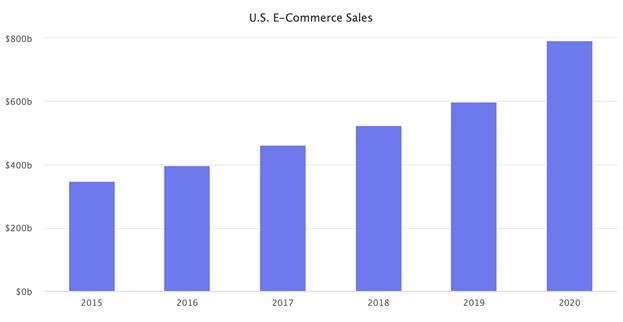
According
to Marketplace Pulse, Amazon was one of the big winners in the fourth quarter, a record quarter with nearly $250 billion in e-commerce
spending. While during the first two quarters boosted by the pandemic – Q2 and Q3 – it grew at or below the overall U.S. e-commerce growth
rate. In the fourth quarter, Amazon grew faster than the market (based on a naive comparison of its reported North America segment growth).
Its fulfillment capacity allowed the company to be more confident with deliveries than its main rivals.
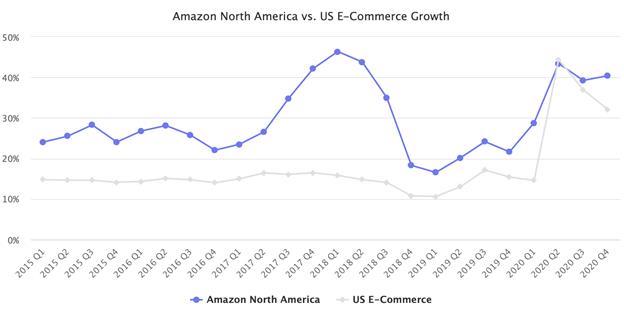
Target
market size
Total
Addressable Market
As
an e-commerce company retailing in the U.S. market, our total addressable market covers all U.S. residents with Internet access, where
segmentally includes repeat customers and new customers to online shopping every year.
Growth
of E-commerce vs. Total Retail Sales
According
to the U.S. Department of Commerce data, the e-commerce’s share of total retail sales has steadily been on the rise, where total
volume increased by an incredible 44% of year-over-year growth. The total retail sales increased by 6.9% to $4.04 trillion from 2019
to 2020, and all growths came from the e-commerce sales. Consumers spent $861.12 billion online with U.S. merchants in 2020, which is
around 21.3% of total retail sales for the year compared to 15.8% in 2019. The strong growth of U.S. online spending shows the future
potential of our target market size. The U.S. e-commerce sales accounted for more than 20% of total retail sales in 2020, and Amazon
represented one-third of the total.
Growth
of Amazon Prime Members
In
2020, Amazon had over 140 million Prime Members in the U.S., and we were seeing continuous year-over-year growth over the past years.
The number of Amazon Prime users in the U.S. is forecasted to reach more than 153 million by 2022, with 3% annual growth.
Operational
advantages
According
to Marketplace Pulse, Hour Loop is one of the top 100 third-party sellers on U.S. Amazon. In 2019 there were only 18,000 sellers, out
of 2,700,000 (or 0.67%) that exceeded $1 million in annual sales. Our sales in 2019 were $26.6 million.
Automation
We
developed a proprietary software that is tailor made to all our operational needs. This includes managing order review process, shipment
managements, inventory management, accounting, and complete end-to-end third-party integrations. This allows us to scale, reduce cost,
and improve quality.
Profitability
Management
We
have experienced operations managers tracking team performances with key performance indicators. We have departments specializing in
logistic costs, advertising, marketing, and product management. We hold monthly process reviews to identify early red flags and look
for areas to optimize. Each quarter we set increasingly difficult bars both to grow gross margin and further reduce expenses.
Continuous
Process Optimization
In
order to improve operating efficiencies, we have effective process optimization adapting to the changing policies of the e-commerce marketplace.
We continuously analyze our performance based on data. We conduct pricing, inventory planning and profitability analysis using this data.
This analysis provides us with insights on the processes that add the most value. Using these insights, we develop guidelines that help
us improve our operations. These guidelines are incorporated into our operations which include (but are not limited to), identifying
and ordering at optimal inventory levels, managing merchandise storage costs, optimizing transit times, and pricing at appropriate levels.
Our operations staff follows these guidelines which help them perform optimally. By continuously analyzing data, we are able to find
insights for improving our business. This drives continuous process optimization and its implementation into our operations. In addition,
our proprietary software allows us to continually accelerate process effectiveness based on specific requirements. Over time, our system
eliminates unnecessary procedures that could be replaced by an advanced algorithm. For instance, we simplify Fulfillment by Amazon (“FBA”)
shipments process through application programming interface (“API”) integration. Our self-developed system also tracks insightful
analysis of our profitability, clearer visualizes the drivers and optimums to better manage operational costs. We monitor operational
parameters that drive our business and proactively try to optimize them. These include fine tuning our item selection, managing our inventory
levels, estimating demand and pricing to maximize our profitability.
Data-Driven
Approach
We
make decisions based on analysis and interpretation of the data sets rather than observations over the market trend. By standardizing
processes and combine data-driven management, we can ensure the organization maintains consistency that is high quality. Our business
managers use historical data and sales projection provided by our proprietary software to find potential product gaps and keep products
in stock all year round. This advantage enables powerful predictive insights in correlating real-time data with past sales patterns.
Training
Programs
Our
effective training programs accelerates employees’ professional development and enables the company to hire new graduates or people
without experience. Our training programs are very task-specific and we continually improve the materials in order to fit new industry
needs. Other than the training material, we assign mentors to evaluate and monitor trainees’ performance at each stage of the training
program.
Task
Generalization
By
generalizing each task with a standard process, we are able to shift assignments at regular intervals in order to find the most suitable
employee for each specific task. Moreover, business managers are also able to rotate the vendors they manage easily. This allows our
organization to effectively and consistently manage a vendor when a key employee who previously managed such vendor is no longer with
the company. In addition, the task generalization allows the company to hire remote teams to further reduce labor costs.
Multicultural
Management
We
have a multicultural management team that is linguistically and culturally diverse in order to make judgments from different perspectives.
Our remote teams in Taiwan and the Philippines provide diverse professional insights on specific tasks.
Technological
advantages
Our
software architecture was designed from the ground up to be scalable, secured, and easily extensible. By using JRuby on Rails, we can
make use the best parts of Java, Ruby, and Rails without paying for their disadvantages. For example, we can use the massive collections
of Java library, portability, speed, multi-threading, and maturity, but we do not have to be tied down with verbose code and strict typing.
Rails allow us to quickly build web pages and integrate both the frontend and the backend. The application runs on Amazon Web Services
(“AWS”) and can be easily scaled up to as many hosts as needed. It is accessible from a browser, so there is no need to setup
or install anything on the client-side.
Cost
advantage
Access
to Low Product Costs
We
lower our product average costs by direct import items that have high volume, purchasing in bulk with better prices, and negotiating
discounts or rebates over increased purchase volume every year. Our strong growth of purchase every year allows us to negotiate better
discounts than the rivals. Therefore, we have the cost advantages to compete at low prices.
Efficient
Processes and Technologies
Our
proprietary software allows us to tailor make tools based on our specific use cases and leverage technologies to greatly reduce manual
operations. We also saved the expense of using third-party software in managing inventory, orders, product listings, and especially the
advertising analytic tool. In fact, our search engine optimization allows us to have Advertising Cost of Sales (“ACoS”) significantly
lower than the industry average of 27.59% in 2020.
Low
Distribution and Logistic costs
We
saved the cost of managing the warehouse, shipping, and product distribution as we are enrolled in Amazon’s FBA program. The program
allows us to reduce fixed costs of the physical assets and quickly scale up the business without thinking much about infrastructure complexity.
Apart from using the FBA program, we also use FedEx, Amazon partnered carrier, Amazon Freight, and Amazon Global Logistics to reduce
expense. The competitive shipping rates we secured provide us a cost-efficient way to deliver shipments from overseas and domestic to
Amazon warehouse.
Efficiently
Managed Operations
We
have a good management structure within the firm and a data-driven system that allows employees to manage tasks quickly and cost-efficiently.
According to the CSI Market, the average annual revenue per employee of the retail industry in 2020 is $429,920, whereas in our company
it is $644,254. Our revenue per employee is also higher than the industry rivals, such as Amazon $483,789, Walmart $238,165, and Costco
$654,308. While our employees on average brought in higher revenues, our annual labor cost per employee is relatively low at less than
$30,000 per year.
Reduced
Labor Costs
Our
labor cost is below 5% of our revenue. We leverage third-party logistic companies to forward or prep our shipments to Amazon, which reduces
our logistic operation labor costs. We also worked with labor outsourcing partner located in Philippines. They provide virtual assistants
to help us with data entries and repetitive work, which is a very cost-effective way to do a lot of grunt work.
List
of key competitors by market size/share
Our
key competitor is Amazon Retail. Amazon Retail frequently buys from the same brands we sell and sells them at a loss. Amazon Retails
offers can be identified by the “Sold by Amazon” tag on Amazon’s site, and they are formed by the two components: 1)
Amazon Vendor Central and 2) Sold by Amazon program. We do not consider other third-party sellers as key competitors, because none of
them represent enough market share to influence sales outcome. The addressable market is incredibly vast, thus we believe there are plenty
of opportunities for everyone.
Amazon
Vendor Central
Amazon
Vendor Central allows manufacturers and brand owners to sell directly to Amazon as a first-party seller. This is one of the key competitive
factors as Amazon usually buys bulk from the brands and sells at a very low price, which leads to hyper-competitive pricing. On pricing
control, Amazon does not always follow the Minimum Advertised Pricing guidelines from manufacturers, which also puts us at a disadvantage
when selling the same products.
Sold
by Amazon Program
With
the rise of e-commerce platforms, Amazon is looking for opportunities to attract customers away from its retail store rivals. In 2019,
they rolled out a new program entitled Sold by Amazon (“SBA”) to help sellers grow their business. This program gives brand
owners the control of inventory management and listings with Amazon having the authority to constantly monitor and change the price to
make sure customers are getting the best deals. Once the products are enrolled in the SBA program, Amazon will set the Minimum Gross
Proceeds (“MGP”) to pay sellers the lowest possible amount on each unit sold. This new program is another threat to our company
as Amazon is the one taking control of pricing, and they set the price very low in order to compete with competitors’ low price
strategy.
Strengths
and weaknesses of each competitor
Strengths
of Sold by Amazon
First,
ship from and Sold by Amazon creates competition for potential customers who prefer to buy products from Amazon rather than a third-party
seller. Secondly, Amazon monitors and manages pricing which makes the product price range at a highly competitive level. In fact, the
chance of Amazon winning buy box is even higher as they have the best deal for customers. Finally, Amazon is not restricted by its policy
to third-party sellers. One of the critical policies is the restock limit. Amazon limits certain items restock quantities based on recent
sales activity, and this affects the in-stock rate of popular items that needs a greater volume.
Weaknesses
of Sold by Amazon
As
Amazon focuses on sales more than relationships with vendors, they do not follow vendors’ Minimum Advertised Pricing (“MAP”)
strictly. We believe this has led to the devaluation of brands and will have a negative impact on building a long-term relationship with
the vendors. Once the vendor hands over their price control to Amazon, we believe it is unlikely for them to sell at their original target
price further, and it influences their offline sales. And in fact, it makes a huge difference in profitability to both Amazon and the
vendor when reacts to the competitive pricing changes.
Apart
from the weaknesses of business relationships, we believe Amazon also has disadvantages in the niche marketplaces, where product offerings
are narrower and more personalized. As a third-party seller, we cooperate with vendors in developing custom projects that bring product
differentiation and scarcity effect. However, we believe Amazon only concentrates on the masses, which gives them the deficiency of having
products that are targeted in certain market segments.
List
potential substitute products that pose a credible threat to Company’s product
No
potential substitute products would pose a credible threat to our company as we have developed a wide product diversification.
As
a company that focus on reselling wholesale products, we have the resilience to find substitution of products or brands. We established
product diversification by managing wide range of SKUs and continually expand our product categories. Our business strategy allows us
to mitigate risk and generate significant profit by selling low volumes items diversified across a large variety of products.
In
contrast, private labels sellers manage small number of SKUs that have large volumes in return with higher profit per unit. However,
private labels have much higher risk when experiencing stagnant or declining sales as they would have lower capability to find sales
replacements that are already established.
Strength
of barriers to entry – risk of entry by additional competitors or alliances
Strength
of Barriers to Entry
Higher
Capital, Low Margin: Selling online is general low margin, but it requires high capital investment in order to purchase goods and
run advertising.
Product
Differentiation: Our proprietary software allows us to manage a huge number of SKUs. This allows us to participate in profitable
long-tail products in addition to well-known popular ones. The turnover rate for long-tail products is slow, so newcomers are not likely
to enter. It also requires a sophisticated system to manage. Furthermore, vendor relationships do not happen overnight.
Advanced
System: We have already developed a highly sophisticated system which has been refined over time to become highly effective. Even
if a new entrant has a team of the best software engineers in the world, it will still take them many years to refine their system. There
is a myriad of intricacies as to the effectiveness of a system. Even if the new entrants have the system built, it will still take them
years to collect historical sales data. By the time new entrants have done all that, our system would have continued to mature. This
means we would be able to manage more SKUs more profitably with lower costs.
Risk
of Entry- Potential Entrants
Vendor
Vertical Integration: A vendor may forward integrate into the e-commerce marketplace in order to directly engage with their online
customers.
Multichannel
E-commerce: There is a chance of established online retail firms such as sellers on eBay, Walmart, and Etsy expanding their business
to the Amazon marketplace.
Brick-and-Mortar:
As the online retail is growing and offline retail is contracting, there are more brick-and-mortar stores migrating from offline
to online.
Improving
Sales of Popular Items and Securing the Inventories Without Paying Higher Storage Fees By Engaging the Services of Third Party
Warehouses
As a retailer our success is
heavily influenced by the inventory control of our suppliers (vendors). However, many of our suppliers are having difficulties to maintain
their stock level due to various reasons, such as the shortage of shipping containers, lack of labor, or disruption in manufacturing.
The situation exacerbates during the pandemic and in peak season. In order to secure the inventories, we start to order large quantities
of popular items or buying them out to store in the Amazon fulfillment center (“FC”). However, the monthly storage fee of
Amazon FC in peak season (Q4) is 3.5 times higher than normal season, which puts pressure on our profits. To maintain the balance of
inventory level and margins, we are currently contracting the warehousing services of third-party warehouses, including, Rahl
Distribution, Inc., Rite Prep Shipping, 3Plzen, Carolina Prep & Ship, and West FBA to support our overall stock planning
process. By doing this, we can improve sales by preventing popular items from going out of stock, since we had secured adequate inventories
ahead of time. Furthermore, we can also avoid paying higher Amazon storage fees in Q4.
Growth
Objectives Outline
In
2021, we plan to grow the number of suppliers from 226 to 300, the number of business managers from 20 to 50, the number of active SKUs
from 42k to 60k, and the number of total employees from 60 to 120. In 2022, we plan to grow the number of suppliers to 650, the number
of business managers to 200, the number of active SKUs to130k, and the number of total employees to 250. In 2023, we plan to grow the
number of suppliers to 1,200, the number of business managers to 350, the number of active SKUs to 200k, and the number of total employees
to 500. In 2024, we plan to grow the number of suppliers to 2000, the number of business managers to 600, the number of active SKUs to
300k, and the number of total employees to 900. We believe in order to be successful in the long-term, we must invest in talents.
New
business managers are the key to growth, they are analogous to new stores in a traditional brick and mortar retail business. Although
the return on investment is extremely high over the long-term when investing in people, initially the return is very low or even negative.
Therefore, as we continue to fuel the rapid growth, we will need to increase the number of people faster than the growth. We anticipate
that ratio to improve when we reached critical mass of highly proficient business managers from the new hires.
Market
and Supplier Development – Establishing a Vendor Acquisition Team
In
order to continue growing at a rapid pace, we must onboard new vendors at scale. We anticipate establishing a vendor acquisition team
dedicated to onboarding new vendors would drastically improve our vendor acquisition success rate. This team would specialize in the
skills required to convince vendors to sell us their goods. Currently, this is being done by individual business managers with varying
skill levels. The success rate by the individual business managers varies. Establishing this new team should ensure more consistency,
so we can better plan for the future. The team would consist of three to five executive managers who are responsible for researching
and contacting potential vendors. Furthermore, on a monthly basis, the team would be reviewing the lists of potential vendors who are
not yet collaborating with us and reach out to them to reconnect. The objective of the vendor and supplier team is to on board 150 vendors
per year and increasing our product range as well as diversifying our product categories.
COVID-19
Our
business, results of operations, and financial condition may be materially adversely impacted if a public health outbreak, including
the recent COVID-19 pandemic, interferes with our ability, or the ability of our employees, contractors, suppliers, and other business
partners to perform our and their respective responsibilities and obligations relative to the conduct of our business.
The
COVID-19 pandemic has adversely affected and may continue to adversely affect the economies and financial markets worldwide, resulting
in an economic downturn that could impact our business, financial condition and results of operations. As a result, our ability to fund
through public or private equity offerings, debt financings, and through other means at acceptable terms, if at all, may be disrupted,
in the event our financing needs for the foreseeable future are not able to be met by our balances of cash, cash equivalents and cash
generated from operations.
In
addition, the continuation of the COVID-19 pandemic and various governmental responses in the United States has adversely affected and
may continue to adversely affect our business operations, including our ability to carry on business development activities, restrictions
in business-related travel, delays or disruptions in our on-going projects, and unavailability of the employees of the Company or third
parties with whom we conduct business, due to illness or quarantines, among others. Our business was negatively impacted by disruptions
in our supply chain, which limited our ability to source merchandise, and limits on products fulfillment placed by Amazon. For example,
we may be unable to launch new products, replenish inventory for existing products, ship into or receive inventory in our third-party
warehouses in each case on a timely basis or at all. The extent to which COVID-19 could impact our business will depend on future developments,
which are highly uncertain and cannot be predicted with confidence, and will depend on many factors, including the duration of the outbreak,
the effect of travel restrictions and social distancing efforts in the United States and other countries, the scope and length of business
closures or business disruptions, and the actions taken by governments to contain and treat the disease. As such, we cannot presently
predict the scope and extent of any potential business shutdowns or disruptions. Possible effects may include, but are not limited to,
disruption to our customers and revenue, absenteeism in our labor workforce, unavailability of products and supplies used in our operations,
shutdowns that may be mandated or requested by governmental authorities, and a decline in the value of our assets, including various
long-lived assets.
Bank
of America Loan
On June
18, 2019, the Company issued a Promissory Note (the “BofA Note”) in the amount of $785,000 to Bank of America (the “Lender”)
for a loan in the amount of $785,000. The BofA Note matures on June 18, 2024 and bears interest at a rate of 8.11% per annum. The monthly
payment is $15,963, consisting of $11,398 of principal and $4,565 of interest. As of July 23, 2021, the aggregate principal amount of
the BofA Note outstanding is $0. As of January 3, 2022, there is an outstanding balance of deferred interest of $27,996.
PPP
Loan
On
April 7, 2020, the Company issued a Promissory Note (the “Note”) in the amount of $27,012 under the Paycheck Protection Program
(“PPP”) to JP Morgan Chase Bank, N.A. (the “Lender”). The PPP, established as part of the Coronavirus Aid, Relief,
and Economic Security Act (the “CARES Act”), which was enacted March 27, 2020, provides for loans to qualifying businesses
for amounts up to 2.5 times of the average monthly payroll expenses of the qualifying business. The Note matures on April 7, 2022 and
bears interest at a rate of 0.98% per annum, payable monthly commencing October 5, 2020, following an initial deferral period as specified
under the PPP loan. The Note may be prepaid at any time prior to maturity with no prepayment penalties. The Paycheck Protection Program
Flexibility Act (the “Flexibility Act”), signed on June 5, 2020, amended certain provisions of the PPP, including the deferral
period and repayment terms. The Flexibility Act extends the deferral period of payments of PPP loan principal, interest, and fees to
the date when the SBA makes a final decision on the borrower’s application for forgiveness, or 10 months after the last day of
the covered period if a borrower has not applied for forgiveness (whichever is earlier). This extension applies regardless of the terms
of the PPP and does not require an amendment of the PPP. As such, the Company has not made any payments on the Note during 2020.
Under
the terms of the PPP loan, up to the entire amount of principal and accrued interest may be forgiven to the extent PPP loan proceeds
are used for qualifying expenses as described in the CARES Act and applicable implementing guidance issued by the U.S. Small Business
Administration under the PPP loan. On May 6, 2021, the entire amount of principal and accrued interest on the Note was forgiven.
Conversion
of S Corporation to C Corporation
On June 30, 2021, the Company
completed a corporate reorganization to convert its status from a S corporation to a C corporation with an effective date of July 27,
2021. Retained earnings in the amount of $4,170,418 were distributed by the Company to the S corporation stockholders ($2,085,209
to each of Mr. Lai and Ms. Yu) on July 27, 2021.
Affiliated
Loans
December
2020 Loan
On
December 31, 2020, Sam Lai, our Chief Executive Officer, and Maggie Yu, our Senior Vice President, made a loan (“December 2020
Loan”) to us of $1,041,353 in a single payment ($520,676 attributable to each of Mr. Lai and Mrs. Yu). The loan is memorialized
in a Loan Agreement dated December 31, 2020. Pursuant to the terms of the Loan Agreement, the loan bore no interest and was payable on
demand.
On
September 16, 2021, Sam Lai, our Chief Executive Officer, and Maggie Yu, our Senior Vice President, and the Company amended and restated
the Loan Agreement to modify the terms of the December 2020 Loan, whereby the interest rate became 2% per annum (applied retroactively)
rather than non-interest bearing and maturity date became December 31, 2021 rather than payable on demand.
On
December 31, 2021, Sam Lai, our Chief Executive Officer, and Maggie Yu, our Senior Vice President, and the Company amended and restated
the Loan Agreement to modify the term of the December 2020 Loan, whereby the maturity date was extended from December 31, 2021 to January
31, 2022.
As
of January 3, 2022, the outstanding principal balance was $987,868 and accrued interest was $20,664 on the December 2020 Loan.
July
2021 Loan
On July
27, 2021, Sam Lai, our Chief Executive Officer, and Maggie Yu, our Senior Vice President, made a loan (“July 2021 Loan”)
to us of the outstanding retained earnings of approximately $4,170,418 in a single payment ($2,085,209 attributable to
each of Mr. Lai and Mrs. Yu). The loan is memorialized in a Loan Agreement dated October 15, 2021. Pursuant to the terms of the Loan
Agreement, the loan bears interest of 2% per annum and the principal of the loan ($4,170,418) and accrued interest becomes due
and payable on December 31, 2022.
As of
January 3, 2022, the outstanding principal balance was approximately $4,170,418 and accrued interest was $36,325 on the
July 2021 Loan.
Stock Splits
On
September 22, 2021, our board of directors and shareholders approved a forward stock split in a ratio of 4.44-for-1 (“Forward Stock
Split”) and on September 27, 2021, we filed a certificate of amendment to our Certificate of Incorporation implementing the Forward
Stock Split in a ratio of 4.44-for-1, effective September 27, 2021. Therefore, on September 27, 2021, following the Forward Stock Split,
Sam Lai, our Chief Executive Officer, and Maggie Yu, our Senior Vice President, each held 22,200,000 shares of common stock (for
an aggregate of 44,400,000 shares of common stock).
On
November 29, 2021, our board of directors and shareholders approved a reverse stock split in a ratio of 0.75-for-1 (“Reverse Stock
Split”) and on December 1, 2021, we filed a certificate of amendment to our Certificate of Incorporation implementing the Reverse
Stock Split in a ratio of 0.75-for-1, effective December 3, 2021. Therefore, on December 3, 2021, following the Reverse Stock Split,
Sam Lai, our Chief Executive Officer, and Maggie Yu, our Senior Vice President, each held 16,650,000 shares of common stock (for
an aggregate of 33,300,000 shares of common stock).
Except
as otherwise indicated, all references to our common stock, share data, per share data and related information has been adjusted for
the Forward Stock Split ratio of 4.44-for-1 and Reverser Stock Split ratio of 0.75-for-1 as if they had occurred at the beginning
of the earliest period presented. The Forward Stock Split, divided each share of our outstanding common stock into 4.44 shares of common
stock, and the Reverse Stock Split, divided each share of our outstanding common stock into 0.75 shares of common stock, without
any change in the par value per share, and the Forward Stock Split and the Reverse Stock Split correspondingly adjusted, among other
things, the exercise rate of our warrants into our common stock. No fractional shares were issued in connection with the Forward Stock
Split and the Reverse Stock Split, and any fractional shares resulting from the Forward Stock Split and Reverse Stock Split were rounded
up to the nearest whole share.
Approval
of the Hour Loop, Inc. 2021 Equity Incentive Plan
On
June 27, 2021, our Board of Directors and shareholders holding a majority of our outstanding shares of common stock approved the Hour
Loop, Inc. 2021 Equity Incentive Plan (the “2021 Plan”). Under the 2021 Plan, a total of 4,995,000 (1,500,000 pre-stock splits)
shares of common stock are authorized for issuance pursuant to the grant of stock options, stock appreciation rights, restricted
stock, restricted stock units, performance units, performance shares or other cash- or stock-based awards to officers, directors, employees
and eligible consultants to the Company or its subsidiaries. Subject to adjustment as provided in the 2021 Plan, the maximum aggregate
number of shares that may be issued under the 2021 Plan will be cumulatively increased on January 1, 2022 and on each subsequent January
1, by a number of shares equal to the smaller of (i) 3% of the number of shares of common stock issued and outstanding on the immediately
preceding December 31, or (ii) an amount determined by our Board of Directors.
Employees
As of January 3, 2022,
we had three full-time employees. As of January 3, 2022, our subsidiary, Flywheel Consulting Limited had 60 full time employees.
None of our employees or Flywheel Consulting Limited’s employees is represented by a union. Flywheel Consulting Limited and us
consider our relations with our employees to be good.
Legal
Proceedings
From
time to time, we are involved in various claims and legal actions arising in the ordinary course of business. To the knowledge of our
management, there are no legal proceedings currently pending against us which we believe would have a material effect on our business,
financial position or results of operations and, to the best of our knowledge, there are no such legal proceedings contemplated or threatened.
Properties
Our
corporate headquarters are located at 8201 164th Ave NE #200, Redmond, WA 98052-7615, where we rent a virtual office from an unaffiliated
third party under a virtual office/meeting room agreement. This agreement provides for daily telephone answering, messaging and fax services,
and paid access to conference rooms on an as-needed basis. The virtual office arrangement expires on August 31, 2021. Terms of the virtual
office arrangement provide for a rent payment of $29.50 per month. We also lease a warehouse located at Floor 35, No. 1123-1139, Fangshan
Beier Road, Xiangbei Industry District, Xiamin, China, where we lease approximately 1680 square feet from an unaffiliated third party.
This lease expires on January 1, 2022. Terms of this lease provides for a base rent payment of RMB$21,840 (US$3,116) per month. Our wholly
owned subsidiary, Flywheel Consulting Limited also has an office at 27F. No.251, Mingquan 1st Rd., Xinxing Dist., Kaohsiungcity,
Taiwan, where we lease approximately 2,230 rentable square feet of office space from an unaffiliated third party. This lease expires
on August 31, 2022. Terms of the Taiwan office lease provide for a base rent payment of NTD$94,500 (US$3,400) per month. We believe that
these facilities are adequate for our current and near-term future needs.
MANAGEMENT’S
DISCUSSION AND ANALYSIS OF
FINANCIAL CONDITION AND RESULTS OF OPERATIONS
References
in this prospectus to “we,” “us” or the “Company” refer to Hour Loop, Inc. The following discussion
and analysis of the Company’s financial condition and results of operations should be read in conjunction with the financial statements
and the notes thereto contained elsewhere in this prospectus.
Overview
Our
Business
We
are an online retailer engaged in e-commerce retailing in the U.S. market. We have operated as a third-party seller on www.amazon.com
since 2013. We have also sold merchandise on our website at www.hourloop.com since 2013. We expanded our operations to www.walmart.com
in October 2020. To date, we have generated practically all of our revenue as a third-party seller on www.amazon.com and
only a negligible amount of revenue from our operations on our website at www.hourloop.com and as a third-party seller on www.walmart.com.
We manage more than 100,000 stock-keeping units (“SKUs”). Product categories include home/garden décor, toys, kitchenware,
apparels, and electronics. Our primary strategy is to bring most of our vendors product selections to the customers. We have advanced
software that assists us in identifying product gaps so we can keep such products in stock year-round including the entirety of the last
quarter (holiday season) of the calendar year (“Q4”). In upcoming years, we plan to expand our business rapidly by increasing
the number of business managers, vendors and SKUs.
Business
Model
There
are three main types of business models on Amazon: wholesale, private label and retail arbitrage. Our business model is wholesale, also
known as reselling, which refers to buying products in bulk directly from the brand or manufacturer at a wholesale price and making a
profit by selling the product on Amazon. We sell merchandise on Amazon and the sales are fulfilled by Amazon. We pay Amazon fees for
allowing us to sell on their platform. Our relationship with Walmart is also similar. We pay Walmart fees for allowing us to sell our
merchandise on their platform. As stated above, to date, we have generated only a negligible amount of revenues as a third-party seller
on www.walmart.com.
The
advantages of selling via a wholesale model:
| – | Purchase lower unit quantities with wholesale orders than private label products. |
|
| – | Selling wholesale is less time intensive and easier to scale than sourcing products via retail arbitrage. |
|
| – | More brands will want to work with us because we can provide broader Amazon presence. |
The
challenges of selling via a wholesale model:
| – | Fierce competition on listing for Buy Box on amazon.com (as described below). |
|
| – | Developing and maintaining relationships with brand manufacturers. |
Market
description/opportunities
Total
retail sales increased 6.9% to $4.04 trillion in 2020 from $3.78 trillion in 2019. Consumers spent $861.12 billion online with U.S. merchants
in 2020, which is around 21.3% of total retail sales for 2020, compared to 15.8% for 2019.
Amazon
accounted for nearly a third of all e-commerce in the United States. With a more than 5% gain in e-commerce penetration for U.S. retail
sales in 2020, we anticipate a larger market in the upcoming years.
Formation
and Management
We
were originally incorporated under the laws of the State of Washington on January 13, 2015. However, we converted from a Washington corporation
to a Delaware corporation on April 7, 2021. The company
was founded in 2013 by Sam Lai and Maggie Yu. With their vision, leadership, and software development skills, the company grew rapidly.
From 2013 to 2020, sales grew from $0 to $38,655,264.
Competitive
advantage
Among
9.7 million sellers on Amazon, we believe we have two main competitive advantages. First, we have strong operations and sales teams experienced
in listing, shipment, advertising, reconciliation and sales. By delivering high quality results and enhancing procedures through the
process, our teams are competitive. Second, we believe our proprietary software system gives us an advantage over our competition. The
system is highly customized to our business model; it collects and processes large amounts of data every day to optimize our operation
and sales. Through advanced software, we can identify product gaps and keep them in stock all year round.
With
respect to our advertising strategy, we advertise those products that we estimate will have greater demand based on our experience. This
lets us allocate our advertising budget in a fashion that delivers positive value. We advertise our products on Amazon. We allocate our
advertising dollars prudently. This is accomplished by advertising items that deliver the most return for our advertising spending. We
monitor the items being advertised by our competitors. On the operations side, we constantly refine our processes based on learnings
from historical data. The combination of managing the business operations effectively along with allocating our advertising budget to
high value items allows us to grow profitably. In cases, where the advertising is fierce, we allocate the spending appropriately. Our
strategy for competing with larger competitors is to monitor their pricing and not compete with them when their pricing is low or at
a loss. Competitors sell at low prices or at a loss due to a variety of reasons, including, but not limited to, their desire to liquidate
inventory or achieve short term increase in revenue. During these times, we avoid matching their prices. This strategy allows us to stay
profitable.
Our
Financial Position
For the fiscal years ended December
31, 2020 and 2019, we generated revenues of $38,655,264 and $26,564,693, respectively, and reported net income of $3,825,389 and
$(424,583), respectively, and cash flow from operating activities of $3,824,729 and cash flow used by operating activities
of $(517,933), respectively. For the nine months ended September 30, 2021 and 2020, we generated revenues of $31,391,254
and $17,466,081, respectively, and reported net income of $2,268,511 and $1,238,523, respectively, and cash
flow from operating activities of $1,664,907 and $910,956, respectively. As noted in our consolidated financial statements,
as of September 30, 2021, we had retained earnings of $139,434.
Results
of Operations
Nine Months Ended September
30, 2021 Compared to Nine Months Ended September 30, 2020
| 9 Months Ended |
||||||||
| September 30, 2021 |
September 30, 2020 |
|||||||
| Statement of Operations Data | ||||||||
| Total revenues | $ | 31,391,254 | 17,466,081 | |||||
| Total cost of goods sold | 13,855,109 | 7,854,285 | ||||||
| Gross profit | 17,536,145 | 9,611,796 | ||||||
| Total operating expenses | 15,418,066 | 8,373,538 | ||||||
| Income (loss) from operations | 2,118,079 | 1,238,258 | ||||||
| Total other non-operating income | 125,661 | 265 | ||||||
| Income tax provisions | 24,770 | – | ||||||
| Net income (loss) | 2,268,511 | 1,238,523 | ||||||
| Other Comprehensive Income | (6,301) | (576) | ||||||
| Total Comprehensive Income | $ | 2,262,210 | 1,237,947 | |||||
Revenue
For the nine months ended
September 30, 2021, our revenues increased by $13,925,173, or 80%, as compared to the nine months ended September
30, 2020. The increase was primarily due to organic growth in our business. Our total orders in the first nine months of 2021
were 1,220,801 as compared with 656,020 orders in the first nine months of 2020. This represented an increase of
86% over the same period last year. However, our revenue per item dropped by 4% to $27.25 in the first nine months of
2021 from $28.60 in the first nine months of 2020. We attribute our growth in revenue to the growth in the e-commerce
market as well as ability of our team to successfully target the customer base.
Cost of Goods Sold
For the nine months ended
September 30, 2021, our cost of goods sold increased by $6,000,824 or 76% as compared to the nine months
ended June 30, 2020. The growth in cost of goods sold was primarily due to larger number of orders. The percentage increase in cost of
goods sales was lower than the percentage increase in revenue reflecting improved profitability.
Operating Expenses
Operating expenses for the nine
months ended September 30,2021 were $15,418,066 as compared to $8,373,538 for the nine months ended September
30, 2020, an increase of $7,044,528 or 84%. The increase is primarily related to an increase in platform fees paid
to Amazon due to greater revenue in this period. The platform fees paid to Amazon are proportional to the revenue generated.
Other Income
For the nine months ended
September 30, 2021, other income amounted to $125,661 as compared to $265 for the nine months ended September
30, 2020, a change of $125,396. The increase in other income was primarily due credit card rewards received due to the
timely payments made by the company.
Total Comprehensive Income
Total comprehensive income for
the nine months ended September 30, 2021 was $2,262,210 as compared to a net income of $1,237,947 for the
nine months ended September 30, 2020, an increase of $1,024,263.
Impacts to Results of Operations from COVID-19
The Company’s business
operations were negatively impacted by disruptions in our supply chain, which limited our ability to source merchandise, and limits on
products fulfillment placed by Amazon. More specifically, COVID-19 limited our ability to stock items because there was not enough inventory
available. Additionally, the cost of these items increased
Year
Ended December 31, 2020 Compared to Year Ended December 31, 2019
The
following table shows a comparison of our 2020 and 2019 income statements.
| Year Ended | ||||||||
| December 31, 2020 | December 31, 2019 | |||||||
| Statement of Operations Data | ||||||||
| Total revenues | $ | 38,655,264 | 26,564,693 | |||||
| Total cost of goods sold | 16,639,491 | 14,135,029 | ||||||
| Gross profit | 22,015,773 | 12,429,664 | ||||||
| Total operating expenses | 18,328,925 | 12,821,405 | ||||||
| Income (loss) from operations | 3,686,848 | (391,741 | ) | |||||
| Total other non-operating income | 138,541 | (32,842 | ) | |||||
| Income tax provisions | – | – | ||||||
| Net income (loss) | 3,825,389 | (424,583 | ) | |||||
| Other Comprehensive Income | (4,691 | ) | 1,510 | |||||
| Total Comprehensive Income | $ | 3,820,698 | (423,073 | ) | ||||
Revenue
We
generated $38,655,264 in revenue in 2020 as compared to $26,564,693 in 2019. The growth in revenue was 12,090,571 or 45.5%. We attribute
this growth to our continued growth and maturity in our operating model which was enhanced by a favorable e-commerce environment. Our
total orders in 2020 were approximately 1,364,557 as compared with approximately 1,019,922 orders in 2019. This represented an increase
of 30%. Additionally, the revenue per order in 2020 was higher than that in 2019.
Cost
of Goods Sold
Cost
of goods sold during the year ended December 31,2020 totaled $16,639,491 as compared to 14,135,029 during the year ended December 31,
2019. Cost of goods sold include the cost of the merchandise sold, shipping costs as well as estimated losses due to damage to goods.
The increase in cost of goods sold is due to a greater number of items sold as a result of greater number of orders in 2020.
Operating
Expense
Operating
Expenses for the year ended December 31,2020 totaled $18,328,925, a $5,507,520 increase from the $12,821,405 of operating expenses in
the year ended December 31, 2019. This change was caused by an increase in platform fees paid to Amazon. These fees are proportional
to the revenue. The increase in revenue in 2020 over 2019 drove this increase in platform fees.
Other
(Expense) Income
Other
income increased to $138,541 for the year ended December 31,2020 from a loss of $32,842 for the year ended December 31, 2019. This was
due to $153,721 in credit card rewards received in 2020 that were not present in 2019. Additionally, the interest expense was $43,269
in 2020 as opposed to interest expense of 51,794 in 2019. The lower interest expense in 2020 was due to our paying off our Bank of America
loan.
Total
Comprehensive Income
Total
Comprehensive Income for the year ended December 31,2020 was $3,820,698 while the net loss for the year ended December 31, 2019 was $423,073.
The change in Total Comprehensive Income was $4,243,771. This change was driven by an improvement in both our revenue as well as our
costs in the year ended December 31, 2020 over the year ended December 31, 2019.
Impacts
to Results of Operations from COVID-19
The
Company’s business operations were negatively impacted by disruptions in our supply chain, which limited our ability to source
merchandise, and limits on products fulfillment placed by Amazon. More specifically, COVID-19 limited our ability to stock items because
there was not enough inventory available. Additionally, the cost of these items increased.
Liquidity
and Capital Resources
Cash
Flows for the Years Ended December 31,2020 and 2019
Liquidity
is the ability of an enterprise to generate adequate amounts of cash to meet its needs for cash requirements. We had cash of $4,968,064
and $838,963 as of December 31,2020 and December 31,2019, respectively.
Our
primary uses of cash have been for inventory, payments to Amazon related to sales and shipping of products, for services provided, payments
for marketing and advertising and salaries paid to our employees. We have received funds from the sales of products that we sell online.
The following trends are reasonably likely to result in changes in our liquidity over the near to long term:
| ● | An increase in working capital requirements to finance the rapid growth in our current business, |
|
| ● | An increase in fees paid to Amazon and other partners as our sales grows |
|
| ● | The cost of being a public company; |
|
| ● | Marketing and advertising expenses for attracting new customers; and |
|
| ● | Capital requirements for the development of additional infrastructure |
Since
inception, we have generated liquidity from the profitability of our ongoing business and from debt to fund our operations.
The
following table shows a summary of our cash flows for the years ended December 31,2020 and December 31, 2019.
| Year Ended |
||||||||
| December 31, 2020 |
December 31, 2019 |
|||||||
| Statement of Cash Flows |
||||||||
| Net cash from operating activities |
$ | 3,824,729 | (517,933 | ) | ||||
| Net cash used in investing activities |
$ | – | – | |||||
| Net cash provided by financing activities |
$ | 299,261 | 509,013 | |||||
| Effect of changes in foreign currency rates |
$ | 5,111 | 4,473 | |||||
| Net increase (decrease) in cash |
$ | 4,129,101 | (4,447 | ) | ||||
| Cash – beginning of the period |
$ | 838,963 | 843,410 | |||||
| Cash – end of the period |
$ | 4,968,064 | 838,963 | |||||
Net
Cash From Operating Activities:
For
the fiscal year ended December 31, 2020, cash generated by operating activities amounted to $3,824,729. This was driven by our net income
of $3,825,389. The increase in net income was driven by an increase in revenue from $38,655,264 in 2020 from $26,564,693 in 2019.
This increase in revenue of $12,090,571 was offset by a corresponding increase in cost of goods sold of $2,504,462 and an increase in
operating expenses of $5,507,520. Changes in our operating liabilities and assets used up cash by $77,086. For the fiscal year ended
December 31, 2019, cash used in operating activities amounted to $517,933, mainly resulting from a net loss of $424,583. Changes in our
operating liabilities and assets used up cash of $185,114.
Net
Cash Provided by (Used in) Investing Activities:
For
the fiscal year ended December 31, 2020, no cash was generated by or used in investing activities. For the fiscal year ended December
31, 2019, no cash was generated by or used in investing activities. In both these years, the company made no investments to procure fixed
assets.
Net
Cash Provided by Financing Activities:
For
the fiscal year ended December 31, 2020, cash provided from financing activities amounted to $299,261, mainly resulting from $991,509
in net advances from related parties offset by payments of $718,362 towards the line of credit. For the fiscal year ended December 31,
2019, cash provided from financing activities amounted to $509,013, mainly resulting from a net change in the line of credit of $455,196
and net advances from related parties of $49,996.
Cash Flows for the Nine Months Ended
September 30, 2021 and 2020
The following table shows a summary
of our cash flows for the nine months ended September 30, 2021 and 2020.
| Nine months ended |
||||||||
| September 30, 2021 |
September 30, 2020 |
|||||||
| Statement of Cash Flows | ||||||||
| Net cash from operating activities | 1,574,465 | 910,956 | ||||||
| Net cash used in investing activities | – | – | ||||||
| Net cash used in financing activities | (2,088,921 | ) | (538,450) | |||||
| Effect of foreign exchange rate | (135) | 1,992 | ||||||
| Net increase (decrease) in cash | (514,591 | ) | 374,498 | |||||
| Cash – beginning of the period | 4,968,064 | 838,963 | ||||||
| Cash – end of the period | 4,453,473 | 1,213,461 | ||||||
Net
Cash From Operating Activities:
Net cash flow generated from
operating activities for the nine months ended September 30, 2021 was $1,574,465 as compared to cash generation
of $910,956 for the nine months ended September 30, 2020, an increase of $663,509 or 73%. Our income
for the nine months ending September 30, 2021 was $2,268,511 as compared with $1,238,523 for the nine months
ending September 30,2020. The revenue was $31,391,254 during the nine months ending on September 30, 2021
as compared with $17,466,081 during the nine months ending on September 30, 2020. The corresponding increase in cost of
goods sold was $6,000,824 and the increase in operating expenses was $7,044,528. However, the increase in income was offset
by cash usage related to the cash used in paying down accrued expenses and other current liabilities. During the nine months
ended September 30, 2021, our accrued expenses and other current liabilities declined by $598,828 as compared to
an increase in accrued expenses and other current liabilities of $16,815 during the nine months ended September
30, 2020.
Net Cash Used in Investing Activities:
Net cash used in investing activities
for the nine months ended September 30, 2021 was $0. The net cash used in investing activities for the nine months
ended September 30, 2020 was $0. During both these periods, the company made no acquisition of property, plant and equipment.
Net Cash Provided by (Used in) Financing Activities:
Net cash used by financing activities
for the nine months ended September 30, 2021 was $2,088,921 as compared to net cash used by financing activities
of $538,450 for the nine months ended September 30, 2020, an increase of $1,550,471.
Off-balance
sheet financing arrangements
We
have no obligations, assets or liabilities which would be considered off-balance sheet arrangements. We do not participate in transactions
that create relationships with unconsolidated entities or financial partnerships, often referred to as variable interest entities, which
would have been established for the purpose of facilitating off-balance sheet arrangements. We have not entered into any off-balance
sheet financing arrangements, established any special purpose entities, guaranteed any debt or commitments of other entities, or purchased
any non-financial assets.
COVID-19
Our
business, results of operations, and financial condition may be materially adversely impacted if a public health outbreak, including
the recent COVID-19 pandemic, interferes with our ability, or the ability of our employees, contractors, suppliers, and other business
partners to perform our and their respective responsibilities and obligations relative to the conduct of our business.
The
COVID-19 pandemic has adversely affected and may continue to adversely affect the economies and financial markets worldwide, resulting
in an economic downturn that could impact our business, financial condition and results of operations. As a result, our ability to fund
through public or private equity offerings, debt financings, and through other means at acceptable terms, if at all, may be disrupted,
in the event our financing needs for the foreseeable future are not able to be met by our balances of cash, cash equivalents and cash
generated from operations.
In
addition, the continuation of the COVID-19 pandemic and various governmental responses in the United States has adversely affected and
may continue to adversely affect our business operations, including our ability to carry on business development activities, restrictions
in business-related travel, delays or disruptions in our on-going projects, and unavailability of the employees of the Company or third
parties with whom we conduct business, due to illness or quarantines, among others. Our business was negatively impacted by disruptions
in our supply chain, which limited our ability to source merchandise, and limits on products fulfillment placed by Amazon. For example,
we may be unable to launch new products, replenish inventory for existing products, ship into or receive inventory in our third-party
warehouses in each case on a timely basis or at all. The extent to which COVID-19 could impact our business will depend on future developments,
which are highly uncertain and cannot be predicted with confidence, and will depend on many factors, including the duration of the outbreak,
the effect of travel restrictions and social distancing efforts in the United States and other countries, the scope and length of business
closures or business disruptions, and the actions taken by governments to contain and treat the disease. As such, we cannot presently
predict the scope and extent of any potential business shutdowns or disruptions. Possible effects may include, but are not limited to,
disruption to our customers and revenue, absenteeism in our labor workforce, unavailability of products and supplies used in our operations,
shutdowns that may be mandated or requested by governmental authorities, and a decline in the value of our assets, including various
long-lived assets.
Contractual
obligations
We
do not have any long-term capital lease obligations, operating lease obligations or long-term liabilities, except as follows:
Bank
of America Loan
On June
18, 2019, the Company issued a Promissory Note (the “BofA Note”) in the amount of $785,000 to Bank of America (the “Lender”)
for a loan in the amount of $785,000. The BofA Note matures on June 18, 2024 and bears interest at a rate of 8.11% per annum. The monthly
payment is $15,963, consisting of $11,398 of principal and $4,565 of interest. As of July 23, 2021, the aggregate principal amount of
the BofA Note outstanding is $0. As of January 3, 2022, there is an outstanding balance of deferred interest of $27,996.
PPP
Loan
On
April 7, 2020, the Company issued a Promissory Note (the “Note”) in the amount of $27,012 under the Paycheck Protection Program
(“PPP”) to JP Morgan Chase Bank, N.A. (the “Lender”). The PPP, established as part of the Coronavirus Aid, Relief,
and Economic Security Act (the “CARES Act”), which was enacted March 27, 2020, provides for loans to qualifying businesses
for amounts up to 2.5 times of the average monthly payroll expenses of the qualifying business. The Note matures on April 7, 2022 and
bears interest at a rate of 0.98% per annum, payable monthly commencing October 5, 2020, following an initial deferral period as specified
under the PPP loan. The Note may be prepaid at any time prior to maturity with no prepayment penalties. The Paycheck Protection Program
Flexibility Act (the “Flexibility Act”), signed on June 5, 2020, amended certain provisions of the PPP, including the deferral
period and repayment terms. The Flexibility Act extends the deferral period of payments of PPP loan principal, interest, and fees to
the date when the SBA makes a final decision on the borrower’s application for forgiveness, or 10 months after the last day of
the covered period if a borrower has not applied for forgiveness (whichever is earlier). This extension applies regardless of the terms
of the PPP and does not require an amendment of the PPP. As such, the Company has not made any payments on the Note during 2020.
Under
the terms of the PPP loan, up to the entire amount of principal and accrued interest may be forgiven to the extent PPP loan proceeds
are used for qualifying expenses as described in the CARES Act and applicable implementing guidance issued by the U.S. Small Business
Administration under the PPP loan. On May 6, 2021, the entire amount of principal and accrued interest on the Note was forgiven.
Conversion
of S Corporation to C Corporation
On June 30, 2021, the Company
completed a corporate reorganization to convert its status from a S corporation to a C corporation with an effective date of July 27,
2021. Retained earnings in the amount of $4,170,418 were distributed by the Company to the S corporation stockholders ($2,085,209
to each of Mr. Lai and Ms. Yu) on July 27, 2021.
Affiliated
Loans
December
2020 Loan
On
December 31, 2020, Sam Lai, our Chief Executive Officer, and Maggie Yu, our Senior Vice President, made a loan (“December 2020
Loan”) to us of $1,041,353 in a single payment ($520,676 attributable to each of Mr. Lai and Mrs. Yu). The loan is memorialized
in a Loan Agreement dated December 31, 2020. Pursuant to the terms of the Loan Agreement, the loan bore no interest and was payable on
demand.
On
September 16, 2021, Sam Lai, our Chief Executive Officer, and Maggie Yu, our Senior Vice President, and the Company amended and restated
the Loan Agreement to modify the terms of the December 2020 Loan, whereby the interest rate became 2% per annum (applied retroactively)
rather than non-interest bearing and maturity date became December 31, 2021 rather than payable on demand.
On
December 31, 2021, Sam Lai, our Chief Executive Officer, and Maggie Yu, our Senior Vice President, and the Company amended and restated
the Loan Agreement to modify the term of the December 2020 Loan, whereby the maturity date was extended from December 31, 2021 to January
31, 2022.
As
of January 3, 2022, the outstanding principal balance was $987,868 and accrued interest was $2,0664 on the December
2020 Loan.
July 2021 Loan
On July
27, 2021, Sam Lai, our Chief Executive Officer, and Maggie Yu, our Senior Vice President, made a loan (“July 2021 Loan”)
to us of the outstanding retained earnings of approximately $4,170,418 in a single payment ($2,085,209 attributable to
each of Mr. Lai and Mrs. Yu). The loan is memorialized in a Loan Agreement dated October 15, 2021. Pursuant to the terms of the Loan
Agreement, the loan bears interest of 2% per annum and the principal of the loan ($4,170,418) and accrued interest becomes due
and payable on December 31, 2022.
As of
January 3, 2022, the outstanding principal balance was approximately $4,170,418 and accrued interest was $36,325 on the
July 2021 Loan.
Leases
The
Company has 3 operating leases (Hour Loop has Xiamen warehouse lease and Seattle warehouse lease, and Flywheel has office lease in Taiwan).
The company has signed leases through 2022. The first payment was made in the amount of $. We make lease payments in advance. The table
below outlines payments for non-cancelable operating leases.
| Years Ending December 31,2021 |
Amount | |||
| 2021 | 59,796 | |||
| Total Lease Payments |
59,796 | |||
Sales
Taxes
We
make an assessment of sales tax payable including any related interest and penalties and accrues these estimates on the financial statements.
Pursuant to the Wayfair decision, each state enforced sales tax collection at different dates. We collect and remit sales tax in accordance
with the state regulations. We estimate that as of June 30, 2021, we owe $634,762 in sales taxes along with penalties and interest. However,
we are currently engaged in the process of negotiating and remediating the amount of sales tax with the states in which we owe sales
tax and anticipate becoming compliant in tax payments in such states in nine months from the date of this prospectus.
Critical
Accounting Policies
The
preparation of consolidated financial statements and related disclosures in conformity with accounting principles generally accepted
in the United States of America (“GAAP”) requires management to make estimates and assumptions that affect the reported amounts
of assets and liabilities, disclosure of contingent assets and liabilities at the date of the financial statements, and income and expenses
during the periods reported. Actual results could materially differ from those estimates.
Cash
and Cash Equivalents
The
Company considers all highly liquid financial instruments purchased with original maturities of three months or less to be cash and cash
equivalents. The carrying amount of cash and cash equivalents approximates fair value.
Inventory
and Cost of Goods Sold
Inventories
are stated at the lower of cost or net realizable value. Cost is principally determined on a first-in first-out basis. The Company’s
costs include the amounts it pays manufacturers for product, tariffs and duties associated with transporting product across national
borders, and freight costs associated with transporting the product from its manufacturers to its warehouses.
Cost
of goods sold is comprised of the book value of inventory sold to customers during the reporting period.
Property
and Equipment
Property,
plant, and equipment are recorded at cost and depreciated or amortized over the estimated useful life of the asset using the straight-line
method.
Fair
Value Measurement
Fair
value is defined as the exchange price that would be received for an asset or paid to transfer a liability (an exit price) in the principal
or most advantageous market for the asset or liability in an orderly transaction between market participants at the measurement date.
The carrying amounts reported in the Consolidated Balance Sheets for cash and cash equivalents, accounts receivable, accounts payable
and other current liabilities approximate fair value because of the immediate or short term maturity of these financial instruments.
Revenue
Recognition
The
Company accounts for revenue in accordance with Financial Accounting Standards Board (“FASB”) Accounting Standard Codification
(“ASC”) Topic 606, Revenue from Contracts with Customers (“ASC Topic 606”). The Company adopted ASC Topic 606
as of January 1, 2019. The standard did not affect the Company’s consolidated financial position, or cash flows. There were no
changes to the timing of revenue recognition as a result of the adoption.
The
Company recognizes revenue in accordance with ASC Topic 606, Revenue from Contracts with Customers, which provided a five-step model
for recognizing revenue from contracts with customers as follows:
| ● | Identify the contract with a customer. |
|
| ● | Identify the performance obligations in the contract. |
|
| ● | Determine the transaction price. |
|
| ● | Allocate the transaction price to the performance obligations in the contract. |
|
| ● | Recognize revenue when or as performance obligations are satisfied. |
The
Company derives its revenue from the sale of consumer products. The Company sells its products directly to consumers through online retail
channels. The Company considers customer order confirmations to be a contract with the customer. Customer confirmations are executed
at the time an order is placed through third-party online channels. For all of the Company’s sales and distribution channels, revenue
is recognized when control of the product is transferred to the customer (i.e., when the Company’s performance obligation is satisfied),
which typically occurs at shipment date. As a result, the Company has a present and unconditional right to payment and record the amount
due from the customer in accounts receivable.
The
Company evaluated principal versus agent considerations to determine whether it is appropriate to record platform fees paid to Amazon
as an expense or as a reduction of revenue. Platform fees are recorded as sales and distribution expenses and are not recorded as a reduction
of revenue because the Company owns and controls all the goods before they are transferred to the customer. The Company can, at any time,
direct Amazon, similarly, other third-party logistics providers (“Logistics Providers”), to return the Company’s inventories
to any location specified by the Company. It is the Company’s responsibility to make any returns made by customers directly to
Logistic Providers and the Company retains the back-end inventory risk. Further, the Company is subject to credit risk (i.e., credit
card chargebacks), establishes prices of its products, can determine who fulfills the goods to the customer (Amazon or the Company) and
can limit quantities or stop selling the goods at any time. The customer can return the products within 30 days after the products are
delivered and estimated sales returns are calculated based on the expected returns. Based on these considerations, the Company is the
principal in this arrangement.
Performance
Obligations. A performance obligation is a promise in a contract to transfer a distinct good to the customer and is the unit of account
in ASC Topic 606. A contract’s transaction price is recognized as revenue when the performance obligation is satisfied. Each of
the Company’s contracts have a single distinct performance obligation, which is the promise to transfer individual goods. For consumer
product sales, the Company has elected to treat shipping and handling as fulfillment activities, and not a separate performance obligation.
The Company bills customers for charges for shipping and handling on certain sales and such charges are recorded as part of net revenue.
For
each contract, the Company considers the promise to transfer products to be the only identified performance obligation. In determining
the transaction price, the Company evaluates whether the price is subject to refund or adjustment to determine the net consideration
to which the Company expects to be entitled.
Accounts
Receivable and Allowance for Doubtful Accounts
Accounts
receivable are stated at historical cost less allowance for doubtful accounts. On a periodic basis, management evaluates its accounts
receivable and determines whether to provide an allowance or if any accounts should be written off based on a past history of write-offs,
collections and current credit conditions. A receivable is considered past due if the Company has not received payments based on agreed-upon
terms. The Company performs on-going evaluations of its customers and maintains an allowance for bad and doubtful receivables.
Leases
The
Company has elected the adoption under ASC Topic 842, Leases, which allows the Company to apply the transition provision at the Company’s
adoption date instead of at the earliest comparative period presented in the financial statements. The Company elected the optional practical
expedient permitted under the transition guidance which allows the Company to carry forward the historical accounting treatment for existing
leases upon adoption.
Sales
Taxes
Company
makes an assessment of sales tax payable including any related interest and penalties. The Company’s accounting policy is to exclude
the tax collected and remitted from revenues and cost of revenues. Pursuant to the Wayfair decision, each state enforced sales tax collection
at different dates. The company makes sales collects and remits sales tax in accordance with the state regulations. In the past, where
the company has not collected these taxes, the company has made estimates of amounts owed and accrued these on the financial statements.
Income
Taxes
Prior
to 2021, the Company, with the stockholder’s consent, has elected to be taxed as an “S corporation” under the provisions
of the Internal Revenue Code and comparable state income tax law. As an S corporation, the Company is generally not subject to corporate
income taxes, and the Company’s net income or loss is reported on the individual tax return of the stockholder of the Company.
Therefore, no provision or liability for income taxes is reflected in the financial statements.
Commitments
and Contingencies
Liabilities
for loss contingencies arising from claims, assessments, litigation, fines, penalties, and other sources are recorded when it is probable
that a liability has been incurred and the amount can be reasonably estimated. Legal costs incurred in connection with loss contingencies
are expensed as incurred.
Related
Parties
The
Company accounts for related party transactions in accordance with FASB Accounting Standards Codification (ASC) Topic 850 (Related Party
Disclosures). A party is considered to be related to the Company if the party directly or indirectly or through one or more intermediaries,
controls, is controlled by, or is under common control with the Company. Related parties also include principal owners of the Company,
its management, members of the immediate families of principal owners of the Company and its management and other parties with which
the Company may deal if one party controls or can significantly influence the management or operating policies of the other to an extent
that one of the transacting parties might be prevented from fully pursuing its own separate interests. A party which can significantly
influence the management or operating policies of the transacting parties or if it has an ownership interest in one of the transacting
parties and can significantly influence the other to an extent that one or more of the transacting parties might be prevented from fully
pursuing its own separate interests is also a related party.
Earnings
per Share
The
Company computes basic earnings per common share using the weighted-average number of shares of common stock outstanding during the period.
For period in which the Company reports net losses, diluted net loss per share attributable to stockholders is the same as basic net
loss per share attributable to stockholders, because potentially dilutive common shares are not assumed to have been issued if their
effect is anti-dilutive.
Foreign
Currency and Currency Translation
In
case of a functional currency other than the U.S. dollar, the functional currency amounts are translated into U.S. dollars at exchange
rates in effect at year-end, with resulting translation gains or losses included within other comprehensive income or loss.
EXPANDED
PRO-FORMA IMPACT OF INCOME TAXES ON 2020 AND 2019 FINANCIALS
This
section expands on the pro forma disclosure included in our 2020 and 2019 financial statements to further detail the impact of state
and federal income taxes as if our company was a C-Corp. in 2020 and 2019.
Reorganization
– On June 30, 2021, the Company completed a corporate reorganization to convert its status from a S corporation (10,000,000
common shares issued and outstanding) to a C corporation (10,000,000 common shares issued and outstanding) with an effective date of
July 27, 2021. The reorganization did not change the ownership of the Company and the two shareholders Sam Lai and Maggie Yu each continue
to own 50% of the Company. The discussion and presentation of the financial statements herein assumes the completion of the Reorganization
had become effective as of the beginning of the first period presented in the accompanying consolidated financial statements.
On
September 27, 2021, the Company completed a stock split such that each outstanding stock was sub-divided and converted into 4.44 shares
of common stock. As result of the stock split, the total number of shares outstanding became 44,400,000.
On
December 3, 2021, the company completed a reverse stock split such that each outstanding stock was sub-divided and converted into 0.75
shares of common stock. As a result of the stock split, the total number of shares outstanding became 33,300,000.
Pro
forma income statement showing the pro-forma income taxes, net earnings and earnings per share for 2019 and 2020 is produced below. This
information is unaudited.
| 2020 | 2019 | |||||||
| Unaudited | Unaudited | |||||||
| Revenues | $ | 38,655,264 | $ | 26,564,693 | ||||
| Cost of revenues | (17,614,036 | ) | (14,135,029 | ) | ||||
| Gross profit | 21,041,228 | 12,429,664 | ||||||
| Operating expenses | ||||||||
| Selling and marketing | 15,156,086 | 11,494,352 | ||||||
| General and administrative | 2,155,025 | 1,327,053 | ||||||
| Total operating expenses | 17,311,111 | 12,821,405 | ||||||
| Income (loss) from operations | 3,730,117 | (391,741 | ) | |||||
| Other income (expenses) | ||||||||
| Other income | 184,781 | 22,871 | ||||||
| Interest expense | (43,269 | ) | (51,794 | ) | ||||
| Other expense | (46,240 | ) | (3,919 | ) | ||||
| Total other income, net | 95,272 | (32,842 | ) | |||||
| Income (loss) before income taxes | 3,825,389 | (424,583 | ) | |||||
| Provision for income taxes | (814,306 | ) | 76,117 | |||||
| Net income (loss) | 3,011,083 | (348,466 | ) | |||||
| Other comprehensive income (loss) | ||||||||
| Foreign currency translation adjustments | (4,691 | ) | 1,510 | |||||
| TOTAL COMPREHENSIVE INCOME (LOSS) | $ | 3,006,392 | $ | (346,956 | ) | |||
| Basic and diluted income (loss) per common share | $ | 0.09 | $ | (0.01 | ) | |||
| Weighted-average number of common shares outstanding | 33,300,000 | 33,300,000 | ||||||
Pro
forma estimates above do not include accrual for state corporate income tax as sufficient information is not available to estimate these
at this time. State income taxes vary from 0% to 11.5% depending on the state. This additional state tax amount at different state tax
rates and its impact is produced below.
| 2020 (Unaudited) | 2019 (Unaudited) | |||||||||||||||
| 5% Assumed State Tax Rate |
8% Assumed State Tax Rate |
5% Assumed State Tax Rate |
8% Assumed State Tax Rate |
|||||||||||||
| Income (loss) before income taxes | $ | 3,825,389 | $ | 3,825,389 | $ | (424,583 | ) | $ | (424,583 | ) | ||||||
| Provision for income taxes | (964,860 | ) | (1,055,193 | ) | 93,540 | 103,994 | ||||||||||
| Net Income | 2,860,529 | 2,770,196 | (331,043 | ) | (320,589 | ) | ||||||||||
| Other comprehensive income (loss) | ||||||||||||||||
| Foreign currency translation adjustments | (4,691 | ) | (4,691 | ) | 1,510 | 1,510 | ||||||||||
| Total Comprehensive Income | $ | 2,855,838 | $ | 2,765,505 | $ | (329,533 | ) | $ | (319,079 | ) | ||||||
| Basic and diluted income (loss) per common share | 0.09 | 0.08 | (0.01 | ) | (0.01 | ) | ||||||||||
Consistent
with Internal Revenue Code (IRC) 1362, the retained earnings as of July 27, 2021 were distributed to the S corporation stockholders.
Stockholders and the company have entered into an agreement for this amount to be loaned to the company.
Four
historical and Pro-forma balance sheets are shown below. This information is unaudited.
Balance
sheet (1) – Actual balance sheet as of December31, 2020. At this time, the company was a S Corporation.
Unaudited
Balance sheet (2) – Pro-forma balance sheet as of December 31, 2020 illustrating the impact of distribution of retained earnings
to Shareholders and their conversion to long term debt. Pro-forma balance sheet assumes that the company was a S Corporation
Unaudited
Balance sheet (3) – Pro-forma balance sheet as of December 31, 2020 illustrating the financials if the company was a C Corporation
Unaudited
Balance sheet (4) – Pro-forma balance sheet as of December 31, 2020 illustrating the financials if the company was a C Corporation
and the retained earnings were distributed to the hareholders and subsequently loaned back to the company as long term debt
| (1) | (2) | (3) | (4) | |||||||||||||
| Unaudited | Unaudited | |||||||||||||||
| Pro-Forma | Unaudited | Pro-Forma | ||||||||||||||
| Actual | S Corp with |
Pro-Forma | C Corp with |
|||||||||||||
| S Corp 2020 |
distribution | C Corp |
distribution | |||||||||||||
| RESTATED | 2020 | 2020 | 2020 | |||||||||||||
| ASSETS | ||||||||||||||||
| Current assets | ||||||||||||||||
| Cash and cash equivalents | $ | 4,968,064 | $ | 4,968,064 | $ | 4,968,064 | $ | 4,968,064 | ||||||||
| Accounts receivable, net | 216,707 | 216,707 | 216,707 | 216,707 | ||||||||||||
| Inventory, net | 4,361,889 | 4,361,889 | 4,361,889 | 4,361,889 | ||||||||||||
| Prepaid expenses and other current assets | 201,022 | 201,022 | 201,022 | 201,022 | ||||||||||||
| Total current assets | 9,747,682 | 9,747,682 | 9,747,682 | 9,747,682 | ||||||||||||
| Deferred Tax Assets | – | – | 84,930 | 84,930 | ||||||||||||
| Right-of-use lease assets | 99,452 | 99,452 | 99,452 | 99,452 | ||||||||||||
| TOTAL ASSETS | $ | 9,847,134 | $ | 9,847,134 | $ | 9,932,064 | $ | 9,932,064 | ||||||||
| LIABILITIES AND STOCKHOLDERS’ EQUITY | ||||||||||||||||
| Current liabilities | ||||||||||||||||
| Accounts payable | $ | 3,204,256 | $ | 3,204,256 | $ | 3,204,256 | $ | 3,204,256 | ||||||||
| Accrued expenses and other current liabilities | 1,342,008 | 1,342,008 | 1,342,008 | 1,342,008 | ||||||||||||
| Current portion of long-term liabilities | 20,958 | 20,958 | 20,958 | 20,958 | ||||||||||||
| Due to related parties | 1,041,353 | 1,041,353 | 1,041,353 | 1,041,353 | ||||||||||||
| Taxes Payable | – | – | 823,119 | 823,119 | ||||||||||||
| Current operating lease liabilities | 57,525 | 57,525 | 57,525 | 57,525 | ||||||||||||
| Total current liabilities | 5,666,100 | 5,666,100 | 6,489,219 | 6,489,219 | ||||||||||||
| Long-term debt due to related parties | – | 4,173,340 | – | 3,435,151 | ||||||||||||
| Long-term liabilities | 6,054 | 6,054 | 6,054 | 6,054 | ||||||||||||
| Total liabilities | 5,672,154 | 9,845,494 | 6,495,273 | 9,930,424 | ||||||||||||
| Commitments and contingencies | ||||||||||||||||
| Stockholders’ equity | ||||||||||||||||
| Preferred stock: $0.0001 par value, 10,000,000 shares authorized, none issued and outstanding |
– | – | – | – | ||||||||||||
| Common stock: $0.0001 par value, 300,000,000 shares authorized, 33,300,000 shares issued and outstanding |
3,330 | 3,330 | 3,330 | 3,330 | ||||||||||||
| Additional paid-in capital | 1,491 | 1,491 | 1,491 | 1,491 | ||||||||||||
| Retained earnings | 4,173,340 | – | 3,435,151 | – | ||||||||||||
| Accumulated other comprehensive loss | (3,181 | ) | (3,181 | ) | (3,181 | ) | (3,181 | ) | ||||||||
| Total stockholders’ equity | 4,174,980 | 1,640 | 3,436,791 | 1,640 | ||||||||||||
| TOTAL LIABILITIES AND STOCKHOLDERS’ EQUITY | $ | 9,847,134 | $ | 9,847,134 | $ | 9,932,064 | $ | 9,932,064 |
Assumptions
for each of the pro-forma balance sheets are below.
| ● | Balance sheet (2) assumptions |
|||||
| a. | The company was a S Corporation as of December 31, 2020 |
|||||
| b. | Retained earnings were distributed to shareholders on December, 31, 2020. These were lent back to the company on the same date and recorded as long term debt. |
|||||
| c. | The repayment schedule of the long term debt is as follows |
|||||
| i. | $2,000,000 is to be repaid by January 31, 2022 |
|||||
| ii. | $2,173,340 is to be repaid by December 31, 2022 |
|||||
| d. | Interest will accrue at 2% per year on this loan amount |
|||||
| ● | Balance sheet (3) assumptions |
||
| a. | The company was a C Corporation as of December 31, 2020. |
||
| b. | Company had the following schedule of tax assets, tax expenses and taxes payable |
||
| December 31, 2020 | December 31, 2019 | |||||||
| Deferred Tax Assets | $ | 84,930 | $ | 126,521 | ||||
| Taxes Payable | $ | 823,119 | $ | 50,404 | ||||
| 2020 | 2019 | |||||||
| Tax Expense | $ | 814,306 | $ | (76,117 | ) | |||
Pro
forma estimates above don’t include accrual for state corporate income tax as sufficient information is not available to estimate
these at this time. State income taxes vary from 0% to 11.5% depending on the state. This state tax amount at different state tax rates
is produced below.
| ● | Balance sheet (4) assumptions |
|||
| a. | The company was a C Corporation as of December 31, 2020. |
|||
| b. | Company had the following schedule of tax assets, tax expenses and taxes payable |
|||
| December 31, 2020 | December 31, 2019 | |||||||
| Deferred Tax Assets | $ | 84,930 | $ | 126,521 | ||||
| Taxes Payable | $ | 823,119 | $ | 50,404 | ||||
| 2020 | 2019 | |||||||
| Tax Expense | $ | 814,306 | $ | (76,117 | ) | |||
| Pro forma estimates above do not include accrual for state corporate income tax as sufficient information is not available to estimate these at this time. State income taxes vary from 0% to 11.5% depending on the state. This state tax amount at different state tax rates is produced below. |
| 2020 (Unaudited) |
2019 (Unaudited) |
|||||||
| State Tax Expense at 5% State Tax Rate |
$ | 191,269 | $ | (21,229 | ) | |||
| State Tax Expense at 8% State Tax Rate |
306,031 | (33,967 | ) | |||||
| c. | Retained earnings were distributed to shareholders on December 31, 2020. These were lent back to the company on the same date and recorded as long term debt. |
|||
| d. | The repayment schedule of the long term debt is as follows |
|||
| i. | $2,000,000 is to be repaid by January 31, 2022 |
|||
| ii. |
$1,435,151 is to be repaid by December 31, 2022 |
|||
| e. | Interest will accrue at 2% per year on this loan amount |
|||
The
following table sets forth the names and ages of the members of our Board of Directors and our executive officers and the positions held
by each. Our Board of Directors elects our executive officers annually by majority vote. Each director’s term continues until his
or her successor is elected or qualified at the next annual meeting, unless such director earlier resigns or is removed.
| Name | Age | Positions Held |
Entity | Initial Term of Office |
||||
| Sam Lai |
38 | Chairman of Board, Chief Executive Officer and Director |
Hour Loop, Inc. |
June 12, 2013 |
||||
| Sau Kuen (Maggie) Yu |
44 | Senior Vice President and Director |
Hour Loop, Inc. |
June 12, 2013 |
||||
| Rahul Ratan |
51 | Chief Financial Officer |
Hour Loop, Inc. |
June 14, 2021 |
||||
| Douglas Branch |
70 | Director | Hour Loop, Inc. |
June 1, 2021 |
||||
| Michael Lenner |
42 | Director | Hour Loop, Inc. |
June 1, 2021 |
||||
| Minghui (Alan) Gao |
47 | Director | Hour Loop, Inc. |
October 6, 2021 |
||||
| Randy Wu |
39 | Finance Manager |
Flywheel Consulting Limited |
May 28, 2021 |
||||
| Chia Wei (Willy) Lin |
28 | General Manager |
Flywheel Consulting Limited |
July 15, 2019 |
||||
| Yu-Chen (Rain) Lee |
23 | Operations Manager of Core Operations |
Flywheel Consulting Limited |
Jun 29, 2020 |
||||
| Ming Fan (Judy) Hou |
25 | Operations Manager of Business Development |
Flywheel Consulting Limited |
September 17, 2018 |
||||
| Emily Wu | 44 | Human Resource Manager |
Flywheel Consulting Limited |
November 12, 2021 |
Biographical
information concerning our directors and executive officers listed above is set forth below.
Executive
Officers
Sam
Lai. Mr. Lai has served as our Chief Executive Officer and been a member of our Board of Directors since June 2013 and our Chairman
of Board since April 2021. He is a seasoned software engineer who has designed and built software and code from the ground up at Hour
Loop, Inc., Amazon.com, Inc., UnifiedEdge, Inc., Kits, and Applied Research Labs for the past 18 years. From December 2009 through June
2017, Mr. Lai served as a Software Development Engineer for Amazon.com, Inc. From March 2009 through December 2009, he served as a Senior
Java Developer at UnifiedEdge, Inc. From February 2007 through March 2009, Mr. Lai served as a Senior Java Developer at Kits. From September
2005 through February 2007, he served as a Software Development Engineer for Amazon.com, Inc. From March 2003 through January 2004, Mr.
Lai served as a Research Engineer Scientist Assistant at Applied Research Labs. Mr. Lai graduated with a Bachelors Degree in Computer
Science from University of Texas at Austin in 2003 and a Masters degree in Computer Science from University of California, San Diego
in 2004. Mr. Lai does not hold, and has not previously held, any directorships in any reporting companies.
Sau
Kuen (Maggie) Yu. Ms. Yu has served as our Senior Vice President and has been a member of our Board of Directors since June 2013.
Since graduating from University of California, San Diego until June 2013, Ms. Yu has no employment history. Ms. Yu graduated with a
Bachelors Degree in Computer Science from University of California, San Diego in 2004. Ms. Yu does not hold, and has not previously held,
any directorships in any reporting companies.
Rahul
Ratan. Mr. Ratan has served as our Chief Financial Officer since June 14, 2021. Mr. Ratan has 20 years of experience as a finance
professional. Prior to joining Hour Loop, he served as Chief Financial Officer at multiple companies. From February 2020 until June 2021,
he was Chief Financial officer Consultant at Commerce Intermediate Holdings, LLC and it’s portfolio companies, namely Compass Sales
Solutions, LLC, Tour de Force, Inc and MITS. From December 2020 until February2021, he served as the Chief Financial Officer at Puppy
Dogs and Ice Cream, a leading e-commerce book seller. From September 2018 until February 2020, he was the Chief Financial Officer at
Commerce Intermediate Holdings, LLC and its portfolio companies. During his time at Commerce Intermediate Holdings, LLC, he helped grow
the company by executing and integrating multiple acquisitions. These included the acquisition of Compass Sales Solutions, Tour de Force
and MITS. He streamlined processes and implemented accounting systems to provide reporting consistent with US GAAP. From November 2017
until December 2019, Mr. Ratan served as the Chief Financial Officer at Connected2Fiber. From February 2016 until November 2017, Mr.
Ratan served as Chief Financial Officer consultant at Connected2Fiber. From September 2013 until June 2021, he served as the principal
at Oxford Management Group LLC, an Accounting and Finance company providing accounting support to several businesses. From June 2012
through August 2013, Mr. Ratan served as a Director at the Yankee Candle Company, Inc. From February 2002 until March 2005 and from September,
2007 through June, 2012, he served as an Associate Director doing Finance and Pricing at AT&T. During his time at AT&T, Mr. Ratan
worked on a variety of financial analysis. Mr. Ratan graduated with an undergraduate degree from the Indian Railways Institute of Mechanical
and Electrical Engineering (IRIMEE) at Jamalpur, India and with a Masters in Business Administration (MBA) Degree from Yale University
in May, 2001. Mr. Ratan does not hold, and has not previously held, any directorships in any reporting companies.
Randy
Wu. Mr. Wu has served as the Finance Manager of our wholly owned subsidiary Flywheel Consulting Limited since May 2021. From
August 2017 through May 2021, Mr. Wu served as Finance Manager at World Resource Pacific Company Limited. From August 2016 through July
2017, Mr. Wu served as Project Assistant Manager at Ta Chong Securities Company Limited. From March 2016 through July 2016, Mr. Wu served
as Finance Manager at MLD. From July 2015 through March 2016, Mr. Wu served as Project Assistant Manager at Fubon Securities Company
Limited. From July 2013 through July 2015, Mr. Wu served as Project Assistant Manager at SinoPac Securities Company Limited. From September
2010 through April 2013, Mr. Wu served as Audit Assistant Manager at Deloitte & Touche.
Chia
Wei (Willy) Lin. Mr. Lin has served as the General Manager of our wholly owned subsidiary Flywheel Consulting Limited since July
2019. From August 2016 through June 2019, Mr. Lin served as a Sales Manager at Taiwan Ecolink International Co., Ltd. Mr. Lin graduated
with a Bachelors Degree in German Studies from Wenzao Ursuline University of Languages in 2015.
Yu-Chen
(Rain) Lee. Ms. Lee has served as the Operations Manager of Core Operations of our wholly owned subsidiary Flywheel Consulting
Limited since June 2020. Ms. Lee graduated with a Bachelors Degree in Business Administration from National Sun Yat-sen University in
2020.
Ming
Fan (Judy) Hou. Ms. Hou had been served as the Operations Manager of Business Development on our wholly owned subsidiary Flywheel
Consulting Limited since September 2018; Ms. Hou graduated with a Bachelors Degree in English from Wenzao Usurline University of Language
in 2018.
Emily
Wu. Ms. Wu has served as the Human Resource Manager of our wholly owned subsidiary Flywheel Consulting Limited since November 12,
2021. Ms. Wu has 15 years of work experience in human resource and administration. From January 2018 through November, 2021, Ms. Wu
served as the HR and Admin Manager, APAC at Woettsern Technology. From May 2015 through July 2017, Ms. Wu served as the HR & Admin
Manager at Japan Tabacco International. From October 2013 through January 2015, Ms. Wu served as the HR Manager at the Shingrila Hotel.
From January 2011 through June 2013, Ms. Wu served as the HR & Admin Assistant Manager at Charge Educational Group. Ms. Wu graduated
with a degree in Business Administration and Marketing from University Hertfordshire in June 2002 and October 2003, respectively.
Independent
Directors
Douglas
Branch. Mr. Branch has been an independent member of our Board of Directors since June 1, 2021. Since 1991, Mr. Branch has served
in a number of executive positions (the latest position as Executive Vice President, US Sales) at Gund, a division of Spin Master Inc.
From 2016 through 2018, he served as the Executive Vice President, US Sales at Enesco. Mr. Branch graduated with a Bachelors of Arts
Degree in marketing from University of Massachusetts. Mr. Branch does not hold, and has not previously held, any directorships in any
reporting companies.
Michael
Lenner. Mr. Lenner has been an independent member of our Board of Directors since June 1, 2021. Since May 2018, Mr. Lenner has
served as Vice President, Software Engineering, Disney Streaming Services at The Walt Disney Company. From August 2017 through May 2018,
he served as Vice President, Software Engineering at BAMTECH Media. From July 2014 through August 2017, Mr. Lenner served as Vice President,
Software Engineering and Senior Director, Software Engineering at Major League Baseball Advanced Media. From February 2011 through June
2014, he served as the Vice President, Engineering at H. Bloom. Mr. Lenner graduated with a Bachelors of Arts Degree in Physics from
Binghamton University and a Masters of Science Degree in Computer Science from Columbia University. Mr. Lenner does not hold, and has
not previously held, any directorships in any reporting companies.
Minghui
(Alan) Gao. Mr. Gao has been an independent member of our Board of Directors since October
6, 2021. Since October 2021, Mr. Gao has served as the Chief Technology Officer of Cue Health, Inc. From January 2018 to October 2021,
he served as the Chief Technology Officer of PillPack (which was acquired by Amazon Pharmacy). From October 2016 to January 2018, Mr.
Gao served as the Director of Prime Video at Amazon.com. From September 2013 to October 2016, he served as Engineering Director of Seller
Services at Amazon.com. From September 2011 to September 2013, Mr. Gao served as the Chief Technology Officer and Senior Vice President
of Product and Engineering at Xiu.com, an e-commerce company in China. From November 2008 through June 2011, he served as Engineering
Director at Amazon.cn in China. From October 2007 to November 2008, Mr. Gao served as Senior Manager, Software Development at Amazon.com.
From November 2006 to October 2007, he served as a Software Development Manager at Amazon.com. From April 2001 to November 2006, Mr.
Gao served as Software Design Engineer and Development Lead. Mr. Gao graduated with a Masters Degree in Computer Science from Baylor
university in 1999. Mr. Gao does not hold, and has not previously held, any directorships in any reporting companies.
Family
Relationships
Sam
Lai, our Chief Executive Officer and member of our Board of Directors, and Maggie Yu, our Senior Vice President and member of our Board
of Directors, are married.
Involvement
in Certain Legal Proceedings
No
executive officer, member of the board of directors or control person of our Company has been involved in any legal proceeding listed
in Item 401(f) of Regulation S-K in the past 10 years.
Board
Committees and Director Independence
Prior to this offering, there
has been no public market for our common stock. Our common stock has been approved for listing on The Nasdaq Capital Market.
In order to list our common stock on the Nasdaq Capital Market, we are required to comply with the Nasdaq Capital Market standards.
Controlled
Company and Director Independence
The
“controlled company” exception to the rules of the Nasdaq Capital Market provide that a company of which more than 50% of
the voting power is held by an individual, group or another company, a “controlled company,” need not comply with certain
requirements of Nasdaq Capital Market corporate governance rules. As stated above, Sam Lai, the Chief Executive Officer of the Company,
and Maggie Yu, Senior Vice President of the Company, who are husband and wife, beneficially owns 10,000,000 shares of the Company’s
common stock, representing 100.00% of the voting power of the Company’s outstanding common stock. As a result, the Company is a
“controlled company” under the Nasdaq Capital Market corporate governance standards. As a controlled company, Hour Loop,
Inc. does not have to comply with certain corporate governance requirements under the Nasdaq Capital Market rules, including the following:
| ● | A majority of the Company’s Board of Directors to consist of “independent directors” as defined by the applicable rules and regulations of the Nasdaq Capital Market; |
|
| ● | The compensation of the Company’s executive officers to be determined, or recommended to the Board of Directors for determination, by independent directors constituting a majority of the independent directors of the Board in a vote in which only independent directors participate or by a Compensation Committee comprised solely of independent directors; and |
|
| ● | That director nominees to be selected, or recommended to the Board of Directors for selection, by independent directors constituting a majority of the independent directors of the Board in a vote in which only independent directors participate or by a nomination committee comprised solely of independent directors. |
The
Company intends to avail itself of each of these exemptions. More specifically, a majority of the Company’s board of directors
will not consist of independent directors and the Company will not have a compensation committee or a nominating and corporate governance
committee. Therefore, for as long as the Company remains a “controlled company,” the Company will not have the same protections
afforded to shareholders of companies that are subject to all of these corporate governance requirements. If at any time the Company
ceases to be a “controlled company” under the rules of Nasdaq Capital Market, the Company’s Board of Directors will
take all action necessary to comply with the corporate governance rules of the Nasdaq Capital Market, including establishing certain
committees composed entirely of independent directors, subject to a permitted “phase-in” period.
Notwithstanding
the Company’s status as a controlled company, the Company will remain subject to the corporate governance standard of the Nasdaq
Capital Market that requires the Company to have an audit committee with at least three independent directors as well as composed entirely
of independent directors. As a result, the Company must have at least one independent director on our audit committee at the time of
listing on the Nasdaq Capital Market, at least two independent directors within 90 days of listing on the Nasdaq Capital Market and at
least three independent directors within one year of listing on the Nasdaq Capital Market, where at least one of the independent directors
qualifies as an audit committee financial expert under SEC rules and as a financially sophisticated audit committee member under the
Nasdaq Capital Market rules.
The
Company’s Board of Directors has affirmatively determined that two of its five directors, including Sam Lai and Maggie Yu are non-independent
directors of the Company and three of its five directors, including Douglas Branch, Michael Lenner and Minghui (Alan) Gao are independent
directors of the Company. The Company’s audit committee consists of the three independent directors, including Douglas Branch,
Michael Lenner and Minghui (Alan) Gao. Mr. Branch is the chair of the audit committee. The Company shall replace one of these audit committee
members within one year following the listing with an independent director who will qualify as an audit committee financial expert under
SEC rules and as a financially sophisticated audit committee member under the Nasdaq Capital Market rules.
Board
Leadership Structure and Board’s Role in Risk Oversight
We
have not separated the positions of Chairman of the Board and Chief Executive Officer. Mr. Lai has served as our Chairman of the Board
of Directors since April 2021 and Chief Executive Officer since June 2013. We believe that combining the positions of Chairman and Chief
Executive Officer allows for focused leadership of our organization which benefits us in our relationships with investors, customers,
suppliers, employees and other constituencies. We believe that consolidating the leadership of the Company under Mr. Lai is the appropriate
leadership structure for our Company and that any risks inherent in that structure are balanced by the oversight of our other independent
directors on our Board. However, no single leadership model is right for all companies and at all times. The Board recognizes that depending
on the circumstances, other leadership models, such as the appointment of a lead independent director, might be appropriate. Accordingly,
the Board may periodically review its leadership structure. In addition, following the completion of the offering, the Board will hold
executive sessions in which only independent directors are present.
Our
Board is generally responsible for the oversight of corporate risk in its review and deliberations relating to our activities. Our principal
source of risk falls into two categories, financial and product commercialization. The audit committee oversees management of financial
risks; our Board regularly reviews information regarding our cash position, liquidity and operations, as well as the risks associated
with each. The Board regularly reviews plans, results and potential risks related to our business. The Board is also expected to oversee
risk management as it relates to our compensation plans, policies and practices for all employees including executives and directors,
particularly whether our compensation programs may create incentives for our employees to take excessive or inappropriate risks which
could have a material adverse effect on the Company.
Committees
of the Board of Directors
Audit
Committee
We
have established an audit committee (“Audit Committee”), which consists of three independent directors, Douglas Branch, Michael
Lenner and Minghui (Alan) Gao. Mr. Branch is the chair of the Audit Committee. The Company shall replace one of these audit committee
members with an independent director within one year following the listing, who will qualify as an “audit committee financial expert.”
Our Audit Committee adopted a written charter, a copy of which is posted on the Corporate Governance section of our website, at www.hourloop.com.
Our
Audit Committee is authorized to:
| ● | approve and retain the independent auditors to conduct the annual audit of our financial statements; |
| ● | review the proposed scope and results of the audit; |
| ● | review and pre-approve audit and non-audit fees and services; |
| ● | review accounting and financial controls with the independent auditors and our financial and accounting staff; |
| ● | review and approve transactions between us and our directors, officers and affiliates; |
| ● | recognize and prevent prohibited non-audit services; |
| ● | establish procedures for complaints received by us regarding accounting matters; and |
| ● | oversee internal audit functions, if any. |
Compensation
Committee
Because
we will be a “controlled company” within the meaning of the corporate governance standards of the Nasdaq Capital Market,
we will not be required to, and do not currently expect to, have a compensation committee.
If
and when we are no longer a “controlled company” within the meaning of the corporate governance standards of the Nasdaq Capital
Market, we will be required to establish a compensation committee. We anticipate that such a compensation committee would consist of
three directors who will be “independent” under the rules of the SEC, subject to the permitted “phase-in” period
pursuant to the rules of the Nasdaq Capital Market.
This
compensation committee would:
| ● | review and determine the compensation arrangements for management; |
| ● | establish and review general compensation policies with the objective to attract and retain superior talent, to reward individual performance and to achieve our financial goals; |
| ● | administer our incentive compensation and benefit plans and purchase plans; |
| ● | oversee the evaluation of the Board of Directors and management; and |
| ● | review the independence of any compensation advisers. |
Upon
formation of a compensation committee, we would expect to adopt a compensation committee charter defining the committee’s primary
duties in a manner consistent with the rules of the SEC and Nasdaq Capital Market standards.
Nominating
and Corporate Governance Committee
Because
we will be a “controlled company” within the meaning of the corporate governance standards of the Nasdaq Capital Market,
we will not be required to, and do not currently expect to, have a nominating and corporate governance committee.
If
and when we are no longer a “controlled company” within the meaning of the corporate governance standards of the Nasdaq Capital
Market, we will be required to establish a nominating and corporate governance committee. We anticipate that such a nominating and corporate
governance committee would consist of three directors who will be “independent” under the rules of the SEC, subject to the
permitted “phase-in” period pursuant to the rules of the Nasdaq Capital Market.
The
functions of the nominating and corporate governance committee, among other things, would include:
| ● | identifying individuals qualified to become board members and recommending director; |
| ● | nominees and board members for committee membership; |
| ● | developing and recommending to our board corporate governance guidelines; |
| ● | review and determine the compensation arrangements for directors; and |
| ● | overseeing the evaluation of our board of directors and its committees and management. |
Upon
formation of a nominating and corporate governance committee, we would expect to adopt a nominating and corporate governance committee
charter defining the committee’s primary duties in a manner consistent with the rules of the SEC and the Nasdaq Capital Market
standards.
Compensation
Committee Interlocks and Insider Participation
Because
we will be a “controlled company” within the meaning of the corporate governance standards of the Nasdaq Capital Market,
we will not be required to, and do not currently expect to, have a compensation committee at the completion of this offering. None of
our executive officers serve on the board of directors or compensation committee of a company that has an executive officer that serves
on our board or compensation committee. No member of our board is an executive officer of a company in which one of our executive officers
serves as a member of the board of directors or compensation committee of that company.
Code
of Ethics
The
Company has adopted a Code of Ethics and Business Conduct that applies to all of its directors, officers (including our principal executive
officer, principal financial officer, principal accounting officer or controller, and any person performing similar functions) and employees.
The Code of Ethics and Business Conduct is available on our website at www.hourloop.com.
Limitation
on Liability and Indemnification of Officers and Directors
Our
certificate of incorporation provides that our officers and directors will be indemnified by us to the fullest extent authorized by Delaware
law, as it now exists or may in the future be amended. In addition, our certificate of incorporation provides that our directors will
not be personally liable for monetary damages to us for breaches of their fiduciary duty as directors, except to the extent such exemption
from liability or limitation thereof is not permitted by the Delaware General Corporation Law (“DGCL”).
Our
certificate of incorporation also permit us to maintain insurance on behalf of any officer, director or employee for any liability arising
out of his or her actions, regardless of whether Delaware law would permit such indemnification. We have purchased a policy of directors’
and officers’ liability insurance that insures our officers and directors against the cost of defense, settlement or payment of
a judgment in some circumstances and insures us against our obligations to indemnify our officers and directors.
These
provisions may discourage stockholders from bringing a lawsuit against our directors for breach of their fiduciary duty. These provisions
also may have the effect of reducing the likelihood of derivative litigation against officers and directors, even though such an action,
if successful, might otherwise benefit us and our stockholders. Furthermore, a stockholder’s investment may be adversely affected
to the extent we pay the costs of settlement and damage awards against officers and directors pursuant to these indemnification provisions.
We
believe that these provisions and the insurance are necessary to attract and retain talented and experienced officers and directors.
Summary
Compensation Table
The following summary compensation
table provides information regarding the compensation paid during our fiscal years ended December 31, 2021 and 2020 to
our Chief Executive Officer (principal executive officer), Senior Vice President and Chief Financial Officer (principal financial
officer and principal accounting officer). We refer to these individuals as our “named executive officers”, or “NEOs”.
| Name and Position |
Year | Salary ($) |
Bonus ($) |
Stock Awards ($) |
Option Awards ($) |
Non- Equity Incentive Plan Compensation ($) |
Non- qualified Deferred Compensation Earnings ($) |
All Other Compensation ($) |
Total ($) |
||||||||||||||||||||||||||
| Sam Lai (1) |
2021 | $ | 350,000 | 300,000 | 0 | $ | 0 | 0 | 0 | $ | 3,237 | (4) | $ | 653,237 | |||||||||||||||||||||
| Chief Executive Officer (principal executive officer) |
2020 | $ | 99,230 | 713,000 | 0 | $ | 0 | 0 | 0 | $ | 3,237 | (4) | $ | 815,467 | |||||||||||||||||||||
| Maggie Yu (2) |
2021 | $ | 318,461 | 500,000 | 0 | $ | 0 | 0 | 0 | $ | 3,237 | (4) | $ | 821.698 | |||||||||||||||||||||
| Senior Vice President |
2020 | $ | 30,000 | 713,000 | 0 | $ | 0 | 0 | 0 | $ | 3,237 | (4) | $ | 746,237 | |||||||||||||||||||||
| Rahul Ratan (3) |
2021 | $ | 107,692 | 10,000 | 0 | $ | 0 | 0 | 0 | $ | 0 | $ | 117,692 | ||||||||||||||||||||||
|
Chief (principal |
2020 | $ | – | – | – | $ | – | – | – | $ | – | $ | – | ||||||||||||||||||||||
| (1) | Sam Lai has served as Chief Executive Officer of the Company since June 2013. |
| (2) | Maggie Yu has served as the Senior Vice President of the Company since June 2013. |
| (3) |
Rahul |
| (4) |
For Mr. Lai and Mrs. Yu includes the following
Healthcare Allowance: For 2021 and 2020, $269.75 |
Employment
Agreements
On
May 27, 2021, the Company entered into an Executive Employment Agreement with each of Mr. Lai and Ms. Yu. Mr. Lai’s agreement provides
that he will serve as the Chief Executive Officer of the Company and Ms. Yu’s agreement provides that she will serve as the Senior
Vice President of the Company. On June 14, 2021, the Company entered into an Executive Employment Agreement with Mr. Ratan, which provides
that he will serve as the Chief Financial Officer of the Company.
Each
of the employment agreements has a three-year term, which automatically extends for additional terms of one year each unless either the
Company or the applicable executive provides notice to the other party of their desire to not so renew term. Each of the employment agreements
are “at will,” meaning that either the executive or the Company may terminate the executive’s employment at any time
and for any reason, subject to certain payments and other actions as set forth below.
Mr. Lai’s agreement provides
for an annual base salary of $500,000, Ms. Yu’s agreement provides for an annual base salary of $450,000 and Mr. Ratan’s agreement
provides for an annual base salary of $200,000. Each of base salaries may be subject to annual adjustments as determined in the discretion
of the Board. Pursuant to their agreements, on December 31, 2021, each of Mr. Lai and Ms. Yu are also entitled to receive a guaranteed
bonus of $50,000, subject to the applicable agreement being in effect at that time. Additionally, pursuant to their agreements, Mr. Lai
and Ms. Yu are entitled to each receive a guaranteed bonus of $100,000 on December 31, 2022, subject to the applicable agreement being
in effect at that time.
Mr.
Lai’s agreement provides that, for the Company’s 2021 fiscal year, (1) if the net profits of the Company for the 2021 fiscal
year equals at least 175% of the net profits of the Company for the 2020 fiscal year, excluding any costs of the Company related to the
IPO, in each case as determined by the Board, Mr. Lai is entitled to receive a bonus of 50% of the base salary as in effect as of the
last business day of the 2021 fiscal year; and (2) if the net profits of the Company for the 2021 fiscal year equals at least 200% of
the net profits of the Company for the 2020 fiscal year, excluding any costs of the Company related to the IPO, in each case as determined
by the Board, Mr. Lai is entitled to receive an additional bonus of 50% of the Base Salary as in effect as of the last business day of
the 2021 fiscal year.
Ms.
Yu’s agreement provides that, for the Company’s 2021 fiscal year, (1) if Ms. Yu successfully launches the Company’s
Vendor Acquisition Team, as determined by the Board, Ms. Yu will be entitled to receive a bonus of 50% of the base salary as in effect
as of the last business day of the 2021 fiscal year; and (2) if Ms. Yu acquires 50 or more new vendors for the Company, as determined
by the Board, Ms. Yu will be entitled to receive a bonus of 50% of the base salary as in effect as of the last business day of the 2021
fiscal year.
Each
of Mr. Lai’s and Ms. Yu’s agreements provide that if at the Company’s request the executive attends any trade shows,
events, or meetings which are independent of the executive’s responsibility under the applicable agreement, the Company will pay
the executive $1,000 in cash per full day for such attendance or $500 in cash for a half day.
Each
of Mr. Lai’s and Ms. Yu’s agreements provide that at the end of each calendar quarter during the term, the Company will issue
to the applicable executive a number of shares of common stock having a fair market value of $3,000 as of such date (with any partial
quarter being pro-rated). The market value of the shares is determined as follows: (a) if the common stock is then listed for trading
on the OTC Markets or a United States national securities exchange (as applicable, the “Trading Market”), the daily volume
weighted average closing price of the common stock during the 20 trading day period immediately prior to the calculation date, (b) if
the common stock is not then listed or quoted for trading on a Trading Market, and if prices for the common stock are then reported in
the “Pink Sheets” published by OTC Markets Group, Inc., the most recent bid price per share of the common stock so reported,
or (c) in all other cases, the fair market value of a share of common stock as is determined in good faith by the Board, without the
involvement of the executive if the executive is then serving on the Board, after taking into consideration factors it deems appropriate.
A “Trading Day” is any day on which the Trading Market is generally open for business and on which the common stock is then
traded.
Notwithstanding
the forgoing, the shares issuable to Mr. Lai and Ms. Yu with respect to the period from the execution of their agreements to December
31, 2021 will be determined, and will be issued, on January 3, 2022, based on the market value as determined on December 31, 2021.
Each
of the three employment agreements provides that, on the last business day prior to the commencement of the Company’s first firm-commitment
underwritten initial public offering of common stock pursuant to a registration statement filed under the Securities Act (the “IPO”),
which condition will be satisfied by this offering, and subject to the applicable agreement not having expired or having been terminated
as of such time, the Company will issue to the applicable executive an option to acquire shares of common stock. For Mr. Lai and Ms.
Yu, this will be an option to acquire 25,000 shares of common stock, and for Mr. Ratan it will be an option to acquire 15,000 shares
of common stock. These options will vest in four equal annual installments, subject to earlier acceleration and forfeiture as set forth
below and in the applicable employment agreement and in the option agreement, if and when signed. The exercise price per share will be
equal to the offering price per share of common stock in the IPO.
Mr.
Lai’s and Ms. Yu’s agreements each provide that they will be entitled to fringe benefits consistent with the practices of
the Company, and to the extent the Company provides similar benefits to the Company’s executive officers; that the Company will
reimburse each of them for all reasonable and necessary out-of-pocket business, entertainment and travel expenses incurred in connection
with the performance of their duties; that they are entitled to a number of vacation days as generally provided to other executive officers
of the Company from time to time; and that they are each, together with their spouses and legal dependents, entitled to participate equally
in the health, dental and other benefit plans, which are available to senior managers of the Company.
Mr.
Ratan’s agreement provides that he is entitled to fringe benefits as determined by the Board or the Chief Executive Officer.
If
Mr. Ratan’s agreement is terminated, either by him or by the Company, for any reason, or is terminated due to his death or total
disability, then the Company will pay to Mr. Ratan (or his estate in the event of his death) any unpaid base salary and benefits then
owed or accrued and any unreimbursed expenses for which the Company has agreed to reimburse Mr. Ratan, through the date of such termination;
and any unvested portion of any equity granted to Mr. Ratan will be forfeited as of the termination date.
Mr.
Lai’s and Ms. Yu’s agreements provide for different results and payments on termination, based on whether the applicable
agreement was terminated by the Company with or without “Cause”, or by the applicable executive with or without “Good
Reason”.
For
purposes of their agreements, “Cause” means any of the following:
| ● | a violation of any material written rule or policy of the Company for which violation any employee may be terminated pursuant to the written policies of the Company reasonably applicable to an executive employee; |
|
| ● | misconduct by the executive to the material detriment of the Company; |
|
| ● | the executive’s conviction (by a court of competent jurisdiction, not subject to further appeal) of, or pleading guilty to, a felony; |
|
| ● | the executive’s gross negligence in the performance of their duties and responsibilities to the Company as described in the applicable agreement; or |
|
| ● | the executive’s material failure to perform their duties and responsibilities to the Company as described in the agreement (other than any such failure resulting from the their incapacity due to physical or mental illness or any such failure subsequent to the executive being delivered a notice of termination without Cause by the Company or delivering a notice of termination for Good Reason to the Company), in either case after written notice from the Board (in the case of Mr. Lai) or from the Chief Executive Officer (in the case of Ms. Yu), which specifies the nature of such material failure and the executive’s failure to cure such material failure within 10 days following receipt of such notice. |
For
purposes of their agreements, “Good Reason” means any of the following:
| ● | a material diminution by the Company of compensation and benefits (taken as a whole) provided to the executive; |
|
| ● | a reduction in base salary or target or maximum bonus, other than as part of an across-the-board reduction in salaries of management personnel; |
|
| ● | the relocation of the executive’s principal executive office to a location more than 50 miles further from the executive’s principal executive office immediately prior to such relocation; or |
|
| ● | a material breach by the Company of any of the terms and conditions of the applicable employment agreement which the Company fails to correct within 10 days after the Company receives written notice from the executive of such violation. |
In
the event that the Company terminates the applicable agreement for “Cause”, or the applicable executive terminates their
agreement without “Good Reason”, then the Company will pay to the applicable executive any unpaid base salary and benefits
then owed or accrued, and any unreimbursed expenses, will issue to the applicable executive the shares as described above (i.e., the
$3,000 of value of shares per calendar quarter) which have accrued as of such date; and any unvested portion of any equity granted to
the applicable executive will be forfeited.
In
the event that the Company terminates the applicable agreement without “Cause”, or the applicable executive terminates their
agreement for “Good Reason”, in addition to the payments and issuances above, the Company will pay to the applicable executive,
in one lump sum, an amount equal to the base salary that they would have been paid for the remainder of the initial 3-year term (if such
termination occurs during that initial term) or the one year renewal term (if such termination occurs during a renewal term), as applicable,
and any equity grant already made to the executive shall, to the extent not already vested, be deemed automatically vested.
Pursuant
to their agreements, in the event of Mr. Lai’s or Ms. Yu’s death or total disability, the applicable agreement will terminate
on the date of death or total disability and the Company will shall pay to the applicable executive (or their estate) any unpaid base
salary and benefits then owed or accrued and any unreimbursed expenses for which the Company has agreed to reimburse the applicable executive,
plus a pro-rata bonus for the year of termination based on the executive’s target bonus for such year and the portion of such year
in which the executive was employed through the date of such termination; and any unvested portion of any equity granted to the applicable
executive will be forfeited as of the termination date.
If
it is determined that any payment or benefit provided to either Mr. Lai or Ms. Yu under their respective agreements would constitute
an “excess parachute payment” within the meaning of section 280G of the Internal Revenue Code of 1986, as amended (the “Code”),
such that the payment would be subject to an excise tax under section 4999 of the Code (the “Excise Tax”), the Company will
pay to the applicable executive an additional amount (the “Gross-Up Payment”) such that the net amount of the Gross-Up Payment
retained by the applicable executive after the payment of any Excise Tax and any federal, state and local income and employment tax on
the Gross-Up Payment, will be equal to the Excise Tax due on the payment and any interest and penalties in respect of such Excise Tax.
For purposes of determining the amount of the Gross-Up Payment, the applicable executive will be deemed to pay federal income tax and
employment taxes at the highest marginal rate of federal income and employment taxation in the calendar year in which the Gross-Up Payment
is to be made and state and local income taxes at the highest marginal rate of taxation in the state and locality of the applicable executive’s
residence (or, if greater, the state and locality in which the applicable executive is required to file a nonresident income tax return
with respect to the payment) in the calendar year in which the Gross-Up Payment is to be made, net of the maximum reduction in federal
income taxes that may be obtained from the deduction of such state and local taxes.
As
a result of the uncertainty in the application of sections 4999 and 280G of the Code, it is possible that the Gross-Up Payments either
will have been made which should not have been made, or will not have been made which should have been made, by the Company (an “Excess
Gross-Up Payment” or a “Gross-Up Underpayment,” respectively). If it is established pursuant to (A) a final determination
of a court for which all appeals have been taken and finally resolved or the time for all appeals has expired, or (B) an Internal Revenue
Service (the “IRS”) proceeding which has been finally and conclusively resolved, that an Excess Gross-Up Payment has been
made, such Excess Gross-Up Payment shall be deemed for all purposes to be a loan to the executive made on the date the executive received
the Excess Gross-Up Payment and the executive shall repay the Excess Gross-Up Payment to the Company either (i) on demand, if the executive
is in possession of the Excess Gross-Up Payment or (ii) upon the refund of such Excess Gross-Up Payment to the executive from the IRS,
if the IRS is in possession of such Excess Gross-Up Payment, together with interest on the Excess Gross-Up Payment at (X) 120% of the
applicable federal rate (as defined in Section 1274(d) of the Code) compounded semi-annually for any period during which the executive
held such Excess Gross-Up Payment and (Y) the interest rate paid to the executive by the IRS in respect of any period during which the
IRS held such Excess Gross-Up Payment. If a Gross-Up Underpayment occurs as determined under one or more of the following circumstances:
(I) such determination is made by the Company (which shall include the position taken by the Company, together with its consolidated
group, on its federal income tax return) or is made by the IRS, (II) such determination is made by a court, or (III) such determination
is made upon the resolution to the executive’s satisfaction of the Dispute, then the Company shall pay an amount equal to the Gross-Up
Underpayment to the executive within ten calendar days of such determination or resolution, together with interest on such amount at
120% of the applicable federal rate compounded semi-annually from the date such amount should have been paid to the executive pursuant
to the terms of his or her employment agreement or otherwise, but for the operation of Section 4(c) of the employment agreements, until
the date of payment.
Each
of the three employment agreements also contains a non-solicitation provision, wherein the executive agrees that, during the term of
their agreement and for 3 years thereafter, the executive will not, directly or indirectly solicit or discuss with any employee of Company
the employment of such Company employee by any other commercial enterprise other than Company, nor recruit, attempt to recruit, hire
or attempt to hire any such Company employee on behalf of any commercial enterprise other than Company, provided that this provision
will not prohibit the applicable executive from undertaking a general recruitment advertisement provided that it is not targeted towards
any person identified above, or from hiring, employing or engaging any such person who responds to that general recruitment advertisement.
Each
of the three employment agreements also provides that, during the term, the applicable executive will be entitled to indemnification
and insurance coverage for officers’ liability, fiduciary liability and other liabilities arising out of the executive’s
position with the Company in any capacity, in an amount not less than the highest amount available to any other executive, and that such
coverage and protections, with respect to the various liabilities as to which the executive has been customarily indemnified prior to
termination of employment, will continue for at least six years following the end of the applicable term.
Each
of the three employment agreements contains customary representations and warranties by the parties, a provision for resolution of disputes
by arbitration, customary confidentiality provisions, customary provisions relating to the Company’s ownership of intellectual
property created by the applicable executive, and other customary miscellaneous provisions.
Director
Agreements
On June 1, 2021, the Company
entered into Director Agreements with each of Mr. Lenner and Mr. Branch in connection with their services as directors of the Company.
On October 6, 2021, the Company entered into Director Agreement with Minghui (Alan) Gao in connection with his services as a director
of the Company.
Pursuant to their respective
agreements, each of Messrs. Lenner, Branch and Gao agreed as a Director of the Company and to be available to perform the
duties consistent with such position pursuant to the Certificate and Bylaws of the Company, and any additional codes, guidelines or policies
of the Company that may be effective now or in the future. Each of the agreements continues in effect until the earliest of (a) such
time as the applicable Director resigns or is removed from office and (b) the death of the director.
Each
agreement provides that, during the term of the applicable agreement, in exchange for their services, the Company shall issue to the
applicable director a number of shares of common stock having a fair market value of $3,000 as of such date (with any partial quarter
being pro-rated). The market value of the shares is determined in the same manner as for the executive’s employment agreements
as discussed above. Also as in the executive employment agreements, the shares issuable with respect to the period from the execution
of their agreements to December 31, 2021 will be determined, and will be issued, on January 3, 2022, based on the market value as determined
on December 31, 2021.
Each
of the director’s agreements provide that if at the Company’s request the director attends any trade shows, events, or meetings
which are independent of the director’s responsibility under the applicable agreement, the Company will pay the director $1,000
in cash per full day for such attendance or $500 in cash for a half day.
The
director agreements provide that, during the applicable term, the Company will reimburse the applicable director for all reasonable out-of-pocket
expenses incurred by them in attending any in-person meetings, provided that the director complies with the generally applicable policies,
practices and procedures of the Company for submission of expense reports, receipts or similar documentation of such expenses. Any reimbursements
for allocated expenses (as compared to out-of-pocket expenses of the director in excess of $500.00) must be approved in advance by the
Company.
Each
of the director agreements contains customary confidentiality provisions, customary provisions relating to the Company’s ownership
of intellectual property created by the applicable director, customary representations and warranties by the parties and other customary
miscellaneous provisions.
Elements
of Compensation
Mr.
Lai and Ms. Yu were provided with the following primary elements of compensation in 2020 and 2019:
Base
Salary
Mr. Lai, Ms. Yu, and Mr. Ratan
received a fixed base salary in an amount determined by the Board of Directors based on a number of factors, including:
| ● | The nature, responsibilities and duties of the officer’s position; |
|
| ● | The officer’s expertise, demonstrated leadership ability and prior performance; |
|
| ● | The officer’s salary history and total compensation, including annual cash bonuses and long-term incentive compensation; and |
|
| ● | The competitiveness of the market for the officer’s services. |
Mr. Lai, Ms. Yu, and Mr. Ratan
base salary for 2021 and 2020 is listed in “—Summary Compensation Table.”
Bonuses
During the year ended December
31, 2021, the Company paid its Chief Executive Officer, Senior Vice President and Chief Financial Officer a bonus of
$300,000, $500,000, and $10,000, respectively. During the year ended December 31, 2020, the Company paid each of its
Chief Executive Officer and Senior Vice President a bonus of $713,000.
The bonuses for 2021 and 2020 were determined
based on peer comparable compensation paid in the Seattle, Washington area reported by www.PerSalary.com (https://www.salary.com/tools/salary-calculator/ceo/seattle-wa?view=table).
According to www.PerSalary.com, the CEO salary range in Seattle was $453,109 to $1,318,542 for 2020. The $650,000 and $815,467
compensation (base salary and bonus) paid to Mr. Lai for 2021 and 2020, respectively, fell in such range and we believed
to be reasonable due to the significant growth in the company in 2021 and 2020, respectively, due in large part to Mr.
Lai’s leadership. According to www.PerSalary.com, the head of operations salary range in Seattle was $285,369 and $776,354 for
2020. The $818,461 and $746,237 compensation (base salary and bonus) paid to Mr. Yu for 2021 and 2020, respectively,
fell slightly above such range and we believed to be reasonable due to Mrs. Yu being instrumental in delivering high growth
along with profitability to the company in 2021 and 2020, respectively.
Stock Awards
We did not grant any stock awards
to our directors or executive officers in fiscal years 2021 and 2020.
Stock Option Grants
We did not grant any stock options
to our directors or executive officers in fiscal years 2021 and 2020.
Other Benefits
In fiscal year 2021 and
2020, Mr. Lai and Ms. Yu were reimbursed healthcare expenses. The amounts paid to Mr. Lai and Ms. Yu in 2021 and 2020
in respect of these benefits is reflected above in the “—Summary Compensation Table” section under the “All
Other Compensation” heading.
Compensation
Discussion and Analysis
2021
Equity Incentive Plan
Overview
The
Board of Directors and shareholders holding a majority of the Company’s voting capital approved and adopted the 2021 Equity Incentive
Plan (the “2021 Plan”) on June 27, 2021. The
2021 Plan authorizes the issuance of up to an aggregate maximum of 1,500,000 shares of the common stock, subject to adjustment as described
in the 2021 Plan. The 2021 Plan shall be administered by the Board or one or more committees appointed by the Board or another
committee (“Administrator”). The Administrator, in its discretion, selects the individuals
to whom awards may be granted, the time or times at which such awards are granted, and the terms of such awards. The 2021 Plan authorizes
the Company to grant stock options, stock appreciation rights, restricted shares, restricted share unit, cash awards, other awards, and
performance-based awards. Awards may be granted to the Company’s officers, employees, directors and consultants.
The
purpose of 2021 Plan is to promote the success of the Company and to increase stockholder value by providing an additional means through
the grant of awards to attract, motivate, retain and reward selected employees and other eligible persons. The Board may, at any time,
terminate or, from time to time, amend, modify or suspend this 2021 Plan, in whole or in part. To the extent then required by applicable
law or any applicable stock exchange or required under the Internal Revenue Code to preserve the intended tax consequences of the 2021
Plan, or deemed necessary or advisable by the Board, the 2021 Plan and any amendment to the 2021 Plan shall be subject to stockholder
approval. Unless earlier terminated by the Board, the 2021 Plan will terminate ten years from the date of adoption.
Authorized
Shares
A
total of 2,000,000 shares of the Company’s common stock are authorized for issuance pursuant to the 2021 Plan. Subject to adjustment
as provided in the 2021 Plan, the maximum aggregate number of shares that may be issued under the 2021 Plan will be cumulatively increased
on January 1, 2022 and on each subsequent January 1, by a number of shares equal to the smaller of (i) 3% of the number of shares of
common stock issued and outstanding on the immediately preceding December 31, or (ii) an amount determined by the Board.
Additionally,
if any award issued pursuant to the 2021 Plan expires or becomes unexercisable without having been exercised in full, is surrendered
pursuant to an exchange program, as provided in the 2021 Plan, or, with respect to restricted stock, restricted stock units (“RSUs”),
performance units or performance shares, is forfeited to or repurchased by the Company due to the failure to vest, the unpurchased shares
(or for awards other than stock options or stock appreciation rights the forfeited or repurchased shares) which were subject thereto
will become available for future grant or sale under the 2021 Plan (unless the 2021 Plan has terminated). With respect to stock appreciation
rights, only shares actually issued pursuant to a stock appreciation right will cease to be available under the 2021 Plan; all remaining
shares under stock appreciation rights will remain available for future grant or sale under the 2021 Plan (unless the 2021 Plan has terminated).
Shares that have actually been issued under the 2021 Plan under any award will not be returned to the 2021 Plan and will not become available
for future distribution under the 2021 Plan; provided, however, that if shares issued pursuant to awards of restricted stock, restricted
stock units, performance shares or performance units are repurchased by the Company or are forfeited to the Company due to the failure
to vest, such shares will become available for future grant under the 2021 Plan. Shares used to pay the exercise price of an award or
to satisfy the tax withholdings related to an award will become available for future grant or sale under the 2021 Plan. To the extent
an award under the 2021 Plan is paid out in cash rather than shares, such cash payment will not result in reducing the number of shares
available for issuance under the 2021 Plan.
Notwithstanding
the foregoing and, subject to adjustment as provided in the 2021 Plan, the maximum number of shares that may be issued upon the exercise
of incentive stock options will equal the aggregate share number stated above, plus, to the extent allowable under Section 422 of the
Internal Revenue Code of 1986, as amended, and regulations promulgated thereunder, any shares that become available for issuance under
the 2021 Plan in accordance with the foregoing.
Plan
Administration
The
Board or one or more committees appointed by the Board will administer the 2021 Plan. In addition, if the Company determines it is desirable
to qualify transactions under the 2021 Plan as exempt under Rule 16b-3 of the Securities Exchange Act of 1934, as amended, such transactions
will be structured with the intent that they satisfy the requirements for exemption under Rule 16b-3. Subject to the provisions of the
2021 Plan, the administrator has the power to administer the 2021 Plan and make all determinations deemed necessary or advisable for
administering the 2021 Plan, including the power to determine the fair market value of the Company’s common stock, select the service
providers to whom awards may be granted, determine the number of shares covered by each award, approve forms of award agreements for
use under the 2021 Plan, determine the terms and conditions of awards (including the exercise price, the time or times at which the awards
may be exercised, any vesting acceleration or waiver or forfeiture restrictions and any restriction or limitation regarding any award
or the shares relating thereto), construe and interpret the terms of the 2021 Plan and awards granted under it, prescribe, amend and
rescind rules relating to the 2021 Plan, including creating sub-plans and modify or amend each award, including the discretionary authority
to extend the post-termination exercisability period of awards (provided that no option or stock appreciation right will be extended
past its original maximum term), and to allow a participant to defer the receipt of payment of cash or the delivery of shares that would
otherwise be due to such participant under an award. The administrator also has the authority to allow participants the opportunity to
transfer outstanding awards to a financial institution or other person or entity selected by the administrator and to institute an exchange
program by which outstanding awards may be surrendered or cancelled in exchange for awards of the same type which may have a higher or
lower exercise price or different terms, awards of a different type or cash, or by which the exercise price of an outstanding award is
increased or reduced. The administrator’s decisions, interpretations and other actions are final and binding on all participants.
Eligibility
Awards
under the 2021 Plan, other than incentive stock options, may be granted to employees (including officers) of the Company or a subsidiary,
members of the Company’s Board, or consultants engaged to render bona fide services to the Company or a subsidiary. Incentive stock
options may be granted only to employees of the Company or a subsidiary.
Stock
Options
Stock
options may be granted under the 2021 Plan. The exercise price of options granted under the 2021 Plan generally must at least be equal
to the fair market value of the Company’s common stock on the date of grant. The term of each option will be as stated in the applicable
award agreement; provided, however, that the term may be no more than 10 years from the date of grant. The administrator will determine
the methods of payment of the exercise price of an option, which may include cash, shares or other property acceptable to the administrator,
as well as other types of consideration permitted by applicable law. After the termination of service of an employee, director or consultant,
they may exercise their option for the period of time stated in their option agreement. In the absence of a specified time in an award
agreement, if termination is due to death or disability, the option will remain exercisable for 12 months. In all other cases, in the
absence of a specified time in an award agreement, the option will remain exercisable for three months following the termination of service.
An option may not be exercised later than the expiration of its term. Subject to the provisions of the 2021 Plan, the administrator determines
the other terms of options.
Stock
Appreciation Rights
Stock
appreciation rights may be granted under the 2021 Plan. Stock appreciation rights allow the recipient to receive the appreciation in
the fair market value of the Company’s common stock between the exercise date and the date of grant. Stock appreciation rights
may not have a term exceeding 10 years. After the termination of service of an employee, director or consultant, they may exercise their
stock appreciation right for the period of time stated in their stock appreciation right agreement. In the absence of a specified time
in an award agreement, if termination is due to death or disability, the stock appreciation rights will remain exercisable for 12 months.
In all other cases, in the absence of a specified time in an award agreement, the stock appreciation rights will remain exercisable for
three months following the termination of service. However, in no event may a stock appreciation right be exercised later than the expiration
of its term. Subject to the provisions of the 2021 Plan, the administrator determines the other terms of stock appreciation rights, including
when such rights become exercisable and whether to pay any increased appreciation in cash or with shares of the Company’s common
stock, or a combination thereof, except that the per share exercise price for the shares to be issued pursuant to the exercise of a stock
appreciation right will be no less than 100% of the fair market value per share on the date of grant.
Restricted
Stock
Restricted
stock may be granted under the 2021 Plan. Restricted stock awards are grants of shares of the Company’s common stock that vest
in accordance with terms and conditions established by the administrator. The administrator will determine the number of shares of restricted
stock granted to any employee, director or consultant and, subject to the provisions of the 2021 Plan, will determine the terms and conditions
of such awards. The administrator may impose whatever conditions to vesting it determines to be appropriate (for example, the administrator
may set restrictions based on the achievement of specific performance goals or continued service to the Company); provided, however,
that the administrator, in its sole discretion, may accelerate the time at which any restrictions will lapse or be removed. Recipients
of restricted stock awards generally will have voting and dividend rights with respect to such shares upon grant without regard to vesting,
unless the administrator provides otherwise. Shares of restricted stock that do not vest are subject to the Company’s right of
repurchase or forfeiture.
Restricted
Stock Units
RSUs
may be granted under the 2021 Plan. RSUs are bookkeeping entries representing an amount equal to the fair market value of one share of
the Company’s common stock. Subject to the provisions of the 2021 Plan, the administrator determines the terms and conditions of
RSUs, including the vesting criteria and the form and timing of payment. The administrator may set vesting criteria based upon the achievement
of Company-wide, divisional, business unit or individual goals (including continued employment or service), applicable federal or state
securities laws or any other basis determined by the administrator in its discretion. The administrator, in its sole discretion, may
pay earned RSUs in the form of cash, in shares of the Company’s common stock or in some combination thereof. Notwithstanding the
foregoing, the administrator, in its sole discretion, may accelerate the time at which any vesting requirements will be deemed satisfied.
Performance
Units and Performance Shares
Performance
units and performance shares may be granted under the 2021 Plan. Performance units and performance shares are awards that will result
in a payment to a participant only if performance goals established by the administrator are achieved or the awards otherwise vest. The
administrator will establish performance objectives or other vesting criteria in its discretion, which, depending on the extent to which
they are met, will determine the number or the value of performance units and performance shares to be paid out to participants. The
administrator may set performance objectives based on the achievement of Company-wide, divisional, business unit or individual goals
(including continued employment or service), applicable federal or state securities laws or any other basis determined by the administrator
in its discretion. After the grant of a performance unit or performance share, the administrator, in its sole discretion, may reduce
or waive any performance criteria or other vesting provisions for such performance units or performance shares. Performance units shall
have an initial dollar value established by the administrator on or prior to the grant date. Performance shares shall have an initial
value equal to the fair market value of the Company’s common stock on the grant date. The administrator, in its sole discretion,
may pay earned performance units or performance shares in the form of cash, in shares or in some combination thereof.
Non-Employee
Directors
The
2021 Plan provides that all non-employee directors will be eligible to receive all types of awards (except for incentive stock options)
under the 2021 Plan. The 2021 Plan includes a maximum limit of $750,000 of equity awards that may be granted to a non-employee director
in any fiscal year, increased to $1,500,000 in connection with his or her initial service. For purposes of this limitation, the value
of equity awards is based on the grant date fair value (determined in accordance with accounting principles generally accepted in the
United States). Any equity awards granted to a person for their services as an employee, or for their services as a consultant (other
than as a non-employee director), will not count for purposes of the limitation. The maximum limit does not reflect the intended size
of any potential compensation or equity awards to the Company’s non-employee directors.
Non-transferability
of Awards
Unless
the administrator provides otherwise, the 2021 Plan generally does not allow for the transfer of awards and only the recipient of an
award may exercise an award during their lifetime. If the administrator makes an award transferrable, such award will contain such additional
terms and conditions as the administrator deems appropriate.
Certain
Adjustments
In
the event of certain changes in the Company’s capitalization, to prevent diminution or enlargement of the benefits or potential
benefits available under the 2021 Plan, the administrator will adjust the number and class of shares that may be delivered under the
2021 Plan or the number, and price of shares covered by each outstanding award and the numerical share limits set forth in the 2021 Plan.
Dissolution
or Liquidation
In
the event of the Company’s proposed liquidation or dissolution, the administrator will notify participants as soon as practicable
and all awards will terminate immediately prior to the consummation of such proposed transaction.
Merger
or Change in Control
The
2021 Plan provides that in the event of the Company’s merger with or into another corporation or entity or a “change in control”
(as defined in the 2021 Plan), each outstanding award will be treated as the administrator determines, including, without limitation,
that (i) awards will be assumed, or substantially equivalent awards will be substituted, by the acquiring or succeeding corporation (or
an affiliate thereof) with appropriate adjustments as to the number and kind of shares and prices; (ii) upon written notice to a participant,
that the participant’s awards will terminate upon or immediately prior to the consummation of such merger or change in control;
(iii) outstanding awards will vest and become exercisable, realizable or payable, or restrictions applicable to an award will lapse,
in whole or in part, prior to or upon consummation of such merger or change in control and, to the extent the administrator determines,
terminate upon or immediately prior to the effectiveness of such merger or change in control; (iv) (A) the termination of an award in
exchange for an amount of cash or property, if any, equal to the amount that would have been attained upon the exercise of such award
or realization of the participant’s rights as of the date of the occurrence of the transaction (and, for the avoidance of doubt,
if as of the date of the occurrence of the transaction the administrator determines in good faith that no amount would have been attained
upon the exercise of such award or realization of the participant’s rights, then such award may be terminated by the Company without
payment) or (B) the replacement of such award with other rights or property selected by the administrator in its sole discretion; or
(v) any combination of the foregoing. The administrator will not be obligated to treat all awards, all awards a participant holds, or
all awards of the same type, similarly. In the event that awards (or portion thereof) are not assumed or substituted for in the event
of a merger or change in control, the participant will fully vest in and have the right to exercise all of their outstanding options
and stock appreciation rights, including shares as to which such awards would not otherwise be vested or exercisable, all restrictions
on restricted stock and RSUs will lapse and, with respect to awards with performance-based vesting, all performance goals or other vesting
criteria will be deemed achieved at 100% of target levels and all other terms and conditions met, in all cases, unless specifically provided
otherwise under the applicable award agreement or other written agreement between the participant and the Company or any of the Company’s
subsidiaries or parents, as applicable. If an option or stock appreciation right is not assumed or substituted in the event of a merger
or change in control, the administrator will notify the participant in writing or electronically that the option or stock appreciation
right will be exercisable for a period of time determined by the administrator in its sole discretion and the vested option or stock
appreciation right will terminate upon the expiration of such period.
For
awards granted to an outside director, the outside director will fully vest in and have the right to exercise all of their outstanding
options and stock appreciation rights, all restrictions on restricted stock and RSUs will lapse and, for awards with performance-based
vesting, unless specifically provided for in the award agreement, all performance goals or other vesting criteria will be deemed achieved
at 100% of target levels and all other terms and conditions met.
Clawback
Awards
will be subject to any Company clawback policy that the Company is required to adopt pursuant to the listing standards of any national
securities exchange or association on which the Company’s securities are listed or as is otherwise required by the Dodd-Frank Wall
Street Reform and Consumer Protection Act or other applicable laws. The administrator also may specify in an award agreement that the
participant’s rights, payments or benefits with respect to an award will be subject to reduction, cancellation, forfeiture or recoupment
upon the occurrence of certain specified events. The Board may require a participant to forfeit, return or reimburse the Company all
or a portion of the award or shares issued under the award, any amounts paid under the award and any payments or proceeds paid or provided
upon disposition of the shares issued under the award in order to comply with such clawback policy or applicable laws.
Amendment
and Termination
The
administrator has the authority to amend, suspend or terminate the 2021 Plan provided such action does not impair the existing rights
of any participant. The 2021 Plan automatically will terminate on June 27, 2031, unless it is terminated sooner.
Executive
Compensation Philosophy
Our
Board of Directors determines the compensation given to our executive officers in their sole determination. Our Board of Directors reserves
the right to pay our executives or any future executives a salary, and/or issue them shares of common stock issued in consideration for
services rendered and/or to award incentive bonuses which are linked to our performance, as well as to the individual executive officer’s
performance. This package may also include long-term stock based compensation to certain executives, which is intended to align the performance
of our executives with our long-term business strategies. Additionally, while our Board of Directors has not granted any performance
base stock options to date, the Board of Directors reserves the right to grant such options in the future, if the Board in its sole determination
believes such grants would be in the best interests of the Company.
Incentive
Bonus
The
Board of Directors may grant incentive bonuses to our executive officers and/or future executive officers in its sole discretion, if
the Board of Directors believes such bonuses are in the Company’s best interest, after analyzing our current business objectives
and growth, if any, and the amount of revenue we are able to generate each month, which revenue is a direct result of the actions and
ability of such executives.
Long-Term,
Stock Based Compensation
In
order to attract, retain and motivate executive talent necessary to support the Company’s long-term business strategy we may award
our executives and any future executives with long-term, stock-based compensation in the future, at the sole discretion of our Board
of Directors.
SECURITY
OWNERSHIP OF CERTAIN BENEFICIAL OWNERS AND MANAGEMENT
The following table sets forth
the number of shares of and percent of the Company’s common stock beneficially owned as of January 3, 2022 by all directors,
our named executive officers, our directors and executive officers as a group, and persons or groups known by us to own beneficially
5% or more of our common stock, immediately prior to this Offering, and immediately after the closing of this offering, as adjusted to
reflect the sale of 1,725,000 shares of our common stock in this Offering, which assumes the underwriters
exercise their option to purchase additional shares of our common stock.
The
business address of each of the beneficial owners listed below is c/o Hour Loop, Inc., 8201 164th Ave NE #200, Redmond, WA 98052-7615.
| Name of Beneficial Owner |
Pre-Closing Amount and |
Pre-Closing Percentage of Class (1) |
Post-Closing Amount and |
Post-Closing Percentage of Class (1) |
||||||||||||
| Named Executive Officers and Directors | ||||||||||||||||
| Sam Lai, CEO | 33,301,772 | (2) | 100 | % | 33,301,772 | 96.26 | % | |||||||||
| Maggie Yu, Senior Vice President | 33,301,772 | (2) | 100 | % | 33,301,772 | 96.26 | % | |||||||||
| Douglas Branch, Director | 1,750 | * | % | *1,750 | * | % | ||||||||||
| Michael Lenner, Director | 1,750 | * | % | *1,750 | * | % | ||||||||||
| Minghui (Alan) Gao, Director | 709 | * | % | *709 | * | % | ||||||||||
| Executive Officers and Directors as a Group (5 persons) | 33,307,753 | 100 | % | 33,307,753 | 96.26 | % | ||||||||||
| 5% Shareholders | ||||||||||||||||
| None | ||||||||||||||||
| (1) | The pre-closing percentages in the table have been calculated on the basis of treating as outstanding for a particular person, all shares of our capital stock outstanding on January 3, 2022. The post-closing percentages in the table have been calculated on the basis of treating as outstanding for a particular personal, all shares of our capital stock outstanding on January 3, 2022, plus the sale of 1,725,000 shares of our common stock in this Offering, which assumes the underwriters exercise their option to purchase additional shares of our common stock. On January 3, 2022, there were 33,307,753 shares of our common stock outstanding. To calculate a stockholder’s percentage of beneficial ownership, we include in the numerator and denominator the common stock outstanding and all shares of our common stock issuable to that person in the event of the exercise of outstanding options and other derivative securities owned by that person which are exercisable within 60 days of January 3, 2022. Common stock options and derivative securities held by other stockholders are disregarded in this calculation. Therefore, the denominator used in calculating beneficial ownership among our stockholders may differ. Unless we have indicated otherwise, each person named in the table has sole voting power and sole investment power for the shares listed opposite such person’s name. |
| (2) | Sam Lai and Maggie Yu are husband and wife, and together beneficially own 33,300,000 shares of the Company’s common stock representing 100% of the voting power of the Company’s outstanding common stock at this time, with each Mr. Lai and Ms. Yu beneficially holding 33,300,000 shares of the Company’s common stock as each of them is deemed to indirectly beneficially own the other’s 16,650,000. |
Securities
Authorized for Issuance under Equity Compensation Plans
The
following table provides information as of December 31, 2020, regarding our compensation plans under which equity securities are authorized
for issuance:
| Plan category |
Number of securities to be issued upon exercise of outstanding options, warrants and rights |
Weighted-average exercise price of outstanding options, warrants and rights |
Number of securities remaining available for future issuance under equity compensation plans (excluding securities reflected in column (a)) |
|||||||||
| (a) | (b) | (c) | ||||||||||
| Equity compensation plans approved by security holders |
– | $ | – | – | ||||||||
| Equity compensation plans not approved by security holders |
– | – | – | |||||||||
| Total | $ | |||||||||||
CERTAIN
RELATIONSHIPS AND RELATED PARTY TRANSACTIONS
Policies
and Procedures for Related Party Transactions
Under
Item 404 of SEC Regulation S-K, a related person transaction is any actual or proposed transaction, arrangement or relationship or series
of similar transactions, arrangements or relationships, including those involving indebtedness not in the ordinary course of business,
to which we or our subsidiaries were or are a party, or in which we or our subsidiaries were or are a participant, in which the amount
involved exceeded or exceeds the lesser of $120,000 or one percent of the average of our total assets at year-end for the last two completed
fiscal years and in which any of our directors, nominees for director, executive officers, beneficial owners of more than 5% of any class
of our voting securities (a “significant shareholder”), or any member of the immediate family of any of the foregoing persons,
had or will have a direct or indirect material interest.
We
recognize that transactions between us and any of our directors or executives or with a third party in which one of our officers, directors
or significant shareholders has an interest can present potential or actual conflicts of interest and create the appearance that our
decisions are based on considerations other than the best interests of our Company and stockholders.
The
Audit Committee of the Board of Directors is charged with responsibility for reviewing, approving and overseeing any transaction between
the Company and any related person (as defined in Item 404 of Regulation S-K), including the propriety and ethical implications of any
such transactions, as reported or disclosed to the Audit Committee by the independent auditors, employees, officers, members of the Board
of Directors or otherwise, and to determine whether the terms of the transaction are not less favorable to us than could be obtained
from an unaffiliated party.
From
time to time we engage in transactions with related parties. The following is a summary of the related party transactions during the
six months ended June 30, 2021 and the fiscal years ended December 31, 2020 and 2019 requiring disclosure pursuant to Item 404 of Regulation
S-K.
Conversion
of S Corporation to C Corporation
On June 30, 2021, the Company
completed a corporate reorganization to convert its status from a S corporation to a C corporation with an effective date of July 27,
2021. Retained earnings in the amount of $4,170,418 were distributed by the Company to the S corporation stockholders ($2,085,209
to each of Mr. Lai and Ms. Yu) on July 27, 2021.
Affiliated
Loans
December
2020 Loan
On
December 31, 2020, Sam Lai, our Chief Executive Officer, and Maggie Yu, our Senior Vice President, made a loan (“December 2020
Loan”) to us of $1,041,353 in a single payment ($520,676 attributable to each of Mr. Lai and Mrs. Yu). The loan is memorialized
in a Loan Agreement dated December 31, 2020. Pursuant to the terms of the Loan Agreement, the loan bore no interest and was payable on
demand.
On
September 16, 2021, Sam Lai, our Chief Executive Officer, and Maggie Yu, our Senior Vice President, and the Company amended and restated
the Loan Agreement to modify the terms of the December 2020 Loan, whereby the interest rate became 2% per annum (applied retroactively)
rather than non-interest bearing and maturity date became December 31, 2021 rather than payable on demand.
On
December 31, 2021, Sam Lai, our Chief Executive Officer, and Maggie Yu, our Senior Vice President, and the Company amended and restated
the Loan Agreement to modify the term of the December 2020 Loan, whereby the maturity date was extended from December 31, 2021 to January
31, 2022.
As
of January 3, 2022, the outstanding principal balance was $987,868 and accrued interest was $20,664 on the December 2020 Loan.
July 2021 Loan
On July
27, 2021, Sam Lai, our Chief Executive Officer, and Maggie Yu, our Senior Vice President, made a loan (“July 2021 Loan”)
to us of the outstanding retained earnings of approximately $4,170,418 in a single payment ($2,085,209 attributable to
each of Mr. Lai and Mrs. Yu). The loan is memorialized in a Loan Agreement dated October 15, 2021. Pursuant to the terms of the Loan
Agreement, the loan bears interest of 2% per annum and the principal of the loan ($4,170,418) and accrued interest becomes due
and payable on December 31, 2022.
As of
January 3, 2022, the outstanding principal balance was approximately $4,170,418 and accrued interest was $36,325 on the
July 2021 Loan.
Issuances
On
January 3, 2022, the Company issued 1,772 shares of Company common stock to each of Sam Lai, our Chief Executive Officer, and Maggie
Yu, our Senior Vice President, with a fair market value of $4.00 per share as compensation for services to the Company pursuant to the
terms of their Executive Employment Agreements with the Company.
On
January 3, 2022, the Company issued 1,750, 1,750, and 709 shares of Company common stock to Michael Lenner, Douglas Branch, and Alan
Gao, respectively, with a fair market value of $4.00 per share as compensation for services as directors to the Company pursuant to the
terms of their Director Agreements with the Company.
Director
Independence
Our common stock has
been approved for listing on The Nasdaq Capital Market. In order to list our common stock on the Nasdaq Capital Market, we
are required to comply with the Nasdaq Capital Market standards.
Controlled
Company and Director Independence
The
“controlled company” exception to the rules of the Nasdaq Capital Market provide that a company of which more than 50% of
the voting power is held by an individual, group or another company, a “controlled company,” need not comply with certain
requirements of Nasdaq Capital Market corporate governance rules. As stated above, Sam Lai, the Chief Executive Officer of the Company,
and Maggie Yu, Senior Vice President of the Company, who are husband and wife, beneficially owns 33,300,000 shares of the Company’s
common stock, representing 100.00% of the voting power of the Company’s outstanding common stock. As a result, the Company is a
“controlled company” under the Nasdaq Capital Market corporate governance standards. As a controlled company, Hour Loop,
Inc. does not have to comply with certain corporate governance requirements under the Nasdaq Capital Market rules, including the following:
| ● | A majority of the Company’s Board of Directors to consist of “independent directors” as defined by the applicable rules and regulations of the Nasdaq Capital Market; |
|
| ● | The compensation of the Company’s executive officers to be determined, or recommended to the Board of Directors for determination, by independent directors constituting a majority of the independent directors of the Board in a vote in which only independent directors participate or by a Compensation Committee comprised solely of independent directors; and |
|
| ● | That director nominees to be selected, or recommended to the Board of Directors for selection, by independent directors constituting a majority of the independent directors of the Board in a vote in which only independent directors participate or by a nomination committee comprised solely of independent directors. |
The
Company intends to avail itself of each of these exemptions. More specifically, a majority of the Company’s board of directors
will not consist of independent directors and the Company will not have a compensation committee or a nominating and corporate governance
committee. Therefore, for as long as the Company remains a “controlled company,” the Company will not have the same protections
afforded to shareholders of companies that are subject to all of these corporate governance requirements. If at any time the Company
ceases to be a “controlled company” under the rules of Nasdaq Capital Market, the Company’s Board of Directors will
take all action necessary to comply with the corporate governance rules of the Nasdaq Capital Market, including establishing certain
committees composed entirely of independent directors, subject to a permitted “phase-in” period.
Notwithstanding
the Company’s status as a controlled company, the Company will remain subject to the corporate governance standard of the Nasdaq
Capital Market that requires the Company to have an audit committee with at least three independent directors as well as composed entirely
of independent directors. As a result, the Company must have at least one independent director on our audit committee at the time of
listing on the Nasdaq Capital Market, at least two independent directors within 90 days of listing on the Nasdaq Capital Market and at
least three independent directors within one year of listing on the Nasdaq Capital Market, where at least one of the independent directors
qualifies as an audit committee financial expert under SEC rules and as a financially sophisticated audit committee member under the
Nasdaq Capital Market rules.
The
Company’s Board of Directors has affirmatively determined that two of its five directors, including Sam Lai and Maggie Yu are non-independent
directors of the Company and three of its five directors, including Douglas Branch, Michael Lenner and Minghui (Alan) Gao are independent
directors of the Company. The Company’s audit committee consists of the three independent directors, including Douglas Branch,
Michael Lenner and Minghui (Alan) Gao. Mr. Branch is the chair of the audit committee. The Company shall replace one of these audit committee
members within one year following the listing with an independent director who will qualify as an audit committee financial expert under
SEC rules and as a financially sophisticated audit committee member under the Nasdaq Capital Market rules.
EF
Hutton, division of Benchmark Investments, LLC (the “Representative”) is acting as the lead managing underwriter and as representative
of the underwriters. We have entered into an underwriting agreement dated January 6, 2022, with the Representative. Subject to
the terms and conditions of the underwriting agreement, we have agreed to sell to each underwriter named below, and each underwriter
named below has severally agreed to purchase, at the public offering price less the underwriting discounts set forth on the cover page
of this prospectus, the number of shares of common stock listed next to its name in the following table:
| Number of Shares of Common Stock |
||||
| EF Hutton, division of Benchmark Investments, LLC | 1,495,000 | |||
| Joseph Gunnar & Co. LLC | 5,000 | |||
| Total | 1,500,000 |
The
underwriters are committed to purchase all of the shares of common stock offered by us other than those covered by the over-allotment
option described below, if it purchases any shares of common stock. The obligations of the underwriters may be terminated upon the occurrence
of certain events specified in the underwriting agreement. Furthermore, pursuant to the underwriting agreement, the underwriters’
obligations are subject to customary conditions, representations and warranties contained in the underwriting agreement, such as receipt
by the underwriters of officers’ certificates and legal opinions.
We
have agreed to indemnify the underwriters against specified liabilities, including liabilities under the Securities Act, and to contribute
to payments the underwriters may be required to make in respect thereof.
The
underwriters are offering the shares of common stock, subject to prior sale, when, as and if issued to and accepted by them, subject
to approval of legal matters by their counsel and other conditions specified in the underwriting agreement. The underwriters reserve
the right to withdraw, cancel or modify offers to the public and to reject orders in whole or in part.
Over-Allotment
Option
We
have granted the underwriters an over-allotment option. This option, which is exercisable for up to 45 days after the date of this prospectus,
permits the underwriters to purchase up to an aggregate of 225,000 additional
shares of common stock (equal to 15% of the common stock sold in the offering), at the public offering price per share, less underwriting
discounts and commissions, solely to cover over-allotments, if any. If this option is exercised in full, the total price to the public
will be $6,900,000 and the total net proceeds, before expenses, to us will be $6,348,000.
Discounts
The
following table shows the per share of common stock and total underwriting discounts and commissions to be paid to the underwriters.
Such amounts are shown assuming both no exercise and full exercise of the underwriters’ option to purchase additional shares.
| Total | ||||||||||||
| Per Share | Without Option |
With Option |
||||||||||
| Public offering price | $ | 4.00 | $ | 6,000,000 | $ | 6,900,000 | ||||||
| Underwriting discounts and commissions (8%) | $ | 0.32 | $ | 480,000 | $ | 552,000 | ||||||
| Non-accountable expense allowance (1%) | $ | 0.04 | $ | 60,000 | $ | 69,000 | ||||||
| Proceeds, before expenses, to us | $ | 3.64 | $ | 5,460,000 | $ | 6,279,000 | ||||||
The
underwriters propose to offer the shares of common stock offered by us to the public at the public offering price set forth on the cover
of this prospectus. In addition, the underwriters may offer some of the shares of common stock to other securities dealers at such price
less a concession of $0.14 per share of common stock. If all of the shares of common stock offered by us are not sold at
the public offering price, the Representative may change the offering price and other selling terms by means of a supplement to this
prospectus.
We
have also agreed to pay the following expenses of the Representative relating to the offering: (a) all filing fees and communication
expenses associated with the review of this offering by FINRA; (b) all fees, expenses and disbursements relating to background checks
of our officers and directors; (c) all fees, expenses and disbursements relating to the registration or qualification of the securities
under the “blue sky” securities laws of such states and other jurisdictions as Representative may reasonably designate (including,
without limitation, all filing and registration fees, and the reasonable fees and disbursements of the Company’s “blue sky”
counsel, which will be Representative’s counsel (in an amount not to exceed $10,000)) unless such filings are not required in connection
with the Company’s proposed listing on a national exchange, if applicable; and (d) maximum of $150,000 for fees and expenses including
“road show” (in an amount not to exceed $10,000), diligence (in an amount not to exceed $10,000), and reasonable legal fees
and disbursements for Representative’s counsel (in an amount not to exceed $130,000). Additionally, one percent (1%) of the gross
proceeds of the Offering shall be provided to Representative for non-accountable expenses.
We
estimate that the total expenses of the offering, including registration, filing and listing fees, printing fees and legal and accounting
expenses, but excluding underwriting discounts and commissions and the nonaccountable expense reimbursement which is based on the amount
raised, will be approximately $727,266 all of which are payable by us. This figure includes expense reimbursements we have agreed to
pay the Representative for reimbursement of its expenses related to the offering up to a maximum aggregate expense allowance of $130,000,
for which we have paid a $30,000 advance, which will be returned to us to the extent not offset by actual expenses.
Discretionary
Accounts
The
underwriters do not intend to confirm sales of the securities offered hereby to any accounts over which they have discretionary authority.
Lock-Up
Agreements
Pursuant
to “lock-up” agreements, we, our executive officers and directors, and certain existing shareholders holding at least 5%
of our outstanding shares, have agreed, subject to limited exceptions, without the prior written consent of the Representative not to
directly or indirectly, for a period of six (6) months after the offering is completed (the “Lock-Up Period”), (i) offer,
pledge, sell, contract to sell, sell any option or contract to purchase, purchase any option or contract to sell, grant any option, right
or warrant to purchase, lend, or otherwise transfer or dispose of, directly or indirectly, any shares of capital stock of the Company
or any securities convertible into or exercisable or exchangeable for shares of capital stock of the Company; (ii) file or caused to
be filed any registration statement with the Commission relating to the offering of any shares of capital stock of the Company or any
securities convertible into or exercisable or exchangeable for shares of capital stock of the Company; (iii) complete any offering of
debt securities of the Company, other than entering into a line of credit with a traditional bank or (iv) enter into any swap or other
arrangement that transfers to another, in whole or in part, any of the economic consequences of ownership of capital stock of the Company,
whether any such transaction described in clause (i), (ii), (iii) or (iv) above is to be settled by delivery of shares of capital stock
of the Company or such other securities, in cash or otherwise. Notwithstanding anything therein to the contrary, the Company may issue
shares of its capital stock or any securities convertible into or exercisable or exchangeable for shares of its capital stock to officers,
directors, employees, consultants, or advisors of the Company as well as strategic investors during the Lock-Up Period so long as the
capital stock or securities exercisable or exchangeable for shares of its capital stock are restricted during the Lock-Up Period in accordance
with Rule 144 or other contractual arrangement
Representative’s
Warrants
We
have agreed to issue to the Representative warrants to purchase up to a total of 75,000
shares of common stock (5% of the shares of common stock sold in this offering, excluding the over-allotment option). The warrants will
be exercisable at any time, and from time to time, in whole or in part, during the four and a half-year period commencing six months
from the effective date of the offering, which period shall not extend further than five years from the effective date of the offering
in compliance with FINRA Rule 5110(f)(2)(G). The warrants are exercisable at a per share price equal to 125% of the public offering price
per share in the offering. The warrants have been deemed compensation by FINRA and are therefore subject to a 180-day lock-up pursuant
to Rule 5110(g)(1) of FINRA. The underwriter (or permitted assignees under Rule 5110(g)(1)) will not sell, transfer, assign, pledge,
or hypothecate these warrants or the securities underlying these warrants, nor will they engage in any hedging, short sale, derivative,
put, or call transaction that would result in the effective economic disposition of the warrants or the underlying securities for a period
of 180 days from the date of this prospectus.
The
exercise price and number of shares issuable upon exercise of the warrants may be adjusted in certain circumstances including in the
event of a stock dividend, extraordinary cash dividend or recapitalization, reorganization, merger or consolidation.
Right
of First Refusal
Following
the closing of this offering, provided that the shares are sold in accordance with the terms of the underwriting agreement, the Representative
shall have an irrevocable right of first refusal (the “Right of First Refusal”), for a period of eighteen (18) months
after the date this offering is completed, to act as sole investment banker, sole book-runner, and/or sole placement agent, at the Representative’s
sole discretion, for each and every future public and private equity and debt offering, including all equity linked financings (each,
a “Subject Transaction”), during such eighteen (18) month period, of the Company, or any successor to or any current
or future subsidiary of the Company, on terms and conditions customary to the Representative for such Subject Transactions. The Representative
shall have the sole right to determine whether or not any other broker dealer shall have the right to participate in the Subject Transactions
and the economic terms of such participation. For the avoidance of any doubt, the Company shall not retain, engage or solicit any additional
investment banker, book-runner, financial advisor, underwriter and/or placement agent in a Subject Transaction without the express written
consent of the Representative. Notwithstanding anything herein to the contrary, this right of first refusal shall not apply to self-directed
offerings in which the Company does not employ the services of an investment banker, finder or financial advisor to which the Company
pays commissions.
Electronic
Offer, Sale and Distribution of Shares
A
prospectus in electronic format may be made available on the websites maintained by one or more of the underwriters or selling group
members. The Representative may agree to allocate a number of shares of common stock and warrants to the underwriter and selling group
members for sale to its online brokerage account holders. Internet distributions will be allocated by the underwriter and selling group
members that will make internet distributions on the same basis as other allocations. Other than the prospectus in electronic format,
the information on these websites is not part of, nor incorporated by reference into, this prospectus or the registration statement of
which this prospectus forms a part, has not been approved or endorsed by us, and should not be relied upon by investors.
Determination
of the Initial Public Offering Price
Prior
to this offering, there has been no public market for our securities. The initial public offering price was determined through negotiations
between us and the Representative. In addition to prevailing market conditions, the factors considered in determining the initial public
offering price included the following:
| ● | the information included in this prospectus and otherwise available to the Representative; |
| ● | the valuation multiples of publicly traded companies that the Representative believes to be comparable to us; |
| ● | our financial information; |
| ● | our prospects and the history and the prospects of the industry in which we compete; |
| ● | an assessment of our management, its past and present operations, and the prospects for, and timing of, our future revenues; |
| ● | the present state of our development and prevailing market conditions; and |
| ● | the above factors in relation to market values and various valuation measures of other companies engaged in activities similar to ours. |
An
active trading market for our common stock may not develop. It is also possible that, after the offering, the shares will not trade in
the public market at or above the initial public offering price.
Stabilization
In
connection with this offering, the underwriters may engage in stabilizing transactions, over-allotment transactions, syndicate-covering
transactions, penalty bids and purchases to cover positions created by short sales.
| ● | Stabilizing transactions permit bids to purchase securities so long as the stabilizing bids do not exceed a specified maximum and are engaged in for the purpose of preventing or retarding a decline in the market price of the securities while the offering is in progress. |
| ● | Over-allotment transactions involve sales by the underwriters of securities in excess of the number of securities the underwriters are obligated to purchase. This creates a syndicate short position which may be either a covered short position or a naked short position. In a covered short position, the number of securities over-allotted by the underwriter is not greater than the number of securities that they may purchase in the over-allotment option. In a naked short position, the number of securities involved is greater than the number of securities in the over-allotment option. The underwriter may close out any short position by exercising its over-allotment option and/or purchasing securities in the open market. |
| ● | Syndicate covering transactions involve purchases of securities in the open market after the distribution has been completed in order to cover syndicate short positions. In determining the source of the securities to close out the short position, the underwriter will consider, among other things, the price of securities available for purchase in the open market as compared with the price at which they may purchase securities through exercise of the over-allotment option. If the underwriter sells more securities than could be covered by exercise of the over-allotment option and, therefore, have a naked short position, the position can be closed out only by buying securities in the open market. A naked short position is more likely to be created if the underwriter is concerned that after pricing there could be downward pressure on the price of the securities in the open market that could adversely affect investors who purchase in the offering. |
| ● | Penalty bids permit the Representative to reclaim a selling concession from a syndicate member when the securities originally sold by that syndicate member are purchased in stabilizing or syndicate covering transactions to cover syndicate short positions. |
These
stabilizing transactions, over-allotment transactions, syndicate covering transactions and penalty bids may have the effect of raising
or maintaining the market price of our securities or preventing or retarding a decline in the market price of our securities. As a result,
the price of our securities in the open market may be higher than it would otherwise be in the absence of these transactions. Neither
we nor the underwriters make any representation or prediction as to the effect that the transactions described above may have on the
price of our securities. These transactions may be affected on the Nasdaq Capital Market, in the over-the-counter market or otherwise
and, if commenced, may be discontinued at any time.
Passive
Market Making
In
connection with this offering, underwriter and selling group members may engage in passive market making transactions in our securities
on the Nasdaq Capital Market in accordance with Rule 103 of Regulation M under the Exchange Act, during a period before the commencement
of offers or sales of the shares and extending through the completion of the distribution. A passive market maker must display its bid
at a price not in excess of the highest independent bid of that security. However, if all independent bids are lowered below the passive
market maker’s bid, then that bid must then be lowered when specified purchase limits are exceeded.
Certain
Relationships
The
underwriters and their affiliates have provided, or may in the future provide, various investment banking, commercial banking, financial
advisory, brokerage or other services to us and our affiliates for which services they have received, and may in the future receive,
customary fees and expense reimbursement.
The
underwriters and their affiliates may, from time to time, engage in transactions with and perform services for us in the ordinary course
of its business for which they may receive customary fees and reimbursements of expenses. In the ordinary course of their various business
activities, the underwriters and their affiliates may make or hold a broad array of investments and actively trade debt and equity securities
(or related derivative securities) and financial instruments (including bank loans) for their own accounts and for the accounts of their
customers and such investment and securities activities may involve securities and/or instruments of our Company. The underwriters and
their affiliates may also make investment recommendations and/or publish or express independent research views in respect of such securities
or instruments and may at any time hold, or recommend to clients that they acquire, long and/or short positions in such securities and
instruments.
Offer
Restrictions Outside the United States
Other
than in the United States, no action has been taken by us or the underwriters that would permit a public offering of the securities offered
by this prospectus in any jurisdiction where action for that purpose is required. The securities offered by this prospectus may not be
offered or sold, directly or indirectly, nor may this prospectus or any other offering material or advertisements in connection with
the offer and sale of any such securities be distributed or published in any jurisdiction, except under circumstances that will result
in compliance with the applicable rules and regulations of that jurisdiction. Persons into whose possession this prospectus comes are
advised to inform themselves about and to observe any restrictions relating to the offering and the distribution of this prospectus.
This prospectus does not constitute an offer to sell or a solicitation of an offer to buy any securities offered by this prospectus in
any jurisdiction in which such an offer or a solicitation is unlawful.
Australia
This
prospectus is not a disclosure document under Chapter 6D of the Australian Corporations Act, has not been lodged with the Australian
Securities and Investments Commission and does not purport to include the information required of a disclosure document under Chapter
6D of the Australian Corporations Act. Accordingly, (i) the offer of the securities under this prospectus is only made to persons to
whom it is lawful to offer the securities without disclosure under Chapter 6D of the Australian Corporations Act under one or more exemptions
set out in section 708 of the Australian Corporations Act, (ii) this prospectus is made available in Australia only to those persons
as set forth in clause (i) above, and (iii) the offeree must be sent a notice stating in substance that by accepting this offer, the
offeree represents that the offeree is such a person as set forth in clause (i) above, and, unless permitted under the Australian Corporations
Act, agrees not to sell or offer for sale within Australia any of the securities sold to the offeree within 12 months after its transfer
to the offeree under this prospectus.
Canada
The
securities may be sold in Canada only to purchasers purchasing, or deemed to be purchasing, as principal that are accredited investors,
as defined in National Instrument 45-106 Prospectus Exemptions or subsection 73.3(1) of the Securities Act (Ontario), and are permitted
clients, as defined in National Instrument 31-103 Registration Requirements, Exemptions and Ongoing Registrant Obligations. Any resale
of the securities must be made in accordance with an exemption from, or in a transaction not subject to, the prospectus requirements
of applicable securities laws.
Securities
legislation in certain provinces or territories of Canada may provide a purchaser with remedies for rescission or damages if this prospectus
(including any amendment thereto) contains a misrepresentation, provided that the remedies for rescission or damages are exercised by
the purchaser within the time limit prescribed by the securities legislation of the purchaser’s province or territory. The purchaser
should refer to any applicable provisions of the securities legislation of the purchaser’s province or territory for particulars
of these rights or consult with a legal advisor.
Pursuant
to section 3A.3 of National Instrument 33-105 Underwriting Conflicts (NI 33-105), the underwriter is not required to comply with the
disclosure requirements of NI 33-105 regarding underwriter conflicts of interest in connection with this offering.
China
The
information in this document does not constitute a public offer of the securities, whether by way of sale or subscription, in the People’s
Republic of China (the “PRC”) (excluding, for purposes of this paragraph, Hong Kong Special Administrative Region, Macau
Special Administrative Region and Taiwan). The securities may not be offered or sold directly or indirectly in the PRC to legal or natural
persons other than directly to “qualified domestic institutional investors.”
European
Economic Area — Belgium, Germany, Luxembourg and Netherlands
The
information in this document has been prepared on the basis that all offers of securities will be made pursuant to an exemption under
the Directive 2003/71/EC (“Prospectus Directive”), as implemented in Member States of the European Economic Area (each, a
“Relevant Member State”), from the requirement to produce a prospectus for offers of securities.
An
offer to the public of securities has not been made, and may not be made, in a Relevant Member State except pursuant to one of the following
exemptions under the Prospectus Directive as implemented in that Relevant Member State:
| ● | to legal entities that are authorized or regulated to operate in the financial markets or, if not so authorized or regulated, whose corporate purpose is solely to invest in securities; |
| ● | to any legal entity that has two or more of (i) an average of at least 250 employees during its last fiscal year; (ii) a total balance sheet of more than €43,000,000 (as shown on its last annual unconsolidated or consolidated financial statements) and (iii) an annual net turnover of more than €50,000,000 (as shown on its last annual unconsolidated or consolidated financial statements); |
| ● | to fewer than 100 natural or legal persons (other than qualified investors within the meaning of Article 2(1)(e) of the Prospectus Directive) subject to obtaining the prior consent of our Company or any underwriter for any such offer; or |
| ● | in any other circumstances falling within Article 3(2) of the Prospectus Directive, provided that no such offer of securities shall result in a requirement for the publication by our Company of a prospectus pursuant to Article 3 of the Prospectus Directive. |
France
This
document is not being distributed in the context of a public offering of financial securities (offre au public de titres financiers)
in France within the meaning of Article L.411-1 of the French Monetary and Financial Code (Code monétaire et financier) and Articles
211-1, et seq. of the General Regulation of the French Autorité des marchés financiers (“AMF”). The securities
have not been offered or sold and will not be offered or sold, directly or indirectly, to the public in France.
This
document and any other offering material relating to the securities have not been, and will not be, submitted to the AMF for approval
in France and, accordingly, may not be distributed or caused to distributed, directly or indirectly, to the public in France.
Such
offers, sales and distributions have been and shall only be made in France to (i) qualified investors (investisseurs qualifiés)
acting for their own account, as defined in and in accordance with Articles L.411-2-II-2° and D.411-1 to D.411-3, D.744-1, D.754-1
and D.764-1 of the French Monetary and Financial Code and any implementing regulation and/or (ii) a restricted number of non-qualified
investors (cercle restreint d’investisseurs non-qualifiés) acting for their own account, as defined in and in accordance
with Articles L.411-2-II-2° and D.411-4, D.744-1, D.754-1 and D.764-1 of the French Monetary and Financial Code and any implementing
regulation.
Pursuant
to Article 211-3 of the General Regulation of the AMF, investors in France are informed that the securities cannot be distributed (directly
or indirectly) to the public by the investors otherwise than in accordance with Articles L.411-1, L.411-2, L.412-1 and L.621-8 to L.621-8-3
of the French Monetary and Financial Code.
Ireland
The
information in this document does not constitute a prospectus under any Irish laws or regulations and this document has not been filed
with or approved by any Irish regulatory authority as the information has not been prepared in the context of a public offering of securities
in Ireland within the meaning of the Irish Prospectus (Directive 2003/71/EC) Regulations 2005 (the “Prospectus Regulations”).
The securities have not been offered or sold, and will not be offered, sold or delivered directly or indirectly in Ireland by way of
a public offering, except to (i) qualified investors as defined in Regulation 2(l) of the Prospectus Regulations and (ii) fewer than
100 natural or legal persons who are not qualified investors.
Israel
The
securities offered by this prospectus have not been approved or disapproved by the Israeli Securities Authority (the “ISA”),
nor have such securities been registered for sale in Israel. The shares may not be offered or sold, directly or indirectly, to the public
in Israel, absent the publication of a prospectus. The ISA has not issued permits, approvals or licenses in connection with the offering
or publishing the prospectus; nor has it authenticated the details included herein, confirmed their reliability or completeness, or rendered
an opinion as to the quality of the securities being offered. Any resale in Israel, directly or indirectly, to the public of the securities
offered by this prospectus is subject to restrictions on transferability and must be effected only in compliance with the Israeli securities
laws and regulations.
Italy
The
offering of the securities in the Republic of Italy has not been authorized by the Italian Securities and Exchange Commission (Commissione
Nazionale per le Societá e la Borsa, “CONSOB”) pursuant to the Italian securities legislation and, accordingly, no
offering material relating to the securities may be distributed in Italy and such securities may not be offered or sold in Italy in a
public offer within the meaning of Article 1.1(t) of Legislative Decree No. 58 of 24 February 1998 (“Decree No. 58”), other
than:
| ● | to Italian qualified investors, as defined in Article 100 of Decree No. 58 by reference to Article 34-ter of CONSOB Regulation no. 11971 of 14 May 1999 (“Regulation no. 11971”) as amended (“Qualified Investors”); and |
| ● | in other circumstances that are exempt from the rules on public offer pursuant to Article 100 of Decree No. 58 and Article 34-ter of Regulation No. 11971 as amended. |
Any
offer, sale or delivery of the securities or distribution of any offer document relating to the securities in Italy (excluding placements
where a Qualified Investor solicits an offer from the issuer) under the paragraphs above must be:
| ● | made by investment firms, banks or financial intermediaries permitted to conduct such activities in Italy in accordance with Legislative Decree No. 385 of 1 September 1993 (as amended), Decree No. 58, CONSOB Regulation No. 16190 of 29 October 2007 and any other applicable laws; and |
| ● | in compliance with all relevant Italian securities, tax and exchange controls and any other applicable laws. |
Any
subsequent distribution of the securities in Italy must be made in compliance with the public offer and prospectus requirement rules
provided under Decree No. 58 and the Regulation No. 11971 as amended unless an exception from those rules applies. Failure to comply
with such rules may result in the sale of such securities being declared null and void and in the liability of the entity transferring
the securities for any damages suffered by the investors.
Japan
The
securities have not been and will not be registered under Article 4, paragraph 1 of the Financial Instruments and Exchange Law of Japan
(Law No. 25 of 1948), as amended (the “FIEL”), pursuant to an exemption from the registration requirements applicable to
a private placement of securities to Qualified Institutional Investors (as defined in and in accordance with Article 2, paragraph 3 of
the FIEL and the regulations promulgated thereunder). Accordingly, the securities may not be offered or sold, directly or indirectly,
in Japan or to, or for the benefit of, any resident of Japan other than Qualified Institutional Investors. Any Qualified Institutional
Investor who acquires securities may not resell them to any person in Japan that is not a Qualified Institutional Investor, and acquisition
by any such person of securities is conditional upon the execution of an agreement to that effect.
Portugal
This
document is not being distributed in the context of a public offer of financial securities (oferta pública de valores mobiliários)
in Portugal, within the meaning of Article 109 of the Portuguese Securities Code (Código dos Valores Mobiliários). The
securities have not been offered or sold and will not be offered or sold, directly or indirectly, to the public in Portugal. This document
and any other offering material relating to the securities have not been, and will not be, submitted to the Portuguese Securities Market
Commission (Comissão do Mercado de Valores Mobiliários) for approval in Portugal and, accordingly, may not be distributed
or caused to distributed, directly or indirectly, to the public in Portugal, other than under circumstances that are deemed not to qualify
as a public offer under the Portuguese Securities Code. Such offers, sales and distributions of securities in Portugal are limited to
persons who are “qualified investors” (as defined in the Portuguese Securities Code). Only such investors may receive this
document and they may not distribute it or the information contained in it to any other person.
Sweden
This
document has not been, and will not be, registered with or approved by Finansinspektionen (the Swedish Financial Supervisory Authority).
Accordingly, this document may not be made available, nor may the securities be offered for sale in Sweden, other than under circumstances
that are deemed not to require a prospectus under the Swedish Financial Instruments Trading Act (1991:980) (Sw. lag (1991:980) om handel
med finansiella instrument). Any offering of securities in Sweden is limited to persons who are “qualified investors” (as
defined in the Financial Instruments Trading Act). Only such investors may receive this document and they may not distribute it or the
information contained in it to any other person.
Switzerland
The
securities may not be publicly offered in Switzerland and will not be listed on the SIX Swiss Exchange (“SIX”) or on any
other stock exchange or regulated trading facility in Switzerland. This document has been prepared without regard to the disclosure standards
for issuance prospectuses under art. 652a or art. 1156 of the Swiss Code of Obligations or the disclosure standards for listing prospectuses
under art. 27 ff. of the SIX Listing Rules or the listing rules of any other stock exchange or regulated trading facility in Switzerland.
Neither this document nor any other offering material relating to the securities may be publicly distributed or otherwise made publicly
available in Switzerland.
Neither
this document nor any other offering material relating to the securities have been or will be filed with or approved by any Swiss regulatory
authority. In particular, this document will not be filed with, and the offer of securities will not be supervised by, the Swiss Financial
Market Supervisory Authority.
This
document is personal to the recipient only and not for general circulation in Switzerland.
United
Arab Emirates
Neither
this document nor the securities have been approved, disapproved or passed on in any way by the Central Bank of the United Arab Emirates
or any other governmental authority in the United Arab Emirates, nor have we received authorization or licensing from the Central Bank
of the United Arab Emirates or any other governmental authority in the United Arab Emirates to market or sell the securities within the
United Arab Emirates. This document does not constitute and may not be used for the purpose of an offer or invitation. No services relating
to the securities, including the receipt of applications and/or the allotment or redemption of such shares, may be rendered within the
United Arab Emirates by our Company.
No
offer or invitation to subscribe for securities is valid or permitted in the Dubai International Financial Centre.
United
Kingdom
Neither
the information in this document nor any other document relating to the offer has been delivered for approval to the Financial Services
Authority in the United Kingdom and no prospectus (within the meaning of section 85 of the Financial Services and Markets Act 2000, as
amended (“FSMA”)) has been published or is intended to be published in respect of the securities. This document is issued
on a confidential basis to “qualified investors” (within the meaning of section 86(7) of FSMA) in the United Kingdom, and
the securities may not be offered or sold in the United Kingdom by means of this document, any accompanying letter or any other document,
except in circumstances which do not require the publication of a prospectus pursuant to section 86(1) FSMA. This document should not
be distributed, published or reproduced, in whole or in part, nor may its contents be disclosed by recipients to any other person in
the United Kingdom.
Any
invitation or inducement to engage in investment activity (within the meaning of section 21 of FSMA) received in connection with the
issue or sale of the securities has only been communicated or caused to be communicated and will only be communicated or caused to be
communicated in the United Kingdom in circumstances in which section 21(1) of FSMA does not apply to our company.
In
the United Kingdom, this document is being distributed only to, and is directed at, persons (i) who have professional experience in matters
relating to investments falling within Article 19(5) (investment professionals) of the Financial Services and Markets Act 2000 (Financial
Promotions) Order 2005 (“FPO”), (ii) who fall within the categories of persons referred to in Article 49(2)(a) to (d) (high
net worth companies, unincorporated associations, etc.) of the FPO or (iii) to whom it may otherwise be lawfully communicated (together
“relevant persons”). The investments to which this document relates are available only to, and any invitation, offer or agreement
to purchase will be engaged in only with, relevant persons. Any person who is not a relevant person should not act or rely on this document
or any of its contents.
The
following description of our capital stock is based upon our certificate of incorporation, as amended, our bylaws and applicable provisions
of law, in each case as currently in effect. This discussion does not purport to be complete and is qualified in its entirety by reference
to our certificate of incorporation, as amended, and our bylaws, as amended, copies of which are filed with the SEC as exhibits to the
registration statement of which this prospectus is a part.
Authorized
Capital Stock
As of the date of this prospectus,
our authorized capital stock consists of (i) 300,000,000 shares of common stock, par value $0.0001 per share, and (ii) 10,000,000 shares
of preferred stock, par value $0.0001 per share. At January 3, 2022, we had 33,307,753 shares of common stock issued and
outstanding and no preferred stock issued and outstanding.
As of January 3, 2022
there were 5 holders of record of our common stock.
Common
Stock
Each
share of common stock entitles the holder to one vote, either in person or by proxy, at meetings of shareholders. The holders are not
permitted to vote their shares cumulatively. Accordingly, the shareholders of our common stock who hold, in the aggregate, more than
fifty percent of the total voting rights can elect all of our directors and, in such event, the holders of the remaining minority shares
will not be able to elect any of such directors. The vote of the holders of a majority of the issued and outstanding shares of common
stock entitled to vote thereon is sufficient to authorize, affirm, ratify or consent to such act or action, except as otherwise provided
by law.
Holders
of common stock are entitled to receive ratably such dividends, if any, as may be declared by the Board of Directors out of funds legally
available. We have not paid any dividends on common stock since our inception, and we presently anticipate that all earnings, if any,
will be retained for development of our business. Any future disposition of dividends will be at the discretion of our Board of Directors
and will depend upon, among other things, our future earnings, operating and financial condition, capital requirements, and other factors.
Holders of our common stock have no preemptive rights or other subscription rights, conversion rights, redemption or sinking fund provisions.
Upon our liquidation, dissolution or winding up, the holders of our common stock will be entitled to share ratably in the net assets
legally available for distribution to shareholders after the payment of all of our debts and other liabilities. There are not any provisions
in our certificate of incorporation or our bylaws that would prevent or delay change in our control.
Preferred
Stock
The
board of directors shall have the authority to authorize the issuance of the preferred stock from time to time in one or more classes
or series, and to state in the resolution or resolutions from time to time adopted providing for the issuance thereof the following:
| (a) | the number of shares of any series and the designation to distinguish the shares of such series from the shares of all other series; |
|
| (b) | the voting powers, if any, and whether such voting powers are full or limited in such series; |
|
| (c) | the redemption provisions, if any, applicable to such series, including the redemption price or prices to be paid; |
| (d) | whether dividends, if any, will be cumulative or noncumulative, the dividend rate of such series, and the dates and preferences of dividends on such series; |
|
| (e) | the rights of such series upon the voluntary or involuntary dissolution of, or upon any distribution of the assets of, the Corporation; |
|
| (f) | the provisions, if any, pursuant to which the shares of such series are convertible into, or exchangeable for, shares of any other class or classes or of any other series of the same or any other class or classes of stock, or any other security, of the Corporation or any other corporation or other entity, and the rates or other determinants of conversion or exchange applicable thereto; |
|
| (g) | the right, if any, to subscribe for or to purchase any securities of the Corporation or any other corporation or other entity; |
|
| (h) | the provisions, if any, of a sinking fund applicable to such series; and |
|
| (i) | any other relative, participating, optional, or other special powers, preferences or rights and qualifications, limitations, or restrictions thereof. |
The
shares of each class or series of the preferred stock may vary from the shares of any other class or series thereof in any respect. The
Board of Directors may increase the number of shares of the preferred stock designated for any existing class or series by a resolution
adding to such class or series authorized and unissued shares of the preferred stock not designated for any existing class or series
of the preferred stock and the shares so subtracted shall become authorized, unissued and undesignated shares of the preferred stock.
Exclusive
Forum Provision
Section
21 of our certificate of incorporation and Section 7.4 of our bylaws provide that “[u]nless the corporation consents in writing
to the selection of an alternative forum, the sole and exclusive forum for (i) any derivative action or proceeding brought on behalf
of the Corporation, (ii) any action asserting a claim of breach of a fiduciary duty owed by any director, officer or other employee of
the Corporation to the Corporation or the Corporation’s stockholders, (iii) any action asserting a claim arising pursuant to any
provision of the DGCL, or (iv) any action asserting a claim governed by the internal affairs doctrine shall be a state or federal court
located in the county in which the principal office of the corporation in the State of Delaware is established, in all cases subject
to the court’s having personal jurisdiction over the indispensable parties named as defendants. Notwithstanding the foregoing,
the exclusive forum provision will not apply to suits brought to enforce any liability or duty created by the Exchange of 1934, as amended,
the Securities Act of 1933, as amended, or any claim for which the federal courts have exclusive or concurrent jurisdiction.”
This
choice of forum provision may limit a bondholder’s ability to bring a claim in a judicial forum that it finds favorable for disputes
with us or our directors, officers or other employees, which may discourage such lawsuits against us and our directors, officers and
employees. Alternatively, a court could find these provisions of our certificate of incorporation and our bylaws to be inapplicable or
unenforceable in respect of one or more of the specified types of actions or proceedings, which may require us to incur additional costs
associated with resolving such matters in other jurisdictions, which could adversely affect our business and financial condition.
Fee
Shifting Provision
Section
7.4 of our bylaws provides that “[i]f any action is brought by any party against another party, relating to or arising out of these
Bylaws, or the enforcement hereof, the prevailing party shall be entitled to recover from the other party reasonable attorneys’
fees, costs and expenses incurred in connection with the prosecution or defense of such action, provided that the provisions of this
sentence shall not apply with respect to “internal corporate claims” as defined in Section 109(b) of the DGCL.”
Our
bylaws provide that for this section, the term “attorneys’ fees” or “attorneys’ fees and costs” means
the fees and expenses of counsel to the Company and any other parties asserting a claim subject to Section 7.4 of the bylaws, which may
include printing, photocopying, duplicating and other expenses, air freight charges, and fees billed for law clerks, paralegals and other
persons not admitted to the bar but performing services under the supervision of an attorney, and the costs and fees incurred in connection
with the enforcement or collection of any judgment obtained in any such proceeding.
We
adopted the fee-shifting provision to eliminate or decrease nuisance and frivolous litigation. We intend to apply the fee-shifting provision
broadly to all actions except for claims brought under the Exchange Act
and Securities Act.
There
is no set level of recovery required to be met by a plaintiff to avoid payment under this provision. Instead, whoever is the prevailing
party is entitled to recover the reasonable attorneys’ fees, costs and expenses incurred in connection with the prosecution or
defense of such action. Any party who brings an action, and the party against whom such action is brought under Section 7.4 of our bylaws,
which could include, but is not limited to former and current shareholders, Company directors, officers, affiliates, legal counsel, expert
witnesses, and other parties, are subject to this provision. Additionally, any party who brings an action, and the party against whom
such action is brought under Section 7.4 of our bylaws, which could include, but is not limited to former and current shareholders, Company
directors, officers, affiliates, legal counsel, expert witnesses, and other parties, would be able to recover fees under this provision.
In
the event you initiate or assert a claim against us, in accordance with the dispute resolution provisions contained in our amended and
restated bylaws, and you do not, in a judgment prevail, you will be obligated to reimburse us for all reasonable costs and expenses incurred
in connection with such claim, including, but not limited to, reasonable attorney’s fees and expenses and costs of appeal, if any.
Additionally, this provision in Section 7.4 of our bylaws could discourage shareholder lawsuits that might otherwise benefit the Company
and its shareholders.
THE
FEE SHIFTING PROVISION CONTAINED IN THE BYLAWS IS NOT INTENDED TO BE DEEMED A WAIVER BY ANY HOLDER OF WORTHY COMMUNITY BONDS OF THE COMPANY’S
COMPLIANCE WITH THE U.S. FEDERAL SECURITIES LAWS AND THE RULES AND REGULATIONS PROMULGATED THEREUNDER. THE FEE SHIFTING PROVISION CONTAINED
IN THE BYLAWS DO NOT APPLY TO CLAIMS BROUGHT UNDER THE EXCHANGE ACT AND SECURITIES ACT.
Anti-Takeover
Effects of Certain Provisions of Our Certificate of Incorporation, as Amended, and Our Bylaws
Provisions
of our certificate of incorporation and our bylaws could make it more difficult to acquire us by means of a merger, tender offer, proxy
contest, open market purchases, removal of incumbent directors and otherwise. These provisions, which are summarized below, are expected
to discourage types of coercive takeover practices and inadequate takeover bids and to encourage persons seeking to acquire control of
us to first negotiate with us. We believe that the benefits of increased protection of our potential ability to negotiate with the proponent
of an unfriendly or unsolicited proposal to acquire or restructure us outweigh the disadvantages of discouraging takeover or acquisition
proposals because negotiation of these proposals could result in an improvement of their terms.
Removal
of Directors. Our certificate of incorporation and bylaws provide that directors may be removed prior to the expiration of their
terms by the affirmative vote of the holders of not less than two-thirds (2/3) of the voting power of the issued and outstanding stock
entitled to vote.
Vacancies.
Our certificate of incorporation and bylaws provide the exclusive right of our board of directors to elect a director to fill a vacancy
created by the expansion of the board of directors or the resignation, death, or removal of a director, which prevents stockholders from
being able to fill vacancies on our board of directors
Preferred
Stock. Our certificate of incorporation authorizes the issuance of up to 10,000,000 shares of preferred stock with such rights and
preferences as may be determined from time to time by our board of directors in their sole discretion. Our board of directors may, without
stockholder approval, issue series of preferred stock with dividends, liquidation, conversion, voting or other rights that could adversely
affect the voting power or other rights of the holders of our common stock.
Amendment
of Bylaws. The certificate of incorporation and bylaws provide that the bylaws may be altered, amended or repealed by the Board of
Directors by an affirmative vote of a majority of the Board of Directors at any regular meeting of the Board of Directors.
Limitation
of Liability. The certificate of incorporation provides for the limitation of liability of, and providing indemnification to, our
directors and officers;
Special
Stockholders Meeting. The certificate of incorporation provides that a special meeting of the stockholders may only be called by
a majority of the board of directors.
Nominations
of Directors. The bylaws provide for advance notice procedures that stockholders must comply with in order to nominate candidates
to our board of directors or to propose matters to be acted upon at a stockholders’ meeting, which may discourage or deter a potential
acquirer from conducting a solicitation of proxies to elect the acquirer’s own slate of directors or otherwise attempting to obtain
control of the Company
Transfer
Agent
The
transfer agent and registrar, for our common stock is Nevada Agency and Transfer Company.
The
transfer agent and registrar’s address is 50 West Liberty Street, Suite 880, Reno, Nevada 89501.
The transfer agent’s telephone (775) 322-0626.
The
validity of the securities offered by this prospectus will be passed upon for us by Anthony L.G., PLLC, 625 N. Flagler Drive, Suite 600,
West Palm Beach, Florida 33401. Pryor Cashman LLP, New York, New York is acting as counsel to the underwriters.
Our
balance sheets as of December 31, 2020 and 2019 and the related statement of operations, changes in stockholders’ equity and cash
flows for the year ended December 31, 2020 and 2019 included in this registration statement and prospectus have been audited by TPS Thayer,
LLC, independent registered public accounting firm, as indicated in their report with respect thereto, and have been so included in reliance
upon the report of such firm given on their authority as experts in accounting and auditing.
On
April 1, 2021, we appointed TPS Thayer, LLC as our independent registered public accounting firm. TPS Thayer, LLC audited our consolidated
financial statements for the years ended December 31, 2020 and 2019 which have been included in this prospectus and registration statement
and TPS Thayer, LLC has been engaged as our independent registered public accounting firm for our fiscal year ended December 31, 2021.
Prior to engaging TPS Thayer, LLC as our independent registered public accounting firm, we did not have an independent registered public
accounting firm to audit our financial statements.
DISCLOSURE
OF COMMISSION’S POSITION ON INDEMNIFICATION FOR SECURITIES ACT LIABILITIES
Our
directors and officers are indemnified as provided by Delaware law, our certificate of incorporation and our bylaws. We have agreed to
indemnify each of our directors and certain officers against certain liabilities, including liabilities under the Securities Act. Insofar
as indemnification for liabilities arising under the Securities Act may be permitted to our directors, officers and controlling persons
pursuant to the provisions described above, or otherwise, we have been advised that in the opinion of the SEC, such indemnification is
against public policy as expressed in the Securities Act and is, therefore, unenforceable. In the event that a claim for indemnification
against such liabilities (other than our payment of expenses incurred or paid by our director, officer or controlling person in the successful
defense of any action, suit or proceeding) is asserted by such director, officer or controlling person in connection with the securities
being registered, we will, unless in the opinion of our counsel the matter has been settled by controlling precedent, submit to a court
of appropriate jurisdiction the question whether such indemnification by it is against public policy as expressed in the Securities Act
and will be governed by the final adjudication of such issue.
WHERE
YOU CAN FIND ADDITIONAL INFORMATION
We
have filed with the SEC the registration statement on Form S-1 under the Securities Act for the securities offered by this prospectus.
This prospectus, which is a part of the registration statement, does not contain all of the information in the registration statement
and the exhibits filed with it, portions of which have been omitted as permitted by SEC rules and regulations. For further information
concerning us and the securities offered by this prospectus, we refer to the registration statement and to the exhibits filed with it.
Statements contained in this prospectus as to the content of any contract or other document referred to are not necessarily complete.
In each instance, we refer you to the copy of the contracts and/or other documents filed as exhibits to the registration statement.
The
registration statement on Form S-1, of which this prospectus forms a part, including exhibits, is available at the SEC’s website
at http://www.sec.gov. You may also read and copy any document we file with, or furnish to, the SEC at its public reference facilities:
| Public Reference Room Office |
|
| 100 F Street, N.E. |
|
| Room 1580 |
|
| Washington, D.C. 20549 |
You
may also obtain copies of the documents at prescribed rates by writing to the Public Reference Section of the SEC at 100 F Street, N.E.,
Room 1580, Washington, D.C. 20549. Callers in the United States can also call (202) 551-8090 for further information on the operations
of the public reference facilities.
HOUR
LOOP, INC.
REPORT
OF INDEPENDENT REGISTERED PUBLIC ACCOUNTING FIRM
To
the Board of Directors and Stockholders of
Hour
Loop, Inc
Opinion
on the Financial Statements
We have audited the accompanying consolidated balance
sheets of Hour Loop, Inc (the Company) as of December 31, 2020 and 2019, and the related consolidated statements of income, comprehensive
income, stockholders’ equity, and cash flows for each of the years in the two-year period ended December 31, 2020, and the related
notes (collectively referred to as the financial statements). In our opinion, the financial statements present fairly, in all material
respects, the consolidated financial position of the Company as of December 31, 2020 and 2019, and the consolidated
results of its operations and its consolidated cash flows for each of the years in the two-year period ended December 31,
2020, in conformity with accounting principles generally accepted in the United States of America.
Restatement
of Prior Issued Financials
As
discussed in Note 13 to the financial statements, the 2020 financial statements have been restated to correct a misstatement.
Basis
for Opinion
These
financial statements are the responsibility of the Company’s management. Our responsibility is to express an opinion on the Company’s
financial statements based on our audits. We are a public accounting firm registered with the Public Company Accounting Oversight Board
(United States) (PCAOB) and are required to be independent with respect to the Company in accordance with the U.S. federal securities
laws and the applicable rules and regulations of the Securities and Exchange Commission and the PCAOB.
We
conducted our audits in accordance with the standards of the PCAOB. Those standards require that we plan and perform the audit to obtain
reasonable assurance about whether the financial statements are free of material misstatement, whether due to error or fraud. The Company
is not required to have, nor were we engaged to perform, an audit of its internal control over financial reporting. As part of our audits,
we are required to obtain an understanding of internal control over financial reporting, but not for the purpose of expressing an opinion
on the effectiveness of the Company’s internal control over financial reporting. Accordingly, we express no such opinion.
Our
audits included performing procedures to assess the risks of material misstatement of the financial statements, whether due to error
or fraud, and performing procedures that respond to those risks. Such procedures included examining, on a test basis, evidence regarding
the amounts and disclosures in the financial statements. Our audits also included evaluating the accounting principles used and significant
estimates made by management, as well as evaluating the overall presentation of the financial statements. We believe that our audits
provide a reasonable basis for our opinion.

| TPS Thayer, LLC |
|
| We have served as the Company’s auditor since 2021 |
|
| Sugar Land, TX |
|
|
October 27, |
|
CONSOLIDATED
BALANCE SHEETS
DECEMBER
31, 2020 AND 2019
| 2020 Restated | 2019 | |||||||
| ASSETS | ||||||||
| Current assets | ||||||||
| Cash and cash equivalents | $ | 4,968,064 | $ | 838,963 | ||||
| Accounts receivable, net | 216,707 | 127,216 | ||||||
| Inventory, net | 4,361,889 | 3,622,450 | ||||||
| Prepaid expenses and other current assets | 201,022 | 24,008 | ||||||
| Total current assets | 9,747,682 | 4,612,637 | ||||||
| Right-of-use lease assets | 99,452 | 109,714 | ||||||
| TOTAL ASSETS | $ | 9,847,134 | $ | 4,722,351 | ||||
| LIABILITIES AND STOCKHOLDERS’ EQUITY | ||||||||
| Current liabilities | ||||||||
| Accounts payable | $ | 3,204,256 | $ | 2,776,041 | ||||
| Accrued expenses and other current liabilities | 1,342,008 | 758,513 | ||||||
| Current portion of long-term liabilities | 20,958 | 138,335 | ||||||
| Due to related parties | 1,041,353 | 49,895 | ||||||
| Current operating lease liabilities | 57,525 | 64,360 | ||||||
| Total current liabilities | 5,666,100 | 3,787,144 | ||||||
| Long-term liabilities | 6,054 | 580,027 | ||||||
| Total liabilities | 5,672,154 | 4,367,171 | ||||||
| Commitments and contingencies | – | – | ||||||
| Stockholders’ equity | ||||||||
| Preferred stock: $0.0001 par value, 10,000,000 shares authorized, none issued and outstanding | – | – | ||||||
| Common stock: $0.0001 par value, 300,000,000 shares authorized, 33,300,000 shares issued and outstanding | 3,330 | 3,330 | ||||||
| Additional paid-in capital | 1,491 | 1,491 | ||||||
| Retained earnings | 4,173,340 | 348,849 | ||||||
| Accumulated other comprehensive income (loss) | (3,181 | ) | 1,510 | |||||
| Total stockholders’ equity | 4,174,980 | 355,180 | ||||||
| TOTAL LIABILITIES AND STOCKHOLDERS’ EQUITY | $ | 9,847,134 | $ | 4,722,351 | ||||
The
accompanying notes are an integral part of these financial statements.
CONSOLIDATED
STATEMENTS OF OPERATIONS AND COMPREHENSIVE INCOME (LOSS)
FOR
THE YEARS ENDED DECEMBER 31, 2020 AND 2019
| 2020 Restated | 2019 | |||||||
| Revenues | $ | 38,655,264 | $ | 26,564,693 | ||||
| Cost of revenues | (16,639,491 | ) | (14,135,029 | ) | ||||
| Gross profit | 22,015,773 | 12,429,664 | ||||||
| Operating expenses | ||||||||
| Selling and marketing | 15,156,086 | 11,494,352 | ||||||
| General and administrative | 3,172,839 | 1,327,053 | ||||||
| Total operating expenses | 18,328,925 | 12,821,405 | ||||||
| Income (loss) from operations | 3,686,848 | (391,741 | ) | |||||
| Other income (expenses) | ||||||||
| Other income | 184,781 | 22,871 | ||||||
| Interest expense | (43,269 | ) | (51,794 | ) | ||||
| Other expense | (2,971 | ) | (3,919 | ) | ||||
| Total other income, net | 138,541 | (32,842 | ) | |||||
| Income (loss) before income taxes | 3,825,389 | (424,583 | ) | |||||
| Provision for income taxes | – | – | ||||||
| Net income (loss) | 3,825,389 | (424,583 | ) | |||||
| Other comprehensive income (loss) | ||||||||
| Foreign currency translation adjustments | (4,691 | ) | 1,510 | |||||
| TOTAL COMPREHENSIVE INCOME (LOSS) | $ | 3,820,698 | $ | (423,073 | ) | |||
| Basic and diluted income (loss) per common share | $ | 0.11 | $ | (0.01 | ) | |||
| Weighted-average number of common shares outstanding | 33,300,000 | 33,300,000 | ||||||
The
accompanying notes are an integral part of these financial statements.
CONSOLIDATED
STATEMENTS OF STOCKHOLDERS’ EQUITY
FOR
THE YEARS ENDED DECEMBER 31, 2020 AND 2019
| Accumulated | ||||||||||||||||||||||||||||||||
| Common | Common | Preferred | Preferred | Additional | Other | Total | ||||||||||||||||||||||||||
| Stock | Stock | Stock | Stock | Paid-In | Retained | Comprehensive | Stockholders’ | |||||||||||||||||||||||||
| Shares | Amount | Shares | Amount | Capital | Earnings | Income (loss) | Equity | |||||||||||||||||||||||||
| BALANCE AT DECEMBER 31, 2018 | 33,300,000 | $ | 3,330 | – | $ | – | $ | – | $ | 773,432 | $ | – | $ | 776,762 | ||||||||||||||||||
| Contribution | – | – | – | – | 1,491 | – | – | 1,491 | ||||||||||||||||||||||||
| Currency translation adjustments | – | – | – | – | – | – | 1,510 | 1,510 | ||||||||||||||||||||||||
| Net loss | – | – | – | – | – | (424,583 | ) | – | (424,583 | ) | ||||||||||||||||||||||
| BALANCE AT DECEMBER 31, 2019 | 33,300,000 | 3,330 | – | – | 1,491 | 348,849 | 1,510 | 355,180 | ||||||||||||||||||||||||
| Distribution | (898 | ) | (898 | ) | ||||||||||||||||||||||||||||
| Currency translation adjustments | – | – | – | – | – | – | (4,691 | ) | (4,691 | ) | ||||||||||||||||||||||
| Net income | – | – | – | – | – | 3,825,389 | – | 3,825,389 | ||||||||||||||||||||||||
| RESTATED BALANCE AT DECEMBER 31, 2020 | 33,300,000 | $ | 3,330 | – | $ | – | $ | 1,491 | $ | 4,173,340 | $ | (3,181 | ) | $ | 4,174,980 | |||||||||||||||||
The
accompanying notes are an integral part of these financial statements.
CONSOLIDATED
STATEMENTS OF CASH FLOWS
FOR
THE YEARS ENDED DECEMBER 31, 2020 AND 2019
| 2020 RESTATED | 2019 | |||||||
| Cash flows from operating activities | ||||||||
| Net income (loss) | $ | 3,825,389 | $ | (424,583 | ) | |||
| Reconciliation of net income (loss) to net cash provided by (used in) operating activities: | ||||||||
| Noncash lease expenses | 76,426 | 91,764 | ||||||
| Changes in operating assets and liabilities: | ||||||||
| Accounts receivable | (89,491 | ) | (123,899 | ) | ||||
| Inventory | (739,439 | ) | (535,534 | ) | ||||
| Prepaid expenses and other current assets | (175,820 | ) | 411,578 | |||||
| Accounts payable | 428,215 | 166,107 | ||||||
| Accrued expenses and other current liabilities | 572,398 | 33,752 | ||||||
| Operating lease liabilities | (72,949 | ) | (137,118 | ) | ||||
| Net cash provided by (used in) operating activities | 3,824,729 | (517,933 | ) | |||||
| Cash flows from financing activities: | ||||||||
| Net advances from related parties | 991,509 | 49,996 | ||||||
| Capital contribution | – | 3,821 | ||||||
| Distribution to stockholders | (898 | ) | – | |||||
| Proceeds from short term borrowing | 20,958 | – | ||||||
| Proceeds from long term borrowing | 6,054 | – | ||||||
| Net change in line of credit | (718,362 | ) | 455,196 | |||||
| Net cash provided by financing activities | 299,261 | 509,013 | ||||||
| Effect of changes in foreign currency exchange rates | 5,111 | 4,473 | ||||||
| Net change in cash and cash equivalents | 4,129,101 | (4,447 | ) | |||||
| Cash and cash equivalents at beginning of year | 838,963 | 843,410 | ||||||
| Cash and cash equivalents at end of year | $ | 4,968,064 | $ | 838,963 | ||||
| Supplemental disclosures of cash flow information: | ||||||||
| Cash paid for interest | $ | 15,273 | $ | 51,794 | ||||
| Cash paid for income tax | $ | – | $ | – | ||||
| Noncash investing and financing activities: | ||||||||
| Right-of-use of assets and operating lease liabilities recognized | $ | 66,432 | $ | 201,478 | ||||
The
accompanying notes are an integral part of these financial statements.
NOTES
TO CONSOLIDATED FINANCIAL STATEMENTS
DECEMBER
31, 2020 AND 2019
NOTE
1 – NATURE OF OPERATIONS AND SUMMARY OF SIGNIFICANT ACCOUNTING POLICIES
Hour
Loop, Inc. (“Hour Loop” or the “Company”) is a rapidly growing technology-enabled consumer products company that
uses machine learning and data analytics to design, develop, market and sell products. Hour Loop predominantly operates through online
retail channels such as Amazon, Walmart, and Hourloop.com. The Company, as an Internet marketplace seller, is selling products in multiple
categories, including home/garden décor, toys, kitchenware, apparels, and electronics. The Company has only one segment, which
is online retails (E-Commerce).
The
Company was incorporated on January 13, 2015 under laws of the state of Washington. On April 7, 2021, the Company was converted from
a Washington corporation to a Delaware corporation.
In
2019, Hour Loop, Inc. formed a wholly owned subsidiary, Flywheel e-commerce Co., Ltd. (“Flywheel”) to provide business operating
consulting services, exclusively to Hour Loop, Inc.
Reorganization
– On June 30, 2021, the Company completed a corporate reorganization to convert its status from a S corporation (10,000,000
common shares issued and outstanding) to a C corporation (10,000,000 common shares issued and outstanding) with an effective date of
July 27, 2021. The reorganization did not change the ownership of the Company and the two shareholders Sam Lai and Maggie Yu each continue
to own 50% of the Company. The discussion and presentation of the financial statements herein assumes the completion of the Reorganization
had become effective as of the beginning of the first period presented in the accompanying consolidated financial statements.
On
September 27th, 2021, the Company completed a stock split such that each outstanding stock was sub-divided and converted into
4.44 shares of common stock. As result of the stock split, the total number of shares outstanding became 44,400,000.
On
December 3rd 2021, the company completed a reverse stock split such that each outstanding stock was sub-divided and converted
into 0.75 shares of common stock. As a result of the stock split, the total number of shares outstanding became 33,300,000.
HOUR
LOOP, Inc.
NOTES
TO CONSOLIDATED FINANCIAL STATEMENTS
DECEMBER
31, 2020 AND 2019
Pro
forma income statement showing the pro-forma income taxes, net earnings and earnings per share for 2019 and 2020 is produced below. This
information is unaudited.
| 2020 | 2019 | |||||||
| Unaudited | Unaudited | |||||||
| Revenues | $ | 38,655,264 | $ | 26,564,693 | ||||
| Cost of revenues | (17,614,036 | ) | (14,135,029 | ) | ||||
| Gross profit | 21,041,228 | 12,429,664 | ||||||
| Operating expenses | ||||||||
| Selling and marketing | 15,156,086 | 11,494,352 | ||||||
| General and administrative | 2,155,025 | 1,327,053 | ||||||
| Total operating expenses | 17,311,111 | 12,821,405 | ||||||
| Income (loss) from operations | 3,730,117 | (391,741 | ) | |||||
| Other income (expenses) | ||||||||
| Other income | 184,781 | 22,871 | ||||||
| Interest expense | (43,269 | ) | (51,794 | ) | ||||
| Other expense | (46,240 | ) | (3,919 | ) | ||||
| Total other income, net | 95,272 | (32,842 | ) | |||||
| Income (loss) before income taxes | 3,825,389 | (424,583 | ) | |||||
| Provision for income taxes | (814,306 | ) | 76,117 | |||||
| Net income (loss) | 3,011,083 | (348,466 | ) | |||||
| Other comprehensive income (loss) | ||||||||
| Foreign currency translation adjustments | (4,691 | ) | 1,510 | |||||
| TOTAL COMPREHENSIVE INCOME (LOSS) | $ | 3,006,392 | $ | (346,956 | ) | |||
| Basic and diluted income (loss) per common share | $ | 0.09 | $ | (0.01 | ) | |||
| Weighted-average number of common shares outstanding | 33,300,000 | 33,300,000 | ||||||
Pro
forma estimates above don’t include accrual for state corporate income tax as sufficient information is not available to estimate
these at this time.
HOUR
LOOP, Inc.
NOTES
TO CONSOLIDATED FINANCIAL STATEMENTS
DECEMBER
31, 2020 AND 2019
Consistent
with Internal Revenue Code (IRC) 1362, the retained earnings as of July 27, 2021 were distributed to the S corporation stockholders.
Stockholders and the company have entered into an agreement for this amount to be loaned to the company.
Four historical and Pro-forma balance sheets are
shown below. This information is unaudited.
Balance sheet (1) – Actual balance
sheet as of December31, 2020. At this time, the company was a S Corporation.
Unaudited Balance sheet (2) –
Pro-forma balance sheet as of December 31, 2020 illustrating the impact of distribution of retained earnings to Shareholders and their
conversion to long term debt. Pro-forma balance sheet assumes that the company was a S Corporation
Unaudited Balance sheet (3) –
Pro-forma balance sheet as of December 31, 2020 illustrating the financials if the company was a C Corporation
Unaudited Balance sheet (4) –
Pro-forma balance sheet as of December 31, 2020 illustrating the financials if the company was a C Corporation and the retained earnings
were distributed to the hareholders and subsequently loaned back to the company as long term debt
HOUR
LOOP, Inc.
NOTES
TO CONSOLIDATED FINANCIAL STATEMENTS
DECEMBER
31, 2020 AND 2019
| (1) | (2) | (3) | (4) | |||||||||||||
| Unaudited | Unaudited | |||||||||||||||
| Pro-Forma | Unaudited | Pro-Forma | ||||||||||||||
| Actual | S Corp with |
Pro-Forma | C Corp with |
|||||||||||||
| S Corp 2020 |
distribution | C Corp |
distribution | |||||||||||||
| RESTATED | 2020 | 2020 | 2020 | |||||||||||||
| ASSETS | ||||||||||||||||
| Current assets |
||||||||||||||||
| Cash and cash equivalents |
$ | 4,968,064 | $ | 4,968,064 | $ | 4,968,064 | $ | 4,968,064 | ||||||||
| Accounts receivable, net |
216,707 | 216,707 | 216,707 | 216,707 | ||||||||||||
| Inventory, net |
4,361,889 | 4,361,889 | 4,361,889 | 4,361,889 | ||||||||||||
| Prepaid expenses and other current assets |
201,022 | 201,022 | 201,022 | 201,022 | ||||||||||||
| Total current assets |
9,747,682 | 9,747,682 | 9,747,682 | 9,747,682 | ||||||||||||
| Deferred Tax Assets |
– | – | 84,930 | 84,930 | ||||||||||||
| Right-of-use lease assets |
99,452 | 99,452 | 99,452 | 99,452 | ||||||||||||
| TOTAL ASSETS |
$ | 9,847,134 | $ | 9,847,134 | $ | 9,932,064 | $ | 9,932,064 | ||||||||
| LIABILITIES AND STOCKHOLDERS’ EQUITY |
||||||||||||||||
| Current liabilities |
||||||||||||||||
| Accounts payable |
$ | 3,204,256 | $ | 3,204,256 | $ | 3,204,256 | $ | 3,204,256 | ||||||||
| Accrued expenses and other current liabilities |
1,342,008 | 1,342,008 | 1,342,008 | 1,342,008 | ||||||||||||
| Current portion of long-term liabilities |
20,958 | 20,958 | 20,958 | 20,958 | ||||||||||||
| Due to related parties |
1,041,353 | 3,041,353 | 1,041,353 | 3,041,353 | ||||||||||||
| Taxes Payable |
– | – | 823,119 | 823,119 | ||||||||||||
| Current operating lease liabilities |
57,525 | 57,525 | 57,525 | 57,525 | ||||||||||||
| Total current liabilities |
5,666,100 | 5,666,100 | 6,489,219 | 6,489,219 | ||||||||||||
| Long-term debt due to related parties |
– | 2,173,340 | – | 1,435,151 | ||||||||||||
| Long-term liabilities |
6,054 | 6,054 | 6,054 | 6,054 | ||||||||||||
| Total liabilities |
5,672,154 | 9,845,494 | 6,495,273 | 9,930,424 | ||||||||||||
| Commitments and contingencies |
||||||||||||||||
| Stockholders’ equity |
||||||||||||||||
| Preferred stock: $0.0001 par value, 10,000,000 shares authorized, none issued and outstanding |
– | – | – | – | ||||||||||||
| Common stock: $0.0001 par value, 300,000,000 shares authorized, 33,300,000 shares issued and outstanding |
3,330 | 3,330 | 3,330 | 3,330 | ||||||||||||
| Additional paid-in capital |
1,491 | 1,491 | 1,491 | 1,491 | ||||||||||||
| Retained earnings |
4,173,340 | – | 3,435,151 | – | ||||||||||||
| Accumulated other comprehensive loss |
(3,181 | ) | (3,181 | ) | (3,181 | ) | (3,181 | ) | ||||||||
| Total stockholders’ equity |
4,174,980 | 1,640 | 3,436,791 | 1,640 | ||||||||||||
| TOTAL LIABILITIES AND STOCKHOLDERS’ EQUITY |
$ | 9,847,134 | $ | 9,847,134 | $ | 9,932,064 | $ | 9,932,064 | ||||||||
Assumptions
for each of the pro-forma balance sheets are below.
| ● | Balance sheet (2) assumptions | |||||
| a. | The company was a S Corporation as of December 31, 2020 |
|||||
| b. | Retained earnings were distributed to shareholders on December, 31, 2020. These were lent back to the company on the same date and recorded as long term debt. |
|||||
| c. | The repayment schedule of the long term debt is as follows |
|||||
| a. | $2,000,000 is to be repaid by January 31, 2022 | |||||
| b. | $2,173,340 is to be repaid by December 31, 2022 | |||||
| d. | Interest will accrue at 2% per year on this loan amount |
|||||
HOUR
LOOP, Inc.
NOTES
TO CONSOLIDATED FINANCIAL STATEMENTS
DECEMBER
31, 2020 AND 2019
| ● | Balance sheet (3) assumptions |
||
| a. | The company was a C Corporation as of December 31, 2020. |
||
| b. | Company had the following schedule of tax assets, tax expenses and taxes payable |
||
| December 31, 2020 | December 31, 2019 | |||||||
| Deferred Tax Assets | $ | 84,930 | $ | 126,521 | ||||
| Taxes Payable | $ | 823,119 | $ | 50,404 | ||||
| 2020 | 2019 | |||||||
| Tax Expense | $ | 814,306 | $ | (76,117 | ) | |||
Pro
forma estimates above don’t include accrual for state corporate income tax as sufficient information is not available to estimate
these at this time.
| ● | Balance sheet (4) assumptions | |||
| a. | The company was a C Corporation as of December 31, 2020. |
|||
| b. | Company had the following schedule of tax assets, tax expenses and taxes payable |
|||
| December 31, 2020 | December 31, 2019 | |||||||
| Deferred Tax Assets | $ | 84,930 | $ | 126,521 | ||||
| Taxes Payable | $ | 823,119 | $ | 50,404 | ||||
| 2020 | 2019 | |||||||
| Tax Expense | $ | 814,306 | $ | (76,117 | ) | |||
| Pro forma estimates above don’t include accrual for state corporate income tax as sufficient information is not available to estimate these at this time. | ||||
| c. | Retained earnings were distributed to shareholders on December, 31, 2020. These were lent back to the company on the same date and recorded as long term debt. | |||
| d. | The repayment schedule of the long term debt is as follows | |||
| a. | $2,000,000 is to be repaid by January 31, 2022 |
|||
| b. | 1,435,151 is to be repaid by December 31, 2022 | |||
| e. | Interest will accrue at 2% per year on this loan amount | |||
Basis
of Presentation – The consolidated financial statements and accompanying notes of the Company have been prepared in accordance
with the accounting principles generally accepted in the United States of America (“US GAAP”).
Principles
of Consolidation – The consolidated financial statements include the accounts of Hour Loop and Flywheel. All material inter-company
accounts and transactions were eliminated in consolidation.
Foreign
Currency and Currency Translation – The assets and liabilities of Flywheel, having a functional currency other than the U.S.
dollar, are translated into U.S. dollars at exchange rates in effect at year-end, with resulting translation gains or losses included
within other comprehensive income or loss. Revenues and expenses are translated into U.S. dollars at average monthly rates of exchange
in effect during each year. All of the Company’s foreign operations use their local currency as their functional currency. Currency
gains or losses resulting from transactions executed in currencies other than the functional currency are included in other income (expense)
in the consolidated statement of operations and other comprehensive income.
HOUR
LOOP, Inc.
NOTES
TO CONSOLIDATED FINANCIAL STATEMENTS
DECEMBER
31, 2020 AND 2019
The
Company is exposed to foreign currency exchange risk through its foreign subsidiary in Taiwan, which reports its earnings in Taiwan dollars.
The Company translates the foreign assets and liabilities at exchange rates in effect at the consolidated balance sheet date, and translates
the revenues and expenses using average rates during the year. The resulting foreign currency translation adjustments are recorded as
a separate component of accumulated other comprehensive income or loss in the accompanying consolidated balance sheet and the consolidated
statements of operations. The Company does not hedge foreign currency translation risk in the net assets and income reported from these
sources.
The
relevant exchange rates are listed below:
| For the fiscal years ended December 31, | ||||||||
| 2020 | 2019 | |||||||
| Period eneded NTD: USD exchange rate | 28.430 | 29.930 | ||||||
| Period Average NTD: USD exchange rate | 29.483 | 30.861 | ||||||
Use
of Estimates – The preparation of financial statements in conformity with US GAAP requires management to make estimates and
assumptions that affect the reported amounts of assets and liabilities and disclosure of contingent assets and liabilities at the date
of the financial statements and the reported amounts of revenues and expenses during the reporting period. Actual results could differ
from these estimates.
Significant
estimated include, but not limited to, estimates associated with the collectability of accounts receivable and inventory valuation.
COVID-19
Pandemic – In March 2020, the World Health Organization recognized the novel strain of coronavirus (COVID-19) as a pandemic.
This COVID-19 outbreak has severely restricted the level of economic activity around the world. In response to this COVID-19 outbreak,
the governments of many countries, states, cities, and other geographic regions have taken preventative or protective actions, such as
imposing restrictions on travel and business operations and advising or requiring individuals to limit or forego their time outside of
their homes. The Company’s services, operating results and financial performance could be adversely affected by the overall impacts
of the pandemic. Management has determined that there is no material uncertainty that casts substantial doubt on the Company’s
ability to continue as a going concern. It is expected that COVID-19 might have some impact, though it is not anticipated to be significant.
Reclassification
– Certain amounts in the consolidated financial statements for the prior year have been reclassified to conform to the current year
presentation. These reclassifications had no impact on consolidated net earnings, consolidated financial position, or consolidated cash
flows.
Cash
and Cash Equivalents – The Company considers all highly liquid financial instruments purchased with original maturities of
three months or less to be cash and cash equivalents. The carrying amount of cash and cash equivalents approximates fair value.
Accounts
Receivable and Allowance for Doubtful Accounts – Accounts receivable are stated at historical cost less allowance for doubtful
accounts. On a periodic basis, management evaluates its accounts receivable and determines whether to provide an allowance or if any
accounts should be written off based on a past history of write-offs, collections and current credit conditions. A receivable is considered
past due if the Company has not received payments based on agreed-upon terms. The Company generally does not require any security or
collateral to support its receivables. The collection is primarily through Amazon and collection period is usually less than 7 days.
The Company performs on-going evaluations of its customers and maintains an allowance for bad and doubtful receivables. As of December
31, 2020 and 2019, the Company did not deem it necessary to have an allowance for bad debt or doubtful accounts.
HOUR
LOOP, Inc.
NOTES
TO CONSOLIDATED FINANCIAL STATEMENTS
DECEMBER
31, 2020 AND 2019
Inventory
and Cost of Goods Sold – The Company’s inventory consists almost entirely of finished goods. Inventories are stated at
the lower of cost or net realizable value. Cost is principally determined on a first-in first-out basis. The Company’s costs include
the amounts it pays manufacturers for product, tariffs and duties associated with transporting product across national borders, and freight
costs associated with transporting the product from its manufacturers to its warehouses, as applicable. The merchandise with terms of
FOB shipping point from vendors was recorded as the inventory-in-transit when inventory left the shipping dock of the vendors but not
yet reached the receiving dock of the Company. Management continually evaluates its estimates and judgments including those related to
merchandise inventory. Management bases its estimates and judgments on experience and other factors that are believed to be reasonable
under the circumstances. Actual results may differ from these estimates under different assumptions or conditions.
The
“Cost of goods sold” line item in the consolidated statements of operations is principally inventory sold to customers during
the reporting period. The Company had inventory allowance balances of $431,312 and $625,814 as of December 31, 2020 and 2019, respectively.
Property
and Equipment – Property and equipment are recorded at cost and depreciated or amortized over the estimated useful life of
the asset using the straight-line method. The Company elected to expense any individual property and equipment items under $2,500. Thus,
as of December 31, 2020 and 2019, property and equipment has no balance.
Fair
Value Measurement – Fair value is defined as the exchange price that would be received for an asset or paid to transfer a liability
(an exit price) in the principal or most advantageous market for the asset or liability in an orderly transaction between market participants
at the measurement date. The carrying amounts reported in the Consolidated Balance Sheets for cash and cash equivalents, accounts receivable,
accounts payable, long term liabilities, due to related parties and other current liabilities approximate fair value because of the immediate
or short term maturity of these financial instruments.
Revenue
Recognition – The Company accounts for revenue in accordance with Financial Accounting Standards Board (“FASB”)
Accounting Standard Codification (“ASC”) Topic 606, Revenue from Contracts with Customers (“ASC Topic 606”).
The Company adopted ASC Topic 606 as of January 1, 2019. The standard did not affect the Company’s consolidated financial position,
or cash flows. There were no changes to the timing of revenue recognition as a result of the adoption.
The
Company recognizes revenue in accordance with ASC Topic 606, Revenue from Contracts with Customers, which provided a five-step model
for recognizing revenue from contracts with customers as follows:
| ● | Identify the contract with a customer. |
|
| ● | Identify the performance obligations in the contract. |
|
| ● | Determine the transaction price. |
|
| ● | Allocate the transaction price to the performance obligations in the contract. |
|
| ● | Recognize revenue when or as performance obligations are satisfied. |
The
Company derives its revenue from the sale of consumer products. The Company sells its products directly to consumers through online retail
channels. The Company considers customer order confirmations to be a contract with the customer. Customer confirmations are executed
at the time an order is placed through third-party online channels. For all of the Company’s sales and distribution channels, revenue
is recognized when control of the product is transferred to the customer (i.e., when the Company’s performance obligation is satisfied),
which typically occurs at shipment date. As a result, the Company has a present and unconditional right to payment and record the amount
due from the customer in accounts receivable.
HOUR
LOOP, Inc.
NOTES
TO CONSOLIDATED FINANCIAL STATEMENTS
DECEMBER
31, 2020 AND 2019
The
Company evaluated principal versus agent considerations to determine whether it is appropriate to record platform fees paid to Amazon
as an expense or as a reduction of revenue. Platform fees are recorded as sales and distribution expenses and are not recorded as a reduction
of revenue because the Company owns and controls all the goods before they are transferred to the customer. The Company can, at any time,
direct Amazon, similarly, other third-party logistics providers (“Logistics Providers”), to return the Company’s inventories
to any location specified by the Company. It is the Company’s responsibility to make any returns made by customers directly to
Logistic Providers and the Company retains the back-end inventory risk. Further, the Company is subject to credit risk (i.e., credit
card chargebacks), establishes prices of its products, can determine who fulfills the goods to the customer (Amazon or the Company) and
can limit quantities or stop selling the goods at any time. The customer can return the products within 30 days after the products are
delivered and estimated sales returns are calculated based on the expected returns. The sales return rates were 4.8% and 4.6% for years
ended December 31, 2020 and 2019, respectively. Based on these considerations, the Company is the principal in this arrangement.
The
company also offers price discounts. From time to time, the company offers price discounts on certain selected items to stimulate the
sales of those items. Revenue is measured as the amount of consideration for which the company expects to be entitled in exchange for
transferring goods. Consistent with this policy, the company reduces the amount of these discounts from the gross revenue to calculate
the net revenue recorded on the statement of operations.
Performance
Obligations. A performance obligation is a promise in a contract to transfer a distinct good to the customer and is the unit of account
in ASC Topic 606. A contract’s transaction price is recognized as revenue when the performance obligation is satisfied. Each of
the Company’s contracts have a single distinct performance obligation, which is the promise to transfer individual goods. For consumer
product sales, the Company has elected to treat shipping and handling as fulfillment activities, and not a separate performance obligation.
The Company has shipping and handling cost $7,159,519 and $5,856,417 for 2020 and 2019, respectively, which were recorded in Selling
and Marketing expenses. Accordingly, the Company recognizes revenue for its single performance obligation related to product sales at
the time control of the merchandise passes to the customer, which is generally at the time of shipment. The Company bills customers for
charges for shipping and handling on certain sales and such charges are recorded as part of net revenue.
For
each contract, the Company considers the promise to transfer products to be the only identified performance obligation. In determining
the transaction price, the Company evaluates whether the price is subject to refund or adjustment to determine the net consideration
to which the Company expects to be entitled. The Company’s revenues for the years ended December 31, 2020 and 2019 are recognized
at a point in time.
Income
Taxes – Prior to 2021, the Company, with the stockholder’s consent, has elected to be taxed as an “S corporation”
under the provisions of the Internal Revenue Code and comparable state income tax law. As an S corporation, the Company is generally
not subject to corporate income taxes, and the Company’s net income or loss is reported on the individual tax return of the stockholder
of the Company. Therefore, no provision or liability for income taxes is reflected in the financial statements. The Company also complied
with state tax code, including California franchise tax.
Management
has evaluated its tax positions and has concluded that the Company had taken no uncertain tax positions that could require adjustment
or disclosure in the financial statements to comply with provisions set forth in Accounting Standards Codification (ASC) section 740,
Income Taxes.
Presentation
of Sales Taxes – Governmental authorities impose sales tax on all of the Company’s sales to nonexempt customers. The
Company collects sales tax from customers and remits the entire amount to the governmental authorities. The Company’s accounting
policy is to exclude the tax collected and remitted from revenues and cost of revenues.
HOUR
LOOP, Inc.
NOTES
TO CONSOLIDATED FINANCIAL STATEMENTS
DECEMBER
31, 2020 AND 2019
The
Company makes an assessment of sales tax payable including any related interest and penalties and accrues these estimated on the financial
statements. Pursuant to the Wayfair decision, each state enforced sales tax collection at different dates. The company collects and remits
sales tax in accordance with the state regulations. The company estimates that as of December 31, 2020, it owed $604,991 in sales taxes
along with penalties and interest.
Concentrations
of Risks – Financial instruments that potentially subject the Company to concentrations of credit risk consist primarily of
cash and accounts receivable. The Company maintains cash with various domestic and foreign financial institutions of high credit quality.
The Company performs periodic evaluations of the relative credit standing of all of the aforementioned institutions.
The
Company’s accounts receivables are derived from sales contracts with a large number of customers. The Company maintains reserves
for potential credit losses on customer accounts when deemed necessary. Significant customers are those which represent more than 10%
of the Company’s total net revenue or gross accounts receivable balance at the balance sheet date. During the years ended December
31, 2020 and 2019, the Company had no customer that accounted for 10% or more of total net revenues. In addition, as of December 31,
2020 and 2019, the Company has no customer that accounted for 10% or more of gross accounts receivable. As of December 31, 2020 and 2019,
all of its accounts receivable is held by the Company’s sales platform agent, Amazon, which collects money on the Company’s
behalf from its customers. Therefore, the Company’s accounts receivable are comprised of receivables due from Amazon and the reimbursement
from Amazon to the Company usually takes 15 to 20 days.
The
Company’s business is reliant on one key vendor which currently provides the Company with its sales platform, logistics and fulfillment
operations, including certain warehousing for the Company’s net goods, and invoicing and collection of its revenue from the Company’s
end customers. In 2019, approximately 100% of the Company’s revenue was through or with the Amazon sales platform and in 2020,
100% of its net revenue was through or with the Amazon sales platform.
Selling
and Marketing – Selling and marketing are expensed as incurred in accordance with ASC 720-35. Among this, advertising and promotion
costs were $1,475,223 and $1,061,313 for years ended December 31, 2020 and 2019, respectively. The rest of the selling and marketing
expenses is the platform fees to Amazon.
General
and Administrative – General and administrative are expensed as incurred in accordance with ASC 720-35.
Commitments
and Contingencies – Liabilities for loss contingencies arising from claims, assessments, litigation, fines, penalties, and
other sources are recorded when it is probable that a liability has been incurred and the amount can be reasonably estimated. Legal costs
incurred in connection with loss contingencies are expensed as incurred.
Related
Parties – The Company accounts for related party transactions in accordance with FASB Accounting Standards Codification (ASC)
Topic 850 (Related Party Disclosures). A party is considered to be related to the Company if the party directly or indirectly or through
one or more intermediaries, controls, is controlled by, or is under common control with the Company. Related parties also include principal
owners of the Company, its management, members of the immediate families of principal owners of the Company and its management and other
parties with which the Company may deal if one party controls or can significantly influence the management or operating policies of
the other to an extent that one of the transacting parties might be prevented from fully pursuing its own separate interests. A party
which can significantly influence the management or operating policies of the transacting parties or if it has an ownership interest
in one of the transacting parties and can significantly influence the other to an extent that one or more of the transacting parties
might be prevented from fully pursuing its own separate interests is also a related party.
HOUR
LOOP, Inc.
NOTES
TO CONSOLIDATED FINANCIAL STATEMENTS
DECEMBER
31, 2020 AND 2019
Earnings
per Share – The Company computes basic earnings per common share using the weighted-average number of shares of common stock
outstanding during the period. For period in which the Company reports net losses, diluted net loss per share attributable to stockholders
is the same as basic net loss per share attributable to stockholders, because potentially dilutive common shares are not assumed to have
been issued if their effect is anti-dilutive.
NOTE
2 – RECENT ACCOUNTING PRONOUNCEMENTS
The
Financial Accounting Standards Board (“FASB”) issues Accounting Standards Updates (“ASU”) to amend the authoritative
literature in the ASC. There have been several ASUs to date that amend the original text of the ASCs. Other than those discussed below,
the Company believes those ASUs issued to date either (i) provide supplemental guidance, (ii) are technical corrections, (iii) are not
applicable to the Company or (iv) are not expected to have a significant impact on the Company.
In
June 2016, the FASB issued ASU No. 2016-13, Financial Instruments – Credit Losses (Topic 326): Measurement of Credit Losses on
Financial instruments. The amendments in this ASU replace the incurred loss model for recognition of credit losses with a methodology
that reflects expected credit losses over the life of the loan and requires consideration of a broader range of reasonable and supportable
information to calculate credit loss estimates. In November 2019, the FASB issued ASU 2019-10, which provides a one-year deferral of
the effective dates of ASU No. 2016-13. Accordingly, the guidance is effective for fiscal years beginning after December 15, 2019 for
public companies. The Company is an Emerging Growth Company (EGC) and currently evaluating the impact the adoption of this standard will
have on the financial statements and related disclosures.
In
February 2016, the FASB issued ASU 2016-02, Leases, which aims to make leasing activities more transparent and comparable and requires
substantially all leases be recognized by lessees on their balance sheet as a right-of-use asset (ROU) and corresponding lease liability,
including leases currently accounted for as operating leases. Leases of mineral reserves and related land leases have been exempted from
the standard. The Company, for reporting purposes, adopted ASU 2016-02, Leases, effective January 1, 2019. The Company elected the “package
of practical expedients” within the standard which permits us not to reassess prior conclusions about lease identification, lease
classification and initial direct costs. The Company made an accounting policy election to not separate lease and non-lease components
for all leases. The adoption of this standard resulted in the recognition of right-of-use assets and lease liabilities of $66,432 and
$201,478 for 2020 and 2019, respectively.
NOTE
3 – Cash and Cash Equivalents
Cash
and cash equivalents is comprised of the following as of December 31:
| 2020 | 2019 | |||||||
| Checking account | $ | 4,966,471 | $ | 837,961 | ||||
| Savings account and Cash | 1,593 | 1,002 | ||||||
| Total | $ | 4,968,064 | $ | 838,963 | ||||
HOUR
LOOP, Inc.
NOTES
TO CONSOLIDATED FINANCIAL STATEMENTS
DECEMBER
31, 2020 AND 2019
NOTE
4 – Inventory
Inventory
was comprised of the following as of December 31:
| 2020 | 2019 | |||||||
| Inventory | $ | 4,172,856 | $ | 4,081,732 | ||||
| Inventory-In-Transit | $ | 620,346 | $ | 166,532 | ||||
| Allowance | (431,312 | ) | (625,814 | ) | ||||
| Total | $ | 4,361,890 | $ | 3,622,450 | ||||
NOTE
5 – Accrued Expenses and Other Current Liabilities
Accrued
expenses and other current liabilities were comprised of the following as of December 31:
| 2020 | 2019 | |||||||
| Sales Tax Payable | $ | 673,334 | $ | 651,454 | ||||
| Accrued Expenses | 668,674 | 107,059 | ||||||
| Total | $ | 1,342,008 | $ | 758,513 | ||||
NOTE
6 – Debts
Line
of Credit
On
June 19, 2019, the Company signed a line of credit agreement in the amount of $785,000 with Bank of America (the “Lender”)
and the agreement matures on June 18, 2024 and bears interest at a rate of 8.11% per annum.
As
of December 31, 2020 and 2019, the outstanding balances under a line of credit from Bank of America were $-0- and $718,362, respectively.
Also, the Company accrued interest expense $27,996 as of December 31, 2020.
PPP
Loan
On
April 3, 2020, to supplement its cash balance, the Company submitted its application for a Paycheck Protection Program (“PPP”)
loan (the “SBA loan”) sponsored by the U.S. Small Business Administration in the amount of $27,012. On April 7, 2020, Company’s
SBA loan application was approved, and the Company received loan proceeds on April 8, 2020. The SBA loan has an interest rate of 0.98%
and matures on April 6, 2022.
The
current and the long-term portions of the Paycheck Protection Program loan balance at December 31, 2020 were $20,958 and $6,054, respectively.
NOTE
7 – Related Party Transactions
From
time to time, the Company receives advances from its stockholders to fund its operations. At December 31, 2020 and 2019, the Company
had payables to its stockholders in the amounts of $1,041,353 and $49,895, respectively. These related party payables are non-interest-bearing
and due upon demand.
HOUR
LOOP, Inc.
NOTES
TO CONSOLIDATED FINANCIAL STATEMENTS
DECEMBER
31, 2020 AND 2019
NOTE
8 – Leases
The
Company adopted as of January 1, 2019 ASC Topic 842, Leases, which allows the Company to apply the transition provision at the Company’s
adoption date instead of at the earliest comparative period presented in the financial statements. Therefore, the Company recognized
and measured leases existing at January 1, 2019 but without retrospective application. In addition, the Company elected the optional
practical expedient permitted under the transition guidance which allows the Company to carry forward the historical accounting treatment
for existing leases upon adoption. No impact was recorded to the beginning retained earnings for ASC Topic 842. The Company had three
operating leases (Hour Loop had Xiamen warehouse lease and Seattle warehouse lease, and Flywheel had office lease in Taiwan as of September
1, 2020). Hour Loop also subleased a Seattle warehouse to third-party in October 2019. The Company had sublease income $36,456 and $10,678
for 2020 and 2019, respectively. The leased assets in Hour Loop and Flywheel are presented as right-of-use assets. The following table
outlines the details:
| Hour Loop | Flywheel | |||||||
| January 2019 | September 2020 | |||||||
| Initial lease term | to January 2022 | to September 2022 | ||||||
| Initial recognition of right-of-use assets | $ | 201,478 | $ | 66,432 | ||||
| Weighted-average remaining lease term at December 31, 2020 | 1.1 | 1.7 | ||||||
| Weighted-average discount rate at December 31, 2020 | 8.11 | % | 8.11 | % | ||||
The
table below reconciles the fixed component of the undiscounted cash flows for each of the first five years and the total remaining years
to the operating lease liabilities recorded in the statements of financial position as of December 31, 2020:
| For the Year Ending | Consolidated | |||
| December 31, | Amount | |||
| 2021 | $ | 59,796 | ||
| 2022 | – | |||
| 2023 | – | |||
| 2024 | – | |||
| 2025 and thereafter | – | |||
| Total minimum lease payments | 59,796 | |||
| Less: effect of discounting | (2,271 | ) | ||
| Present value of the future minimum lease payment | 57,525 | |||
| Less: current operating lease liabilities | (57,525 | ) | ||
| Total long-term operating lease liabilities | $ | – | ||
HOUR
LOOP, Inc.
NOTES
TO CONSOLIDATED FINANCIAL STATEMENTS
DECEMBER
31, 2020 AND 2019
NOTE
9 – Revenues
Revenues
comprised of the following for years ended December 31:
| 2020 | 2019 | |||||||
| Revenue | $ | 41,092,944 | $ | 28,140,119 | ||||
| Sales returns | (1,986,192 | ) | (1,287,922 | ) | ||||
| Discount | (451,488 | ) | (287,504 | ) | ||||
| Total | $ | 38,655,264 | $ | 26,564,693 | ||||
NOTE
10 – General and Administrative
General
and administrative expenses comprised of the following for years ended December 31:
| 2020 | 2019 | |||||||
| Storage & Rental Fee | $ | 235,222 | $ | 175,861 | ||||
| Outside Service | 158,631 | 550,498 | ||||||
| Payrolls | 2,336,724 | 214,001 | ||||||
| Sales Taxes | 92,579 | 194,551 | ||||||
| Other General & Administrative Expenses | 349,683 | 192,143 | ||||||
| Total | $ | 3,172,839 | $ | 1,327,053 | ||||
NOTE
11 – Stockholders’ Equity
Preferred
Stock
The
authorized capital stock of the Company was 10,000,000 shares of preferred stock with $0.0001 par value per share as of December 31,
2020. The Company did not have any preferred shares outstanding as of December 31, 2020 or 2019. The holders of the preferred stock in
preference, are entitled to receive dividends, if and when declared by the Board of Directors.
Common
Stock
As
of December 31, 2020 and 2019 the authorized capital stock of the Company was 300,000,000 shares of common stock with $0.0001 par value
per share and there were 44,400,000 shares of common stock outstanding. On September 27th, the company did a stock split.
Each existing share was split and converted into 4.44 shares. This stock split caused the number of shares outstanding to increase from
10,000,000 to 44,400,000. All per share amounts and number of shares in the consolidated financial statements and related notes have
been retrospectively adjusted to reflect the stock split.
HOUR
LOOP, Inc.
NOTES
TO CONSOLIDATED FINANCIAL STATEMENTS
DECEMBER
31, 2020 AND 2019
NOTE
12 – Commitments and Contingencies
As
of December 31, 2020 and 2019, the Company had no material or significant commitments outstanding.
From
time-to-time, the Company is subject to various litigation and other claims in the normal course of business. The Company
establishes liabilities in connection with legal actions that management deems to be probable and estimable. As of December 31, 2020
and 2019, the Company had no pending legal proceeds outstanding. No amounts have been accrued in the financial statements with
respect to any matters.
NOTE
13 – Restatement of Prior Issued Financials
Correction
of errors – During the preparation of it’s second quarter financial statements, the company noticed that a reclassification
was needed to correct it’s previously issued financial statements due to an accounting error. Specifically, the company recorded
the Cash Back Rewards received from the Corporate Credit Card as a Current Liability under the Due to Related Parties account. These
Cash Back Rewards should have been recorded in the Other Income account.
Accordingly,
the accompanying consolidated financial statements and the related note 7 – Related Party Transactions and note 13 – Subsequent
Events, have been revised.
The
correction of the immaterial error resulted in a $153,721 decrease in the Due to Related Parties account and an increase of $153,721
in the Retained Earnings account. Net Income also increased by $153,721.
Accordingly,
the following table summarizes the immaterial error correction to the Company’s consolidated financial statements as of and for
the year ended December 31, 2020.
| December 31, 2020 | ||||||||||||
| As Previously Reported | Impact of Adjustment | As Revised | ||||||||||
| Consolidated Balance Sheet | ||||||||||||
| Due to related parties | 1,195,074 | (153,721 | ) | 1,041,353 | ||||||||
| Total current liabilities | 5,819,821 | (153,721 | ) | 5,666,100 | ||||||||
| Total liabilities | 5,825,875 | (153,721 | ) | 5,672,154 | ||||||||
| Retained Earnings | 4,019,619 | 153,721 | 4,173,340 | |||||||||
| Total Stock Holders Equity | 4,021,259 | 153,721 | 4,174,980 | |||||||||
| For the year ended December 31,2020 | ||||||||||||
| As Previously Reported | Impact of Adjustment | Revised As | ||||||||||
| Consolidated Statement of Operations | ||||||||||||
| Other income | 31,060 | 153,721 | 184,781 | |||||||||
| Total other income, net | (15,180 | ) | 153,721 | 138,541 | ||||||||
| Income (loss) before income taxes | 3,671,668 | 153,721 | 3,825,389 | |||||||||
| Net income (loss) | 3,671,668 | 153,721 | 3,825,389 | |||||||||
| TOTAL COMPREHENSIVE INCOME (LOSS) | 3,666,977 | 153,721 | 3,820,698 | |||||||||
NOTE
14 – Subsequent Events
PPP
Loan
Under
the terms of the PPP loan, up to the entire amount of principal and accrued interest may be forgiven to the extent PPP loan proceeds
are used for qualifying expenses as described in the CARES Act and applicable implementing guidance issued by the U.S. Small Business
Administration under the PPP loan. On May 6, 2021, the entire amount of principal and accrued interest on the Note was forgiven.
Affiliated
Loans
On
September 16, 2021 the company amended their loan agreement with stockholders to modify the terms of the $1,041,353 loan given on December
31, 2020. These amendment in these terms was retroactive to January 1, 2021. The interest rate is amended to 2% annually from non-interest
bearing. The repayment date is amended to December 31, 2021 from payable on demand.
HOUR
LOOP, Inc.
NOTES
TO CONSOLIDATED FINANCIAL STATEMENTS
DECEMBER
31, 2020 AND 2019
Stock
Split
On September 27th, 2021 the
company did a stock split. Each existing share was split and converted into 4.44 shares. This stock split caused the number of shares
outstanding to increase from 10,000,000 to 44,400,000. All share and earning per share information has been retroactively
adjusted to reflect the stock split.
On December 3rd 2021, the company did a reverse
stock split. Each existing share was slit into 0.75 shares. This split caused the number of shares outstanding to decrease from 44,400,000
to 33,300,000.
The Company has evaluated subsequent events through
October 27th, 2021 the date the financial statements were available to be issued. Except as noted above, no other matters were
identified affecting the accompanying financial statements or related disclosures.
HOUR LOOP, INC.
INTERIM CONSOLIDATED BALANCE SHEETS
SEPTEMBER 30, 2021 AND DECEMBER 31, 2020
| Sep 30, | December 31, | |||||||
| 2021 | 2020 RESTATED | |||||||
| (Unaudited) | (Audited) | |||||||
| ASSETS | ||||||||
| Current assets | ||||||||
| Cash and cash equivalents | 4,453,473 | $ | 4,968,064 | |||||
| Accounts receivable, net | 148,285 | 216,707 | ||||||
| Inventory, net | 5,508,644 | 4,361,889 | ||||||
| Prepaid expenses and other current assets | 344,323 | 201,022 | ||||||
| Total current assets | 10,454,725 | 9,747,682 | ||||||
| Deferred Tax Asset | 53,943 | – | ||||||
| Right-of-use lease assets | 48,237 | 99,452 | ||||||
| TOTAL ASSETS | $ | 10,556,905 | $ | 9,847,134 | ||||
| LIABILITIES AND STOCKHOLDERS’ EQUITY | ||||||||
| Current liabilities | ||||||||
| Accounts payable | $ | 4,336,467 | $ | 3,153,190 | ||||
| Accrued expenses and other current liabilities | 803,805 | 1,342,008 | ||||||
| Current portion of long-term liabilities | – | 20,958 | ||||||
| Due to related parties | 3,108,642 | 1,092,419 | ||||||
| Current operating lease liabilities | – | 57,525 | ||||||
| Total current liabilities | 6,248,914 | 5,666,100 | ||||||
| Long Term Debt from related parties | 2,170,418 | – | ||||||
| Long-term liabilities | – | 6,054 | ||||||
| Total liabilities | 10,419,332 | 5,672,154 | ||||||
| Stockholders’ equity | ||||||||
| Preferred stock: $0.0001 par value, 10,000,000 shares authorized, none issued and outstanding | – | – | ||||||
| Common stock: $0.0001 par value, 300,000,000 shares authorized, 33,300,000 shares issued and outstanding |
3,330 | 3,330 | ||||||
| Additional paid-in capital | 4,291 | 1,491 | ||||||
| Retained earnings | 139,434 | 4,173,340 | ||||||
| Accumulated other comprehensive loss | (9,482 | ) | (3,181 | ) | ||||
| Total stockholders’ equity | 137,573 | 4,174,980 | ||||||
| TOTAL LIABILITIES AND STOCKHOLDERS’ EQUITY | $ | 10,556,905 | $ | 9,847,134 | ||||
The
accompanying notes are an integral part of these financial statements.
INTERIM CONSOLIDATED STATEMENTS OF OPERATIONS AND COMPREHENSIVE
INCOME (LOSS) (UNAUDITED)
FOR THE THREE AND NINE-MONTH PERIODS ENDED
SEPTEMBER 30, 2021 AND 2020
| Three Months | Three Months | Nine Months | Nine Months | |||||||||||||
| Ended | Ended | Ended | Ended | |||||||||||||
| Sept 30, | Sept 30, | Sept 30, | Sept 30, | |||||||||||||
| 2021 | 2020 | 2021 | 2020 | |||||||||||||
| Revenues | $ | 10,425,111 | $ | 6,626,638 | $ | 31,391,254 | $ | 17,466,081 | ||||||||
| Cost of revenues | (4,915,104 | ) | (2,936,266 | ) | (13,855,109 | ) | (7,854,285 | ) | ||||||||
| Gross profit | 5,510,007 | 3,690,372 | 17,536,145 | 9,611,796 | ||||||||||||
| Operating expenses | ||||||||||||||||
| Selling and marketing | 4,427,774 | 2,679,800 | 13,058,566 | 7,307,959 | ||||||||||||
| General and administrative | 896,993 | 408,250 | 2,359,500 | 1,065,579 | ||||||||||||
| Total operating expenses | 5,324,767 | 3,088,050 | 15,418,066 | 8,373,538 | ||||||||||||
| Income from operations | 185,240 | 602,322 | 2,118,079 | 1,238,258 | ||||||||||||
| Other income (expenses) | ||||||||||||||||
| Other expense | (877 | ) | 1,900 | (5,501 | ) | – | ||||||||||
| Interest expense | (20,005 | ) | – | (30,333 | ) | (14,306 | ) | |||||||||
| Other income | 82,075 | (3,458 | ) | 161,494 | 14,571 | |||||||||||
| Total other income, net | 61,194 | (1,558 | ) | 125,661 | 265 | |||||||||||
| Income before income taxes | 246,434 | 600,764 | 2,243,741 | 1,238,523 | ||||||||||||
| Provision for income taxes | 24,770 | – | 24,770 | – | ||||||||||||
| Net income | 271,204 | 600,764 | 2,268,511 | 1,238,523 | ||||||||||||
| Other comprehensive loss | ||||||||||||||||
| Foreign currency translation adjustments | (6,750 | ) | (1,225 | ) | (6,301 | ) | (576 | ) | ||||||||
| TOTAL COMPREHENSIVE INCOME | $ | 264,454 | $ | 599,539 | $ | 2,262,210 | $ | 1,237,947 | ||||||||
| Basic and diluted income per common share | $ | 0.01 | $ | 0.02 | $ | 0.07 | $ | 0.04 | ||||||||
| Weighted-average number of common shares outstanding | 33,300,000 | 33,300,000 | 33,300,000 | 33,300,000 | ||||||||||||
The
accompanying notes are an integral part of these financial statements.
INTERIM CONSOLIDATED STATEMENTS OF STOCKHOLDERS’
EQUITY (UNAUDITED)
FOR THE PERIODS ENDED SEPTEMBER 30, 2021 AND
2020
Consolidated
Statement of Stockholders’ Equity
For
the three months period ended September 30, 2021 and 2020
(Unaudited)
| Accumulated | ||||||||||||||||||||||||||||||||
| Common | Common | Preferred | Preferred | Additional | Other | Total | ||||||||||||||||||||||||||
| Stock | Stock | Stock | Stock | Paid-In | Retained | Comprehensive | Stockholders’ | |||||||||||||||||||||||||
| Shares | Amount | Shares | Amount | Capital | Earnings | Income (loss) | Equity | |||||||||||||||||||||||||
| BALANCE AT JUNE 30, 2020 | 33,300,000 | $ | 3,330 | $ | 0 | $ | 0 | 1,491 | 978,609 | 1,785 | 985,215 | |||||||||||||||||||||
| Contribution | ||||||||||||||||||||||||||||||||
| Distribution | – | – | – | – | – | 7,100 | – | 7,100 | ||||||||||||||||||||||||
| Currency translation adjustments | – | – | – | – | – | – | (576 | ) | (576 | ) | ||||||||||||||||||||||
| Net income | – | – | – | – | – | 600,764 | – | 600,764 | ||||||||||||||||||||||||
| BALANCE AT SEPTEMBER 30, 2020 | 33,300,000 | $ | 3,330 | $ | – | $ | – | $ | 1,491 | $ | 1,586,474 | $ | 1,209 | $ | 1,592,504 | |||||||||||||||||
| BALANCE AT JUNE 30, 2021 | 33,300,000 | $ | 3,330 | $ | 0 | $ | 0 | 4,291 | 4,038,648 | (2,732 | ) | 4,043,537 | ||||||||||||||||||||
| Contribution | – | – | – | – | – | – | – | – | ||||||||||||||||||||||||
| Distribution | – | – | – | – | (4,170,418 | ) | – | (4,170,418 | ) | |||||||||||||||||||||||
| Currency translation adjustments | – | – | – | – | – | – | (6,750 | ) | (6,750 | ) | ||||||||||||||||||||||
| Net income | – | – | – | – | – | 271,204 | – | 271,204 | ||||||||||||||||||||||||
| BALANCE AT SEPTEMBER 31, 2021 | 33,300,000 | $ | 3,330 | $ | – | $ | – | $ | 4,291 | $ | 139,434 | $ | (9,482 | ) | $ | 137,573 | ||||||||||||||||
Consolidated
Statement of Stockholders’ Equity
For
the nine months period ended September 30, 2021 and 2020
(Unaudited)
| Accumulated | ||||||||||||||||||||||||||||||||
| Common | Common | Preferred | Preferred | Additional | Other | Total | ||||||||||||||||||||||||||
| Stock | Stock | Stock | Stock | Paid-In | Retained | Comprehensive | Stockholders’ | |||||||||||||||||||||||||
| Shares | Amount | Shares | Amount | Capital | Earnings | Income (loss) | Equity | |||||||||||||||||||||||||
| BALANCE AT DECEMBER 31, 2019 | 33,300,000 | $ | 3,330 | – | $ | – | $ | 1,491 | $ | 348,849 | $ | 1,510 | $ | 355,180 | ||||||||||||||||||
| Contribution | ||||||||||||||||||||||||||||||||
| Distribution | – | – | – | – | – | (899 | ) | – | (899 | ) | ||||||||||||||||||||||
| Currency translation adjustments | – | – | – | – | – | – | (301 | ) | (301 | ) | ||||||||||||||||||||||
| Net income | – | – | – | – | – | 1,238,523 | – | 1,238,523 | ||||||||||||||||||||||||
| BALANCE AT SEPTEMBER 30, 2020 | 33,300,000 | $ | 3,330 | $ | – | $ | – | $ | 1,491 | $ | 1,586,474 | $ | 1,209 | $ | 1,592,504 | |||||||||||||||||
| BALANCE AT DECEMBER 31, 2020 | 33,300,000 | $ | 3,330 | $ | 0 | $ | 0 | 1,491 | 4,173,340 | (3,181 | ) | 4,174,980 | ||||||||||||||||||||
| Contribution | – | – | – | – | 2,800 | – | – | 2,800 | ||||||||||||||||||||||||
| Distribution | – | – | – | – | – | (6,302,418 | ) | – | (6,302,418 | ) | ||||||||||||||||||||||
| Currency translation adjustments | – | – | – | – | – | – | (6,301 | ) | (6,301 | ) | ||||||||||||||||||||||
| Net income | – | – | – | – | – | 2,268,511 | – | 2,268,512 | ||||||||||||||||||||||||
| BALANCE AT SEPTEMBER 30, 2021 | 33,300,000 | $ | 3,330 | $ | – | $ | – | $ | 4,291 | $ | 139,434 | $ | (9,482 | ) | $ | 137,573 | ||||||||||||||||
The accompanying notes are
an integral part of these financial statements.
HOUR LOOP, INC.
INTERIM CONSOLIDATED STATEMENTS OF CASH FLOWS(UNAUDITED)
FOR THE PERIODS ENDED SEPTEMBER 30, 2021 AND
2020
| Nine Months | Nine Months | |||||||
| Ended | Ended | |||||||
| Sep 30, | Sep 30, | |||||||
| 2021 | 2020 | |||||||
| Cash flows from operating activities | ||||||||
| Net income | $ | 2,268,511 | $ | 1,238,523 | ||||
| Reconciliation of net income to net cash used in | ||||||||
| operating activities: | ||||||||
| Noncash lease expenses | 52,668 | 60,525 | ||||||
| Changes in operating assets and liabilities: | ||||||||
| Accounts receivable | 68,422 | (67,753 | ) | |||||
| Inventory | (1,146,755 | ) | (1,711,422 | ) | ||||
| Prepaid expenses and other current assets | (167,231 | ) | (393,004 | ) | ||||
| Accounts payable | 1,132,211 | 1,792,676 | ||||||
| Accrued expenses and other current liabilities | (598,828 | ) | 16,815 | |||||
| Deferred tax assets | – | |||||||
| Operating lease liabilities | (34,532 | ) | (25,404 | ) | ||||
| Net cash provided in operating activities | 1,574,465 | 910,956 | ||||||
| Cash flows from financing activities: | ||||||||
| Net advances from related parties | 67,291 | 3,361 | ||||||
| Capital contribution | 2,800 | |||||||
| Distribution to stockholders | (2,132,000 | ) | (899 | ) | ||||
| Net change in line of credit | (27,012 | ) | (540,912 | ) | ||||
| Net cash used in financing activities | (2,088,921 | ) | (538,450 | ) | ||||
| Effect of changes in foreign currency exchange rates | (135 | ) | 1,992 | |||||
| Net change in cash and cash equivalents | (514,591 | ) | 374,498 | |||||
| Cash and cash equivalents at beginning of year | 4,968,064 | 838,963 | ||||||
| Cash and cash equivalents at end of period | $ | 4,453,473 | $ | 1,213,461 | ||||
Supplemental
disclosures of cash flow information:
| Noncash transactions: | ||||||||
| Related-party short-term debt | 2,000,000 | – | ||||||
| Related-party long-term debt | 2,170,418 | – | ||||||
The
accompanying notes are an integral part of these financial statements.
NOTES
TO INTERIM CONSOLIDATED FINANCIAL STATEMENTS (UNAUDITED)
SEPTEMBER
30, 2021 AND 2020
NOTE
1 – NATURE OF OPERATIONS AND SUMMARY OF SIGNIFICANT ACCOUNTING POLICIES
Hour
Loop, Inc. (“Hour Loop” or the “Company”) is a rapidly growing technology-enabled consumer products company that
uses machine learning and data analytics to design, develop, market and sell products. Hour Loop predominantly operates through online
retail channels such as Amazon, Walmart, and Hourloop.com. The Company, as an Internet marketplace seller, is selling products in multiple
categories, including home/garden décor, toys, kitchenware, apparels, and electronics. The Company has only one segment, which
is online retails (E-Commerce).
The
Company was incorporated on January 13, 2015 under laws of the state of Washington. On April 7, 2021, the Company was converted from
a Washington corporation to a Delaware corporation.
In
2019, Hour Loop, Inc. formed a wholly owned subsidiary, Flywheel e-commerce Co., Ltd. (“Flywheel”) to provide business operating
consulting services, exclusively to Hour Loop, Inc.
Reorganization
– On June 30, 2021, the Company completed a corporate reorganization to convert its status from a S corporation (10,000,000
common shares issued and outstanding) to a C corporation (10,000,000 common shares issued and outstanding) with an effective date of
July 27, 2021. The reorganization did not change the ownership of the Company and the two stockholders Sam Lai and Maggie Yu each continue
to own 50% of the Company. The discussion and presentation of the financial statements herein assumes the completion of the Reorganization
had become effective as of the beginning of the first period presented in the accompanying consolidated financial statements.
Pro
forma income statement showing the pro-forma income taxes, net earnings and earnings per share for Q3 2021 is produced below. This information
is unaudited.
HOUR
LOOP, INC.
NOTES
TO INTERIM CONSOLIDATED FINANCIAL STATEMENTS (UNAUDITED)
SEPTEMBER
30, 2021 AND 2020
| Three Months | Six Months | Nine Months | ||||||||||
| Ended | Ended | Ended | ||||||||||
| March 30, | June 30, | September 30, | ||||||||||
| 2021 | 2021 | 2021 | ||||||||||
| Revenues | $ | 11,643,230 | $ | 20,966,143 | $ | 31,391,254 | ||||||
| Cost of revenues | (4,845,454 | ) | (8,940,006 | ) | (13,855,109 | ) | ||||||
| Gross profit | 6,797,776 | 12,026,137 | 17,536,145 | |||||||||
| Operating expenses | ||||||||||||
| Selling and marketing | 4,803,598 | 8,630,792 | 13,058,566 | |||||||||
| General and administrative | 925,698 | 1,462,507 | 2,359,500 | |||||||||
| Total operating expenses | 5,729,296 | 10,093,299 | 15,418,066 | |||||||||
| Income from operations | 1,068,480 | 1,932,838 | 2,118,079 | |||||||||
| Other income (expenses) | ||||||||||||
| Other expense | (3,754 | ) | (4,624 | ) | (5,501 | ) | ||||||
| Interest expense | (10,328 | ) | (10,328 | ) | (30,333 | ) | ||||||
| Other income | 77,014 | 79,420 | 161,494 | |||||||||
| Total other income, net | 62,932 | 64,468 | 125,661 | |||||||||
| Income before income taxes | 1,131,412 | 1,997,306 | 2,243,740 | |||||||||
| Provision for income taxes | (291,892 | ) | (521,942 | ) | (590,697 | ) | ||||||
| Net income | 839,520 | 1,475,364 | 1,653,043 | |||||||||
| Other comprehensive income | ||||||||||||
| Foreign currency translation adjustments | 2,893 | 1,671 | (6,301 | ) | ||||||||
| TOTAL COMPREHENSIVE INCOME | $ | 842,413 | $ | 1,477,035 | $ | 1,646,742 | ||||||
| Basic and diluted income per common share | $ | 0.03 | $ | 0.04 | $ | 0.05 | ||||||
| Weighted-average number of common shares outstanding | 33,300,000 | 33,300,000 | 33,300,000 | |||||||||
On
September 27, 2021, the Company completed a stock split such that each outstanding stock was sub-divided and converted into 4.44 shares
of common stock. As result of the stock split, the total number of shares outstanding became 44,400,000.
On
December 3, 2021, the company completed a reverse stock split such that each outstanding stock was sub-divided and converted into 0.75
shares of common stock. As a result of the stock split, the total number of shares outstanding became 33,300,000.
HOUR
LOOP, INC.
NOTES
TO INTERIM CONSOLIDATED FINANCIAL STATEMENTS (UNAUDITED)
SEPTEMBER
30, 2021 AND 2020
Basis
of Presentation – The consolidated financial statements and accompanying notes of the Company have been prepared in accordance
with the accounting principles generally accepted in the United States of America (“US GAAP”).
Principles
of Consolidation – The consolidated financial statements include the accounts of Hour Loop and Flywheel. All material inter-company
accounts and transactions were eliminated in consolidation.
Interim
Financial Statements – These unaudited consolidated financial statements have been prepared in accordance U.S. GAAP for interim
financial information and with the instructions to Form 10-Q and Regulation S-X. Accordingly, the consolidated financial statements do
not include all of the information and footnotes required by generally accepted accounting principles for complete financial statements.
In the opinion of management, all adjustments considered necessary for a fair presentation have been included and such adjustments are
of a normal recurring nature. These consolidated financial statements should be read in conjunction with the consolidated financial statements
for the year ended December 31, 2020 and notes thereto. The results of operations for the nine months ended September 30, 2021,
are not necessarily indicative of the results to be expected for the full fiscal year ending December 31, 2021.
Foreign
Currency and Currency Translation – The assets and liabilities of Flywheel, having a functional currency other than the U.S.
dollar, are translated into U.S. dollars at exchange rates in effect at year-end, with resulting translation gains or losses included
within other comprehensive income or loss. Revenues and expenses are translated into U.S. dollars at average monthly rates of exchange
in effect during each year. All of the Company’s foreign operations use their local currency as their functional currency. Currency
gains or losses resulting from transactions executed in currencies other than the functional currency are included in other income (expense)
in the consolidated statement of operations and other comprehensive income.
The
Company is exposed to foreign currency exchange risk through its foreign subsidiary in Taiwan, which reports its earnings in Taiwan dollars.
The Company translates the foreign assets and liabilities at exchange rates in effect at the consolidated balance sheet date, and translates
the revenues and expenses using average rates during the year. The resulting foreign currency translation adjustments are recorded as
a separate component of accumulated other comprehensive income or loss in the accompanying consolidated balance sheet and the consolidated
statements of operations. The Company does not hedge foreign currency translation risk in the net assets and income reported from these
sources.
The
relevant exchange rates are listed below:
| For the fiscal period ended September 30, |
||||||||
| 2021 | 2020 | |||||||
| Period NTD: USD exchange rate | 27.800 | 29.050 | ||||||
| Period Average NTD: USD exchange rate | 27.668 | 29.753 | ||||||
Use
of Estimates – The preparation of financial statements in conformity with US GAAP requires management to make estimates and
assumptions that affect the reported amounts of assets and liabilities and disclosure of contingent assets and liabilities at the date
of the financial statements and the reported amounts of revenues and expenses during the reporting period. Actual results could differ
from these estimates.
HOUR
LOOP, INC.
NOTES
TO INTERIM CONSOLIDATED FINANCIAL STATEMENTS (UNAUDITED)
SEPTEMBER
30, 2021 AND 2020
Significant
estimated include, but not limited to, estimates associated with the collectability of accounts receivable and inventory valuation.
COVID-19
Pandemic – In March 2020, the World Health Organization recognized the novel strain of coronavirus (COVID-19) as a pandemic.
This COVID-19 outbreak has severely restricted the level of economic activity around the world. In response to this COVID-19 outbreak,
the governments of many countries, states, cities, and other geographic regions have taken preventative or protective actions, such as
imposing restrictions on travel and business operations and advising or requiring individuals to limit or forego their time outside of
their homes. The Company’s services, operating results and financial performance could be adversely affected by the overall impacts
of the pandemic. Management has determined that there is no material uncertainty that casts substantial doubt on the Company’s
ability to continue as a going concern. It is expected that COVID-19 might have some impact, though it is not anticipated to be significant.
Reclassification
– Certain amounts in the consolidated financial statements for the prior year have been reclassified to conform to the current year
presentation. These reclassifications had no impact on consolidated net earnings, consolidated financial position, or consolidated cash
flows.
Cash
and Cash Equivalents – The Company considers all highly liquid financial instruments purchased with original maturities of
three months or less to be cash and cash equivalents. The carrying amount of cash and cash equivalents approximates fair value.
Accounts
Receivable and Allowance for Doubtful Accounts – Accounts receivable are stated at historical cost less allowance for doubtful
accounts. On a periodic basis, management evaluates its accounts receivable and determines whether to provide an allowance or if any
accounts should be written off based on a past history of write-offs, collections and current credit conditions. A receivable is considered
past due if the Company has not received payments based on agreed-upon terms. The Company generally does not require any security or
collateral to support its receivables. The collection is primarily through Amazon and collection period is usually less than 7 days.
The Company performs on-going evaluations of its customers and maintains an allowance for bad and doubtful receivables. As of September
30, 2021 and 2020, the Company did not deem it necessary to have an allowance for bad debt or doubtful accounts.
Inventory
and Cost of Goods Sold – The Company’s inventory consists almost entirely of finished goods. Inventories are stated at
the lower of cost or net realizable value. Cost is principally determined on a first-in first-out basis. The Company’s costs include
the amounts it pays manufacturers for product, tariffs and duties associated with transporting product across national borders, and freight
costs associated with transporting the product from its manufacturers to its warehouses, as applicable. The merchandise with terms of
FOB shipping point from vendors was recorded as the inventory-in-transit when inventory left the shipping dock of the vendors but not
yet reached the receiving dock of the Company. Management continually evaluates its estimates and judgments including those related to
merchandise inventory.
The
“Cost of revenues” line item in the consolidated statements of operations is principally inventory sold to customers during
the reporting period. The Company had inventory allowance balances of $259,781 and $431,312 as of September 30, 2021 and December
31, 2020, respectively.
Property
and Equipment – Property and equipment are recorded at cost and depreciated or amortized over the estimated useful life of
the asset using the straight-line method. The Company elected to expense any individual property and equipment items under $2,500. Thus,
as of September 30, 2021 and December 31, 2020, property and equipment had no balance.
Fair
Value Measurement – Fair value is defined as the exchange price that would be received for an asset or paid to transfer a liability
(an exit price) in the principal or most advantageous market for the asset or liability in an orderly transaction between market participants
at the measurement date. The carrying amounts reported in the Consolidated Balance Sheets for cash and cash equivalents, accounts receivable,
accounts payable, long term liabilities, due to related parties and other current liabilities approximate fair value because of the immediate
or short term maturity of these financial instruments.
HOUR
LOOP, INC.
NOTES
TO INTERIM CONSOLIDATED FINANCIAL STATEMENTS (UNAUDITED)
SEPTEMBER
30, 2021 AND 2020
Revenue
Recognition – The Company accounts for revenue in accordance with Financial Accounting Standards Board (“FASB”)
Accounting Standard Codification (“ASC”) Topic 606, Revenue from Contracts with Customers (“ASC Topic 606”).
The Company adopted ASC Topic 606 as of January 1, 2019. The standard did not affect the Company’s consolidated financial position,
or cash flows. There were no changes to the timing of revenue recognition as a result of the adoption.
The
Company recognizes revenue in accordance with ASC Topic 606, Revenue from Contracts with Customers, which provided a five-step model
for recognizing revenue from contracts with customers as follows:
| ● | Identify the contract with a customer. |
|
| ● | Identify the performance obligations in the contract. |
|
| ● | Determine the transaction price. |
|
| ● | Allocate the transaction price to the performance obligations in the contract. |
|
| ● | Recognize revenue when or as performance obligations are satisfied. |
The
Company derives its revenue from the sale of consumer products. The Company sells its products directly to consumers through online retail
channels. The Company considers customer order confirmations to be a contract with the customer. Customer confirmations are executed
at the time an order is placed through third-party online channels. For all of the Company’s sales and distribution channels, revenue
is recognized when control of the product is transferred to the customer (i.e., when the Company’s performance obligation is satisfied),
which typically occurs at shipment date. As a result, the Company has a present and unconditional right to payment and record the amount
due from the customer in accounts receivable.
The
Company evaluated principal versus agent considerations to determine whether it is appropriate to record platform fees paid to Amazon
as an expense or as a reduction of revenue. Platform fees are recorded as sales and distribution expenses and are not recorded as a reduction
of revenue because the Company owns and controls all the goods before they are transferred to the customer. The Company can, at any time,
direct Amazon, similarly, other third-party logistics providers (“Logistics Providers”), to return the Company’s inventories
to any location specified by the Company. It is the Company’s responsibility to make any returns made by customers directly to
Logistic Providers and the Company retains the back-end inventory risk. Further, the Company is subject to credit risk (i.e., credit
card chargebacks), establishes prices of its products, can determine who fulfills the goods to the customer (Amazon or the Company) and
can limit quantities or stop selling the goods at any time. The customer can return the products within 30 days after the products are
delivered and estimated sales returns are calculated based on the expected returns. Based on these considerations, the Company is the
principal in this arrangement. The rates of sales return were 5.6% and 5.6% for the nine-month periods of September 30, 2021 and 2020,
respectively.
The
company also offers price discounts. From time to time, the Company offers price discounts on certain selected items to stimulate the
sales of those items. Revenue is measured as the amount of consideration for which the Company expects to be entitled in exchange for
transferring goods. Consistent with this policy, the Company reduces the amount of these discounts from the gross revenue to calculate
the net revenue recorded on the statement of operations.
Performance
Obligations. A performance obligation is a promise in a contract to transfer a distinct good to the customer and is the unit of account
in ASC Topic 606. A contract’s transaction price is recognized as revenue when the performance obligation is satisfied. Each of
the Company’s contracts have a single distinct performance obligation, which is the promise to transfer individual goods. For consumer
product sales, the Company has elected to treat shipping and handling as fulfillment activities, and not a separate performance obligation.
The Company had shipping and handling costs $6,268,260 and $3,671,667 for the nine month periods ended September 30, 2021 and
2020, respectively, which were recorded in Selling and Marketing expenses. Accordingly, the Company recognizes revenue for its single
performance obligation related to product sales at the time control of the merchandise passes to the customer, which is generally at
the time of shipment. The Company bills customers for charges for shipping and handling on certain sales and such charges are recorded
as part of net revenue.
HOUR
LOOP, INC.
NOTES
TO INTERIM CONSOLIDATED FINANCIAL STATEMENTS (UNAUDITED)
SEPTEMBER
30, 2021 AND 2020
For
each contract, the Company considers the promise to transfer products to be the only identified performance obligation. In determining
the transaction price, the Company evaluates whether the price is subject to refund or adjustment to determine the net consideration
to which the Company expects to be entitled. The Company’s revenues for the periods ended September 30, 2021 and 2020 are recognized
at a point in time.
Income Taxes
– Prior to 2021, the Company, with the stockholder’s consent, has elected to be taxed as an “S corporation” under
the provisions of the Internal Revenue Code and comparable state income tax law. As an S corporation, the Company was generally not subject
to corporate income taxes, and the Company’s net income or loss is reported on the individual tax return of the stockholder of
the Company. On July 27th, 2021, the tax status changed to C Corporation. Per ASC 740-10-45-19, when deferred tax accounts
are recognized or derecognized due to a change in tax status, then as required by paragraphs 740-10-25-32 and 740-10-40-6, the
effect of recognizing or derecognizing the deferred tax liability or asset shall be included in income from continuing operations.
Consistent with ASC 740, the tax benefit for the third quarter was $24,770. Accrual for state income tax was not made because the
amount was expected to be immaterial.
Management
has evaluated its tax positions and has concluded that the Company had taken no uncertain tax positions that could require adjustment
or disclosure in the financial statements to comply with provisions set forth in Accounting Standards Codification (ASC) section 740,
Income Taxes.
Presentation
of Sales Taxes – Governmental authorities impose sales tax on all of the Company’s sales to nonexempt customers. The
Company collects sales tax from customers and remits the entire amount to the governmental authorities. The Company’s accounting
policy is to exclude the tax collected and remitted from revenues and cost of revenues.
The
Company makes an assessment of sales tax payable including any related interest and penalties and accrues these estimated on the financial
statements. Pursuant to the Wayfair decision, each state enforced sales tax collection at different dates. The company collects and remits
sales tax in accordance with the state regulations. The company estimates that as of September 30, 2021, it owed $615,832 in sales taxes
along with penalties and interest as compared with $673,334 as of December 31, 2020.
Concentrations
of Risks – Financial instruments that potentially subject the Company to concentrations of credit risk consist primarily of
cash and accounts receivable. The Company maintains cash with various domestic and foreign financial institutions of high credit quality.
The Company performs periodic evaluations of the relative credit standing of all of the aforementioned institutions.
The Company’s accounts receivables are derived
from sales contracts with a large number of customers. The Company maintains reserves for potential credit losses on customer accounts
when deemed necessary. Significant customers are those which represent more than 10% of the Company’s total net revenue or gross
accounts receivable balance at the balance sheet date. During the periods ended September 30, 2021 and 2020, the Company had no customer
that accounted for 10% or more of total net revenues. In addition, as of September 30, 2021 and December 31, 2020, the Company
has no customer that accounted for 10% or more of gross accounts receivable. As of September 30, 2021 and December 31, 2020, all
of its accounts receivable is held by the Company’s sales platform agent, Amazon, which collects money on the Company’s behalf
from its customers. Therefore, the Company’s accounts receivable are comprised of receivables due from Amazon and the reimbursement
from Amazon to the Company usually takes 15 to 20 days.
The Company’s business is reliant on one key
vendor which currently provides the Company with its sales platform, logistics and fulfillment operations, including certain warehousing
for the Company’s net goods, and invoicing and collection of its revenue from the Company’s end customers. For the
periods ending September 30, 2021 and 2020, approximately 100% of the Company’s revenue was through or with the Amazon sales
platform.
Selling
and Marketing – Selling and marketing are expensed as incurred in accordance with ASC 720-35. Among these, advertising and
promotion expenses were $1,215,121 and $694,031 for the nine-month periods of 2021 and 2020, respectively.
HOUR
LOOP, INC.
NOTES
TO INTERIM CONSOLIDATED FINANCIAL STATEMENTS (UNAUDITED)
SEPTEMBER
30, 2021 AND 2020
General
and Administrative – General and administrative are expensed as incurred in accordance with ASC 720-35.
Commitments
and Contingencies – Liabilities for loss contingencies arising from claims, assessments, litigation, fines, penalties, and
other sources are recorded when it is probable that a liability has been incurred and the amount can be reasonably estimated. Legal costs
incurred in connection with loss contingencies are expensed as incurred.
Related
Parties – The Company accounts for related party transactions in accordance with FASB Accounting Standards Codification (ASC)
Topic 850 (Related Party Disclosures). A party is considered to be related to the Company if the party directly or indirectly or through
one or more intermediaries, controls, is controlled by, or is under common control with the Company. Related parties also include principal
owners of the Company, its management, members of the immediate families of principal owners of the Company and its management and other
parties with which the Company may deal if one party controls or can significantly influence the management or operating policies of
the other to an extent that one of the transacting parties might be prevented from fully pursuing its own separate interests. A party
which can significantly influence the management or operating policies of the transacting parties or if it has an ownership interest
in one of the transacting parties and can significantly influence the other to an extent that one or more of the transacting parties
might be prevented from fully pursuing its own separate interests is also a related party.
Earnings
per Share – The Company computes basic earnings per common share using the weighted-average number of shares of common stock
outstanding during the period. For period in which the Company reports net losses, diluted net loss per share attributable to stockholders
is the same as basic net loss per share attributable to stockholders, because potentially dilutive common shares are not assumed to have
been issued if their effect is anti-dilutive.
NOTE
2 – RECENT ACCOUNTING PRONOUNCEMENTS
The
Financial Accounting Standards Board (“FASB”) issues Accounting Standards Updates (“ASU”) to amend the authoritative
literature in the ASC. There have been several ASUs to date that amend the original text of the ASCs. Other than those discussed below,
the Company believes those ASUs issued to date either (i) provide supplemental guidance, (ii) are technical corrections, (iii) are not
applicable to the Company or (iv) are not expected to have a significant impact on the Company.
In
June 2016, the FASB issued ASU No. 2016-13, Financial Instruments – Credit Losses (Topic 326): Measurement of Credit Losses on
Financial instruments. The amendments in this ASU replace the incurred loss model for recognition of credit losses with a methodology
that reflects expected credit losses over the life of the loan and requires consideration of a broader range of reasonable and supportable
information to calculate credit loss estimates. In November 2019, the FASB issued ASU 2019-10, which provides a one-year deferral of
the effective dates of ASU No. 2016-13. Accordingly, the guidance is effective for fiscal years beginning after December 15, 2019 for
public companies. The company is assessing the impact of ASU No. 2016-13 and expects the standard have immaterial impact on
the Company’s financial statement disclosures
HOUR
LOOP, INC.
NOTES
TO INTERIM CONSOLIDATED FINANCIAL STATEMENTS (UNAUDITED)
SEPTEMBER
30, 2021 AND 2020
NOTE
3 – Cash and Cash Equivalents
As
of September 30, 2021 and December 31, 2020, cash and cash equivalents consisted of the following:
| September 30, |
December 31, | |||||||
| 2021 | 2020 | |||||||
| Checking account | $ | 4,452,332 | $ | 4,966,471 | ||||
| Petty Cash | 1,141 | 1,593 | ||||||
| Total | $ | 4,453,473 | $ | 4,968,064 | ||||
NOTE
4 – Inventory Net
As
of September 30, 2021 and December 31, 2020, inventory consisted of the following:
| September 30, | December 31, | |||||||
| 2021 | 2020 | |||||||
| Inventory | $ | 5,059,481 | $ | 4,172,856 | ||||
| Inventory-In-Transit | $ | 708,944 | $ | 620,346 | ||||
| Allowance | (259,781 | ) | (431,312 | ) | ||||
| Total | $ | 5,508,644 | $ | 4,361,889 | ||||
NOTE
5 – Accrued Expenses
As
of September 30, 2021 and December 31, 2020, Accrued expenses consisted of the following:
| September 30, | December 31, | |||||||
| 2021 | 2020 | |||||||
| Sales Tax Payable | $ | 615,832 | $ | 673,334 | ||||
| Accrued Expenses | 187,973 | 668,674 | ||||||
| Total | $ | 803,805 | $ | 1,342,008 | ||||
NOTE
6 – Borrowings
Line
of Credit
On
June 19, 2019, the Company signed a line of credit agreement in the amount of $785,000 with Bank of America (the “Lender”)
and the agreement matures on June 18, 2024 and bears interest at a rate of 8.11% per annum.
As
of June 30, 2021, and December 31, 2020, the outstanding balances under a line of credit from Bank of America were $-0- and $-0-, respectively.
Also, the Company has accrued interest expense $27,996 as of September 30, 2021. Accrued interest expense has been recorded
in the accrued expenses on the balance sheet.
HOUR
LOOP, INC.
NOTES
TO INTERIM CONSOLIDATED FINANCIAL STATEMENTS (UNAUDITED)
SEPTEMBER
30, 2021 AND 2020
PPP
Loan
On
April 3, 2020, to supplement its cash balance, the Company submitted its application for a Paycheck Protection Program (“PPP”)
loan (the “SBA loan”) sponsored by the U.S. Small Business Administration in the amount of $27,012. On April 7, 2020, Company’s
SBA loan application was approved, and the Company received loan proceeds on April 8, 2020. The SBA loan has an interest rate of 0.98%
and matures on April 6, 2022.
The
current and the long-term portions of the Paycheck Protection Program loan balance at September 30, 2021 were $0 and $0, respectively.
The current and the long-term portions of the Paycheck Protection Program loan balance at December 31, 2020 were $20,958 and $6,054,
respectively.
Section
1106 of the Coronavirus Aid, Relief, and Economic Security Act (“CARES Act”) provides for forgiveness of up to the full principal
amount of qualifying loans guaranteed under the PPP. The PPP and loan forgiveness are intended to provide economic relief to small businesses,
such as the Company, that are adversely impacted under the COVID-19 Emergency Declaration issued by President Donald J. Trump on March
13, 2020. The Company’s PPP loan was forgiven on May 6, 2021 and was recorded as other income.
NOTE
7 – Related Party Transactions
From
time to time, the Company receives loans and advances from its stockholders to fund its operations.
On
September 16, 2021, the company and the stockholders modified the terms of the $1,041,353 loan payable and converted it into an interest-bearing
loan with a repayment date of December 31, 2021. Additionally, the company repaid a portion of this loan. As of September 30,
2021, the Company had the following payables to its stockholders. This payable included both principal as well as accrued interest.
| Loan/Advance | Interest rate | Repayment date | ||||||
| $ | 1,018,200 | 2 | % | December 31, 2021 | ||||
| $ | 90,442 | Non interest bearing | October 31, 2021 | |||||
Per the original loan, as of December 31, 2020,
the Company had $1,041,353 payables to its stockholders as following:
| Loan/Advance | Interest rate | Repayment date | ||||
| $ | 1,041,353 | Non interest bearing | Payable upon demand | |||
| $ | 51,067 | Non interest bearing | 31st January, 2021 | |||
On September 16,
2021 the company and the stockholders signed an agreement
to convert the amount of retained earnings as of July 27, 2021 into debt. The terms of the debt are set forth below.
| Loan Amount | Annual Interest rate | Repayment date | ||||||
| $ | 2,000,000 | 2 | % | January 31, 2022 | ||||
| $ | 2,170,418 | 2 | % | December 31, 2022 | ||||
| Loan Amount | Annual Interest rate | Repayment date | ||||||
| $ | 4,170,418 | 2 | % | December 31, 2022 | ||||
HOUR
LOOP, INC.
NOTES
TO INTERIM CONSOLIDATED FINANCIAL STATEMENTS (UNAUDITED)
SEPTEMBER
30, 2021 AND 2020
NOTE
8 – Leases
The
Company adopted as of January 1, 2019 ASC Topic 842, Leases, which allows the Company to apply the transition provision at the Company’s
adoption date instead of at the earliest comparative period presented in the financial statements. Therefore, the Company recognized
and measured leases existing at January 1, 2019 but without retrospective application. In addition, the Company elected the optional
practical expedient permitted under the transition guidance which allows the Company to carry forward the historical accounting treatment
for existing leases upon adoption. No impact was recorded to the beginning retained earnings for ASC Topic 842. The Company had three
operating leases (Hour Loop had Xiamen warehouse lease and Seattle warehouse lease, and Flywheel had office lease in Taiwan. The leased assets in Hour Loop and Flywheel are presented as right-of-use assets.
NOTE
9 – Revenue
Revenue
was comprised of the following for the nine months ended September 30:
| Nine Months Ended | Nine Months Ended | |||||||
| September 30, 2021 | September 30, 2020 | |||||||
| Revenue | $ | 33,589,074 | $ | 18,722,556 | ||||
| Sales returns | $ | (1,879,699 | ) | $ | (1,038,151 | ) | ||
| Discounts | (318,121 | ) | (218,324 | ) | ||||
| Total | $ | 31,391,254 | $ | 17,466,081 | ||||
NOTE
10 – General and Administrative Expenses
General
and administrative expenses were comprised of the following for the nine months ended September 30:
| Nine Months Ended | Nine Months Ended | |||||||
| September 30, 2021 | September 30, 2020 | |||||||
| Storage & Rental Fees | $ | 87,267 | $ | 80,353 | ||||
| Outsourced Services | 139,926 | 73,523 | ||||||
| Payroll | 1,368,365 | 514,439 | ||||||
| Sales Taxes | 13,018 | 91,125 | ||||||
| Legal and Professional | 449,848 | 24,572 | ||||||
| Office | 121,130 | 91,804 | ||||||
| Licenes & Taxes | 62,353 | 4,914 | ||||||
| Other G&A Expenses | 117,593 | 184,848 | ||||||
| Total | $ | 2,359,500 | $ | 1,065,579 | ||||
HOUR
LOOP, INC.
NOTES
TO INTERIM CONSOLIDATED FINANCIAL STATEMENTS (UNAUDITED)
SEPTEMBER
30, 2021 AND 2020
NOTE
11: – Stockholders’ Equity
Preferred
Stock
The
authorized capital stock of the Company was 10,000,000 shares of preferred stock with $0.0001 par value per share as of September 30,
2021. The Company did not have any preferred shares outstanding as of September 30, 2021 or December 31, 2020. The holders of
the preferred stock in preference, are entitled to receive dividends, if and when declared by the Board of Directors.
Common
Stock
As
of September 30, 2021 and December 31, 2020 the authorized capital stock of the Company was 300,000,000 shares of common stock
with $0.0001 par value per share and there were 44,400,000 shares of common stock outstanding. On September 27, 2021, the company did
a stock split. Each existing share was split and converted into 4.44 shares. This stock split caused the number of shares outstanding
to increase from 10,000,000 to 44,400,000.
On
December 3, 2021, the company did a reverse stock split. Each existing share was slit into 0.75 shares. This split caused the number
of shares outstanding to decrease from 44,400,000 to 33,300,000. All per share amounts and number of shares in the consolidated
financial statements and related notes have been retrospectively adjusted to reflect the stock split.
NOTE
12 – Commitments and Contingencies
As
of September 30, 2021 and 2020, the Company had no material or significant commitments outstanding.
From
time-to-time, the Company is subject to various litigation and other claims in the normal course of business. The Company establishes
liabilities in connection with legal actions that management deems to be probable and estimable. As of September 30, 2021 and 2020, the
Company had no pending legal proceeds outstanding. No amounts have been accrued in the financial statements with respect to any matters.
NOTE
13 – Restatement of Prior Issued Financials
Correction
of errors – During the preparation of it’s second quarter financial statements, the company noticed that a reclassification
was needed to correct it’s previously issued financial statements due to an accounting error. Specifically, the company recorded
the Cash Back Rewards received from the Corporate Credit Card as a Current Liability under the Due to Related Parties account. These
Cash Back Rewards should have been recorded in the Other Income account.
Accordingly,
the accompanying consolidated financial statements and the related note 7 – Related Party Transactions and note 13 – Subsequent
Events, have been revised.
The
correction of the immaterial error resulted in a $153,721 decrease in the Due to Related Parties account and an increase of $153,721
in the Retained Earnings account. Net Income also increased by $153,721.
Accordingly,
the following table summarizes the immaterial error correction to the Company’s consolidated financial statements as of and for
the year ended December 31, 2020.
| December 31, 2020 | ||||||||||||
| As Previously Reported | Impact of Adjustment | As Revised | ||||||||||
| Consolidated Balance Sheet | ||||||||||||
| Due to related parties | 1,195,074 | (153,721 | ) | 1,041,353 | ||||||||
| Total current liabilities | 5,819,821 | (153,721 | ) | 5,666,100 | ||||||||
| Total liabilities | 5,825,875 | (153,721 | ) | 5,672,154 | ||||||||
| Retained Earnings | 4,019,619 | 153,721 | 4,173,340 | |||||||||
| Total Stock Holders Equity | 4,021,259 | 153,721 | 4,174,980 | |||||||||
| For the year ended December 31,2020 |
||||||||||||
| As Previously Reported |
Impact of Adjustment |
Revised As |
||||||||||
| Consolidated Statement of Operations |
||||||||||||
| Other income |
31,060 | 153,721 | 184,781 | |||||||||
| Total other income, net |
(15,180 | ) | 153,721 | 138,541 | ||||||||
| Income (loss) before income taxes |
3,671,668 | 153,721 | 3,825,389 | |||||||||
| Net income (loss) |
3,671,668 | 153,721 | 3,825,389 | |||||||||
| TOTAL COMPREHENSIVE INCOME (LOSS) |
3,666,977 | 153,721 | 3,820,698 | |||||||||
NOTE
14 – Subsequent Events
Affiliated
Loans
On
October 15, 2021, the company entered into an amended loan agreement with the stockholders for repayment of retained earnings.
Consequent to the conversion of the company from an S Corp to a C Corp on July 27, 2021, the retained earnings were payable to the stockholders.
Company entered into a loan agreement with the stockholders for this amount with annual interest rate of 2%. The effective date of
the loan is July 27, 2021. The terms of the loan agreement are listed below.
| Loan Amount |
Annual Interest rate |
Repayment date |
||||||
| $ | 4,170,418 | 2 | % | December 31, 2022 |
||||
Stock
Split
On
December 3, 2021, the company did a reverse stock split. Each existing share was slit into 0.75 shares. This split caused the
number of shares outstanding to decrease from 44,400,000 to 33,300,000.
The
Company has evaluated subsequent events through December15, 2021 the date the financial statements were available to be
issued. Except as noted above, no other matters were identified affecting the accompanying financial statements or related disclosures.
(Update to filing date.)
On December 31, 2021, Sam Lai, our Chief Executive
Officer, and Maggie Yu, our Senior Vice President, and the Company amended and restated the Loan Agreement to modify the term of the
December 2020 Loan, whereby the maturity date was extended from December 31, 2021 to January 31, 2022.
On January 3, 2022, the Company issued 1,772
shares of Company common stock to each of Sam Lai, our Chief Executive Officer, and Maggie Yu, our Senior Vice President, with a fair
market value of $4.00 per share as compensation for services to the Company pursuant to the terms of their Executive Employment Agreements
with the Company.
On January 3, 2022, the Company issued 1,750,
1,750, and 709 shares of Company common stock to Michael Lenner, Douglas Branch, and Alan Gao, respectively, with a fair market value
of $4.00 per share as compensation for services as directors to the Company pursuant to the terms of their Director Agreements with the
Company.
1,500,000
Shares of Common Stock

HOUR
LOOP, INC.
PROSPECTUS
EF
HUTTON
division
of Benchmark Investments, LLC
January
6, 2022
Through
and including January 31, 2022 (the 25th day after the date of this offering), all dealers effecting transactions in
these securities, whether or not participating in this offering, may be required to deliver a prospectus. This is in addition to a dealer’s
obligation to deliver a prospectus when acting as an underwriter and with respect to an unsold allotment or subscription.
