

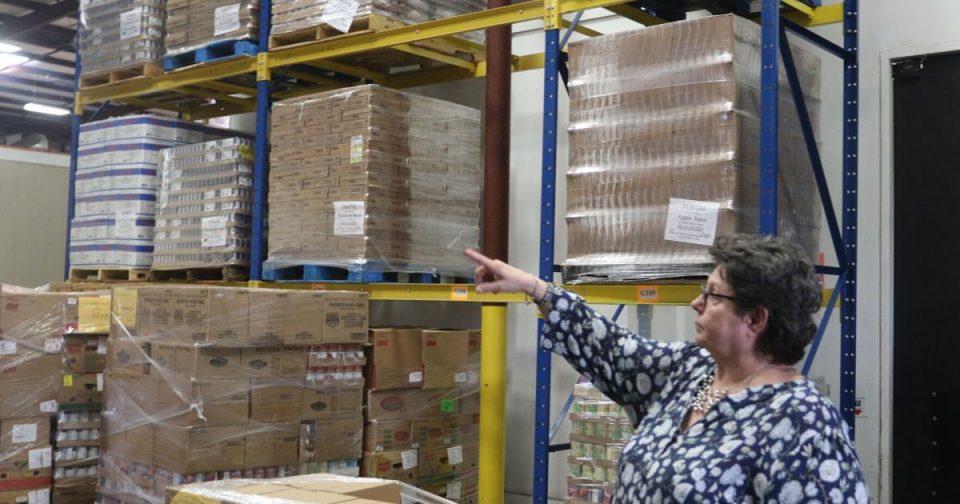
The shelves at the Food Bank of the Golden Crescent in Victoria are filled with pallets of food that stretch to the ceiling. The warehouse is operating at capacity, and has been for some time.
“When I first came here (in 2013), our shelves were not full,” said Robin Cadle, CEO of the food bank.
The amount of meals the food bank distributes nearly doubled when the COVID-19 pandemic hit, and the nonprofit has continued to feed the Crossroads while operating out of a building that can barely support it. While the food bank sees no end in sight for increased operations, the nonprofit continues to meet demand and has even found a new home that could ease its stresses.
The end of pandemic-era benefits combined with inflation has contributed to increased need for food banks, said Celia Cole, CEO of Feeding Texas, a network of food banks that the Food Bank of the Golden Crescent is part of.
At Victoria’s food bank, that need continues to be met, though the small size of their building makes it difficult to do so, Cadle said.
Luckily, she said, in the coming months they will move into a building that is double the size of their current one, which will make processing and distributing food a much smoother process.
Benefits ending and inflation increasing cause stress
It’s “alarming” that a higher need for food bank services continues while pandemic-related assistance ceases, Cole said.
“When a benefit like the Child Tax Credit expires, as it did in January, we see increased need,” Cole said. “People lose resources that they were relying on to buy food and put gas in the car and pay their rent.”
In late January and early February, 35% of adults living in a household with children reported having trouble covering usual costs after Child Tax Credit ended, according to census data.
Benefits expiring combined with the impact of inflation driving up food and gas prices makes it more difficult for families to plan budgets, Cole said.
“I always compare a family to a juggling act, where there’s always a number of balls that you need in there in order to make ends meet month to month,” she said. “What’s happening now is that the inflation is just making that juggling act that much more complicated.”
Victoria’s food bank is serving more first-time customers through food distributors or pantries than ever before, Cadle said.
“It’s eye opening,” she said. “It’s our own neighbors. It’s not that they’re homeless or begging for food. These are people who have jobs and can’t make ends meet. They may have to pay for a car payment. They may have to pay for a car repair rather than buy food.”
Changes to the Supplemental Nutrition Assistance Program could also drive up the need for food banks, Cole said. That program is used to provide families a monthly food benefit that can be used to purchase groceries and is the largest anti-hunger program in the country.
During the pandemic, USDA gave states the option to increase SNAP benefits to the maximum allowed so that, regardless of a person’s circumstances, they would receive the maximum benefits for a household of their size.
The last of the maximum allotments is expected to come in June and will result in families seeing a cut to their SNAP benefits, Cole said. This is especially alarming, as for every one meal that food banks provide, SNAP provides nine.
Cole is looking at the Great Recession in 2008 as a model for what is happening to food banks now, and doesn’t see an end to the demand happening anytime soon.
“It took years for people that we serve, people who are low income to begin with, to really rebuild their lives and get back on track,” she said.
Cadle echoed those sentiments.
“As much as we would like to end hunger, that’s not a reality,” she said. “We’re doing a better job at providing better foods, more nutritious foods, but we’re not ending hunger.”
Where does the food come from?
Most of the food at the Food Bank of the Golden Crescent is rescued, Cadle said.
Rescue food that is approaching a best by date — not an expiration date — or is not selling well and is donated to the food bank by a store.
“We pick up at all the stores in our area, and of course, there’s 11 counties,” Cadle said. “So if there’s an H-E-B or Walmart or Sam’s, we pick up and rescue that food.”
Additionally, H-E-B sends two 53-foot trailers full of rescued food to the food bank each month, she said.
The food bank has to process all of the rescued food to ensure it is edible, cans aren’t dented, bags aren’t punctured and more before organizing food items into categories, Cadle said. This is a time and labor intensive process that is made more difficult by a lack of space combined with increased amounts of food to process.
Rescued food from retail partners, along with food donated from the U.S. Department of Agriculture and the Texas Department of Agriculture, make up 65% of all funding at Victoria’s food bank.
The food bank hasn’t felt the effects of supply chain challenges, Cadle said. While it does take sometimes six months for the organization to get food it orders in, it’s not a huge challenge because the organization already has to place food orders a year in advance.
New location
In the coming months, the food bank will move from its 22,496-square-foot building to an approximately 44,000 square foot building.
“It’s a better situation, and we’re more accessible, I think,” Cadle said of the building, which she hopes to be fully moved into in May.
Though the new warehouse will only fit racks that can hold three levels of pallets instead of the four that current one can, the total area of the warehouse is much larger, she said.
Additionally, the flow of the building will lead to much more efficient operations, she said.
The building’s large loading dock leads directly into the processing center, which feeds straight into the warehouse and back to the loading dock. At the current facility, there are actually loading docks on each side of the building, so some trucks will pick up loads on one side while others will go to the other.
Another benefit of the new facility is a massive freezer and refrigeration area, Cadle said. She hopes to be able to provide more fresh produce now that there’s access to the refrigeration area.
While food banks typically focus mostly on shelf stable goods, the freezer and cool produce areas at the new facility will allow the food bank to take advantage of an abundance of produce available in Texas and Mexico, Cadle said.
