

For families on a tight budget, nutrition and health are often sacrificed due to affordability and accessibility.
Recently, the Choctaw Nation Food Distribution Program expanded its services into western Arkansas with the goal of providing healthier choices to more families in need.
However, participation numbers decreased during the pandemic.
Typically, the markets serve around 5,000 households across its service area, but right now it is down to just 2,000 to 2,500 households per month.
The Choctaw Nation of Oklahoma has food distribution markets in five locations: Durant, McAlester, Antlers, Poteau and Broken Bow. The service area includes Sebastian, Sevier, Polk, Little River and Scott counties in Arkansas.
The Food Distribution Program provides USDA foods for households that meet income requirements, do not receive SNAP benefits and have at least one household member who is a member of any federally recognized tribe. Each household receives about 80 pounds of food per household member per month.
The markets stand in the gap for families who live in food deserts and struggle to afford higher quality, healthier foods on limited incomes.
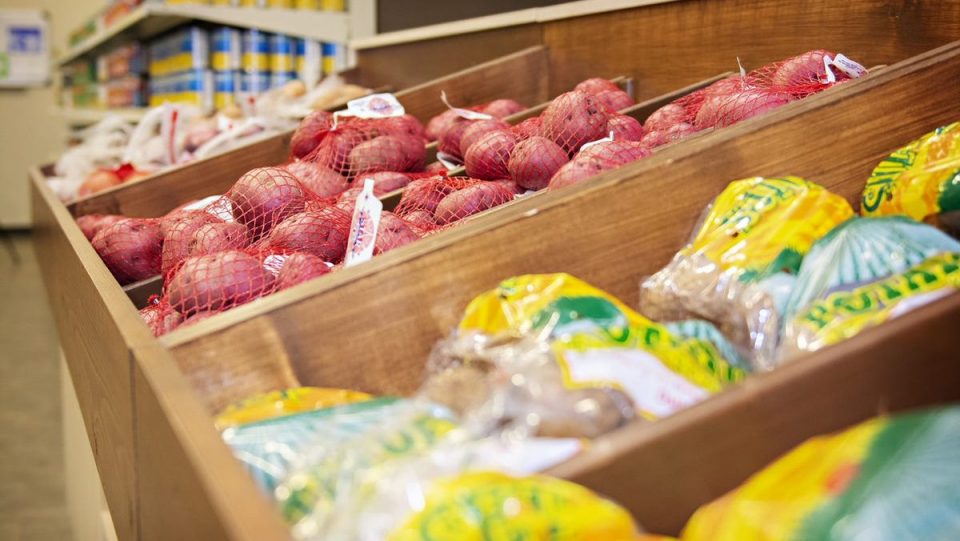
Unlike some food pantries that distribute pre-packaged boxes, the Choctaw Nation Food Distribution markets use a grocery store model where recipients select their own food items.
“You come in and shop for yourself,” said Jerry Tonubbee, director of Food Distribution Program for Choctaw Nation of Oklahoma. “Nobody pays. There’s no money involved. All of our food has to be produced in the United States, which helps our farmers as well as our clients.”
Throughout the store, clients will find a variety of healthy foods like fresh produce, frozen ground beef, bison and chicken.
“It has to be low in fat, nutritious-type food, low sugar or no sugar preferably because Native Americans historically have issues with heart disease and diabetes,” Tonubbee said.
According to the Indian Health Service, heart disease was the leading cause of death for American Indians and Alaska Natives from 2009 to 2011. The IHS report also stated that “American Indians and Alaska Natives born today have a life expectancy that is 5.5 years less than the U.S. all races population (73.0 years to 78.5 years, respectively).” Systemic barriers include “discrimination in the delivery of health services.”
Tonubbee said the food distribution program has a registered dietician on staff who hosts cooking demonstrations at the markets, holds monthly meetings with clients and can set up nutrition plans on request. For Sebastian County residents, the closest market is about 36 miles away in Poteau.
Cooking with healthier foods often means balancing meals with more perishable items. Having to make one trip for a month’s worth of food was a difficult task for families and could limit the types of food they selected, especially produce.
Tonubbee and his staff made a crucial change “because a lot of people don’t really have storage space for a month’s worth of groceries.”
Now, clients can come as often as they would like during the month to get their predetermined amount of food. The markets also offer curbside pickup.
“We actually have clients that come in, just like you would stop by the store and pick up fixings for dinner tonight … That’s all they’ll want for that particular trip,” Tonubbee said.
The Food Distribution Program on Indian Reservations (FDPIR) is jointly funded with 80% of funding received from the USDA and 20% from the tribal government. Tonubbee said the centers have not experienced any issues with inflation.
However, the decrease in participation during the pandemic has led to secondary issues as the markets work to prevent food waste.
“[The food] may still be good, but for our program, we cannot issue it if it’s beyond the ‘best if used by’ date,” Tonubbee said while explaining important partnerships with local food banks.
“We try to watch our ‘best if used by dates’ and make sure we get it out of our inventory and get it to somebody who can give it to a household that would benefit from it,” he said.
How to get help
Interested households can apply for the Choctaw Nation Food Distribution Program by calling 800-522-6170 or visiting www.choctawnation.com/food-distribution.
Applications are also available at each food distribution store, tribal headquarters, Choctaw Nation community center and can be submitted by mail.
Food distribution locations
Store hours are 8:30 a.m. to 3:30 p.m. on Monday, Tuesday, Wednesday and Friday and 9:30 a.m. to 5:30 p.m. on Thursday. The markets are closed the last two days of each month for inventory unless otherwise posted.
- Durant: 2352 Big Lots Pkwy. Durant, OK 74702, 580-642-8471
- McAlester: 3244 Afullota Hina McAlester, OK 74501, 580-642-7682
- Antlers: 400 S.W. “O” St. Antlers, OK 74523, 580-298-6443
- Poteau: 106 B Street Poteau, OK 74953, 580-642-6441
- Broken Bow: 109 Choctaw Rd. Broken Bow, OK 74728, 580-584-2842
