

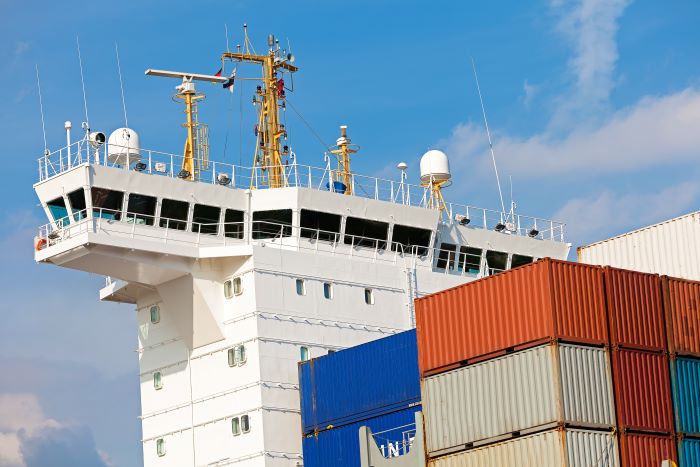
Due to high container rates and tight capacity, some logistics providers are deploying multipurpose ships in container trades. Photo credit: Shutterstock.com.
In a sign of shrinking capacity and sky-high freight rates on the container shipping side, South Korean container carrier HMM and the Danish forwarder DSV are temporarily using multipurpose and heavy-lift (MPP) ships to transport containers.
DSV, the Danish logistics and shipping company, is chartering in three multipurpose vessels for an ad-hoc container service between Denmark and China that will begin in late December.
Flemming Ole Nielsen, DSV executive vice president of investor relations, confirmed to JOC.com that three vessels of between 700 to 1,230 TEU will be chartered. “For now, this is only for one trip with each of the three vessels,” he said.
“This is an extraordinary initiative, driven by the extreme lack of capacity in the market,” Nielsen added. “And it is a good example of how our skilled freight forwarders can find solutions for our customers.”
One industry insider said DSV decided to charter MPPs after liner vessel rates “exploded” over the last four weeks.
On the container side, Asia-Europe shippers are seeing long-term rates 23 percent higher than those agreed to for 2020, maritime consultancy Sea-Intelligence Maritime Analysis warned in its latest Sunday Spotlight newsletter. Spot rates for China to North Europe were at $2,091 per TEU as of Friday, according to the Shanghai Containerized Freight Index (SCFI), a number not far off the record $2,164 per TEU reached in March 2010, and up 173 percent compared with the same week last year.
In a LinkedIn post on Tuesday, Lars Jensen, chief executive and partner of Denmark-based SeaIntelligence Consulting, said that DSV has also leased a small pool of containers and will be providing its customers with a direct service that will help them circumvent the scarcity of container vessel space and equipment now plaguing the market.
Jensen noted that the use of these relatively small MPPs on a trade lane where 18,000 TEU ultra large container ships are the norm “is a good indication that [container] freight rates have reached levels where unusual alternatives now become viable … This might also be an indication that we are approaching a test of the upper limits of the spot rates charged by the carriers.”
HMM deploys MPPs
As demand for container capacity skyrockets, South Korean container carrier HMM has also temporarily deployed several MPP ships in various container services, company spokesperson Hojoon Lee told JOC.com. Most of these are “not new MPPs we recently chartered, but vessels we have been operating for several years,” Lee said. “Their operation on the container trades is temporary and they will return to heavy lift and project services once their liner assignments are done.”
One industry executive told JOC.com that HMM shifted the MPPs into the container market in November for about six months to minimize losses amid the weak multipurpose and heavy-lift market and strong container shipping demand.
HMM’s online 117-vessel fleet list includes the MPP ships Hyundai Masan, Hyundai Antwerp, and Hyundai Ulsan. In addition, HMM recently chartered the 30,000 dwt MPP Thalia, built in 2003. The Thalia, formerly the Rickmers New Orleans and then the Zea New Orleans, has a combined lift capacity of 640 tons.
“Originally, Thalia was intended to be deployed on our project cargo services, but due to changes in our fleet operations including phase-in and phase-out vessel plans, we decided this vessel should be temporarily deployed for just one week to serve a container route,” a second HMM spokesperson, Joon Kim, told JOC.com. The Thalia was used on HMM’s KR2 service linking South Korea and eastern Russia, with the deployment finishing at the end of November, he said. The ship is now scheduled to carry project cargoes in Asia.
“It is true that carriers are having a hard time securing container ships in the charter market, but to date HMM has acquired sufficient ships for its operations,” Kim told JOC.com. HMM has not yet decided whether to charter more MPP ships, he said.
While container; roll-on, roll-off (ro-ro); bulk; and breakbulk carriers typically compete for many breakbulk cargoes including steel and some smaller wind and project cargoes, it is quite rare for MPP ships to be pressed into container service.
“Many MPPs are not very suitable for regular container trades even at high container rates, so it does not make commercial sense to use them on the container trades,” Yorck Niclas Prehm, head of research at Hamburg-based shipbroker Toepfer Transport, told JOC.com.
However, another European ship broker, who did not want to be identified due to client confidentiality, told JOC.com that one container carrier recently paid a premium to purchase three 8,000-dwt MPPs for use as box ships.
He said the vessels, at about 15 years old, “were on the sales blocks for more than half a year and only attracting buyers offering below-demolition prices when all of sudden a container operator picked them up at a speed I have seldom seen before.”
The broker said that container ship buyers “are now confronted with a new situation — that is the non-availability of distressed tonnage, which is already leading to increasing asset prices.”
This could be a good sign for the MPP sector, which suffers from chronic overcapacity. It has begun to recover from the pandemic downturn, but is still seeing weak demand and spongy freight rates.
Contact special correspondent Keith Wallis at [email protected].
