

LENOX — Bill and Elaine Markham built their current sugarhouse on New Lenox Road 40 years ago, but their roots in making maple sugar go back much further.
Elaine’s father ran his own sugaring operation when she was a child. Three years before their current facility at Mill Brook Sugarhouse was built, the Markhams made a batch of maple sugar “on that fire pit in front of those apple trees,” Bill says, pointing out a window.
Sugaring can be a finicky business. It often is dependent on the whims of the weather — warm days and cold nights create ideal sugaring conditions — which has been affected by climate change, and, more recently, there has been supply chain disruptions. The Markhams have seen it all.
“In this kind of business,” Elaine said, “there’s always a hiccup.”
Elaine is referring specifically to a pump that broke earlier that day, but her comment also could have been speaking to the supply chain shortages that began to affect the sugaring industry last year, during the COVID-19 pandemic, and that have carried over into 2022.
“They’ve been terrible,” said Carla Turner, who, with her husband, Paul, runs Turner Farms Maple Syrup in South Egremont, on the dairy farm of her husband’s family. The business is in its 38th year.
“Throughout this pandemic, there’s been supply chain issues,” she said. “I never thought of myself as a hoarder, but because of it, I think I’ve become one.”
Turner is referring to the difficulty local maple sugar producers have had in packaging their products this year, the result of shortages of glass and plastic containers.
Containers of maple syrup are displayed in the refrigerator at Mill Brook Sugarhouse in Lenox.
“We package in both plastic and glass,” Turner said. “A year ago in June, we couldn’t get certain glass; some, but not all of it. And then we couldn’t get plastic. I knew what we needed to get, so, I hoarded as much glass as I could possibly get.”
The skyrocketing increases in the price of oil, exacerbated by the war in Ukraine and the decision by the U.S. to ban oil imports from Russia, also might affect pricing, leading to increased packaging costs.
“You have to realize that all plastic is made from oil,” Turner said, adding that she expects her packaging costs to increase by 35 percent this year.
Turner did obtain additional plastic containers just before Christmas, but she said the issues around packaging maple syrup products are expected to linger.
“We just found out through the industry that we’re going to have possibly, possibly, two years or even a year-and-a-half before they can get new containers for us,” she said. “At this point, we can only get jugs with no labeling.”
This is a hardship for the Turners, who have 4,000 taps and try and make as much as 1,000 gallons of maple syrup each year.
“The [U.S. Department of Agriculture] says because of the amount of syrup that we sell, we have to have labeling, we have to have addresses,” Turner said. “So, the [unlabeled] jug isn’t going to work for us.”
Winton Pitcoff, coordinator of the Massachusetts Maple Producers Association in Worcester, said that obtaining jugs this year is “definitely a challenge” and that the nonprofit organization founded in 1947 has tried to alleviate this issue by purchasing containers in bulk for its approximately 250 members.
At the sugarhouse, Elaine Markham prepares tags for maple syrup containers.
“It has resolved a little bit,” he said. “It started as a plastics problem but has become more of a labor problem for our supplier, in that they can make the jugs but don’t have the personnel to do the art that they need to do, the screenprinting on the jugs. So, we have been supplementing with blank jugs and labels that you can put on. But, it’s definitely an ongoing issue.”
With or without jugs, sugaring is a significant business in Massachusetts. That is especially true in Western Massachusetts, where 80 percent of the state’s maple sugar producers are located west of Interstate 91, according to the Massachusetts Maple Producers Association. Sugaring in Massachusetts began before the Pilgrims landed in 1620 — Native Americans taught early settlers the process. The industry currently employs 1,000 farmworkers across the state and is worth more than $5 million to state farmers.
Buckets are used to collect the sap that Bill and Elaine Markham tap from their sugar maple trees.
The state has 320,000 maple syrup taps, according to Pitcoff, who estimates the annual production of maple sugar in Massachusetts to be about 70,000 gallons. Exact figures haven’t been available since 2019, Pitcoff said, because that was the year budget cuts and shortfalls caused the USDA’s Agricultural Statistics Service to limit the tracking of those numbers to the country’s seven top-producing states (Massachusetts is ranked ninth).
The Turners aren’t the only Berkshire County maple producers who tried to get an early start on sugaring season this year.
“Supply and demand is still a significant challenge across the board, whether you’re in maple sugaring or anything,” said Missy Leab, who runs the sugaring operation at Ioka Valley Farm in Hancock along with her husband, Donald. The Leabs, who started their operation with 13 taps in 1992, produce about 8,000 gallons of maple syrup annually “in good years.”
“We’re all trying to troubleshoot and prepare and have foresight on what we might need,” she said. “In looking ahead to what we might need, we started placing orders in the summer.
“We are very optimistic that this will be a good year, based on the first couple of boils that we’ve had,” she added.
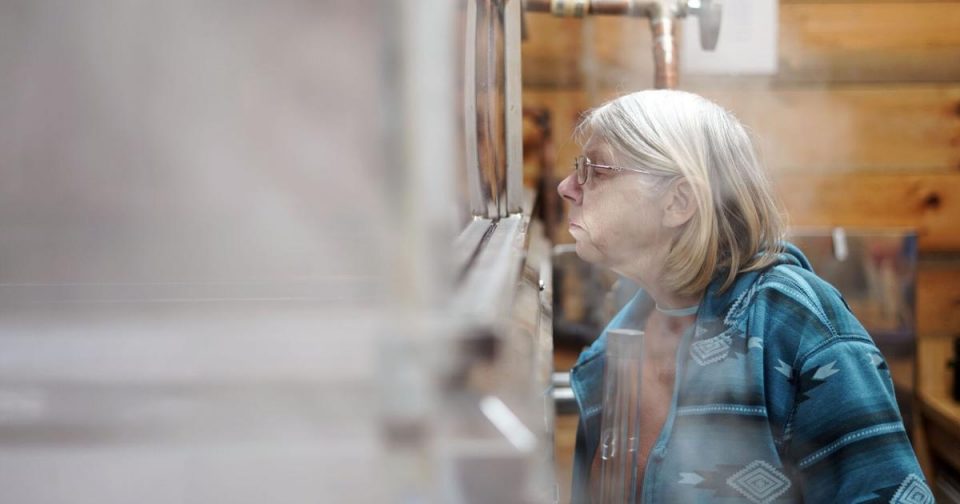
Boiling is the process that turns the sap that sugar producers procure from sugar maple trees into syrup. It is conducted in a large, vatlike machine called an evaporator, and it typically takes place in a sugarhouse. The Markhams were boiling sap in their sugarhouse Monday.
Bill Markham operates the state-of-the-art evaporator, which turns tree sap into maple syrup.
Mill Brook Sugarhouse, which operates 1,300 taps in three locations, had its best year ever last year, producing 442 gallons of maple syrup. The Markhams hope to produce 550 to 600 gallons this year.
“We were more ready this year than in the past,” Bill Markham said, speaking over the roar of the machine. “We had a little bit of an issue getting containers, but most of the other supplies, we were able to get.”
Sugaring season in Massachusetts usually begins in late February or early March, so, even with the supply chain disruptions, it’s too early to tell how this season will turn out.
“You really can’t predict the season,” Pitcoff said. “It’s the same as any crop. You’re at the whim of Mother Nature. So far, what we’re seeing is good, but we’re only a very, very small part of the way into it. The reality of it is, because of the changing climate, the weather is less predictable, and we’re depending on the weather.”
Ah, yes, the weather.
Last spring was warmer than normal in Quebec, which caused the Canadian province’s maple sugar production to drop about 42 million pounds from a record high of 175 million pounds in 2020, according to the Quebec Maple Syrup Producers Association.
This decline was significant because Quebec produces 72 percent of the world’s maple syrup, and it accounted for 133 million pounds of the 182 million pounds that were produced worldwide last year, according to Fortune Magazine. Global demand for maple sugar increased 37 percent from 2020 to 2021, according to the Quebec Maple Syrup Producers Association.
Pitcoff said that what occurred in Quebec last year can carry over into Massachusetts.
Tubes are used to collect the sap that it is obtained by tapping the sugar maple trees at the sugarhouse.
“Absolutely,” he said. “It’s more about consistency than anything else. If you look back even just three decades or so ago, sugar-makers knew you were going to tap at the beginning of March and make their syrup in March.
“What we were used to were slow, gradual thaws, but what we’re seeing now is shorter runs of syrup and much more spread out over time, so, some people are making syrup in January, and sometimes it goes well into April,” Pitcoff said. “I think one year we had someone making syrup in May. It’s not the same year after year.”
When asked how climate change could affect sugaring in Massachusetts in five or 10 years, Pitcoff said: “It’s a pretty gradual change. It’s not something that in even five or 10 years from now we’ll notice a change. It’s more of a generational creep.”
Climate change, and the realities of the global economy, have introduced a number of new invasive pests to Massachusetts that harm the environment because they have no natural predators here, Pitcoff said. As an example, he cited the Asian long-horned beetle, which arrived in Worcester on shipping pallets and caused 39,000 trees to be taken down in Massachusetts, a majority of them sugar maples.
“Things like that are going to continue to be issues for us,” he said. “As far as the actual range of trees, it’s not like we’re in the far southern edge of climate for sugar maple trees. There are sugar maple trees as far south as Kentucky and West Virginia, and they have a pretty sizable sugar-making industry in that region.”
Berkshire sugar-makers say that they will be able to adjust to any changes in climate, because that is what they always do.
“As farmers in general, we’re all watching the patterns of growing season,” Leab said. “It’s just one more piece of the puzzle. Farmers know how to adapt.”
