

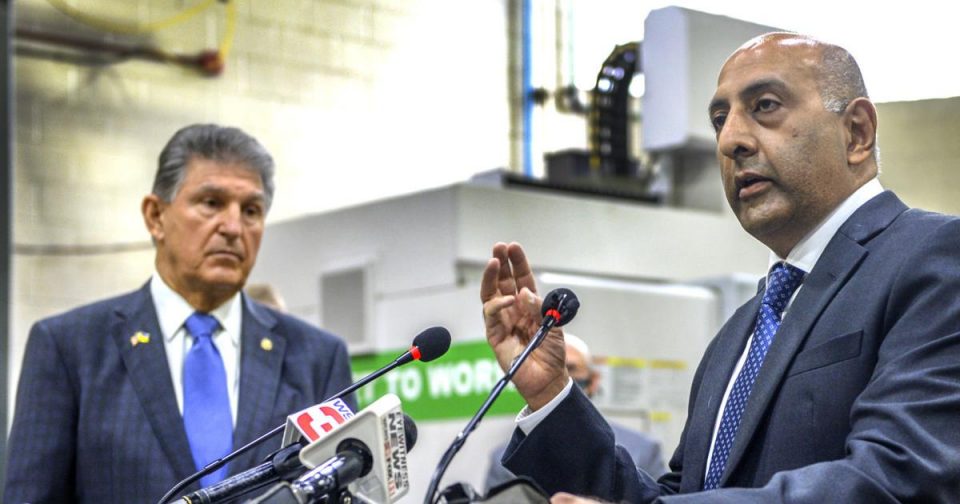
Sanjiv Malhotra says the batteries his startup makes can power more than just electric vehicles and energy storage systems.
The Biden administration says the same.
Malhotra said he expects his lithium-ion batteries to support a more independent U.S. economy. Department of Energy officials and West Virginia leaders said the power sources will support a path for the state through the energy transition instead of away from it.
Economically and environmentally sustainable futures for West Virginia and the rest of the country might depend on them being right.
“Clearly, time is of the essence,” Malhotra said.
Malhotra, CEO of the California-based battery supply startup Sparkz, announced during a March 18 press conference in South Charleston that his company would build a battery plant in an unspecified location in West Virginia that would employ at least 350 people.
Malhotra said his mission is to help build a battery supply chain independent of China-sourced materials as lithium-based batteries become increasingly vital to commercial markets.
“We should not be relying upon countries like China or others,” Department of Energy Secretary Jennifer Granholm said alongside Malhotra at the Robert C. Byrd Institute at Marshall University in South Charleston. “We should be building a full supply chain here.”
West Virginia offered enough workforce development potential, critical minerals for battery supply and available land to merit Sparkz turning here for its first site outside its California corporate office and Tennessee innovation center, Malhotra said.
Malhotra said in a phone interview Sparkz would announce a factory site in three to four weeks.
An initial workforce of 350 could increase tenfold if the plant can scale up production — a goal Malhotra said his company won’t reach if it can’t ensure high-precision battery manufacturing training for workers.
That’s where the United Mine Workers of America comes in.
Sparkz will recruit and train dislocated miners to work at the factory in partnership with the union.
UMWA International Secretary-Treasurer Brian Sanson said the partnership fits with energy transition principles the union released last year supporting the buildout of renewable supply chain manufacturing in coalfield areas with hiring preference for dislocated miners and families.
Malhotra said Sparkz also might partner with community and technical colleges to develop a labor pool.
“If we can cross this hurdle of getting the right talent pool, I think we are in a good position, we’re in good stead to start scaling up in West Virginia,” Malhotra said.
Malhotra said the potential to hire former Mylan Pharmaceuticals plant workers also drew him to West Virginia.
Viatris Inc., a global company formed from a 2020 merger of Mylan and Upjohn, laid off more than 1,200 workers in July and shuttered the Morgantown plant that produced pharmaceuticals for generations.
“That is what attracted me to West Virginia aside from it being a natural resource state, the fact that there are companies like Mylan who have moved out and there’s a lot of workforce, about a thousand or so folks who worked at the Mylan plant who can easily be accommodated on battery manufacturing production lines,” Malhotra said.
Sparkz is exploring opportunities for another location in West Virginia.
The timeline for Sparkz choosing West Virginia as its newest home has been short. Malhotra recalled that the road to the Mountain State began at a White House workgroup meeting in December focused on training mine workers to work with newer energy technologies like batteries and solar. That’s where Malhotra met a UMWA representative, leading to the partnership.
Battery supply chain concernsThe Biden administration has focused on equipping the U.S. to make its own clean energy infrastructure.
Granholm announced $5 million to support up to five training pilot programs in energy and automotive communities bringing together labor and industry partners to establish union jobs in the domestic battery supply chain.
Pilot program partners will include the UMWA, the AFL-CIO and the United Auto Workers, said Granholm, a former governor of Michigan. Pilot program sites are yet to be determined.
“I think you’ll be well-positioned, I’ll just say that,” Granholm said inside a shared manufacturing space at the Robert C. Byrd Institute.
The Department of Energy announced last month that it is collecting information through March from government agencies, industries, developers and potentially affected communities on the construction and operation of a rare-earth element facility to turn mine waste into valuable materials for clean energy technology.
The Infrastructure Investment and Jobs Act enacted in November provides $140 million for the rare-earth element and critical minerals extraction and separation refinery program.
The department has committed to investing $2.91 billion to bolster the production of advanced batteries vital to growing clean energy technologies, including electric vehicles and energy storage.
Last year, the Federal Consortium for Advanced Batteries led by the Energy, Defense, Commerce and State departments released a blueprint for lithium batteries in which it committed to setting up a secure battery materials and technology supply chain with U.S. partners by 2030.
That’s an ambitious target, given that China accounted for 76% of commissioned manufacturing capacity for lithium-ion batteries in 2020, according to the Energy Department.
The Biden administration has set goals of carbon pollution-free electricity by 2035 and net zero emissions by 2050.
That won’t be possible without significantly more robust U.S. lithium-ion battery manufacturing.
The federal batteries consortium set a goal last year of reducing dependence on scarce materials, particularly cobalt and nickel, to forge a stronger, more secure battery supply chain.
Forecasted U.S. lithium-ion battery production by 2028 is half the projected demand, the consortium said.
“These projections show there is a real threat that U.S. companies will not be able to benefit from domestic and global market growth, potentially impacting their long-term financial viability,” the consortium warned.
China boasts the largest global electric vehicle market and dominates the processing of minerals and raw materials for making lithium-ion batteries.
The consortium resolved to eliminate cobalt and nickel in lithium-ion batteries by supporting research and development.
Malhotra founded Sparkz in late 2019 after three years in the Department of Energy, where he was the first director of the Energy Investor Center, which works to advance private investment in energy technologies.
Malhotra said the U.S. neglected battery supply chain development for too long and battery companies that received federal funding early in the Obama administration focused too much on research and development, resulting in a dearth of workforce training and manufacturing.
Sparkz has taken a different approach, partnering with the Department of Energy’s Oak Ridge and Lawrence Berkeley national laboratories to save time and money before entering the market.
“Let the labs do the R and D [research and development],” Malhotra said. “We should focus on scale-up and manufacturing.”
Sparkz’s plan to set up shop in West Virginia comes amid other investments in an electrified energy future.
Michigan officials announced Tuesday that electric vehicle battery cell and pack maker LG Energy Solution would invest $1.7 billion and create 1,200 jobs to expand manufacturing in western Michigan. That announcement followed General Motors’ January announcement of plans to invest up to $2.5 billion in building a battery cell plant in the central part of the state.
LG Energy and Stellantis, the parent company of Chrysler, announced they will build a $4.1 billion electric vehicle battery factory in Ontario, a 10-minute drive from Detroit.
Malhotra has emphasized avoiding cobalt in Sparkz’s battery production since China has cornered the market on refining the metal mostly produced in the Democratic Republic of the Congo.
“Let’s focus on technologies that do not use cobalt and hit China in a very soft spot because, sure, yeah, you control cobalt — doesn’t matter,” Malhotra said. “We will [use] technologies that are cobalt-free.”
Searching for energy independenceEnergy independence has become a key term in the wake of Russia’s attack on Ukraine, which drew attention to U.S. imports of Russian energy that President Joe Biden banned in response to the attack.
Google searches for ‘energy independence’ in the U.S. have soared.
Resources for the Future fellow Daniel Raimi argued in a global energy system analysis published by the Washington-based environmental and energy research nonprofit group earlier this month that energy independence is the wrong goal.
Isolating the U.S. from global critical mineral supply chains would increase price volatility, Raimi argued.
“A clean energy future will not be an energy-independent future,” Raimi wrote. “Whether it’s nickel from Russia, cobalt from the Democratic Republic of Congo, ‘rare earths’ from China, or lithium from Chile, the metals and minerals that underpin batteries, wind turbines, and solar photovoltaic modules rely on global supply chains that are subject to the same market and geopolitical pressures of oil.”
Malhotra said he doesn’t want the U.S. to depend on a supply chain outside its control.
“That’s called being dead on arrival,” Malhotra said. “You cannot keep on repeating the same story over and over again.”
Malhotra praised the infrastructure act signed into law by Biden and championed by Sen. Joe Manchin, D-W.Va., who hailed Sparkz’s commitment to operate in West Virginia and partner with the UMWA. Malhotra also recommended reviving a tax credit Manchin has blocked — the Section 48C advanced energy property credit.
Under the Build Back Better Act that Manchin joined Senate Republicans in opposing in December, the federal government would allocate $5 billion in tax credits in 2022 and 2023 and $1.875 billion annually from 2024 through 2031, with $4 billion in total reserved for energy communities like those throughout West Virginia.
Manchin introduced separate legislation last year that would reinstate and build upon the tax credit, which provided a 30% investment tax credit to clean energy manufacturing facilities in 2009, 2010 and 2013. He touted the credit at the International Energy Agency’s ministerial meeting Wednesday in Paris.
Manchin cited concerns about inflation and the rising national debt as his reasons for opposing the Build Back Better as passed by the House.
National reports this week said Manchin has signaled he could support a smaller domestic spending package, which could include clean energy and electric vehicle tax credits.
Manchin spokeswoman Sam Runyon declined to confirm or deny the reporting.
Manchin admitted he has been skeptical of supply chains and electric vehicles because he doesn’t want the United States to be “held captive” by foreign supply chains.
But Manchin, a coal brokerage founder who has supported an “all-of-the-above” energy approach that includes coal and other fossil fuels, said the recent announcements point the way to a more diverse state economy amid the energy transition.
“It’s a new day,” Manchin said.
Energy for the futureSparkz’s battery supply factory could spur sorely needed economic development in West Virginia, where the population and tax base are dwindling.
The battery plant also could also be part of an energy shift that especially benefits West Virginia’s high concentration of rural, older residents.
Stationary energy storage, in which energy is stored and released as electricity when needed, could benefit remote communities and support vital services like health care, the batteries consortium said.
Sparkz is focused on batteries both for the transportation sector — including farming and mining equipment — and energy storage.
“There’s clearly a huge demand for electricity, for affordable power that can be provided with a combination of generating technologies like solar, wind, etc., along with storage or batteries,” Malhotra said. “That’s the idea, and that’s the next thing we want to start discussing.”
For now, Malhotra said, he aims to start ordering equipment for the site, which he estimates could take nine to 12 months due to supply chain challenges.
“So our idea is, during that time frame, get the workforce ready so that once the equipment arrives at the facility, we can start commissioning and start producing,” Malhotra said.
Malhotra said he has been thrilled by the reception that Sparkz has received from West Virginia leaders. His message to them is simple.
“[W]e just want to partner with you and grow this thing together,” Malhotra said. “And grow it fast.”
