


American auto demand is
The ramp up has some workers on edge, despite the extra money they stand to earn from the overtime and extra Saturday shifts Ford is adding at its Dearborn, Michigan, truck factory. The local union has already
“People will be working in close proximity for more hours per week,” said
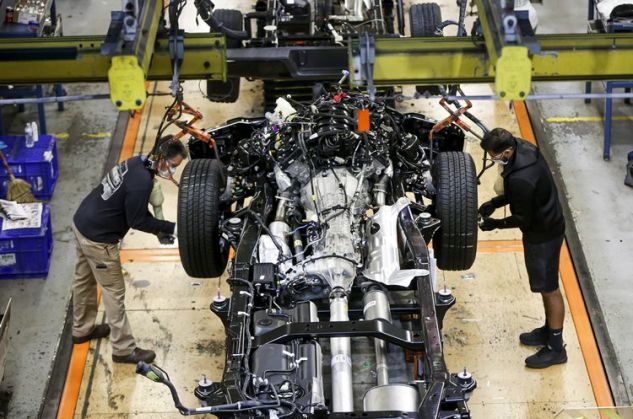
Workers at Ford’s Dearborn Truck Plant.
Photographer: Charlotte Smith/Ford Motor Co.
The situation in Dearborn is a microcosm of an industry entering the next phase of its reopening — where factories that
What workers fear is that the holes in the companies’ safety nets will be exposed as production volumes pick back up. By quickly restoring shifts at pickup and SUV plants, Ford and
“Demand for production is very enticing, but it has to be done in a way that you’re not doing it on the backs of the workers,” said
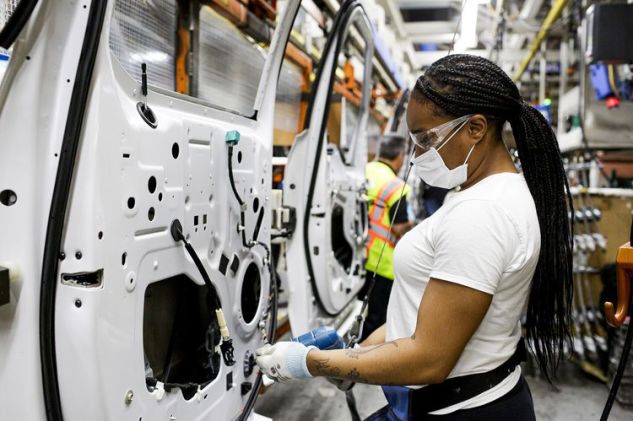
Workers at Ford’s Dearborn Truck Plant.
Photographer: Charlotte Smith/Ford Motor Co.
The UAW local in Dearborn is
“A widespread outbreak hasn’t happened yet, but these next couple of weeks are really the test,” said
According to Plan
Ford says everything is going to plan. It isn’t aware of any worker contracting the disease inside its plants, and no quarantined employee has ended up testing positive.
“The process is working and the demand is there, so we’re starting to ramp up,”
GM has had positive cases in its plants since it began producing personal-protective equipment in early April, Jeff Hess, the automaker’s chief medical officer, said in an interview. He said 49 people have quarantined as part of the carmaker’s contact-tracing program, and none of them developed Covid-19.
Still, as GM boosts production, the risk of infection remains.
“We have had employees that have the disease, which we feel is a community-acquired disease, not factory-acquired,” Hess said. “The more people we have coming into our facilities, the more likely we’re going to have individuals who’ve been exposed in the community who could potentially bring the disease into the plant.”
New Normal
The automakers are requiring employees to fill out daily health-screening documents, taking their temperatures with thermal scanners and mandating safeguards such as face shields for those who are in closer contact with colleagues.
In some cases, work spaces also have been redesigned for social distancing. Occasional pauses of production to clean after workers test positive also have become the new normal.
“Until we have a vaccine that’s out there 100% and more testing is available over the next few months, then I think we’ll still have cases,” Ford’s Johnson said.
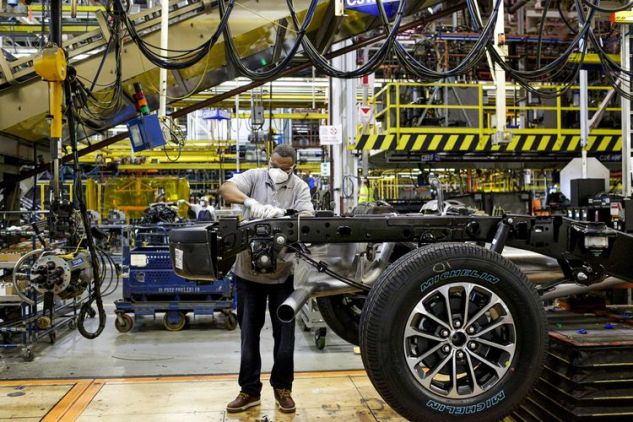
A worker at Ford’s Dearborn Truck Plant.
Photographer: Charlotte Smith/Ford Motor Co.
“If asymptomatic cases are as prominent as people say, you will get inadvertent exposure,” said Amesh Adalja, an infectious disease doctor who specializes in pandemic policy. “It’s very hard to guard against and it’s an open, ongoing issue.”
The makers of the thermal scanners that have become ubiquitous at factory entrances also acknowledge their equipment isn’t foolproof.
“Infrared cameras do not detect Covid, they do not detect diseases and, if I am being honest, they don’t definitively detect fever,” said Chris Bainter, director of global business at
Safety experts still praise automakers and the UAW for the steps they’ve taken, including their policies to keep paying workers who test positive or go into quarantine. Those benefits aren’t afforded to non-unionized workers in other sectors.
“The meat-processing plant workers are in very close proximity to each other,” said Sanchoy Das, professor of mechanical and industrial engineering at the
Labor-Relations Test
When automakers first attempted to reopen plants, UAW President
Last week, Ford
“If we get a mini outbreak at a plant or a spike in frequency of cases, you might see further pushback from the union,” said
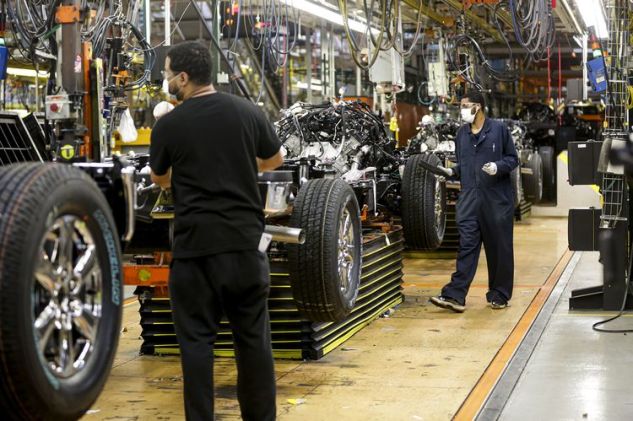
Workers at Ford’s Dearborn Truck Plant.
Photographer: Charlotte Smith/Ford Motor Co.
And the risk of infection will only increase as states lift stay-at-home orders. Infection rates inside plants are likely to track closely with the spread in surrounding areas.
“As long as there is incidence in that community, you have to assume every day that somebody is walking into this plant who may be carrying the virus,” Das said. “You cannot let your guard down.”
–With assistance from
To contact the reporters on this story:
To contact the editors responsible for this story:
Chester Dawson
© 2020 Bloomberg L.P. All rights reserved. Used with permission.
