


The story about El Pomar Foundation paying $15 million from an unknown source to Continental Materials to ward off a legal action over a quarry project southwest of Colorado Springs has raised the question of whether state records were destroyed in violation of the law.
We reported on the payment and what led up to it on July 17.
The Indy first tried to shake loose the records in question in October 2019 with no luck.
Whether the disappearance of records from the governor’s office will be challenged remains to be seen. But let us recount what could lead someone to believe that those records were destroyed, which would be a violation of the state’s records retention laws.
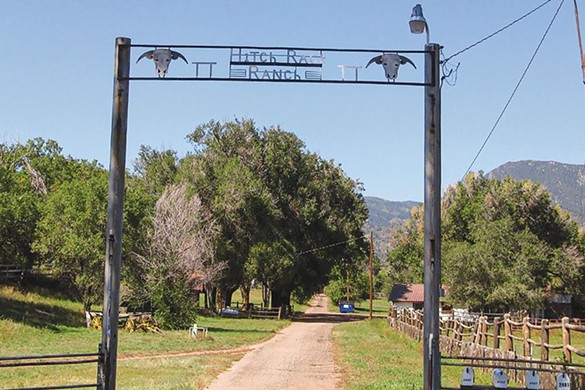
This case involves El Pomar’s payment on Dec. 28, 2018, to Transit Mix Concrete Co., a subsidiary at that time of Continental Materials, based in Chicago, to prevent litigation over El Pomar’s alleged interference in the state’s consideration of Transit Mix’s 2017 application to mine aggregate material from a site on Hitch Rack Ranch.
El Pomar opposed the mining operation, because it’s due to inherit a neighboring tract of land from the Ingersoll Trust, which dictates the land be left in its natural state and never developed.
El Pomar’s then-chief operating officer Kyle Hybl engineered a meeting with then-Governor John Hickenlooper’s staff members on March 9, 2018, regarding El Pomar’s opposition. Such meetings outside the presence or without the knowledge of the applicant are considered ex parte communications, which are barred by state law. One expert the Indy cited in its July 17 online story about the payment said ex parte communications carry an air of corruption, which is why they’re not allowed.
Those involved in the meeting either declined to comment to the Indy or said there were no issues that violated state law prohibiting ex parte communications.

But Transit Mix apparently had acquired some powerful ammo if it led the 83-year-old foundation to pony up $15 million to keep the situation under wraps. (El Pomar refuses to disclose the source of the money, which could have come from the foundation itself or some type of insurance coverage.)
After the Mined Land Reclamation Board voted 3-2 in late April 2018 to deny the mining permit, Transit Mix’s law firm, Hogan Lovells, submitted a Colorado Open Records Act request to the governor’s office seeking all communications between state officials and El Pomar representatives.
The law firm received some records, but in an Aug. 10, 2018, letter to the Attorney General’s Office, it noted the response included “several redacted documents … covered by various privileges.”
Meantime, a similar CORA request to the Department of Natural Resources (DNR) yielded a July 23, 2018, response from DNR that noted “certain pages in the CORA response were redacted as attorney-client privileged communications and ‘work product’,” according to the Aug. 10 letter.
The purpose of that letter was to notify the state that Transit Mix planned to seek a hearing in District Court where the records custodian would have to “show cause” to a judge for why the records hadn’t been released. Here’s that letter:
Then, on Aug. 17, 2018, Assistant Attorney General Jeff Fugate wrote to Hogan Lovells saying the state had changed its mind about the redacted DNR documents and was providing them without redactions.
Here’s that letter:
Those emails initially redacted but later unredacted showed that the governor’s legal counsel, Jacki Melmed, asked DNR chief Bob Randall to review Kyle Hybl’s letter, submitted as a follow up to the March 9 meeting, outlining the case against the quarry.
Randall then wrote back to Melmed saying he thought the state’s review had been thorough and the staff’s recommendation to approve the mining permit based on adequate review. (Randall then voted on April 26, 2018, to deny the permit.)
Here’s that email exchange:
In his Aug. 17 letter, Fugate wrote, “I am now aware that the Governor’s office, by letter dated Aug. 15, 2018, has provided you with additional responsive documents, including certain documents that were previously redacted and withheld as work-product….” (Emphasis added.)
Fugate goes on to say, “With the production of these emails [meaning the Randall-Melmed exchange], we have now provided all public records in the possession and custody of the DNR responsive to your original CORA request.”
Fugate indicates there were “additional” documents, but does that mean he’s suggesting there were records beyond the Randall-Melmed exchange or not?
The Indy believes, based on sources that declined to be named, that the answer is “no.”
On Oct. 28, 2019, First Amendment attorney Steve Zansberg of Denver wrote a letter to the Office of the Governor’s Office of Legal Counsel noting the Indy had sought those records in question on Oct. 8 and Oct. 10, 2019, but had been told that both the governor’s office and the state archivist had determine there are no public records responsive to those requests.
From Zansberg’s letter:
Schedule 1-4a and Schedule 15(8) of the State Agency Records Management Manual promulgated by the State Archivist declares that all records concerning CORA requests are to be retained by State offices in Colorado for a period of two years after the response to the CORA request has been sent. Schedule 1-5a and 1-5b further state that all correspondence – other than “transitory” (meaning having no substantive significance) – must be retained for a minimum of two years and, correspondence of more weighty, important content must be retained permanently.
On Nov. 4, 2019, Zansberg conferred with a governor’s office attorney, the substance of which cannot be disclosed due to those parties having agreed the conversation would remain confidential.
After the Indy renewed its request for these suspected missing documents, it received an email on Dec. 3, 2019, from Conor Cahill with Gov. Jared Polis’ office, who said:
Thanks for your patience as I gathered this information. Since the questions that you have are in relation to documents and decisions made under the previous administration, this is what I have been able to gather.
It’s my understanding that DNR provided you with substantially the same documents that the Hickenlooper administration produced under the prior CORA request regarding this matter. It is also my understanding that the Hickenlooper administration worked with archives and provided all documents that archives requested to be saved at the end of that administration. Our understanding is that the archive office is the custodian of the Hickenlooper administration’s documents…. You can work with archives to process the request.
The State Archivist had already told the Indy that no responsive records existed.
Yet, the Gazette reported on July 19 that an unnamed source says some records were destroyed.
If it’s proven that records were destroyed, someone might be in big trouble. That’s because the State Agency Records Management Manual used by the State Archivist “declares that all records concerning CORA requests are to be retained by State offices in Colorado for a period of two years after the response to the CORA request has been sent,” Zansberg said in the letter to the state on Oct. 28, 2019 on the Indy‘s behalf.
And it’s worth noting the Indy‘s request fell squarely within the two-year time period.
The records manual further states that “all correspondence — other than ‘transitory’ (meaning having no substantive significance) — must be retained for a minimum of two years and, correspondence of more weighty, important content must be retained permanently.”
