

MULLINS — In the heart of the Pee Dee, a small factory has tall marching orders: feed thousands of men and women in uniform when they need it most.
SOPACKO, a food processing and manufacturing company, has been keeping guardsmen, soldiers, sailors, Marines and airmen fed on the front lines since 1943. They make MREs, or Meals, Ready-To-Eat, and have been for more than 75 years. The South Carolina company is the largest suppliersof the rations in the United States.
When a service member is in the field, with no mess hall in sight, it is often their only food option. The unrefrigerated, vacuum-sealed pouches are like a small care package. There’s a hearty meal such as chili-mac, shredded beef or spaghetti and meatballs. There is a side dish, dessert, candy and even a pre-stamped postcard that service members can use to write home.

MRE packages at the Sopakco Processing plant on Thursday, March 12, 2020 in Mullins. Andrew J. Whitaker/ Staff
More importantly, it doesn’t require a kitchen to cook. It can be eaten right out of the package or heated up using a plastic sleeve and a chemical packet that heats up water, sort of like a package of microwave rice.
It is as close to a home cooked-meal, a small piece of comfort, when a service member is deployed in a foreign country. SOPACKO CEO Lonnie Thompson, himself a former tank commander in the Army, has fond memories of them.
Lonnie Thompson the president Sopakco Inc. lays out an MRE chili and macaroni at their packaging plant in Mullins on Thursday, March 12, 2020. Andrew Whitaker/Staff
“I’ve had them, and these standalone are really good,” Thompson said. “We get feedback from service members overseas, and we figure out what they like.”
The business has been a godsend for Mullins, once a tobacco boom town.
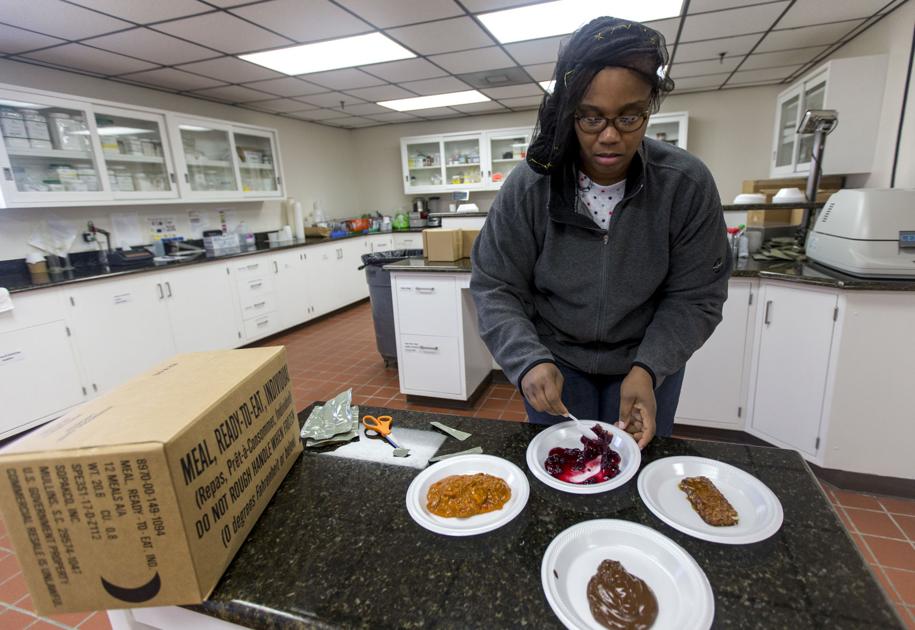
Four separate MRE meals including the chocolate protein pudding, maple sausage, Italian sausage with peppers and blueberry and cherry cobbler are seen at the Sopakco Processing plant on Thursday, March 12, 2020 in Mullins. Andrew J. Whitaker/ Staff
But as of this year the company has roughly 850 employees across its South Carolina locations, it hires nearly one-fourth of the town’s population. And the facility is growing. Last year, SOPACKO announced a $12.5 million investment, its third expansion since 2015.
“SOPAKCO has been a job creator in Marion County for several decades,” County Council Chairman Buddy Collins said. “It is a great thing that they will expand and remain in our county.”
Feeding a literal army
World War II set the gold standard for the wartime economy, and thousands of businesses chipped in to help create goods for the military.
In 1943, SOPACKO, which was partially based in Tennessee, packaging began supplying canned rations for the war effort. The rations were rudimentary, dubbed C-Rations.
The first version of them contained three options: meat and beans, meat and potato hash, or meat and vegetable stew. They later began to contain a side package of sugar tablets, water tablets, chewing gum and, what many soldiers looked forward to, a nine pack of commercial-grade cigarettes.
But the chief complaints of the meals were that they were bland, cumbersome and lacked variety.
Under the guidance of Defense Secretary Robert McNamara, the Pentagon began researching and developing the MRE concept in 1963. SOPACKO was asked if they wanted to be a part of it.
“The Department of Defense contacted us and asked if we wanted to be a part of the MRE program,” Thompson said. “But we needed to own a processing and packaging facility. We didn’t have one, so we bought one.”
By 1965, the company opened up a headquarters in Mullins and then later in Bennetsville. Since then, they’ve been churning out a variety of the meals. Thompson said it makes up about 60 to 70 percent of their business, the rest comes from a variety of commercial food products they make.
They hit their peak during Operation Dessert Storm and Shield, when it seemed like they couldn’t produce enough rations.
Jalawanda Taylor cuts up the maple sausage into pieces at the Sopakco Processing plant on Thursday, March 12, 2020 in Mullins. Andrew J. Whitaker/ Staff
“I ran 24 hours a day, seven days a week, for an entire year,” Thompson said. “I had Christmas Day off that year, that was it. There was a lot of demand.”
Calorie binge
At their research and development facility, in a small test kitchen, they are sampling and preparing a variety of meals.
Tim Rich the VP of Production talks with Jalawanda Taylor prepare several MREs to sample at the Sopakco Processing plant on Thursday, March 12, 2020 in Mullins. Andrew J. Whitaker/ Staff
Tim Rich, vice president of operations, said there’s a lot of variety in meals. There’s maple breakfast sausage, cherry blueberry cobbler and even chocolate protein pudding. His favorite is the Italian sausage and peppers.
“We’re more geared towards what the consumer wants when it comes to the quality of the entree,” Rich said. “There’s a lot of variety.”
The food is dense, salty and thick. Clocking in at 1,200 to 1,600 calories a meal, they’re meant to be for war fighters, people hauling packs and equipment for miles on end. But they pack flat, they weigh practically nothing and are good for 10 years, Thompson said.
“If you’re on a diet, don’t look at an MRE,” Thompson said. “It’s a rarity that a soldier will eat a whole one.”
SOPACKO’s small test kitchen has even changed and influenced the way the Pentagon has shaped their meals.
Three MRE cases including the Halal Meals, Emergency Rations Meals and the commercial MREs are seen at the Sopakco Processing plant on Thursday, March 12, 2020 in Mullins. Andrew J. Whitaker/ Staff
“They wanted to broadened the scope,” Thompson said. “We’ve helped the Department of Defense come up with new ideas.”
They manufacture a vegetarian option and a Halal option for those who have religious dietary restrictions in the Middle East. SOPACKO was even honored by the Defense Logistics Agency’s with a coveted gold award for innovation.
And even as the new coronavirus spreads throughout South Carolina, harming lungs and the local economy as it makes its way from county to county, SOPACKO still continues to make rations.
Thompson said because of Department of Defense directives, they must continue to produce the MREs. There are no cases in Marion County as of Tuesday.
And, additionally, Thompson said the company is seeing a bump in sales for customers who prep for the worse and want to have emergency food options on hand. They make a whole line called Sure-Pak that’s available at stores and online from their website.
“It’s very close to what the soldiers would eat,” Thompson said. “With the virus, those sales have ratcheted up a bit.”
SOPACKO has also been a major supplier to the Federal Emergency Management Agency for the past decade. Thompson said he has about 2 million meals in his inventory just for a catastrophic event. They provided millions of meals during Hurricane Katrina and Hurricane Sandy.
Rising from tobacco ashes
But, as they’ve fed service members overseas and those in need, they’ve also filled the town in their backyard with new hope.
At one time, Mullins was one of the largest tobacco-producing towns in the United States. But as the smoking industry shrunk, SOPACKO rose from the ashes and brought a growing supply of jobs and economic wealth to the area.
Drew Foil, a longtime resident and manager of Barringer’s Jewelry on Main Street in Mullins has seen the tobacco industry crumble away firsthand.
“We’ve lost a lot,” “But SOPACKO has been steady for us. It’s filled a big void for us.”
This is due, in part, to millions of dollars of government contracts being flooded to the food processing company. A recent Post and Courier analysis of Pentagon spending in the Palmetto State showed that SOPACKO was one the top 10 Department of Defense contractors in South Carolina, netting $375 million in the past five years alone.
“The value that Marion County brings through its business-friendly climate and quality workforce has allowed us to thrive here and we look forward to continuing our partnership,” Thompson said.
