

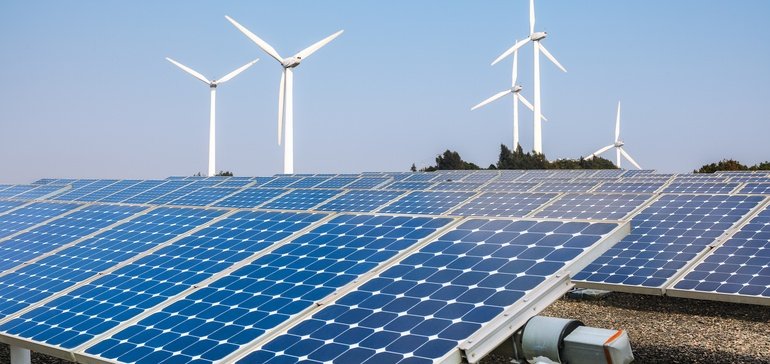
Like 2020, 2021 has been a record-breaking year for deployment in the renewable energy sector, and experts say the next year will follow that trend. With the low cost of solar and onshore wind, analysts and advocates alike see 2022 as a record-year in the making, although supply chain difficulties persist.
The Energy Information Administration (EIA) has announced planned deployments for 21.5 GW of solar and 7.6 GW of wind in the U.S. in 2022, based on surveys of developers through October 2021. For utility-scale solar, that would surpass the estimated 15.5 GW of solar additions in 2021.
Developers will continue to announce deployments for the year, and the wind projects announced last fall have more to climb before surpassing the record-high 17.1 GW of capacity that came online last year, according to EIA’s survey. S&P Global Platts Analytics has projected 11 GW of new wind to come online in the U.S. as the wind tax credit ends this year, as part of over 30 GW of solar, wind and storage deployment.
“Last year we installed more wind, solar and battery storage than any year in history… But what’s clear is, as important as 2021 was, 2022 will be the year that determines whether we accelerate progress or whether we plateau” on renewable energy deployments, Heather Zichal, CEO and president of American Clean Power, said at the U.S. Energy Association’s Annual State of Energy Industry Forum on Thursday.
One aspect that continues to raise the price of developing clean energy is supply chain impacts, but experts expect those impacts will lessen as more manufacturing capacity is developed internationally. From 2021 through about 2023, IHS Markit analysts expect to see “a very discrete bump” in costs for wind and solar due to the supply chain bottlenecks.
“Over the next 10 years, we would expect those [supply chain] constraints to abate and for new wind and solar to be the bulk of new capacity additions in the power system,” Patrick Luckow, associate director of the power and renewables group of IHS Markit, said.
Another dark spot for U.S. renewables is the uncertainty of federal legislation that clean energy advocates view as essential to decarbonization: the Build Back Better bill that has failed to advance in the Senate. Stakeholders are watching closely for opportunities to pass that package and other options to extend the wind tax credit or the solar tax credit that is set to begin phasing down. President Joe Biden has voiced his support for a piecemeal approach to pass the bill’s clean energy provisions.
While hydropower did not receive specific incentives in the budget reconciliation bill, plant operators are seeking to update the permitting process for plant renewal, as nearly 300 hydroelectric and pumped hydro facilities totaling about 16 GW have licenses that expire this decade, a coalition of stakeholders told a Senate committee in January.
“We’re also in a moment where we have uncertainty on critical tax policy, and unfortunately, it’s a reality that the renewables sector has had to deal with from the beginning,” Greg Wetstone, president and CEO of the American Council on Renewable Energy (ACORE), said.
Solar to soar ahead despite political unknowns
Utility-scale solar “has just been taking off as the costs come down,” and there’s an increasing “pressure to allow commercial and industrial customers to procure [more] clean energy,” Mike O’Boyle, director of electricity policy for Energy Innovation, said.
“The low cost of these technologies is a big driver in addition to being able to say they’re clean,” Luckow said.
Separately, solar and wind developers are seeking better transmission planning, shorter processing of interconnection requests and a number of other incentives from federal legislators and regulators.
Mercom Capital Group, which does not forecast but tracks transactions in the energy sector as they happen, saw 2021 as a “banner year” for solar, energy storage hybrids, and renewables development in general, Mercom CEO Raj Prabhu said.
Demand for solar assets last year also came from pension funds and infrastructure funds, who want very low risk investments, said Prabhu. “When these investors, mature investors, come into a sector, we have crossed a threshold.”
The clean energy provisions in the Build Back Better bill remain “obviously, the priority,” Wetstone said. Another critical priority for ACORE is to help incentivize investment in critical enabling technology like energy storage and high-voltage transmission, he said.
Despite the high focus on the Build Back Better bill’s impacts on solar and wind, “historically, states have really driven renewable energy policies,” Autumn Proudlove, NC Clean Energy Technology Center senior policy program director, said. But “the federal government is in a position to accelerate what’s happening in the states,” she added. While policy and regulatory uncertainty can remain, the sector will look to the federal level for funding, particularly after last year’s passage of the infrastructure bill, Proudlove said.
Proactive transmission planning would also reduce barriers for competitive renewable projects to enter the market, experts say, and the Federal Energy Regulatory Commission is evaluating this issue in its transmission planning docket.
“The big problem that FERC is trying to address with this [transmisssion] proceeding is the inability [of] renewables that are economic, that would be profitable…. to enter the market in a timely fashion,” O’Boyle said, pointing to a Lawrence Berkeley National Laboratory study that says interconnection times have nearly doubled in the last decade.
Offshore wind moving forward on all coasts
Offshore wind in the U.S. is set to have a big year, according to the road map of leasing activities shared by Interior Secretary Deb Haaland in October.
In February, the Bureau of Ocean Energy Management will hold the largest offshore wind auction in the U.S. to date, covering six areas in the New York Bight. The agency will continue to identify leasing areas in the Gulf of Mexico and off of Northern California. States also are setting deployment targets, with New York recently announcing an additional solicitation for up to 2 GW of offshore wind.
“Moving away from the East Coast to two more coasts, we’ve already started seeing supply chain penetration into the rest of the United States. That’s just going to continue,” Sam Salustro, director of coalitions and strategic partnerships in Maryland for the Business Network for Offshore Wind, said.
As demand continues to grow for the resource, one of the key regional policies guiding deployment is state targets, especially as they ramp up high-level decarbonization goals, Proudlove said.
New York announced its third solicitation at the beginning of this year, separate from the Interior’s leasing auction. And looking ahead to the Biden administration’s goals to lease offshore wind on multiple coasts, the Western Governors Association put offshore wind into their 2022 portfolio of energy priorities, which is “extremely significant… for an area that has long looked toward carbon mining,” Salustro said.
2022 is also poised to mark the beginning of offshore turbine installations on the first U.S. large-scale project that has received federal approval for its construction and operations plan: Vineyard Wind.
“The first actual installation of that one monopile [for Vineyard] is going to be that source of comfort and spark for the rest of the supply chain [certainty] that they’re going to truly understand how real this is,” Salustro said. Other deadlines from federal and state governments will continue to spark investments, sector activity, contracts and shipbuilding orders needed to get a lot of work done, advocates said.
While offshore wind is a huge market, “they really haven’t gotten going in earnest yet,” Luckow said. “To some extent, that’s good because the supply chain issues are less of an issue for offshore wind.”
As greater concentration of offshore wind emerges, better planning for transmission connection points will also be needed. “We need to solve transmission issues, especially with the leasing in the New York Bight bringing seven more gigawatts on to sort of a small area,” Salustro said.
Conversations about public and private investment in an offshore grid network could also lead to more regional cooperation on transmission, especially around the East Coast, Salustro said.
Supply chain impacts
Global ripples in the supply chain are impacting all industries and project developments, experts say, though some say solar in the U.S. is particularly vulnerable to delays and rising prices due to the need to import solar panel components.
“We almost have no capacity for [solar] module …manufacturing” in the U.S., Prabhu said. Aside from a “negligible amount, we are completely dependent on Asia for all the imports, so it’s a pretty sensitive market to all the duties and tariffs.”
The Trump administration had set Section 201 tariffs on solar modules that are set to expire in February, and a bipartisan group of senators asked the Biden administration on Thursday not to extend the tariffs, which have driven up costs for solar developers according to the Solar Energy Industries Association.
“With the shipping crisis, it’s become a huge deal because everything that comes in here for solar has to get shipped from the other side of the world,” he added.
This also applies to onshore wind for the materials used in the turbines, IHS’ Luckow said. He estimates supply chain constraints will play an important role “for the next year or two, but after that time, the improved performance of wind, as well as solar, will bring down … the levelized cost of electricity from those resources.”
Over 7 GW of wind capacity and 6.8 GW of solar were scheduled to come online in November and December, according to EIA. Any supply chain delay or development hurdle could push some of those projects into 2022 and increase the EIA’s expected renewable energy capacity deployments, Suparna Ray, project lead of EIA’s Annual Electric Generator Report, said in an email.
“When we look deeper at the supply chain, it looks like somewhere towards the end of 2022 we’re going to see it easing a little bit and then prices [will start] to come down” as China’s efforts to increase manufacturing will come into effect, Prabhu said. With pricing from supply chains easing, more sector growth is expected, experts say.
Another national change that will be impacting construction projects is the announcement in January that the Federal Reserve will be raising the interest rate this year, possibly multiple times, to counter inflation. This change affects all ongoing projects, Prabhu said.
Energy storage momentum grows
2021 was a “breakthrough year” for renewables as well as for energy storage, Mercom’s Prabhu said. Other analysts agree that storage has been deployed in record numbers, particularly through the use of the solar investment tax credit that applies to hybrid solar-plus-storage projects.
“A lot of [hybrid projects are] driven by the tax credit structure,” Luckow said. “I think that will continue to be a big driver. It sort of depends on what happens with federal legislation,” he added, noting interest in battery incentives and a market need for more firm capacity from hybrid solar + storage installations.
“You are really seeing a meaningful amount of investment starting to happen in 2021,” Prabhu said in January, ahead of the publication of Mercom’s 2021 year-end renewables report. Mercom logged $8-$9 billion of investments for U.S. storage, breaking records of previous years. “We’ve never even had anything more than $2 billion since 2014,” when Mercom began tracking energy storage investments.
According to the EIA, utility-scale battery capacity in the U.S. is expected to grow 84% in 2022, by 5.1 GW.
“If you look at the interconnection queue [for this year], half the projects are hybrids,” O’Boyle said, particularly solar projects adding storage. “With record-breaking solar will come record-breaking utility-scale storage, and I think that trend is going to be one way that 2022 distinguishes itself from 2021.”
“More and more, the [requests for proposals] we see are seeking projects, or allowing projects, that are paired with storage,” Proudlove said. “A lot of utilities are looking at adding storage to existing generation,” as part of a larger trend of pairing things with storage.
Opportunities for developments in wind and solar
Research in further efficiencies in wind and solar designs will continue, experts say.
“The performance of onshore wind plants continues to improve, people are finding ways to get better capacity factors and continue to push costs down, so I think we see a temporary increase in costs when those tax credits go away but that doesn’t put that much of a damper on demand,” Luckow said.
“There’s just so much appetite for these resources.”
For wind, the industry is expected to continue studying efficiencies achieved through the use of forecasting tools and sensors, to understand shifts in wind speed based on seasonal variations and changes from day to night.
One such research effort, published last summer in the Journal of Renewable and Sustainable Energy, assesses a different wind speed probability distribution to account for wind speed both during diurnal changes and seasonal patterns, to better forecast wind resource output.
With solar, large arrays are beginning to age enough that discussions about replacement and recycling of solar panels are going to take a “bigger and bigger focus,” Proudlove said.
The solar industry is “definitely looking at recycling rules and plans for solar decommissioning policies,” she said, adding that some storage advocacy groups are also being forward-looking and helping lead these conversations for battery disposals.
Other clean energy technology, like hydrogen and advanced vehicle technologies as well as storage technologies will also receive more research and development funding from the federal level as part of a solution to integrating wind and solar into the grid at higher levels, Proudlove said. “Things like storage and transmission upgrades to the distribution grid… are things that clean energy advocates need to be looking at,” as more wind and solar are added online.
