

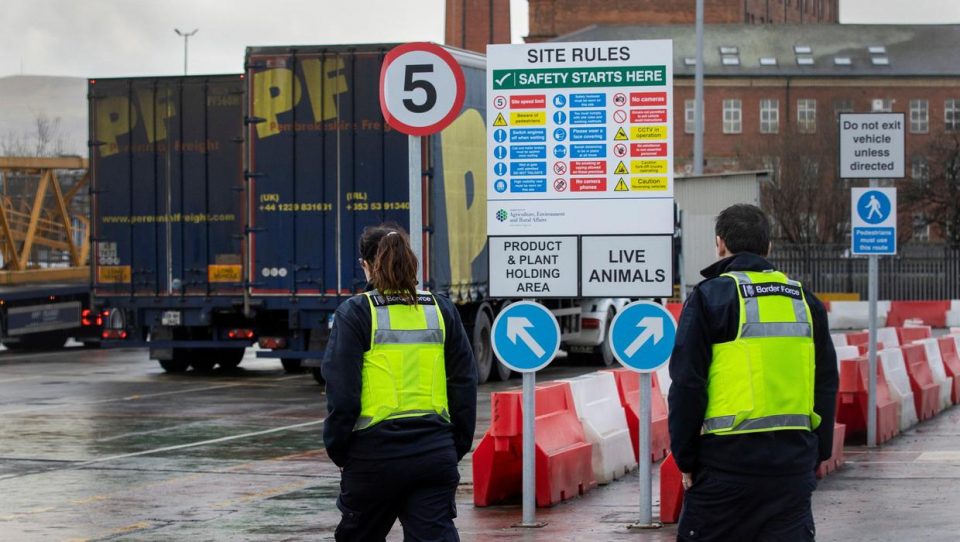
A month ago, a Northern Irish lorry carrying New Zealand and Australian lamb was stopped at the Irish Sea border in Belfast Harbour after coming off the ferry from Cairnryan.
hat followed is highly significant because it suggests civil servants may be acting at the behest of the European Union, or at least from someone other than their minister. Whoever took this decision, the consequence has been an unannounced hardening of the Irish Sea border.
The lorry was owned by McCulla Ireland, a major haulier based in Lisburn and Dublin. It was carrying a familiar cargo which a Northern Irish manufacturer was to make into readymeals for a British supermarket, part of the free flow of goods back and forth across borders which has been increasing for decades due to globalisation.
After a day of phone calls, confusion, debate, and frustration, the driver was issued with a formal TARP notice — a legal instruction under the Trade in Animals and Related Products Regulations — which meant the load had to be returned to Britain or destroyed. The frozen load sat in Belfast for five days before heading back and being processed by a British company, leaving the Northern Irish manufacturer at a disadvantage. Some time later, another load containing cases of Thai chicken for a Belfast restaurant was stopped and the items removed. They are understood to be awaiting destruction at Belfast Harbour.
News of what was happening spread within the haulage and food industries, where it was met with bafflement and anger because companies had been told that all of this was perfectly legal.
The story of why this happened is intriguing because no one will admit they instructed this hardening of the border, and because it seems arbitrary changes to rules so complex that few people understand them could happen again without a democratically accountable minister approving them.
The load was denied entry to Northern Ireland by officials from the Department of Agriculture, Environment and Rural Affairs (Daera). McCulla’s managing director, Peter Summerton, recounted some details of the incident this week to a Stormont committee. Other sources to whom the Belfast Telegraph has spoken have confirmed the main outline of what happened, and this newspaper has seen documentation which also endorses the haulier’s claims.
Mr Summerton said a Daera official at the harbour told his firm “we have received this instruction last week” and referred to a new “note for guidance”.
He said they suggested the issue was a concern that Great Britain could get a trade advantage if such trade was allowed to continue — something Mr Summerton said was “concerning” because sanitary and phytosanitary (SPS) rules are meant to be about animal and plant health, not about trade protection.
The businessman said that he contacted a senior Daera official who told him, in an email seen by the Belfast Telegraph, that “the EU Commission have confirmed that the movement of [rest-of-world] products, such as NZ lamb, into GB and then on to NI/EU is prohibited unless the consignment is further processed in GB”.
The Daera official said that for now, the department was allowing processed rest-of-world animal products into Northern Ireland, but “at this stage I cannot confirm how long this trade will be permitted to continue for”.
Mr Summerton said the situation “could affect thousands of retail products”. One prominent British business has said privately that it would have to reconsider whether its Northern Ireland stores were viable if the Irish Sea border was hardened in this way.
Any conventional understanding of how government operates would involve the conclusion that such a major policy change by civil servants could only be done on the authority of their minister. But here, something very odd has happened. Last night Mr Poots’ department confirmed what other sources had said — he knew nothing about this change. One Stormont figure said: “In light of how controversial all of this is, it is really incredible that officials didn’t even run it past their minister”.
So, how could a matter of this significance happen without ministerial authority or any public announcement? Everyone involved in this is economical in what they say. No one is accepting responsibility for the fact that businesses doing what the government had told them lost thousands of pounds through no fault of their own.
When asked why it had changed the rules, Daera denied it had done so and said there was new “guidance” from its equivalent in Whitehall, Defra, which had changed what was allowed into Northern Ireland “following clarification of the position by the EU”.
Daera said its officials (but not its minister) “were aware of the issue, having been previously discussed at technical meetings between EU and UK officials”.
However, that statement does not tell the whole story. It is understood that Northern Ireland’s chief vet, Robert Huey, and a colleague met European Commission representatives three times in the days before the load was stopped, and that in those meetings this issue was discussed. What a Daera vet told Mr Summerton implied the real source of the change was the EU, whose position is that the whole protocol should be enforced.
With Daera blaming Defra for the issue, I asked the Whitehall department whether its minister, George Eustice, had signed off on banning these products.
In a deeply misleading statement, the department replied: “There is no ban on the onward movement of EU and unprocessed rest-of-world products of animal origin from GB into NI. These products can continue to move into Northern Ireland as they have done under the current standstill arrangements.”
Defra added that such products can flow from GB to NI “as they have done since January 1, 2021, under the existing ‘standstill’ arrangement”.
When it was put to Defra that such a statement was wholly inaccurate because products were blocked last month, it responded with an intriguing claim, stating that Daera officials had acted not at its behest but had “enacted the EU’s interpretation of the rules”.
When challenged again about the issue, Defra said: “There was no ministerial sign off [by George Eustice] as Daera is the competent authority, and… they enacted the Commission’s interpretation of its own legislation. The Secretary of State agreed that the UK should not enforce that interpretation”.
Mr Poots’ department blamed Defra for the failure to tell anyone that the Irish Sea border had been hardened, saying it had “responsibility for communication of such changes”. But Defra denies there was a change, so how could it tell businesses that a non-existent change was happening? When asked if it would compensate the businesses that lost large sums of money because of this mess, Mr Poots’ department washed its hands of the consequences of its actions, simply saying: “Traders may wish to raise the issue of compensation with the exporter”.
When the European Commission was asked to comment on whether the decision to harden the Irish Sea border was taken as a result of EU discussions with either Defra or Daera officials or ministers, it declined to comment. For some reason, last week there was an unexplained U-turn by Daera, with the department relaxing the stricter rules which it had started to implement.
John Martin, from the Road Haulage Association, said checks had been “enhanced a few weeks ago…without anybody actually being told”, but his body had challenged the change and had succeeded.
The U-turn points to how arbitrary the Irish Sea border rules have become. Daera is subject to a court injunction meaning that its officials must continue with protocol checks even if their minister orders them to stop, as he has attempted to do.
However, the full protocol is not, and never has been, implemented by any of these officials, despite no change to the law to give them legal cover for that.
And if it was legally necessary to ban unprocessed New Zealand lamb a month ago, how could it now be lawful to allow it in because a minister, either in London or Belfast, has changed their mind? The law has not changed; the protocol is quite clear about these products being banned.
Officials, like ministers, seem to be using the protocol as a pick and mix, dipping in at different times and choosing to either enforce or not enforce different parts. Not only is that a shambolic way in which to govern, but it is impossible for businesses to anticipate. Mr Summerton said that if what was glimpsed for a brief period at Belfast Harbour is where the protocol finally lands, it will have major implications for both the cost and range of goods which cross the Irish Sea into Northern Ireland.
He said the issue has already had “a chilling effect” on the GB-NI supply chain because an local company making readymeals could not be sure when bidding for a contract whether they will have access to the same raw materials in a few months’ time.
This chaotic situation is at least partly because the chain of command has become blurred — officials are taking the views of their own minister, Defra and the EU.
The episode shows how difficult democratic accountability for such clumsy decision-making is going to be.
