

Through four offseasons, the Edmonton Oilers under general manager Ken Holland have developed a unique procurement model. Beyond the annual flushing of draft picks, it does not resemble the Oilers of the past and it is showing signs of working.
What’s he building in there? Here’s a look.
Some things remain the same
Since 2014, the various NHL drafts have provided each team with 63 rounds of talent procurement over those nine seasons. Edmonton has drafted 55 men, close to one player less than average each year.
It’s even more severe in early rounds. Each team has enjoyed 18 possible selections (before trades) in the top two rounds, with Oilers management using just 12. In nine seasons, the organization has sacrificed six high picks in exchange for immediate help.
The second round for Oilers scouts is breakfast time, because there are no picks in sight.
Things have remained the same since Holland took over. The team has drafted six or fewer players in each draft, with just four chosen this summer. There are changes in the procurement model under new management but the flushing of draft picks remains. Holland has retained his first-round picks, but the team has chosen in the second round just once and third round twice since his arrival.
Slow down!
At the point Holland took over the team, in the spring of 2019, there were few prospects pushing for NHL work.
Edmonton’s long-established preference for pushing high picks into the NHL immediately, combined with a large group of traded picks, meant that there were very few early picks below the NHL. There simply wasn’t enough bubbling under and there was no chance to recall a quality prospect from the minors and get an immediate boost from the new player’s performance.
Everyone good enough was already in the NHL and the AHL players with real talent were small in number.
Using the 2016-18 drafts as an example of what happened before Holland’s arrival, the long-running fast train preference of the Oilers was obvious then and now.
These are seasons after the flurry of No. 1 selections, but the predictable move for the organization, pre-Holland, was breaking camp with the first-round selection. The ultimate in this area was Kailer Yamamoto, chosen No. 22 but the author of a fantastic preseason with the team in the fall of 2017. His making the roster, at the expense of another teenager (Jesse Puljujarvi) who had been pushed the season before, is peak Oilers for the era.
The highlighted portion of the graph represents the seasons Holland was the general manager. The one player impacted most was Evan Bouchard, although he was on the roster. Coach Dave Tippett barely played Bouchard in his rookie year (2020-21), and Bouchard’s 2021-22 season screams he was NHL-ready. The Oilers’ slow-playing has benefits, but it worked against team and player in the case of Bouchard.
Here are the 2019-21 drafts, all players chosen and deployed after Holland’s arrival in the spring of 2019.
| Player | NHL G Dr. +1 | NHL G Dr. +2 | NHL G Dr. +3 |
|---|---|---|---|
|
Philip Broberg |
0 |
0 |
23 |
|
Raphael Lavoie |
0 |
0 |
0 |
|
Dylan Holloway |
0 |
1 |
|
|
Xavier Bourgault |
0 |
There is just one NHL game played (Dylan Holloway) in the first two seasons after the draft, and that was in the playoffs. Holloway is the one player in the Holland group who probably would have played a substantial number of games in his second post-draft season barring injury.
Holland is increasing the quality of the AHL recall pool by slow-playing all talent, including the first-round picks. The Oilers did this during the 1980s, 1990s and early 2000s, but did away with the practice (mostly) after the excitement of Sam Gagner’s early showing at the 2007 preseason.
Increasing NHL talent by parking overqualified talent in the minors is an effective tool for contending teams.
AHL contracts
The Oilers are at 43 contracts, with one restricted free agent (Ryan McLeod) to sign and a PTO (defenceman Jason Demers) who could sign with a successful camp. Since his arrival, Holland hasn’t been close to the 50-man limit and that seems to be a constant.
One workaround for the organization is a plethora of AHL contracts, including some players who were drafted by the organization. Since 2019 and the management change, signing AHL players who eventually earn NHL deals has become a trend.
Just a couple of months after he took the job, Bakersfield signed Edmonton’s 2016 seventh-round selection Vincent Desharnais to an AHL deal. He signed the same contract that later names (Beau Starrett, Liam Folkes, Blake Christensen, Janis Jaks, Devin Brosseau, Yanni Kaldis, James Hamblin and Dino Kambeitz) would also sign in hopes of hitting a home run by landing an NHL deal.
In Oilers history, it’s rarely happened. Mark Arcobello signed an ECHL-AHL deal in April 2011 and worked his way to an NHL contract. That is best described as a one-off that vaulted Bill Scott into Oilers management and delivered an effective player to Edmonton for free.
Desharnais and Hamblin received NHL contracts after the 2021-22 season and the current list of AHL contracts that could one day turn into NHL deals include Filip Engarås, Darien Kielb, Dino Kambeitz, Yanni Kaldis, Luke Esposito, Adam Brubacher, Alex Peters and Graham McPhee.
It’s an unusual wrinkle, but the results so far are positive.
Cost control
The Oilers had the option to slide Bouchard’s contract in 2019-20, and did so, thus delaying his second contract to next summer. Including his bonus, which he’ll surely earn, Bouchard stands to make about $1.7 million in the coming season. Next year? The coming contract for this player will be a major topic over the coming year, but the cap room acquired this offseason by slow-playing Bouchard’s pro arrival benefits the organization in terms of cap.
The organization has also been strong on entry contracts, like McLeod this season, Ethan Bear and others in previous years. Edmonton has been hesitant at times to use the powers available to them with entry-level players, but the current administration has used the tool to its advantage at times.
Value deals
This is an underrated part of the organization’s recent growth and should be useful in the next couple of seasons.
This season’s value deals could include Bouchard, Holloway and Philip Broberg, with names like Xavier Bourgault, Tyler Tullio and Carter Savoie possibly on the way. Edmonton needs value contracts, because of the high-end elite talents on the roster.
Holland’s scouting staff has been able to find them.
Drafting offence
Holland, along with director of scouting Tyler Wright and his staff, are “fishing where the fish are” when drafting forwards who may one day play in the NHL. The offensive output in a player’s draft year is a good predictor of future success. There is no guarantee offensive forwards will make the NHL, but it’s absolutely true that checking wingers in junior do not make the NHL. Here are the top offensive players (with junior totals) drafted 2009-12 outside the first round by Edmonton. Players who delivered enough offence to be considered legit prospects for future NHL deployment are highlighted:
| Player | Draft Year | League | Pts-Game |
|---|---|---|---|
|
Anton Lander |
2009 |
SEL |
0.21 |
|
Cameron Abney |
2009 |
WHL |
0.08 |
|
Toni Rajala |
2009 |
Liiga |
0.24 |
|
Tyler Pitlick |
2010 |
WCHA |
0.5 |
|
Curtis Hamilton |
2010 |
WHL |
0.62 |
|
Ryan Martindale |
2010 |
OHL |
0.98 |
|
Drew Czerwonka |
2010 |
WHL |
0.24 |
|
Kellen Jones |
2010 |
BCHL |
1.29 |
|
Travis Ewanyk |
2011 |
WHL |
0.38 |
|
Tobias Rieder |
2011 |
OHL |
0.75 |
|
Mitch Moroz |
2012 |
WHL |
0.38 |
|
Jujhar Khaira |
2012 |
BCHL |
1.46 |
|
Daniil Zharkov |
2012 |
OHL |
0.72 |
|
John McCarron |
2012 |
ECAC |
0.54 |
Six names out of 14 who could be considered in the range, with several higher selections (Anton Lander, Curtis Hamilton, Mitch Moroz) falling short of the line that would suggest future offensive success and a possible NHL career. The years that followed those drafts confirmed the initial suspicion, with only Tyler Pitlick and Tobias Rieder delivering NHL careers of note.
Now, a look at 2019-22 draft picks, again forwards outside the first round. Notice the spike in points per game in the draft year.
| Player | Draft Year | League | Pts-Game |
|---|---|---|---|
|
Raphael Lavoie |
2019 |
QMJHL |
1.18 |
|
Matej Blumel |
2019 |
USHL |
1.03 |
|
Maxim Denezhkin |
2019 |
MHL |
0.76 |
|
Carter Savoie |
2020 |
AJHL |
1.83 |
|
Tyler Tullio |
2020 |
OHL |
1.32 |
|
Maxim Berezkin |
2020 |
MHL |
1.06 |
|
Filip Engaras |
2020 |
H-East |
0.6 |
|
Jeremias Lindewall |
2020 |
Swe Jrs. |
0.72 |
|
Jake Chiasson |
2021 |
WHL |
0.87 |
|
Matvey Petrov |
2021 |
MHL |
0.72 |
|
Joel Maatta |
2022 |
H-East |
0.19 |
The current staff is aiming higher, with seven of 11 names drafted covering the bet required for reasonable expectations on draft day. Many of these names will get derailed for reasons yet unknown, but the base evaluation on draft day suggested the team was procuring a player who could deliver in this key area.
The big news here is the number of players delivering over a point-per-game in good leagues. This is a far richer prospect pool, and includes a player who fell below the offensive cut line (Matvey Petrov) but blossomed in his draft-plus-one season.
It’s clear the organization has adjusted, via improved scouting, analytics or both.
A quick note on the defencemen chosen in this period. Broberg, Luca Munzenberger, Maximus Wanner and Nikita Yevseyev have size and good mobility, with all reports suggesting the ability to cover, close gaps and suppress offence are strengths. Only Broberg has shown offensive flair so far, but these men appear to be qualified to defend, always a key.
Bottom line
The Oilers trade too many draft picks, that’s a fact. However, Holland’s workaround, which includes signing college men and CHL grads to AHL deals, slow-playing prospects with extra time in the AHL and using later picks on scoring forwards might be a winning template.
If enough of these kids can arrive to help out in the NHL on value deals in the next three seasons, all this effort will be worth it, and criticism of the draft pick exits will subside.
There’s a lot of talent in this organization, and some of it will be in Bakersfield waiting for the recall.
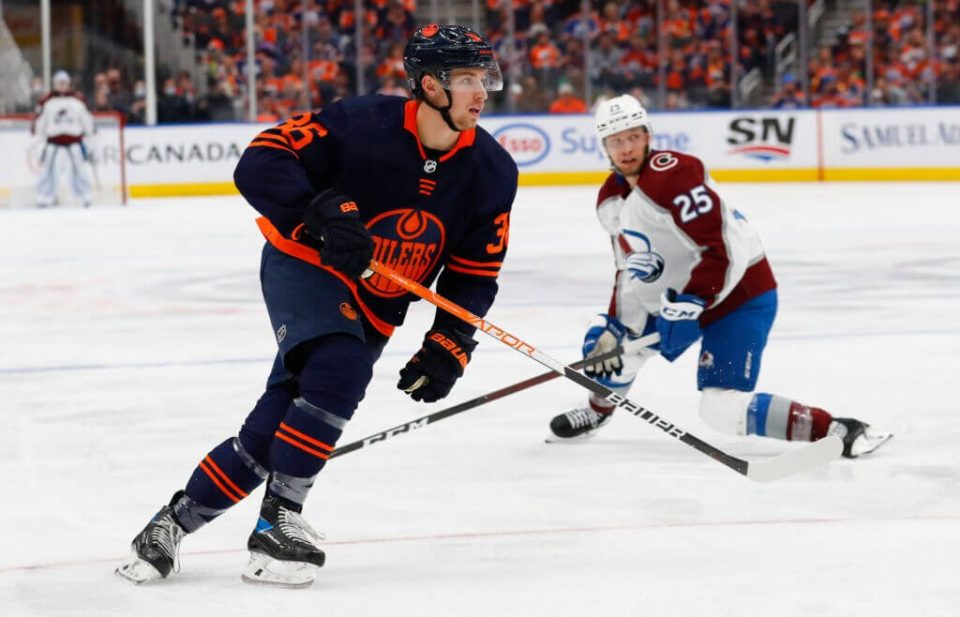
(Photo of Dylan Holloway: Perry Nelson / USA Today)
