

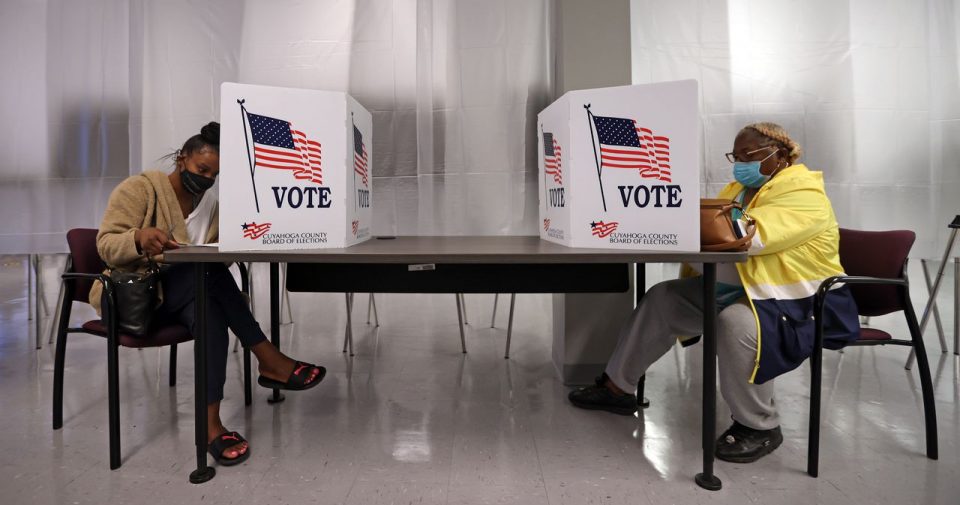
CLEVELAND — Without a doubt, people are energized to vote this year. According to the Ohio secretary of state, over 8 million Ohioans are registered to vote this year. That’s about 200,000 more than in 2016. In the first week of early in-person voting, the number casting ballots was triple that of four years ago. Here in Cuyahoga County, on the first Saturday of early in-person voting, the line stretched from the Board of Elections office on Euclid Avenue all the way to the Chester Avenue exit ramp off the Inner Belt. Clearly, the people are showing up and showing out.
And they have good reason to. The last four years have been, well … there are a lot of things I can say here, but I don’t want anyone to miss the point, so let’s just call them a rollercoaster. An already short news cycle was further shortened by the “Tweeter-in-Chief.” It felt like, every day, the media were reporting something that Trump had tweeted overnight. And these tweets were not mundane. Some caused stocks to fall overnight. Others threatened nuclear war. He fired his secretary of state via Twitter. Personally, I enjoy rollercoasters. A lot. But I absolutely do not enjoy emotional ones. And I don’t think I’m in the minority on that one.
But, with all this energy going around, I have one simple request this week. When it comes to state and local elections, keep the same energy.
The importance of state and local government cannot be understated. Name your top issue for the 2020 election and I can tell you how local decisions have equal or greater impact on that issue. The economy? State and local governments employ one in seven of all workers nationally. They spend as much as $2 trillion purchasing goods and services from private businesses. Health care? It was Gov. John Kasich’s decision to expand Medicaid under the Affordable Care Act that led to an additional 700,000 Ohioans having health insurance. The coronavirus response? For better or worse, that has been a state and local decision.
The courts are also important. In a Pew Research Center poll, 64% of voters in this election said U.S. Supreme Court appointments were a top issue. People are understandably concerned about who is given a lifetime appointment to interpret the U.S. Constitution and apply it to our laws. But I would argue that state and local judges are just as, if not more, important. Americans have a 10% chance of being sued in any given year and a 33% chance of being sued in their lifetimes, according to IFG Trust Services Inc., an international investment firm. In 2015, America had roughly the same number of people with criminal records as it had people with four-year college degrees. Who will you see when you go into the courtroom? It won’t be Amy Coney Barrett.
Racism is a big issue this election season. In that Pew poll, 52% of voters cited “race and ethnic inequality” as a top issue. A Washington Post-Ipsos poll found that more than 90% of Black Americans rate racism and police treatment as the most important issues in this election cycle. Yes, the federal government plays an important role in eliminating systemic racism. However, the everyday decisions of local officials also work to either perpetuate or eliminate that system: how (or if) police misconduct is dealt with; where (or if) affordable housing is built; how funds for business development are allocated; where and how much money is spent on educating your children; the enforcement of anti-discrimination laws. These are all primarily local decisions made by your governor, state legislator, mayor, councilperson, police chief, and prosecutor.

Eric Foster is a columnist for The Plain Dealer and cleveland.com.
Remember, this is how our system of government was designed. The U.S. Constitution expressly reserves for the states (and the people) the rights not specifically granted to the federal government. The Founders wanted the states to have considerable rights to govern how they see fit. However, that framework is distorted when the people engage the federal government more than their state and local governments. This creates state and local governments, vested with broad authority, exercising that authority on behalf of the few who vote and not the many that don’t. That is where we are now.
A common excuse I hear from someone who did not vote is that they did not feel like their vote mattered. I can understand the sentiment in a presidential election, but not in a local one. Remember, significantly fewer people vote in local elections. Every vote is more important. Increased importance gives you, the voter, increased power over the outcome. In Ohio’s November 2014 election, seven local issues were decided by one vote or tied. One. Single. Vote.
On the other hand, I understand why people vote less in local elections. It is more difficult to be informed about local elections than national ones. In presidential election years, the media does much of the work for you. If you want information on the candidates, just turn on the television. But in a local election, you have to do the work. There are generally no television debates. You have to do your own research. Understandably, many of us do not have the time or energy for that.
But like I noted earlier, it appears many of you have that energy now. The energy which compels you to believe that your vote makes a difference. The energy which has you standing in line for an hour to vote. The energy which has you debating with strangers on Facebook. That energy.
Keep that same energy. For every election. Every year. Decide, once and for all, whether voting matters. If it matters in this election, with hundreds of millions of votes, it certainly matters in elections with hundreds of thousands of votes.
Keep that same energy. The sustainability of our democracy, our future, depends on it.
Eric Foster, a community member of the editorial board, is a columnist for The Plain Dealer and cleveland.com. Foster is a lawyer in private practice. The views expressed are his own.
To reach Eric Foster: [email protected]
Have something to say about this topic?
* Send a letter to the editor, which will be considered for print publication.
* Email general questions about our editorial board or comments or corrections on this opinion column to Elizabeth Sullivan, director of opinion, at [email protected].
