

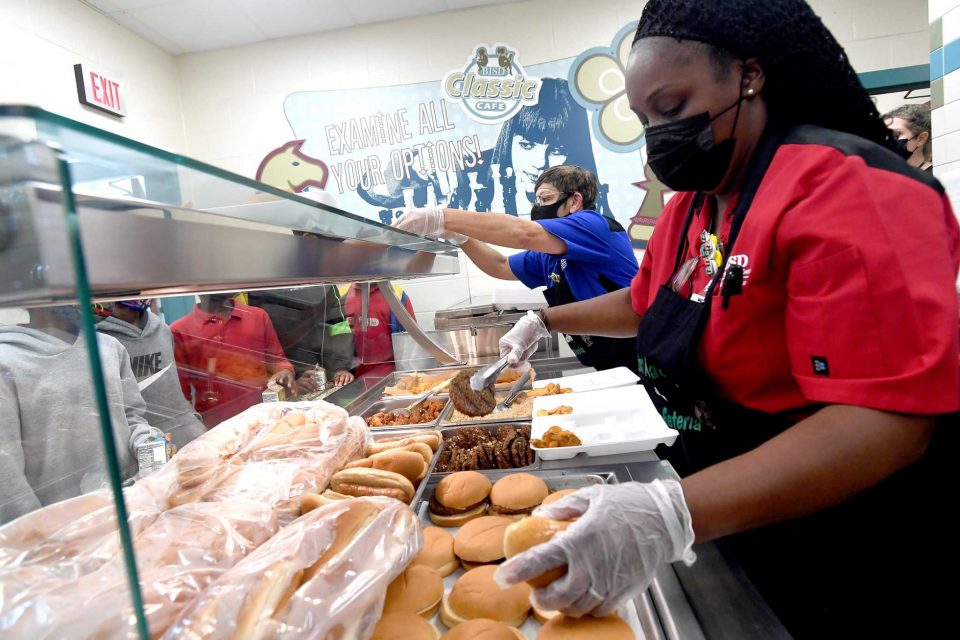
Beaumont Independent School District hasn’t been spared from a labor shortage and supply chain issues plaguing the nation.
The district is rationing trays and cutlery and has not been able to consistently get some food staples such as hamburger buns or chicken products.
That challenge has led to some district parents to take to social media, expressing dissatisfaction and posting pictures of their students’ meals.
But Beaumont ISD staff says children still are getting the same nutritional value required by the National School Lunch Program — menus just might look a little different as staff adjusts to availability of food and the ability to serve it.
In the month of October, BISD served about 17,400 breakfasts and lunches per day, or 87,000 meals per week — up from 75,000 at the beginning of the school year. The district, which serves breakfast and lunch for free, has seen a steady increase in the number of meals served due to increased enrollment and attendance rates.
“There are millions of students across the state who go hungry without these meals,” said BISD Director of Child Nutrition Tiffany Eckenrod. “We know that on Monday morning, there are many children who did not have a complete meal over the weekend, or their last meal was on Friday, and it breaks my heart. But it’s something that we face across the state, so these meals are really important for our students.”
The increase in meals being served per day in BISD coincides with a nationwide labor shortage and supply-chain issues, which has led to certain product outages within the district and a maximum number of cases of food the district can get from its food distributor.
“It is no secret that all school districts across the nation are seeing these food chain supply issues,” Eckenrod said at the district’s October board meeting. “Locally, we’re doing everything that we know how to do. As hard as it is, I think we’re in a good position to manage as long as we have support from our team here in the district, our parents and our students.”
Even still, District Superintendent Shannon Allen said the situation in the child nutrition department is “critical.”
The district currently is seeing shortages in food trays, cutlery, hamburger buns, rolls, croissants, chicken, green beans and other high-demand veggies, tater tots, fries, cereals (due to the ongoing Kellogg strike) and pizza, Eckenrod said.
BISD’s food distributor, which is located in Houston, is one of only two in the area that supplies products for K-12. Eckenrod said that the department received an email Oct. 17 from the distributor alerting the district that they would now have a case cap of 2,800 per week for the next five weeks.
The cases contain any kind of products supplied by the distributor such as chicken, paper products, trays and some fruits and vegetables.
The district typically orders 3,000 cases each week.
The five-week cap period will take the district through the Thanksgiving holiday, after which the distributor will reexamine if there’s a need for its continuation, removal or increase.
“We are going to be receiving parents on campus for some of those meals. So, we have started ordering some of those goods now,” Eckenrod said. “We don’t know what will happen after that five-week run time, it will depend on how (the distributor) is staffed. They’re seeing a lot of turnover.”
Eckenrod said that the district is rationing food trays and noted that some others have started serving meals on butcher paper because of the nationwide shortage on serving supplies.
“I hope that we don’t ever get there, but we are just going to have to have grace with where we’re at,” she said.
Because BISD is a part of the National School Lunch Program, there are regulations on what kind of food the district can serve and where it comes from.
The Department of Agriculture purchases food grown and produced domestically before distributing the food to be used to prepare school meals.
“We have committed hundreds of thousands of pounds to (these) certain vendors, but they can’t make the products,” she said.
For example, Eckenrod said that the district had an agreement for 19,000 pounds of beef, but the order could not be fulfilled. The district then went to Tyson, which also could not fulfill the order.
“Right now, we’re trying to find out who’s going to turn our cows into hamburger patties …” she said.
The main issue is the amount of labor it takes for that process to happen, Eckenrod said.
“There is a shortage in labor across the nation,” she said. “We all feel it, we all see it, and I don’t have the answer, but we are going to manage this challenge, again, with the support of our community and the district.”
Eckenrod said there aren’t a lot of distributors in the K-12 market, making it hard for the district to seek out others.
“Because of our guidelines being so strict, we can’t just go buy anything – our options are limited,” she said. “Sodium is very restricted – calories, we have a range depending on the level.”
BISD released a statement Nov. 3, alerting parents that there might be changes to their students’ school menus. Eckenrod noted that each meal still meets all nutritional requirements, but Second Grade students and older have an option to choose what to put on their plates.
In addition to dealing with product outages, Allen at the board meeting said the child nutrition department has been operating with 50% of its regular staff. While the department has made some hires and the number of applicants has increased, the challenge persists.
“It was actually a strategic decision that we made during COVID,” Eckenrod said. “Last year we were face-to-face, and we were virtual, so as we lost employees to whatever, we did not backfill those positions because we didn’t have the hours to provide.”
Eckenrod said the issues that her department — and child nutrition departments across the nation — are facing did not happen overnight.
“There was a change when the pandemic first started,” she said. “The change is (now), schools are not doing half (in-person) and half (virtual). Most schools are going back to face-to-face. Another factor is that most schools this year across the nation are doing free meals for all students, so that has increased participation of children eating at school.”
The demand for school food products has increased, and the supply has not been able to keep up, Eckenrod said.
“That is why we’re seeing our supply become less and less,” she said. “When we started this conversation, we knew it was coming, but we weren’t at a point where, ‘Hey, we’re out of food.’ It’s not just one section of what we do, it’s really across the board.”
Parents and community members interested in volunteering in the child nutrition department can visit bmtisd.com/volunteers and would be provided training in Texas Food Handlers, Eckenrod said. Passing the training is required to volunteer in food service.
Eckenrod said that she encourages any parent who is concerned about their child’s meals to contact her with their questions at 409-617-5065.
To view the breakfast and lunch menus for any BISD campus, visit bmtisd.nutrislice.com/menu.
twitter.com/oliviamalick
