

Kaman Pitches New Cargo Drone for Marines
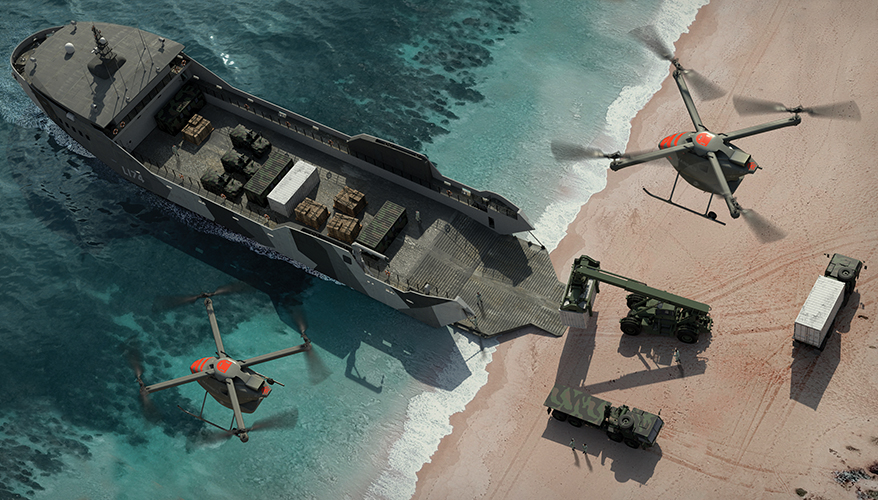
Photo illustration of KARGO UAV in the Indo-Pacific
Kaman illustration
Kaman — the maker of unmanned helicopters the Marine Corps famously flew in Afghanistan — has a new system that it’s pitching to the service.
The company built its new medium-lift KARGO unmanned aerial vehicle with Marine Corps specifications in mind. The system can facilitate distributed logistics, according to the manufacturer.
The demonstrator — unveiled at the Association of the United States Army’s annual conference in October — was designed based on conversations between Kaman and the military, company CEO and President Ian Walsh said on the sidelines of the conference in Washington, D.C.
After the Marine Corps started working with the company to upgrade its heavy-lift K-MAX air vehicles for unmanned operations, Walsh said the service became interested in a medium-lift option that could more easily traverse expansive regions such as the thousands of islands in the Indo-Pacific.
“The Marine Corps has a very clear idea — even though it’s still in a formulation stage — [of] what the requirements are around distributed lethality and distributed logistics in a very dispersed environment like the INDOPACOM region,” he said.
Marine Corps Commandant Gen. David Berger said the service is doing what it can to prepare for contested logistics in the Pacific.
“We’re going to need more agility than we have right now,” he said at a September briefing.
As a logistics vehicle, KARGO’s design prioritizes range and lift over speed and altitude, Walsh said. It can self-deploy up to 523 nautical miles while carrying as much as 800 pounds of equipment, food or other supplies. But the central benefit for the military is its simplicity, Walsh said.
The drone is small enough to fit inside a shipping container. Kaman’s partner in developing the system — Near Earth Autonomy — built the operating software on the vehicle that will allow it to detect and avoid obstacles autonomously, which could be especially useful in GPS-denied environments, he said.
It’s also less expensive than other cargo aircraft, enabling logisticians to resupply highly contested areas without putting costly systems at risk, he noted.
“It’s really not something that people are going to worry about [losing] because you’ve got plenty more you can send in … versus a $45 million other type of aircraft,” he said.
The company hopes to have a full-scale demonstrator in the air for testing by late 2022.
The Army and Air Force have also expressed interest in the UAV, but they have yet to determine how they would use the capability, he noted.
Topics: Marine Corps News
