

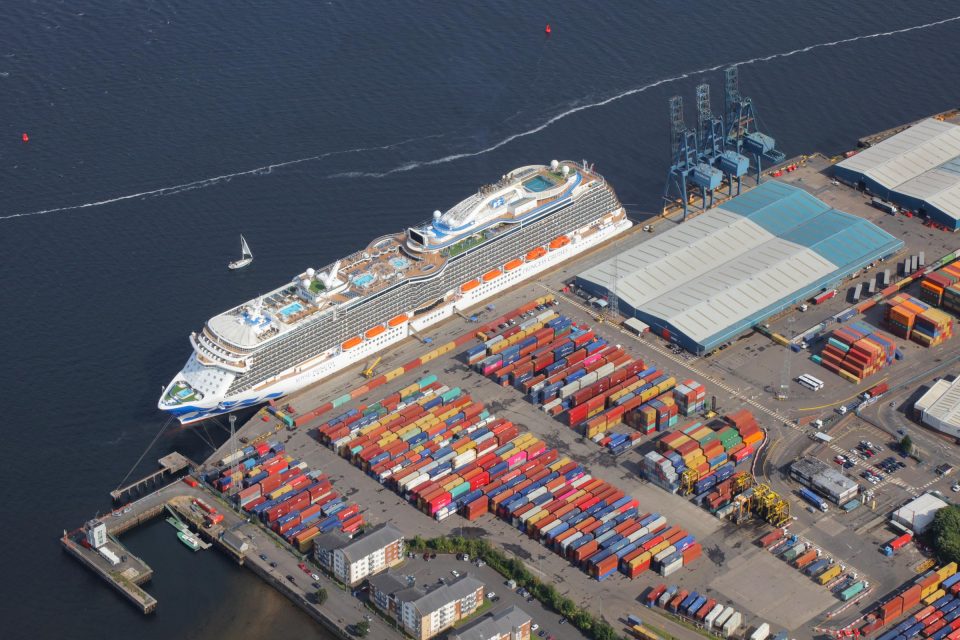
Success stories such as King V Dock and Ocean Terminal not only prove there‘s plenty of life left in the Clyde, but also suggest the west coast will continue to thrive well into the future thanks to significant new investment. By Colin Cardwell
IF anyone should lament that big ships no longer come up the Clyde to Glasgow, Andrew Hemphill is swift to correct them. The Port Director of Clydeport, Scotland’s largest west coast port organisation, points to The King V Dock (KGV) just 10 minutes away from Glasgow city centre and strategically sited beside Scotland’s rail and motorway system.
KGV, situated on a huge site that includes 60,000 sq. m of storage space and a 1568m long quay, was built in 1931 and so dates from the glory days on the Clyde. But it has also had significant investment in state-of-the art equipment and is now part of a distinctly 21st century infrastructure that comprises Greenock Ocean Terminal, Inchgreen Dry Dock, Hunterston PARC and Ardrossan – part of the Peel Ports Group, one of the largest operators in the United Kingdom.
Andrew has been part of the group since 1986 and held several roles before moving to Greenock Ocean Terminal in 2002. He says the facilities at Clydeport give immediate access to a local population of more than two million people. Clydeport is also the harbour authority of the River Clyde and its estuary, managing a jurisdiction of 450 square miles.
“We operate, manage and handle millions of tonnes of cargo every year and each of our ports handles various different commodities, so whatever the enquiry is within Clydeport we are ready to offer them a solution,” he says.
He explains that KGV is a traditional dock that has seen substantial investment over several years with the purchase of a new multi-docker crane that allows it to handle commodities such as biomass, agri-bulks, renewables and metals.
“We have seen encouraging growth and new customers – basically it just goes from strength to strength. And if people are in any doubt about ships coming up the Clyde, these vessels are getting larger, in line with the developments in shipping. KGV currently has a vessel alongside that is 180m long (the length of a football pitch is 105m) so we are handling some very large ships and substantial tonnages.”
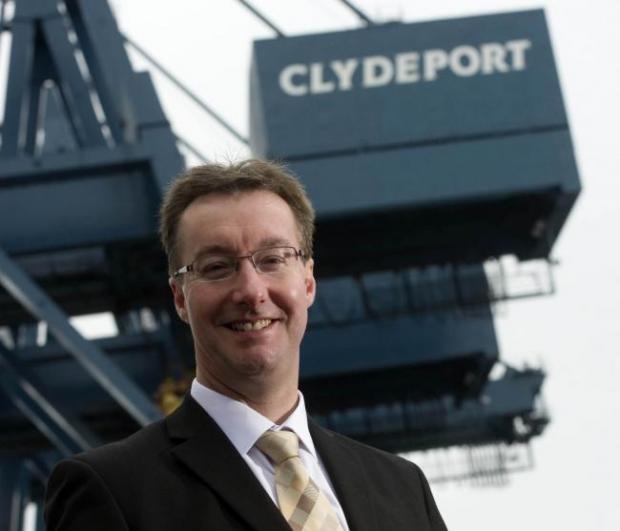
BUOYANT FUTURE: Port Director of Clydeport Andrew Hemphill.
At Greenock, Ocean Terminal was built in 1969 and is still the only deep-sea port on the west coast of Scotland, purpose-built for containers. “It has significantly diversified in recent years,” explains Hemphill.
“Now the main shipping lines call at deep-sea ports such as Southampton, Antwerp, Rotterdam and London Gateway, and Greenock has become a major hub, a feeder port with smaller ships going to the large, deep sea ports.”
The opening of Liverpool2 (L2), he adds has transformed the outlook for Greenock Ocean Terminal. L2, part of the Peel Ports Group, represents a £400 million investment in a deep-water container terminal at the Port of Liverpool, enabling the largest vessels to call directly on the UK’s west coast and with the capability to attract the largest vessels in the global container fleet.
This has brought deep-sea connections much closer to Scotland.
“We are now in a unique position thanks to our Irish Sea hubs. Mega ocean container ships can now call directly into Liverpool, which acts as a feeder hub to us in Greenock, Ireland and Manchester, allowing closer import and export routes to market. Also, customers can go from Greenock via Liverpool or European hubs into the Irish Sea, using Peel Ports’ own shipping line BG Freight Line or with their own vessels
“The volumes have changed over the years, but they have been increasing, and through investment in the plant and staff we have doubled the workforce over the past five years,” he says. “We’re no longer solely a container port and have diversified into other products such as forest products, timber and paper, importing some 80% of the newsprint used by Scottish newspapers and we also export paper to the American market”.
Currently riding high on the agenda at Greenock Ocean Terminal is the new £19 million cruise berthing and visitor centre. Work has begun on the project, led by Peel Ports and Inverclyde Council, which is scheduled to open in May this year and last year it received funding of £9.7m from the Glasgow City Region City Deal.
Which, says Hemphill, is extremely good news for Inverclyde and Scotland in general and exemplifies the importance of Greenock Ocean Terminal to the country’s economy – an importance he is confident will not be undermined by the UK’s exit from the European Union.
While he concedes that this will doubtless bring challenges, he takes a pragmatic stance: “Who really knows what Brexit will bring, but as island we will continue to export and import as we have done for centuries. And while there may be layers of paperwork and taxes to confront there will also be a strong and continuing demand for our goods.
“Greenock is well placed to rise to whatever is demanded of it and whatever hurdles may be encountered, in terms of the port I can only see the future bringing new opportunities.”
It’s a long-term approach well suited to shipping. Storm Brendan saw ships all over the UK harbour bound for days this month but as Hemphill points out: “The weather is something we’re used to – whether it’s a shipping line or a restaurant, sometimes there’s a queue and you just have to work your way through it.
“Ships come and ships go – but the most important thing is that it’s all done safely.”
