

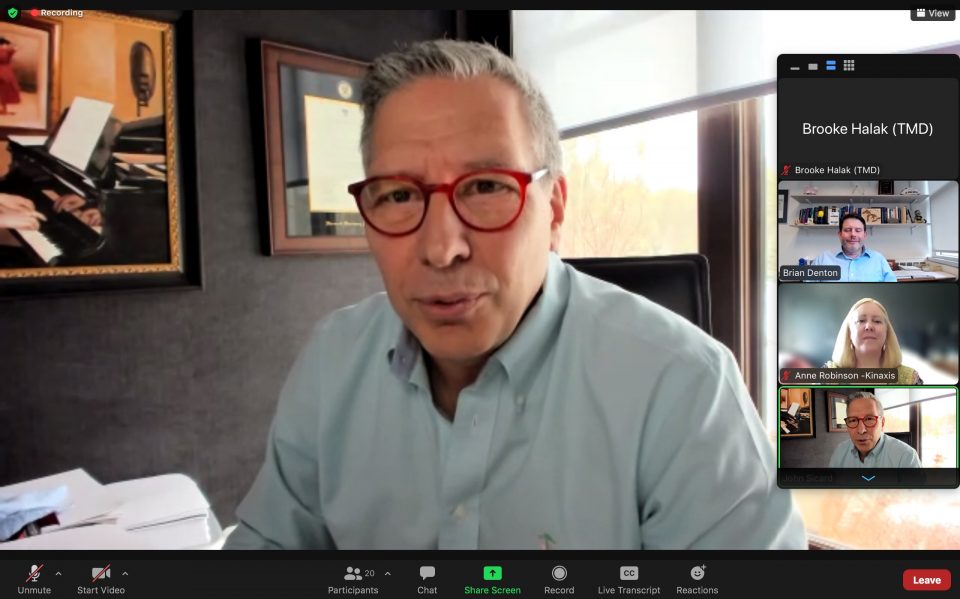
On Friday, the University of Michigan Industrial and Operations Engineering Department hosted the seminar “The Resilient Supply Chain: Harnessing agility for a post-pandemic world.” This discussion focused on the evolution of the supply chain — or the necessary activities required by a company in order for consumers to receive their products — after the pandemic and how companies can remain resilient to the changes. The conversation was led by two Kinaxis executives, Chief Strategy Officer (CSO) Anne Robinson and John Sicard, the President and CEO.
According to their website, Kinaxis is a supply chain, management, sales and operation planning software company, which has had to constantly adapt to the supply chain’s fast-paced environment.
Sicard said while the supply chain is a highly technical endeavor, the pandemic posed serious issues to the functionalities of the discipline as many reliable models collapsed during the pandemic.
“This isn’t about bad technology, this isn’t a technical problem, it’s one of a failure in assumptive parameters … it’s one in a loss of control over the assumptive parameters,” Sicard said. “The things you would come to know to be fact could no longer be trusted.”
Sicard acknowledged that resilience in the supply chain is the goal of numerous companies. He explained how resilience is an outcome of competence, and a lack of resilience can come from lethargy which has been prevalent throughout the pandemic.
“I think this is where the craft is moving; I think there is a greater appreciation now for what it feels like to have an agility muscle atrophy,” Sicard said. “That’s what people felt during COVID in supply chain – an agility muscle that atrophies and so when you go to use it, it has no strength.”
The constant need to update and improve methods of supply chain and accommodate human needs, Sicard said, is driving a reevaluation in the overall supply chain planning model.
“There needs to be a shift in governance model here for the next 30 years,” Sicard said. “The methods that we’re using today will not sustain business conditions tomorrow.”
Sicard and Robinson were asked which products Kinaxis manufactures and the types of supply chain problems that Kinaxis works with. Sicard answered by reiterating that technology and products don’t matter until the proper techniques are acquired.
“I’ve come to believe that products and technologies really don’t matter — they don’t. Kinaxis product doesn’t matter until you bond on technique first. Techniques inform technologies, not the other way around,” Sicard said. “This is one of the things I’m learning, if you attempt to tackle today’s problem with better technology and you don’t have the conversation on technique first, you’ve lost the plot.”
Robinson said the stages in supply chain management require time for buffers, which serve as a safety net for unexpected or unpredictable delays or surges in demand. She added that planning these buffers can lead to the bullwhip effect, which are forecast errors within the supply chain that misrepresent the true supply and demand and exaggerate customer demand. Additionally, Sicard said Kinaxis views supply chains as living organisms with a multitude of requirements needing different competencies.
“This cascaded kind of waterfall approach to planning is what breeds lethargy; it’s slow,” Sicard said. “It also breeds blindness. You hear a lot about this in organizations where the people living on the inventory team are blind to what’s going on on the commercial side and vice versa.”
Sicard then said Kinaxis changed its philosophy of planning into concurrency, where multiple computations are happening simultaneously. This transformation makes it impossible to plan one function without planning all others.
“Perhaps it’s what’s making us more relevant now than ever before because all of these supply chains all over the world are fighting to strengthen their agility muscle; they’re fighting to become more resilient,” Sicard said. “And for that concurrent planning as a foundation, well, it becomes a critical prerequisite quite frankly.”
Robinson discussed the dated traditional time-series approaches to planning and supply chain execution. She said that the supply chain has been disrupted by the pandemic, and forecasting and planning must be as optimal as possible at the moment.
“We need to think about the richness of all those other variables around us and thinking about changing our models to include as many external factors as possible as well as that internal data,” Robinson said.
The discussion moved on to the end-to-end visibility in supply chain and its insignificance. Sicard described visibility as seeing things and transparency as understanding what you see. Transparency avoids secrecy and the lack of information flowing to groups in different stages, and the speed of compromising with confidence is a focus of the supply chain, Sicard said.
“One of those things is interesting and one of those is valuable,” Sicard said. “So that’s an example of where this language is changing. There’s this appreciation that part of becoming hyper-agile is increasing transparency.”
Sicard said COVID-19 was a universal shock to supply chains and everyone felt the impact, so it was impossible to evade the side effects. He then discussed how COVID-19 was also a catalyst for change and a huge shift — it is now taking more effort to manage the supply chains. According to Sicard, hyperagility is necessary for companies as they are forced to adapt to regulations and detrimental events.Sicard continued by recognizing the supply chain is the most strategic competence manufacturers have. In order to be effective, the speed to course correct and run alternative scenarios is vital, something he said is prevalent with rising inflation today.
Kinaxis co-founder Duncan Klett explained that the time it takes to respond to a scenario is critical and course correction when you can’t rely on previous assumptions is also vital.
“The fact that you can react immediately, make a decision and execute that decision immediately really matters,” Klett said. “Analyzing what might happen, knowing what you would do in response to that, and when something that you never thought about happens, how quickly can you respond, how rapidly can you get a new supplier on line, get products in, or simply decide what to make and what you can’t make because the supplies aren’t there.”
Robinson ended the discussion by acknowledging how the roles have changed so much in the supply chain. She said that rather than performing calculations and crunching numbers — which were important roles in the past — supply chain professionals today need to understand both the math and the business aspects.
“Because the supply chain is a lot more horizontal, a lot of the other functions are very just sort of point in time … supply chain cuts across all of them,” Robinson said. “You need to have those collaborative skills … because the supply chain is the last entity in an organization before the customer gets the widget.”
Daily Staff Reporter Brooke Halak can be reached at [email protected].
