

First reported at 5:15 p.m. on July 31, it took 27 days for the Pine Gulch Fire to become the largest in the history of Colorado. At 139,006 acres, the Pine Gulch Fire officially pushed past the Hayman Fire (138,114) on Thursday and, while the two will forever be tied to one another in the history books, the Pine Gulch has been much less destructive.
“To have a fire of this size with no serious injuries is pretty great,” Bureau of Land Management spokesperson Eric Coulter said. “Our priority has always been public safety and it’s been for the most part a landscape fire. Typically on fires we’ll get crewmen with dehydration or cuts and bruises and that’s about all we have seen.”
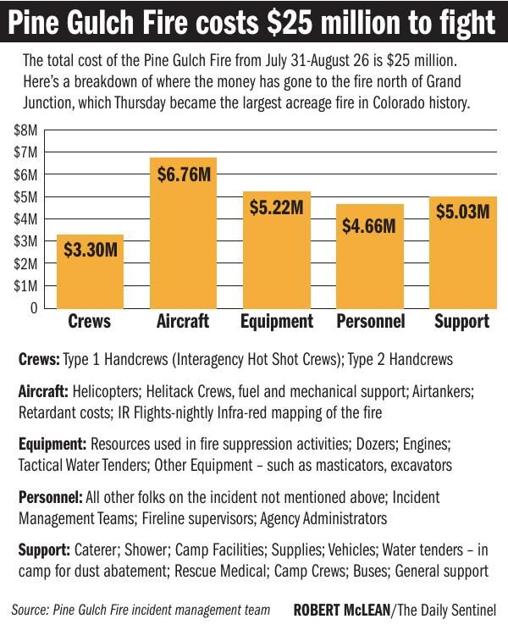
One abandoned outbuilding was destroyed early on and a cabin was reportedly destroyed during the fire’s biggest jump on Aug. 19, when it grew nearly 40,000 acres in a number of hours. As of Wednesday, the fire suppression effort at the Pine Gulch Fire has cost approximately $25 million. While those costs are expected to increase, it should pale in comparison to the Hayman Fire, as well as other large fires across the state.
In a story published in 2012, the Denver Post reports the Hayman Fire cost a total of $238 million. Those costs included a variety of different expenses attributed to the fire such as timber lost and insurance claims made.
In a federal case study released a year after the fire, suppression efforts on the Hayman Fire cost approximately $42 million with another $2 million spent by the Bureau of Land Management and $1.5 million by the state. In addition to the money spent fighting the fire, rehabilitation and restoration expenditures were expected to cost another $72 million. A total of 600 structures were lost, including 132 residences, with total insured private property losses estimated at $38.7 million. Those figures are all in 2003 dollars.
Coulter said the rehabilitation and restoration effort for the Pine Gulch Fire will be extensive. He expected it to be a focus for the local field office for the next several years. The Burned Area Emergency Response team will analyze what needs to be addressed, looking at past fires in the area on similar terrain to asses what areas will come back on their own and which will need additional seeding.
FIGHTING THE FIRE FROM THE AIR
The steep and rugged terrain firefighters faced on this fire was a reason it’s grown to the size it has.
Helicopters and air tankers were used to drop water and retardant where firefighters couldn’t go as aircraft proved to be the largest share of the cost as of Wednesday at 27%, or $6,765,799. This includes helitack crews, fuel, retardant costs and IR flights, which are nightly infra-red mapping flyovers on the fire, as well as additional mechanical support.
On Friday, seven helicopters were being used on the fire.
David Boyd with the Bureau of Land Management said the helicopters have been mostly used to drop water on the fire, though they have been used, along with airtankers, to drop retardant.
Helicopters are typically used to make water drops over a fire, often using a local river or lake to refill; however, mobile retardant bases have been set up on the southeast and northeast ends of the fire. Both were reportedly key in getting the fire in check when it made a northwest run due to high winds.
Fire retardant slows the spread by coating the vegetation with nonflammable red material that evaporates at a slower rate than water. It acts as a natural fertilizer and is not harmful to the environment when kept away from open water, the Pine Gulch Incident Command Team reports.
Equipment, which is any resource used to fight the fire such as dozers, engines and tactical water tenders, has been the second largest expenditure on the fire, costing $5,224,466, or 21% of the overall cost.
FIGHTING THE FIRE FROM THE GROUND
Following active suppression, the fire operation moved to mopping up inside containment as firefighters have looked to extinguish or remove burning and hazardous material within or close to the fire’s edge.
Fire containment jumped to 77% on Thursday evening, up from the last report hours earlier that had it at 53%, and way up from the 19% it was reported to be at to begin the week. A lot of that containment jump has been thanks to the work from the boots on the ground.
Firefighters douse any remaining flames, embers or burning materials and stir and drown any hot areas that are still smoking. The hand crews have cost $3,301,828 or 13% of the money spent. There are typically 20 to 22 firefighters per hand crew and 12 hand crews were reportedly helping out at the fire on Friday.
Jacob Welsh with the Pine Gulch Fire operation said that as the firefighting operation moves forward, the team will begin to “draw down” its resources.
“It’s already starting to go down,” he said. “As we are more focused on mop up now and will continue to make sure homes are protected and begin back hauling equipment.”
Mopping up requires firefighters to venture as far as 300 feet inside the control lines as they extinguish all smoldering materials in their path.
Mop up sometimes lasts for days after the last active flame as firefighters patrol the fire for days or even weeks until the fire edge is completely out.
