

Overview of Mobile Storage Units
One of the emerging areas of concern by both the Government and farmers has been the limited availability of covered space for storage of food grains across the country. The situation is further aggravated by the year-on-year accumulation of surplus grains under the Central Pool and during the harvesting seasons of Rabi and Kharif.
In order to compensate for the lack of adequate storage, farmers, procurement agencies and States, therefore have to rely on Open storage or Cover and Plinth storage (CAP) techniques. When using Open or CAP storage, there is much higher risk of losses due to the climatic conditions (rain, heat, and snow) as well as pest and rodent infestations which renders grains unfit for human consumption. However, the greatest impact is on the farmers, as it leads to large post-harvest losses, resulting in reduced income.
To address this challenge, the World Food Programme (WFP) India has been exploring possibilities for increasing storage capacities for state Governments, leveraging its experience as the world’s largest humanitarian organization and the lead on logistics and supply chain for the UN system. One such solution is through the use of Mobile Storage Units (MSU) which are used by WFP worldwide as temporary warehouses for the food which WFP procures and distributes to vulnerable food insecure households across the globe.
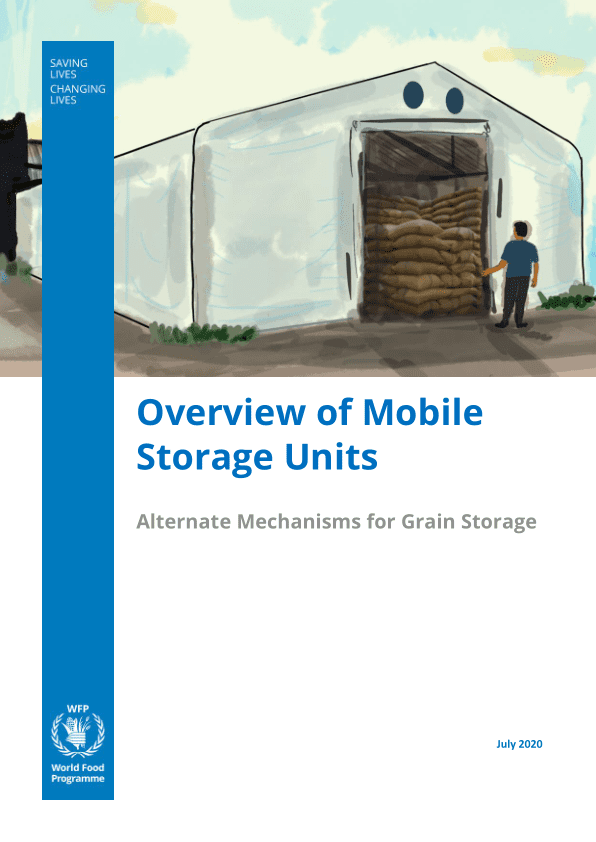
An MSU is akin to a scientific warehouse that can be erected within 2-3 days on flat, hard earth or on a raised elevation. It is 24 meters x 10 meters x 5.5 meters in dimension and has a storage capacity of nearly 450 metric tonnes. It is constructed of a material that is waterproof but at the same time allows ventilation (See Annexure I for details).
Additionally, there are other options available as well such as permanent pre-fabricated structures and semi-permanent storage structures like Flospan, with their own advantages and disadvantages. The comparison of all three structures is provided in Annexure II.
