


“For a business to deliver its promise to its customers, it must have a properly functioning supply chain,” Without an intact supply chain, a manufacturing business will starve for key inputs into its production process.
The spread of the coronavirus is impacting individuals and supply chains alike, with hundreds of new cases announced every day. A pandemic is the major business disruption among the disruptions as natural disaster, accidents, government policies, Non-compliance, competition, economy, social dissatisfaction and intentional disruptions. Pandemics has caused great losses throughout the history.
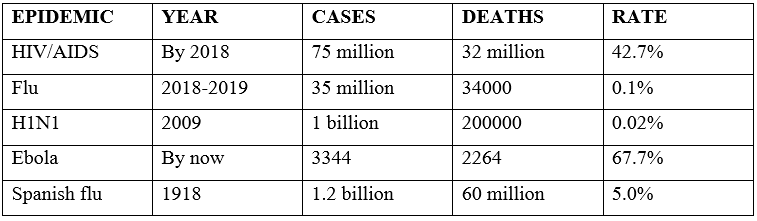
Comparing to economic impacts of the historic pandemics with the covid-19, it will be inaccurate because the problem with the covid-19 is that it impacts both supply and demand. China today is a much larger element of the worlds GDP than during those disruptions, so both supply and demand affecting china will thereby affect the rest of the world, the main impact will be demand reduction due to fear and social distancing and obliviously the media hype may bring about a severe recession. There is a principle called ‘the anna karenina principle’ which says that’s “Happy families are all alike; every unhappy family is unhappy in its own way”. This suggests that every disruption comes with its own cascade of effects – no two are the same but management of every risk involves prevention, detection and response. China’s dominant role as the “world’s factory” means that any major disruption puts global supply chains at risk. Highlighting this is the fact that more than 200 of the Fortune Global 500 firms have a presence in Wuhan, the highly industrialized province where the outbreak originated, and which has been hardest hit. Companies whose supply chain is reliant on Tier 1 (direct) or Tier 2 (secondary) suppliers in China are likely to experience significant disruption.
The major impacts of covid-19 on the supply chain are listed below:-
1. Workforce
As the virus is spreading globally and now announced as a pandemic all around the world the government has advised employees to stay home. This has impacted the organisations on a large scale, factories are not able to produce goods which lead to failure in exporting the goods to the dependent markets. “As the virus extends globally, supply chain leaders need to think about how to protect the health of workers, and support individuals who are ill. Providing clear and consistent communication through human resources and travel security is essential,” as this crisis is ongoing, the risk is that crisis management teams become fatigued and make poor decisions.
2. Products
P&G Says 17,600 products could be affected by coronavirus in China, highlighting supply chain risk. Consumer goods giant P&G, joining a chorus of companies including Apple, Adidas and Starbucks, warned that its sales and profit in China, its second-largest market, would be hurt by the coronavirus outbreak there. Apple warned that the worldwide iPhone supply would be “temporarily constrained,” with its factories in China “ramping up more slowly” than it had expected.
But the main deal is with the small-scale suppliers who cannot hold the weight of the lockdown for a long time. The virus could transform the competitive landscape. Suppliers for commoditized products are at risk to lose market share, as clients will look into substitute suppliers when they don’t receive goods on time. It is thought that products associated with brand loyalty will be less impacted because customers are more willing to wait
Most probably the Supply chains will experience sharp increases in demand for products or unexpected consequences from the event, such as panic buying for essential items.
3. Stockpiling
Stockpiling means a spike in demand in the short term. The impact of stockpiling depends on the size of a business—larger businesses such as Walmart tend to be more robust because of their centralized strategy, better inventory control, and diverse supply bases, but for the smaller businesses, this could be a very vulnerable moment because stockpiling creates variability in their demand. Variability is hard for smaller businesses to absorb because they do not have the level of scale and flexibility required to maintain a reasonable level of product availability at times of demand shocks.
4. Costs
There has been a considerable impact to organisations with increased costs of shipping, as well as a concern of companies meeting their financial objectives. If there are any additional costs incurred due to the coronavirus, it should be fit to the entire organization rather than individual departments. This will make it easier to assess the costs against organisations ability to achieve its strategic objectives and manage stakeholder expectations
Conclusion
So far, the global effects on supply chains have resulted mostly from the serious situation in China, and we can talk about those effects in two distinct ways. First, it’s having an impact on the supply of inputs for many manufacturers and retailers all over the world, and that’s important because China is a huge source of components and finished goods.
Second, China is also a major market for goods and services. Anywhere in the world, local economies that depend on China as a customer are feeling the effects, For an example, a recent article in The New York Times explained how truck drivers in Mongolia are losing their income because they can no longer deliver coal to China—the border is closed, and the demand for coal is way down anyway. The flow of tourists from China has come to a screeching halt, and that’s affecting the tourism sector in many countries, from freelancing guides to major hotels, especially in Asia.
The major issue is arising because china is the major supplier and serves as the biggest markets among all. The better solution is to diversify the supply base, so as to have uncorrelated sources of supply. So that when one set of suppliers may be down due to a regional problem, another set might still be in operation.
When a situation like this happens, living in 2020, we are in a much better position than before say, 17 years ago when the SARS outbreak occurred. Today we have so many options, even futuristic ones. Who knows, things like drone deliveries and self-driving cars may be able to finally take off.
