


Shifting of the power centre of global politics from the West to the East and the rise of multiple power hubs across the Asian region are giving a renewed vibrancy to the concept of ‘Asian century’. It is against this backdrop that the new and acceptable equations of geo-political and economic domination is beginning to unfold. It is up to the major powers in this region to build a new security architecture and figure out the wise and justifiable norms that would govern the future global order.
Although forums like BRICS and the Shanghai Cooperation Organisation (SCO) bring on board countries like China, India and Russia — key players in the Eurasian region — to lead the 21st century world politics, the cautious distrust among the trio forestalls the innate bonhomie, which is fundamental to provide an alternative to the existing western dominant US-led global order that is characterised by structural inequalities and asymmetry of power.
Trilateral Grouping
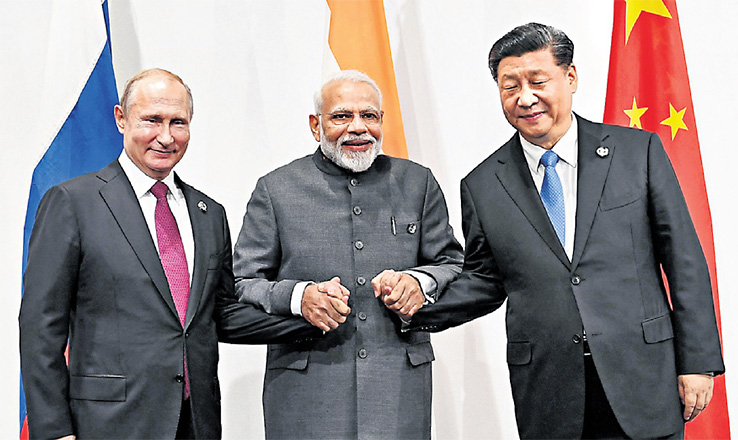
The transformation of Sino-Russian relationship from enmity to detente, as misgivings between China and Russia take a backseat, provides an opportunity for India to adjust with the reality. Here Moscow can act as a neutralising force between China and India. Russia, India and China (RIC), a trilateral grouping, considered as a possible counterweight to the western alliance, is falling behind in a number of parameters to realise its true potential. The purpose and goal of the trio are interspersed and overlapping, the reason why RIC fails to see itself as an exclusive distinct entity.
India has extended an olive branch to Russia, its all-weather friend, to reinvigorate the time-tested friendship. There has been a lull in the relationship and mutual apathy from both sides, thanks to the twin reasons — 1991 reforms, where India’s dependence on the US became more pronounced, and the Soviet disintegration. China, the present-day economic powerhouse of the world, is pushing its own agenda of rule-based order across Asia to exert its influence both economically and politically, which eventually provides the ability to enforce its priorities across the region. This is where Russia sees India as a means of balancing the Asian giant.
Move Over Non-alignment
India, ever since its independence, followed the path of equality, non-aggression, peace and compassion. Initially, India opted for the non-alignment policy, whereby it maintained equidistance from the two superpower blocs and chalked out an alternative plan for the newly-independent Third World countries. India, under the banner of the Third World solidarity, spearheaded the concerns and ambitions of these countries in multilateral organisations such as the United Nations and the World Trade Organisation.
With the adoption of market reforms in the 1990s, India shelved NAM (Non-Aligned Movement) but the spirit still resonates in its external outlook. It is quite apparent that Indian diplomacy is tilted towards the US in the post-reform era. However, the time has come for striking the right balance with multiple players. Meanwhile, the status of India has transformed from rule-taker to rule-maker, which exasperates China, underscoring the neo-power struggle within Asia itself.
Indo-Russian Convergence
Within the framework of Greater Eurasian partnership, Moscow considers India as a crucial player in containing the growing influence of ferocious ‘dragon’. As China started to make inroads into Central Asia, a resource-rich region which is traditionally under the Russian sphere of influence, with its Belt and Road Initiative (BRI), India wants to fast track the actual realisation of the International North-South Transport Corridor (INSTC), a multi-modal transport network that aims at seamless transfer of freight and improved trade connectivity from the Mumbai coast to Moscow, the north terminus of INSTC.
Apart from defence ties, both India and Russia are looking forward to expand cooperation in multiple ways. Both, as member nations of the BRICS, — a multilateral arrangement among the world’s largest emerging economies — are committed to shared prosperity, mutual benefit and non-interference. Russia’s Far East, a region rich in natural resources yet underdeveloped, is in dire need of investments and manpower. Russia has been looking for trusted allies amid the growing Chinese factor in the region. With the launch of ‘Act Far East Policy’, India offered a $1-billion line of credit for the development of Far East.
Act East Policy
Adding an extra dimension to the existing ‘Act East Policy’, the new plan unveils the intent of New Delhi to engage actively albeit carefully to promote its strategic interests in the region. The proposed maritime link between the port cities of Chennai and Vladivostok will not only help India in providing an alternative maritime sea route and in reducing the transportation time to reach Russia but also guarantees our stand for “free, open and inclusive Indo- Pacific”. The melting of Arctic glaciers opened up new avenues for Russia in terms of exploring natural resources and shipping lanes. In future, the Chennai-Vladivostok link will join what is termed as Northern sea route, which connects East Asia to Western Europe via Russia’s Far East.
RIC, a troika of three Eurasian powers, core of BRICS and SCO, can work extensively on issues like counter-terrorism, transnational organised crime, drug trafficking and climate change. It can steer the reform agenda, according to the current needs, in global institutions like the UN and the WTO. RIC would be a potential game changer in the geo-economic and political fronts if the trio comes on board with a broader consensus and a clear cut road map. China’s chequebook diplomacy has transformed into a policy of intimidation and trapping nations in economic bondage. Beijing must soften its approach to resolve its differences with India and Russia.
The US has been looking at India, given its size and stature, as a potential player in the region in checking the hawkish Chinese power. The US wants India to be more assertive and arrangements like QUAD (Quadrilateral Security Dialogue) and JAI (Japan-America-India) are part of its long-term geo-political strategy.
The real success for the Indian diplomacy depends on how well we would maintain our strategic autonomy in both continental and maritime security spheres and in designing an independent and sustainable plan of action ensuring long-term peace and stability in the region.
(The author is Director, Samudrala VK IAS Academy)
Now you can get handpicked stories from Telangana Today on WhatsApp / Telegram everyday. Click these links to subscribe and save this number 9182563636 on your contacts.
Click to follow Telangana Today Facebook page and Twitter .
