

Third-quarter 2022 Dry Bulk Utilization Index is now
available through the Freight Rate Forecast
Volatile path to lower freight rates in near term before
recovering in late 2023 with regulation impact on supply and
gradual demand recovery
Summary
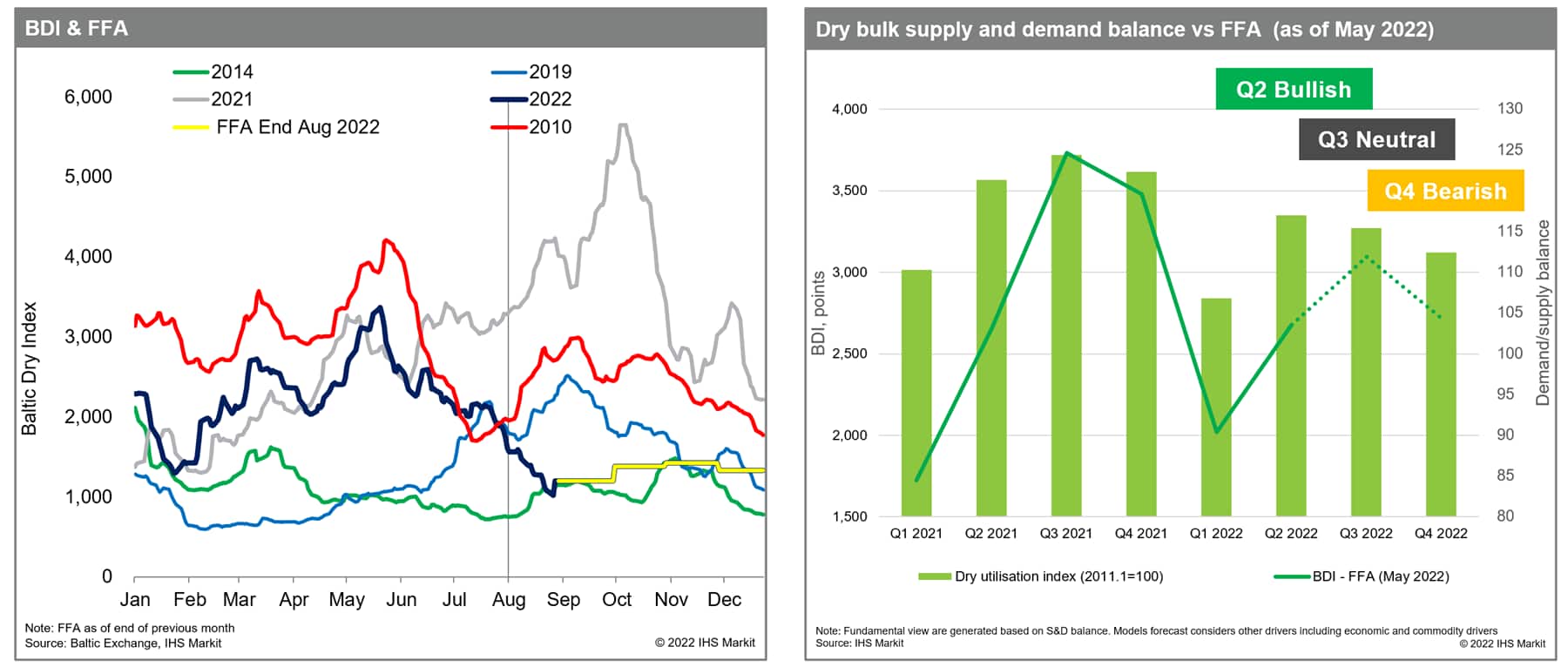
Dry bulker earnings have continued to fall over the last three
months after a brief rebound in the early third quarter of 2022.
The seasonality pattern fell to that of 2014 which we observed as
being the low case scenario of market (2010 as base-case scenario
of seasonal trend). Typical seasonality of the market indicated
that dry freight rates would peak again in the third quarter of
2022 as can be seen in the FFA assessment at the end of May 2022;
however, our fundamental analysis and forecast of the previous FRF
long-term outlook (May 2022) showed that the second quarter would
be the peak of 2022. Therefore, in previous edition, we outlined
several downside risks from the later part of the third quarter of
2022, including:
- Softening container market with a changing consumer pattern, as
well as a weaker purchasing power - Higher efficiency or productivity of vessels with reduced
congestion and higher speed - Lower Russian coal demand after the European and Japanese coal
import ban, stronger domestic coal production in mainland
China - Limited wheat export volume during the Black Sea grain
season
As of end of August 2022, it seems all risk factors turned out
to be worse than expected.
- Container freight market: We have consistently
argued that as long as container freight rates remain high enough
to capture part of general cargo vessels (multipurpose) and open
hatch cargo vessels share in the commercial container sector, small
geared bulker rates are expected to be supported, specifically for
the backhaul routes. That is why our major assumption for dry bulk
demand and supply has been heavily linked with the container market
outlook. As we had forecast, container freight rates have indeed
declined significantly over the last three months with slower
container trade demand growth in response to high inflation rate
and endemic consumer pattern. After the third-quarter peak season
is over, the de-containerized trend is expected to be reversed and
some part of the container spillover-related minor bulk cargo will
gradually return to container box. A large amount of scheduled
newbuilding deliveries of container vessel capacity, starting from
the end of 2022 and expected further softening in port congestion,
would put the container shipping rates as well as the backhaul dry
bulk freight rates under further pressure. Now, we assume container
freight rates will continue to decline to an average of
$4,000-5,000 per box (FEU) in 2023 from an average of $7,000 per
box (FEU) in 2021-2022.
- Efficiency : We believe that much of the
reduced mainland Chinese port congestion level in Panamax and
Capesize, along with weaker cargo arrivals, was one of the major
reasons behind a significant decrease in freight rates. The
relatively stable congestion level in geared vessel tonnage with
stable export activity has kept geared vessel congestion higher
than the larger size segment market. Based on expectation of cargo
arrivals into mainland Chinese ports, we do not expect extremely
high congestion again in the coming quarters. Interestingly, CII
rating issue would incentivize higher demurrage to reduce idling
time and prevent further upside risk in congestion in coming years.
On the other hand, significant drops in freight rates prevented
potential sailing speed increase with lower bunker prices in the
short term. In the medium and long term, we expect that EEXI’s EPL
impact will be limited on commercial speed, while CII will start to
impact from 2024 onwards in operational speed as well as scrap
activities. Meanwhile, EEXI-CII regulation impact is considered in
this supply outlook; however, with the ongoing uncertainty of
penalty and reduced earning, the potential recovery in demolition
activities and slippage will remain the major downside risk for
2023-2024 fleet supply growth outlook.
- Coal and grain: We expect that strong coal
trade will continue due to the uncertainty around gas supply issues
linked to the ongoing Russia-Ukraine conflict. However, with
difficulty in insurance and several sanction risks, we expect
limited coal and grain shipments to be out of the Atlantic side of
Russian ports in the coming months compared with normal seasonal
pattern. Also, limited ballast tonnage availability towards Russian
ports and stronger domestic coal production in mainland China may
limit further Russian cargo shipping demand.
Although we expect some seasonal improvements in dry bulk market
in the coming months, volatile path to lower rates is expected in
the absence of high congestion, slower-than-expected economic
growth with continued weakness in mainland China’s real estate
sector in the near-term. Eventually, overall dry bulk freight rates
may return to the level that we have seen in pre-pandemic period in
the coming months. However, limited supply growth driven by
regulation and lack of new building order will help to market to
recover in the second half of 2023 and 2024. In this context, we
predict the Baltic Dry Index (BDI) is expected to fall about 20 to
30 percent on the year to average about 1,300-1,400 points in 2023
before recovering to average about 1,400-1,500 points in 2024.
Earlier-than-expected change in mainland China’s ‘zero-COVID’
policy or ceasefire agreements in the Russia-Ukraine war would
remain the major upside risks, while strong domestic coal
production and faster declining container market with global
recession remain as major downside risks in the medium and
long-term.
Chart1. Typical seasonality of market indicated dry
freight rates would peak in the third quarter; however, fundamental
analysis (May 2022 outlook) showed Q2 would be the peak of
2022
For more insight suscribe to our complimentary commodity analytics
newsletter
This article was published by S&P Global Market Intelligence and not by S&P Global Ratings, which is a separately managed division of S&P Global.
