

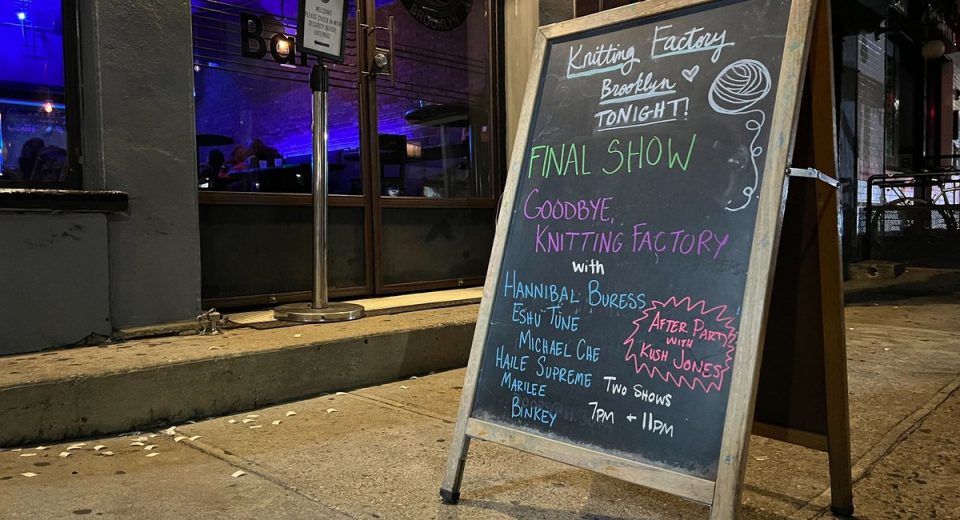
‘Tight-knit Knit fam’
But in Williamsburg, the Knitting Factory was a mainstay for the city’s comedy and music scenes, itself a capsule of memories for the staff that ran it, and the artists and regulars who frequented it for more than a decade.
“The fact that it’s closing, it’s like a chapter of my life is ending, which is kind of sad,” said Jane August, holding back tears on her last night as a bartender at the Brooklyn venue. “I’m not gonna be able to see everyone every week anymore. I get weepy, I’m a weepy person. We’ve all been into each other’s lives, because that’s just what a venue is and that’s how tight-knit our Knit fam is.”
After getting their IDs checked at the door, patrons would walk through a hallway wallpapered with old band posters leading to two separate spaces. The largest was a 300-person capacity concert space in the back, where local and smaller traveling bands performed throughout the week. It’s also where the final curtain call took place.
“I always appreciated how intimate the space was, because it wasn’t that big, but this last show at Knitting Factory was powerful,” said Haile Supreme, a musician who frequented the venue and performed at that last night. “The energy in the room was beautiful. The crowd was really ready to engage.”
Standing room only
Music has been the Knitting Factory’s specialty from the start. But, in Brooklyn, it wasn’t the only draw.
At the bar in the front of the venue, the weekly stand up show, “Comedy at the Knitting Factory,” took the stage right next to the door. It wasn’t an ideal set up, but it was still a favorite for comics like Jon Laster, who performed at the last rendition of the series in July.
“When I first got there, before I went on stage, I thought it was horrible. I was like, ‘Why would he do something with people walking in and out of the door right there by the stage?’” Laster told Gothamist. “And then once you walked on stage, you were like, ‘Oh my God, these people are locked in.’”
Buress started the show in 2009 when the venue was new to Brooklyn. He was also the first person ever to perform at the venue. It soon became a staple in the New York comedy scene, known for its lineups of diverse, sharp, up-and-coming comics intermingled with industry veterans.
“For me particularly, it was very cool to see that many young, black comics just killing it,” comedian Will Miles, one of the hosts who took over the show after Buress, told Gothamist. “It was great to have that little safe haven where, if you’re a young up-and-coming black comic, you knew you would see other young up-and-coming black comics there.”
Fans would pack the room every Sunday. A lucky few sat in one of the three rows of folding chairs, or at booths in the back of the room. But most would stand for the two-hour-long show.
“I’d never get here in time to get a seat, so I’d stand normally by the bar,” said Gregory Greene, a former regular who went to the final show. “And I’d see a lot of people. I’ve seen big names. I’ve seen Dimitri Martin. I was here when Robin Williams came.”
