

Friday, June 24, 2022
Media Contact:
Trisha Gedon | Communications Specialist | 405-744-3625 | [email protected]
As gardeners spend time in their flower beds and landscapes, they might uncover some
worms in the soil — and not just any worm, the invasive Asian jumping worm. Unlike
native earthworms, this and other non-native earthworm species, can wreak havoc in
the soil. And yes, they do jump.
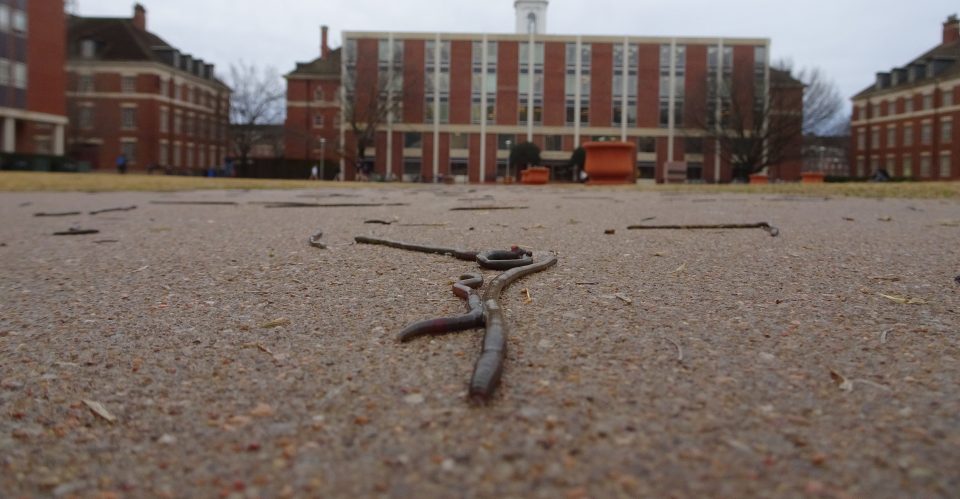
Asian jumping worms are somewhat new to the United States, said Scott Loss, associate professor with Oklahoma State University’s Department of Natural Resource Ecology and Management.
“While no systematic surveys have been done, I have found them around the OSU campus
in Stillwater, as well as a few spots in eastern Oklahoma,” Loss said. “Although not
currently a significant concern in the state, these aren’t your regular earthworms.
They multiply more rapidly than other species, but the real difference is they can
devour organic material quickly, which can alter the soil structure and chemistry
of land. Their movement also differs in that they move and thrash around like a snake.”
In addition to the Asian jumping worm, Loss said other species of non-native earthworms,
primarily originating from Europe, are established throughout North America, including
Oklahoma. These groups also have documented negative effects on the environment.
Most earthworms burrow in the soil, but jumping worms and other non-native species,
such as those in the genus Aporrectodea, feed on or near the surface of the soil and
may have negative effects on the soil and plant growth, said David Hillock, OSU Extension consumer horticulturist.
“They like to feast on leaf litter and are known for leaving castings (earthworm feces)
behind,” Hillock said. “Mulch is another favorite food source. Be aware they can eat
two to three times their body weight every day. Because of their eating patterns,
jumping worms and other non-native species can cause an imbalance in soil nutrition,
which can disrupt the natural ecosystem and home landscapes.”
Removing the surface organic matter isn’t a good method of control because that poses
a risk to other organisms by eliminating their food source. Hillock said removing
leaf litter also decreases the habitat for ground-nesting birds and other species
who find refuge there.
In addition, jumping worm activity can cause changes in the physical characteristics
of soil, which can contribute to soil erosion and changes in water permeability. Soil
infested with jumping worms resembles coffee grounds and deprives other plants of
essential nutrients.
Right now, Hillock said education is the key. Jumping worms look similar to any other
earthworm except for the lighter-colored band near the anterior end of the body and
a more shiny/smooth appearance. Unfortunately, there is not currently a viable method
of control. Compounds available that might work against jumping worms would also kill
other beneficial earthworms.
The most important form of management is preventing the worms from establishing in
the first place. This can be done in the following ways:
- When purchasing bulk mulch or compost, look for a reputable producer who has heat-treated
the material. - Check property for jumping worms using a mustard pour. Mix a gallon of water with
1/3 cup of ground yellow mustard seed and pour slowly into the soil. This will drive
any worms to the surface where they can easily be removed. This mixture is safe for
plants. - Cocoons, which overwinter in the soil, are sensitive to heat and can be destroyed
with clear plastic solarization. If establishing a new garden bed, cover moistened
soil with a sheet of transparent polyethylene for two or three weeks until the soil
temperature exceeds 104 degrees Fahrenheit for at least three days. - If you discover a small population of jumping worms, handpick and destroy them by
placing in a sealed bag or container and freezing them, then throw away the sealed
container. - Don’t buy or use jumping worms for bait, vermicomposting or gardening. This can allow
them to invade new areas. Note that some of these worms are marketed with native-sounding
names, such as Texas jumpers or Alabama jumpers. Consumers are advised to avoid purchasing
those worms. The most widely used compost worm, commonly known as red wiggler, isn’t
able to survive and establish self-sustaining populations if released into the wild,
so this is the recommended one to use.
Loss said jumping worms and other non-native species are widely used for fishing bait.
“While we can’t realistically prevent use of these species for bait, we do recommend
disposing of unused bait rather than dumping on the ground and establishing a new
invasion,” he said.
Loss provides more information about invasive worms on this episode of OSU Agriculture’s Oklahoma Gardening television program, as well as on his website.
