

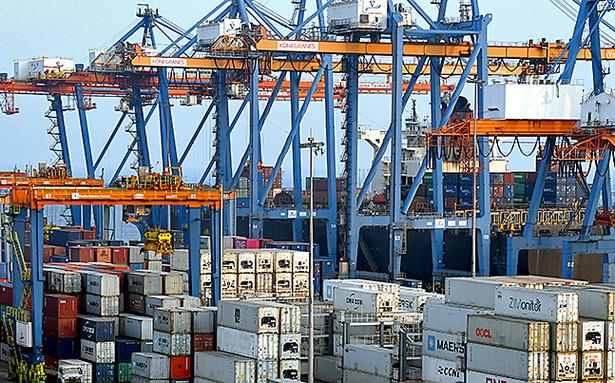
Central Board of Indirect Taxes and Customs (CBIC) has come out with a Time Release Study (TRS) for 2022. TRS is a tool to measure the time taken for completing the regulatory and logistics processes involved in clearance of import/export consignments. Customs plays a pivotal role in regulatory functions with Participating Government Agencies (PGAs) including but not limited to Plant/Animal Quarantine authorities.
Private stakeholders like terminal operators, transporters, Container Freight Stations (CFSs), Customs brokers, etc., perform logistics functions. The role of importers and exporters too are important. TRS, while measuring these functions through time stamps, also identifies bottlenecks and suggests corrective actions. This study in CBIC started in 2013.
Since then it has come a long way in terms of expansion in scope, standardisation in methodology and in-house capacity. In terms of Article 7.6 of Trade Facilitation Agreement (TFA), “Members are encouraged to measure and publish their average release time of goods periodically and in a consistent manner, using tools such as, inter alia, the Time Release Study of the World Customs Organization (referred to in this Agreement as the WCO)”.
The 2022 report of CBIC unfolds the performance of Customs and other players in the supply chain ecosystem by drawing inferences from data-driven sources in an impartial manner. The study has been conducted by a team of officers from CBIC by collaborating with stakeholders.
To enable a trade-friendly environment, government of India has put in place National Trade Facilitation Action Plan 2020-2023 containing and envisaging measures to reduce the overall release time associated with the clearance of goods both on import and export side with the following time lines:
Imports — less than 48 hours for sea/ICD/ICP and less than 24 hours for air.
Exports — less than 24 hours for sea/ICD/ICP and less than 12 hours for air
To ascertain the extent to which these time lines have been achieved, TRS has taken up a study relating to 61,976 import declarations known as Bills of Entry (Bs/E) and 50, 656 export declarations known as Shipping Bills (S/Bs) filed for a period of one week from January 1-7, 2022, and made a comparison of the same with 53,844 Bs/E and 34,722 S/Bs for 2021.
Average Release Time (ART) of these declarations have been measured by considering the time taken for release/clearance of the cargo right from the time of its arrival. Arrival to release of cargo is not a single step process. Instead, it is segmented into a series of stages and time taken for completion of each such stage is measured to arrive at the ART. The spread of the study spans across 15 ports — four sea ports, six air cargo complexes (ACCs), three inland container depots (ICDs) and two integrated check posts (ICPs) under four broad categories.
Data generated from different sources has been refined to draw tangible inferences. It is also fascinating to note the resilience shown by the trade despite pandemic situation, rising freight costs and shortage of containers globally.
The study covers release time relating to both imports and exports. Coming to the import side, the study reports an improvement in port-wise ART for 13 out of the 15 ports when compared with 2021. ART for seaport has dipped from 108 hours in 2021 to 95 hours in 2022. In the case of ACC, ART for 2022 is 49.56 hours vis-a-vis 59.29 hours in 2021. ICDs and ICPs have clocked 89.39 hours and 17.07 hours respectively.
It may also be noted that over the last five years, the average release time in Nhava Sheva has halved from 181 hours in 2017 to 88.23 hours in 2022, a testimony to our commitment towards trade facilitation.

The study also analysis the impact of Direct Port Delivery (DPD) on ART. DPD is a facility extended to trusted importers to move their containers from terminals to their warehouses without transiting through CFSs. Such DPD containers are found to have a better ART than the ones that are moved to CFSs for clearances.
Significant progress has been made in Mundra seaport wherein DPD container release time has improved from 123.54 hours in 2021 to 52.54 hours in 2022, while Chennai leads with an ART of 47.54 hours as against 122.31 hours of ART for non-DPD containers moved to CFSs.
In this regard, it is noteworthy to recall Prime Minister Narendra Modi’s inaugural address at the Maritime India Summit on March 2, 2021, that made specific reference to DPD and Direct Port Entry (DPE). A paradigm shift in stakeholders’ preference for DPD has the potential to significantly reduce release time.
On the export side too, there has been remarkable improvement on some of the processes. These benchmarking has been possible by reducing the layers of transaction through the initiatives of CBIC that has done away with static time-consuming assessment and inspection cycles. Credit should be recognised with the way Customs formations have steadily and systematically shrunk the dwell time and have enhanced the speed of cargo release. PGAs and trade too deserve their share of appreciation.
Way forward
This study of TRS is comprehensive and indicate definitive patterns of a process involved in clearance of cargo. The study will serve the purpose when it is widely discussed and debated by the stakeholders. Penal provisions imposed for delayed filing of Bs/E and duty payments have facilitated faster filing of documents and expeditious realisation of duties to Customs. Instead it should be a voluntary process so that it sets in a healthy trend — both for department and for importers.
TRS should attempt a detailed impact analysis relating to specific trade facilitation measures that were initiated with an aim to achieve reduced release time.
While time has been measured, the scope can be widened to include cost-benefit analysis also.
At times, some traders abuse facilitation measures, which calls for action. Thus, the balancing acts of facilitation and enforcement are not without challenges.
The writer is OSD to Chairman CBIC. Views are personal
Published on
April 28, 2022
