

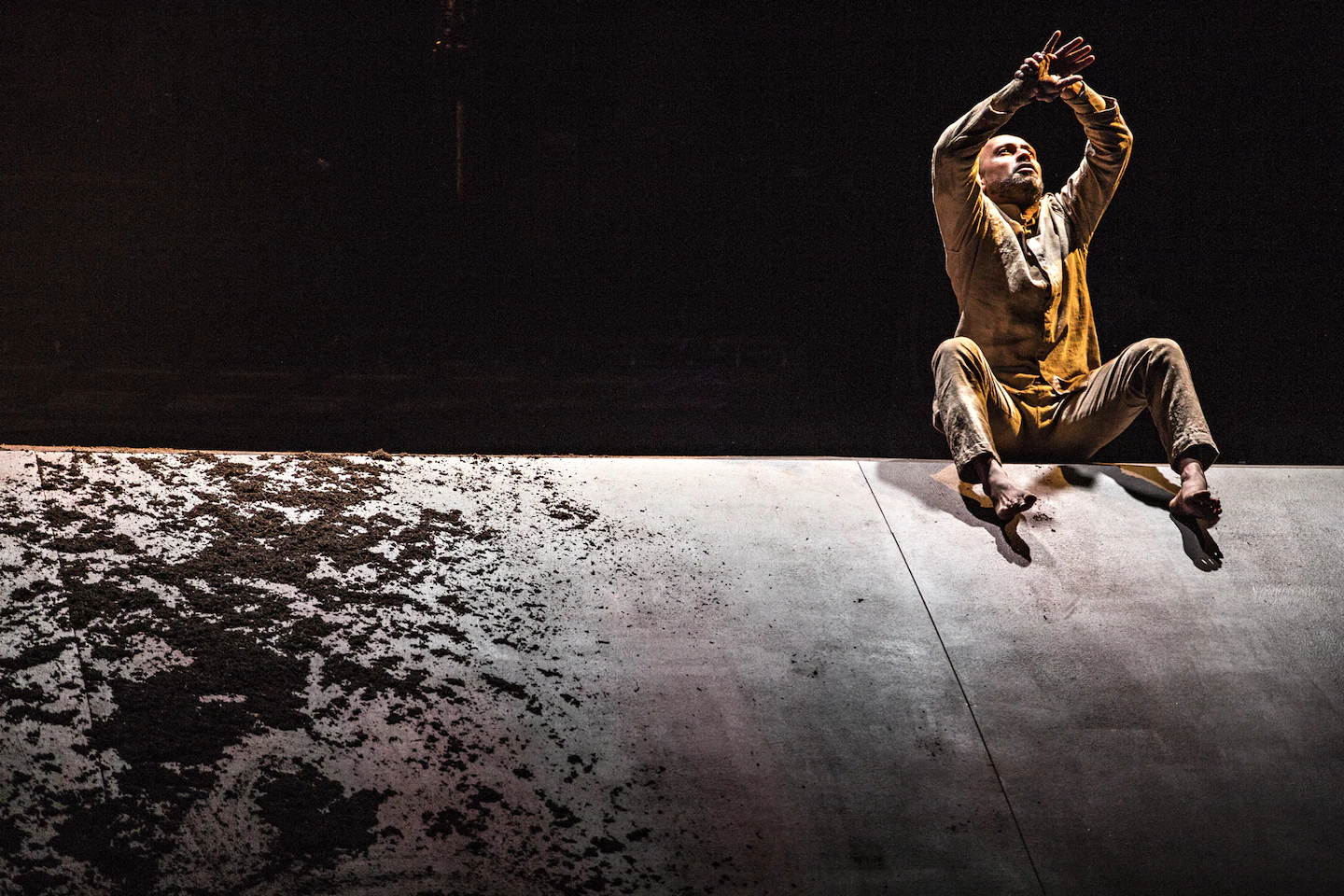
Khan’s production fell victim to the massive supply-chain bottlenecks causing shortages of goods throughout the country. In this case, the backups left Chicago dance lovers disappointed, and Khan and his accompanying artists suffered a six-figure revenue loss and a great deal of heartache, given the agonizing postponements of 2020 and that Khan, 48, is not likely to tour another strenuous solo work again.
“Those are the incalculable losses beyond the money,” said John Luckacovic, Khan’s North American tour manager.
But shipping woes are only some of the troubles dance groups face as they get back on the road to perform. Arriving at this point after nearly two years without in-person audiences has been challenging enough, with revenue drying up, salaries reduced or eliminated, all under the persistent health threats unique to dance, with its reliance on bodies moving together in time and space. Training and creative processes have been profoundly strained. Now there are new hurdles. To better understand the pressures facing these artists and how they’ll affect audiences, I spoke with presenters, consultants and company leaders about what’s happening now, and what the longer-term story may be.
Fewer international groups
Recent visa delays, quarantine policies and vaccine requirements have caused international troupes to cancel or postpone. The Kennedy Center, which, along with arts presenters worldwide, had to cancel most offerings between spring 2020 and last fall, scratched two foreign ballet companies from this season’s list. First, the National Ballet of China pulled out of its January booking. Traveling to the United States meant “they’d have to quarantine for three weeks after going back to China,” said Alicia Adams, the arts center’s vice president for international programming and dance, “and they didn’t want to do that.”
Next, the famed Mariinsky Ballet of St. Petersburg had to scrap next month’s run of Balanchine’s “Jewels” when the coronavirus vaccines the company received failed to meet approval by the World Health Organization, as is required, Adams said. Conversations about canceling “had nothing to do with Ukraine,” she said, and were going on long before Russia’s invasion. The center is talking to the Mariinsky, Adams added, “about future seasons. We hope to get them back.”
The Cuban contemporary dance troupe Malpaso faced a similar vaccine issue before its planned U.S. tour (and did miss several stateside performances in January and February). To avoid even more delays, it sought approved vaccinations from a country that didn’t require entry visas. Serbia turned out to have the perfect mix, where dancers could get the shots and keep in shape in the weeks between doses.
Linda Shelton, director of New York’s Joyce Theater, had to cancel Malpaso’s winter dates and is working to reschedule the group for next fall. She praised Serbian dance presenter Aja Jung, who directs the Belgrade Dance Festival, for helping the Cuban company overcome the vaccination problem “by arranging rehearsal space and some showings.” This, Shelton said, is an example of how presenters have come to rely on one another to help solve some of these problems. Malpaso is still on track for its spring dates (including an April 27 appearance at the University of Maryland).
Yet as navigating restrictions on foreign visitors has grown ever more complicated, some presenters, understandably, are avoiding the headaches. As a result, “nobody wants to work with international artists,” said Luckacovic. “Presenters who we have excellent relationships with suddenly said, ‘We’ve got to book stuff closer to home, because we can’t deal with all these issues.’ ”
In general, sales are down for performing arts across the country, presenters and company officials say. This may be a good time to snag tickets to “Hamilton,” with Broadway shows offering more availability than before the pandemic. According to the Broadway League, the trade association for the Broadway industry, 80 percent of seats for most Broadway shows have been filled to date since the season began last fall.
This is down from non-pandemic years, when sales would have been a little higher in February, said league president Charlotte St. Martin. “And our biggest season is November and December,” she added, “which we didn’t get to have.” Those months saw the rise of the omicron variant, when a number of Broadway shows had to close because entire casts tested positive for the virus.
But song-and-dance shows such as the Michael Jackson musical, “MJ,” “Moulin Rouge!” and “The Music Man” are going strong on Broadway. “They’re full of dance,” St. Martin said. “And I don’t see that changing.”
The Kennedy Center has seen about a 25 percent drop in ticket sales for dance offerings, according to Adams — though subscriptions for its ballet and contemporary series are “about on par from pre-pandemic times,” she said. At Jacob’s Pillow, the long-running dance festival in Becket, Mass., membership so far is up over 2021, according to Pamela Tatge, the festival’s director.
At George Mason University, the Center for the Arts’s concert hall was about half-full for each of Mark Morris Dance Group’s two shows last month, which is “pretty spot on with where we’ve been for all our performances,” said Adrienne Bryant Godwin, the center’s director of programming. “Absolutely everyone’s buying last-minute, across the board. It is a nail-biter every week.”
Of course, it stands to reason that ticket sales are low. Given the pandemic, people have more than enough reasons to think twice about sitting in a theater — if they’re thinking about it at all.
“If you’ve spent two years not going to the theater, do you really need it in your life? So many people have evaluated their lives and made changes,” said Nancy Umanoff, executive director of Mark Morris Dance Group. “People have completely different lifestyles now. If they’re not in their offices, they’re not going to that restaurant after work and then on to the theater. All of that impacts the ecosystem of the arts.”
Michael Kaiser, chairman of the DeVos Institute of Arts Management and former Kennedy Center president, said the drop in ticket sales reflects a hesitancy playing out across many leisure activities.
“Everyone is managing their own personal risk, so they’re saying, ‘What’s worth it, what am I really going to take a risk for?’ That includes going out to eat, to a performance, to a movie,” he said. “When you average that cutback across the country, you end up with much lower attendance levels.”
More Haydn, at least for now
For presenters, dance can be expensive. The venue might need dozens of stagehands and one or two days to load in a dance production, along with expensive lighting and sound setups. Some dance advocates are seeing multidisciplinary presenters make other choices, requiring fewer crew members, costs and complexities.
“They’re dealing with string quartets instead,” Luckacovic said.
‘We can’t be boring’
As government funds have diminished and audiences are less than robust, many dance companies are leaning hard on donors. They’re in a tough spot, though, having relied on their most loyal donors during the months of shutdowns. That generosity may now be tapped out, but finding other donors can be tricky without new, exciting art with which to entice them.
Companies “will have to work really hard to meet new people and cultivate new donors, do interesting work, and compete well and market hard,” Kaiser said. “They need to be very aggressive in this next year if they’re going to find new resources.
“Even under the most optimistic scenario where covid evaporates, it’s still going to take time for audiences to come back to where they were before,” he added. “I’m optimistic in the long run. But in the next year we won’t have the same level of ticket sales as before the pandemic. I think eventually we will, but not over the next 12 months.”
Kaiser said his chief concern is that companies “will get conservative and boring.” Programming the familiar standards — the “Swan Lakes” and such — might sell tickets in the short term but won’t bring notice on the national stage as compared with a new and ambitious work.
Godwin, at George Mason University, agreed. “For the time being, we might not be able to do the same number of performances,” she said. “That’s probably okay. We need to focus more on work that’s impactful.”
The Brooklyn Academy of Music is aligned with this thinking in presenting Mark Morris’s grand-scale modern-dance production “L’Allegro, il Penseroso ed il Moderato,” March 24 to 27. This infrequently performed full-length work, accompanied by Handel’s oratorio of the same name, requires supplementary dancers, a chorus, live music and expansive space for its layered, color-drenched scrims. An explosion of dance, space, light and rapturous feeling, “L’Allegro” makes a magnificently optimistic statement about the power of human fellowship to lead us out of dark times.
The excitement factor of a bold production such as this is key because arts organizations aren’t just competing with other arts organizations. They’re competing with every other form of diversion: theme parks, cruise lines, movies. Kaiser predicts that those deep-pocketed industries will be coming on strong for your entertainment dollars.
“Everyone whose income was depressed in the pandemic is going to be marketing, and the marketing activity will be huge,” he said. “That’s not simple to address as a dance company, so we can’t be boring.”
For the future: ‘Hybridity’
Look for dance groups and venues to experiment with “hybridity,” the new buzzword. It’s a mix of live, in-person shows and digital versions. Many venues find themselves with a digital crew now, and are seeking to use it. At George Mason University, for example, the full-time, salaried crew became video producers during the pandemic’s shutdown phase, Godwin said. To move digital content online when live shows were canceled, she added, “we bought cameras, and our audio and lighting engineers became video editors. Everyone gained new skills.” The question now is: “How is digital going to play into our programming?”
Every venue and company I spoke with is grappling with the same question.
At the Kennedy Center, “we haven’t quite figured out how to make it work and how audiences will deal with it,” Adams said. “But it’s going to be there.” She’s envisioning streaming live performances and offering works that are available only online.
Digital viewers and in-person audiences seem to be largely separate groups that don’t intersect much. At Jacob’s Pillow, Tatge said, there is only about an 8 percent overlap between the two audiences. “But our digital presentations reached 66 countries,” she said. “What that tells us is there is an audience that’s hungry for Pillow content that may never make it to Becket, and we feel a responsibility to serve that audience. It’s also a younger and more diverse audience, and that’s exciting.”
With distancing requirements blowing up the way dancers rehearsed, many choreographers learned to use digital tools to create work, and we’ll probably see some of this continue.
Liz Lerman, the longtime D.C. choreographer who teaches at Arizona State University, used the shutdown period to create dances for the laptop, reworking parts of her new production. It’s called “Wicked Bodies,” and it reflects on the way women throughout history have been seen as witches, evildoers and wielders of often-frightening power.
“I didn’t make dance for film, I made dance for the computer, to be seen with a glass of wine,” she said. She also found other ways to show the work: In a Jacob’s Pillow event, she engaged in a discussion with Tatge and showed rehearsal footage. (She’ll also present the full stage work at the Pillow in August.) She led rehearsals outdoors and on Zoom. With these hybrid activities, she was able to build her project and — importantly — pay her dancers.
“We were surviving an extinction, in a way,” she said. “You need to be a generalist, not a specialist, and you need to be adaptable.”
But Lerman isn’t entirely sold on merging digital and live performance. “Now that I’m back in rehearsal, trying to put ‘Wicked Bodies’ onstage, it’s hard, because we’d found a way to tell this story that works. Now we’re debating, do we show a bit of video when we’re in the theater?”
The question is whether translating the work from screen to stage has artistic value. “It’s a challenge,” she said. “Time will tell if it’s a great challenge, or just a good one.”
Taking a hard look at touring
Dance companies have traditionally counted on touring for revenue from presenters’ fees and associated activities such as teaching and residencies. Tours also bring in new donors and increase visibility. But some dance leaders are questioning whether touring is viable in the longer run.
“I think there’s going to be a look at touring in general, and I don’t know how that’s going to play out,” said the Joyce Theater’s Shelton. “There are concerns about climate change and the environmental footprint. I think there’ll be attention paid to that.”
Akram Khan, whose U.S. tour of “Xenos” was complicated by its elaborate scenery, has already been thinking of this. His new work, “Jungle Book Reimagined,” premieres April 7 in Leicester, England. The set is minimal: scrims, projections and animation. It can travel as excess baggage on a flight.
No shipping containers needed.
