

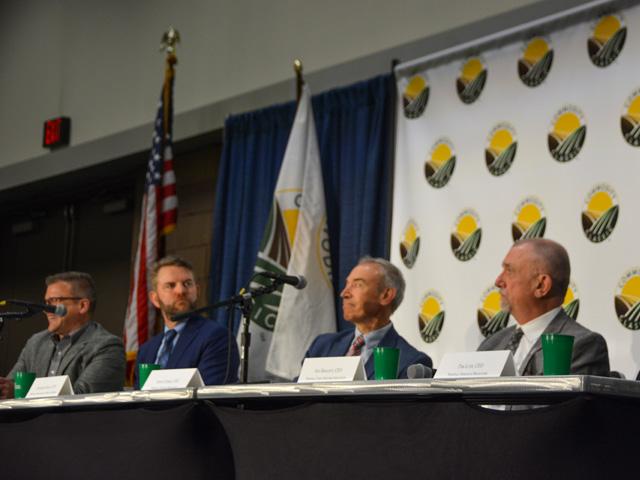
Goule added, “A lot of the cover crop programs that they’re working on implementing are not going to be available to over 70% of wheat growers because that 70% is winter wheat,” Goule said.
Tim Lusk, CEO of National Sorghum Producers, said sorghum growers are having discussions about the fine details of the program, pointing to geographical differences across regions as well. Lusk said sorghum farmers have been working with USDA’s Natural Resources Conservation Services on programs related to carbon sequestration or emission reductions.
“And it’s something that we believe there’s a future there, but I think we have to understand that this is a learning process … I hope it’s not seen that we have all of the answers because I think certainly, from our crop’s standpoint, there are still a lot of questions that have to be answered as part of this process.”
INPUT CHALLENGES
Doggett said the biggest issue he hears about now from corn farmers is fertilizer prices and he said there should be some type of investigation into fertilizer markets.
“We are very concerned about the fertilizer markets, how fertilizers are imported into this country, and the companies that produce those products,” Doggett said. “We are working hard to address that.”
Doggett said there needs to be “some kind of investigation” into what’s really happening with fertilizer markets and supply chains. The situation creates significant uncertainty “at a moment when the world’s going to need us to maximize our productive potential.”
Doggett added farmers are becoming increasingly innovative about how to use less fertilizer in their operations.
Doggett later noted, “Imagine what the nightmare would be for corn if for prices you had a three in front of it instead of a seven, and you have all of these input costs,” he said. “It would be a whole different world today.”
Lusk said all of the organizations are looking at ways to address fertilizer costs. Farmers could be facing a “perfect storm” when it comes to crop improvement tools. Lusk also pointed to problems with steel shortages, labor and trucking.
“So, this is a multi-faceted problem and one we’ll have to work through,” he said.
Steve Censky, CEO of the American Soybean Association and a former deputy USDA secretary under the Trump administration, said his growers are concerned about how the Biden administration’s EPA makes decisions on crop protection tools that farmers rely on.
“Our message to them is, don’t be making a decision to take tools away when we already have high herbicide costs and availability quite low,” Censky said. “We can’t be taking those tools away from farmers because that will just add to the supply chain issues.”
Censky added, “Same thing on the fertilizer side. We’ve seen phosphate and potash prices double. We’ve seen nitrogen prices tripled.”
That’s one reason ASA, NGCA, NAWG and NSP have each tried to appeal to the International Trade Commission to rescind import tariffs placed on phosphate from Morocco, as well as opposition to putting tariffs on nitrogen products from Trinidad and Tobago that are under review. “It just does not make any sense and the economic circumstances just don’t warrant that,” he said.
FARM BILL
Depending on the outcome of the fall elections, the House Agriculture Committee could have more than half of its members who weren’t around for the 2018 farm bill vote, Goule noted. That would require spending a lot of time in 2023 just educating newer members about the various titles of the farm bill and programs involved in each area of USDA.
NAWG likely will wait until this summer to focus more on farm bill policies, but Goule and Censky both pointed out the need to raise reference prices. Censky said the reference price soybeans under the Agricultural Risk Coverage/Price Loss Coverage programs, $8.40 a bushel, is so low it didn’t trigger payments even during the trade war with China that dragged down commodity prices. He also said higher production costs should factor into reference prices as well.
“I think that has always factored into how Congress has set (reference prices),” Censky said. “It’s not necessarily only based on cost of production, but it’s one of those factors that Congress has always traditionally considered in setting those reference prices, or target prices, previously,” Censky said.
Goule added that farmers were seeing higher production costs even before the Russia-Ukraine conflict and the farm bill should protect against those higher production costs. “Reference prices have got to be able to come more in line with what our true cost of production is,” Goule said. “Otherwise, it’s not a true safety net.”
Chris Clayton can be reached at [email protected]
Follow him on Twitter @ChrisClaytonDTN
(c) Copyright 2022 DTN, LLC. All rights reserved.
