


Oak processionary moth (OPM) (Thaumetopoea processionea)
Oak processionary moth (OPM) (Thaumetopoea processionea)
What is OPM?
The caterpillars of oak processionary moth (OPM) infest oak trees, eating (defoliating) the leaves, weakening the tree and leaving it vulnerable to other threats. The OPM nests and caterpillars are also a hazard to human and animal health.
OPM was first identified in London in 2006 and has spread to some surrounding counties including Surrey and other parts of south east England. See the latest .
OPM moths spread by flying from one tree to the next. Normally they stay close to the tree they were on as a caterpillar.
How to identify OPM
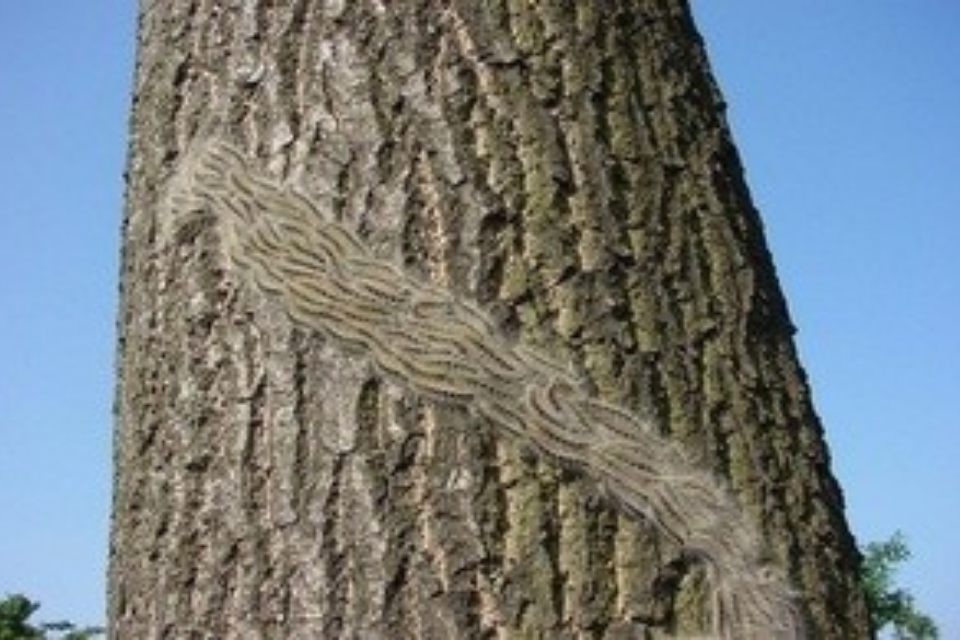
Late spring and early summer are the best times to spot OPM caterpillars and their new nests. The caterpillars have black heads and bodies covered in long white hairs. The caterpillars usually move nose-to-tail in a procession, hence their name.
If you have reasonable eyesight, you should be able to spot the caterpillars and nests, although binoculars are useful.
Nests are typically dome or teardrop-shaped, ranging in size from a 50 pence piece to a rugby ball. They are white when fresh, but soon become discoloured and brown. Nests are usually found in early summer, in the trunks and branches of oak trees.
Do not touch or get close to the caterpillars or nests. They contain hairs which can cause itchy rashes, eye and throat irritations and occasionally breathing difficulties in people and animals. The hairs can be blown about in the wind.
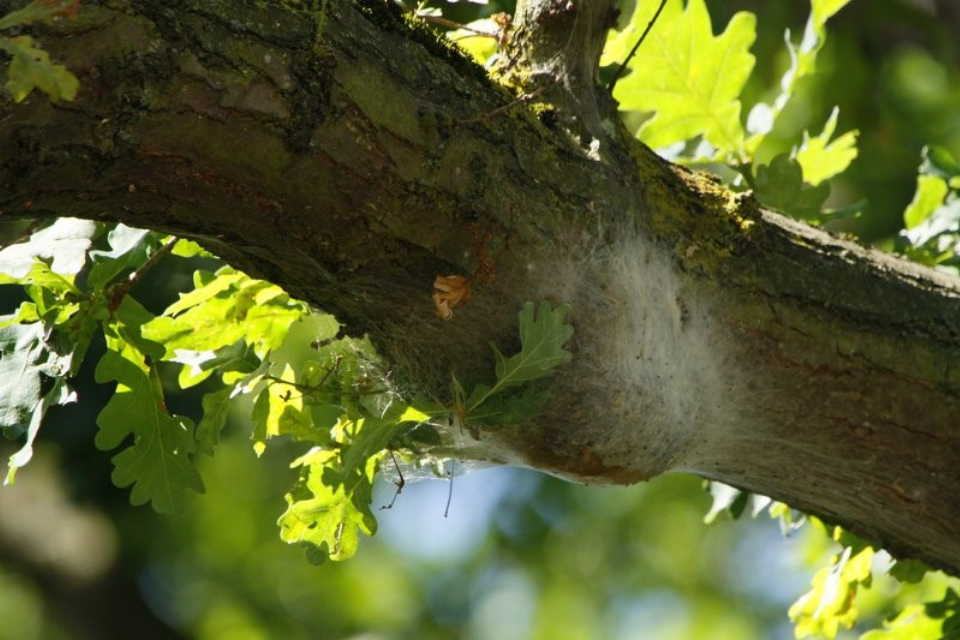
Oak processionary moth nests
Caterpillars
The caterpillars have black heads and grey bodies covered in long white hairs. Use the to help you identify them.
The caterpillars are only about 2mm long when they emerge in Spring, and tend to remain high in the trees until they are older and larger. When they reach 1cm long they develop the irritating hairs. They’re fully grown at 2cm long.
They usually move nose-to-tail in a procession, hence their name. You may be able to see them on all parts of the tree – on the trunk, branches and leaves, and also on the ground.
You’re less likely to find them on fences, walls or similar structures such as garden furniture.
How to report sightings of OPM and what happens after you file a report
Any sightings should be reported to the Forestry Commission via the Tree Alert online form. Alternatively, people can email [email protected] or call 0300 067 4442.
The Forestry Commission may issue you with a Statutory Plant Health Notice (SPHN) asking you to take action. This document will explain what action is needed.
In general, the Forestry Commission will take charge of treating infested trees in the buffer and Pest Free Area. You can view these areas on the . These areas come into force on 1 March 2022.
YouRemoving nests and caterpillars is a hazardous operation, you- a professional will need to do this. You can find a professional on the Arboricultural Association website. They may spray the trees with an approved bio-pesticide or insecticide.
Risks of OPM
Do not touch or get close to the caterpillars or nests. They are a hazard to human and animal health.
OPM caterpillars and nests affect the health of people and animals, as they contain hairs which can cause itchy rashes, eye and throat irritations and occasionally breathing difficulties in both people and animals.
In rare cases the hairs may cause an allergic reaction. You can become sensitised by repeated exposure to the hairs, worsening your symptoms.
People or animals can come into contact with OPM hairs if they touch OPM caterpillars and their nests, brush past tree bark or walk through grass with hairs sticking to them, or are near infested trees – hairs can get blown about in the wind.
Animals can get hairs on their paws, and hairs can also get into their mouth and nose by sniffing, licking and picking up caterpillars or nests causing irritation. Livestock and horses can come into contact with hairs on the grass or other plants they eat, and by grazing close to a fallen nest.
The greatest risk is between May to July when the caterpillars are active. Although the risk is possible at any time of year due to hairs from old nests.
Reduce risk to people and animals
To avoid contact with the hairs, make sure you, and people or animals in your care, do not touch or go near nests or caterpillars.
Removing nests and caterpillars is a hazardous operation, you should call a suitably qualified arborist or pest control expert to remove infestations from your trees.
If you work on or close to oak trees in the affected areas, you need to take care and use protective measures, such as personal protective equipment (PPE). Read the guide on how to plan and manage risk of OPM for more information on controlling it and the PPE you need.
What to do if exposed
If you or someone in your care has a serious allergic reaction, get medical help. For less severe reactions, a pharmacist can provide advice on relief from skin or eye irritations.
If an animal in your care is seriously affected, get advice from a vet.
Tell the medical person or vet you suspect it is due to OPM contact.
You should report OPM via the Tree Alert online form, and let your neighbours who have oak trees know that they might also have an OPM infestation.
Further advice is available from the NHS Choices website and the blue cross for pets.
How to manage OPM
Forestry Commission leads an annual programme of work to manage OPM. The actions required under the programme will vary depending on where your site is located.
There are currently three areas or zones described below.
Pest free area
This area is officially designated free from the pest and covers most of the country. In this area government funds an extensive programme of surveillance to monitor for OPM and help demonstrate pest freedom. Any outbreaks of OPM found in the wider environment within this area are managed by government with the objective of eradicating the outbreaks.
Buffer zone
In this area there is an annual OPM programme of surveillance and control, led by Forestry Commission. This programme involves detecting the pest and treating infested oak trees (and those trees in close proximity). If you own an infested oak tree in the buffer zone, the Forestry Commission may issue you with a Statutory Plant Health Notice (SPHN) asking you to take action, and in most cases support is currently available for treatment of trees within this zone. The SPHN document will explain what action is needed.
Established area
This is the area where OPM is established. In this area landowners are responsible for the management of OPM on their land, however guidance is available on the OPM hub. If you own an infested oak tree in this area it is recommended you find a professional on the Arboricultural Association website to remove the hazardous material. They may spray the trees with an approved bio-pesticide or insecticide. The most effective time to do this is April to June. You should still check for OPM every year.
The OPM management zones are being updated for the start of the OPM 2022 season and a new map showing these zones can be found on the to help landowners plan OPM management. The management zones will come into force on 1 March 2022.
If you own or manage oak trees, you should use the Oak Processionary Moth: plan and manage risks guidance to help plan and manage the risks from OPM.
Restrictions on trade and movement of oak trees
To protect the country against OPM through movement and imports, OPM is regulated as a quarantine pest and legislation is in place to protect oak trees against the pest.
No imports of oak trees from outside the EU are currently permitted.
The import of large oaks (which are susceptible to OPM) from EU countries is also prohibited, unless they originate in a pest free area, a country where OPM is not known to occur, or have been grown under physical protection throughout their life. The legislation applies to oak trees (Quercus L), with a girth at 1.2m above the root collar of 8cm or more as these trees represent the greatest likelihood of introducing OPM.
The legislation requires that imports into the GB Pest Free Area from EU countries and movements within GB can only take place if the oak trees concerned:
- have been grown throughout their life in places of production in countries in which OPM is not known to occur
- have been grown throughout their life in a Pest Free Area for OPM, established by the national plant protection organisation in accordance with ISPM No. 4
- have been grown throughout their life in a site with complete physical protection against the introduction of OPM and have been inspected at appropriate times and found to be free
The requirements apply to movements within GB, and therefore movements of large oak trees (with a girth at 1.2m above the root collar of 8cm or more) from the buffer and established areas into the Pest Free Area are prohibited unless they have been grown throughout their life in a site with complete physical protection and have been inspected.
The OPM management zones are being updated for the start of the OPM 2022 season. The will come into force and replace the existing boundaries on 1 March 2022 and a in the buffer and established area is also available.
What support is available
In 2022 two pilots are operating within the established area:
- OPM facilitation pilot grant scheme under the Tree Health Pilot, to enable better coordination between landowners at a local level
- support for private residents with small numbers of oak trees to help with costs of treatment of oak
Residential owners in the established area can apply to participate in the pilot for help in treating trees to manage OPM. You must be in the established area. Check the to see if you are eligible. The offer is only open to residential properties that have four or less oak trees. To be eligible, your tree also had to have an Oak Processionary Moth (OPM) infestation in 2020 and/or 2021 or have been within 50 metres of an oak tree with OPM. The trees must be at least 2 metres tall. The offer is open until 9am on 21 February 2022. Find out more information.
Further information about OPM is available:
If a site is subject to a designation such as Site of Special Scientific Interest (SSSI), or might contain European Protected Species, additional rules apply. See guidance from Natural England.
Guidance is also available from the Tree Council for local authorities and larger landowners on preparing an action plan to manage OPM.
Advice about stings and bites is available on the NHS website.
You can also receive updates from the Forestry Commission’s OPM control programme, which are available throughout the season through regular OPM programme newsletters.
