

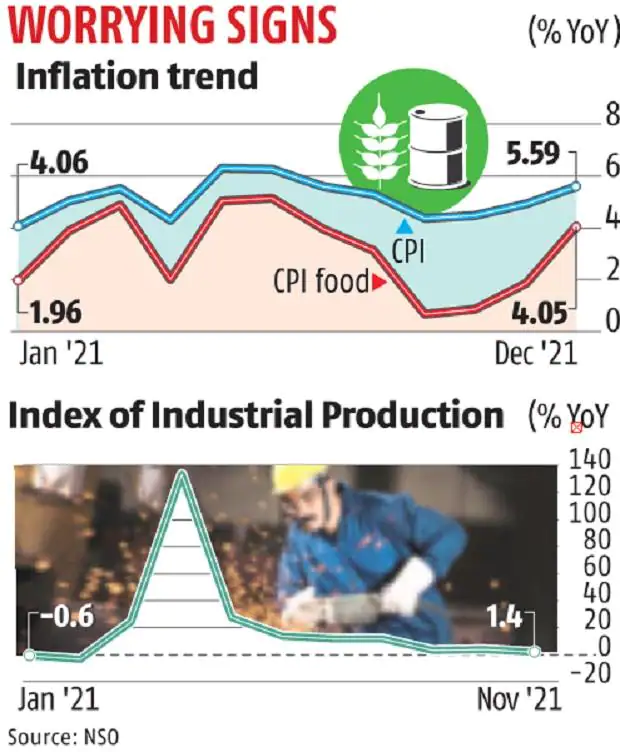
In a double whammy for the economy, India’s retail inflation rate shot up to a five-month high in December and industrial output growth decelerated to a nine-month low in November, signalling that economic recovery remains fragile.
The final set of macroeconomic indicators before the February 1 Budget may convince Finance Minister Nirmala Sitharaman that the government would need to continue doing the heavy lifting through higher spending to support growth momentum.
The data released by the statistics department showed that the retail inflation rate, as measured by the Consumer Price Index (CPI), surged to 5.59 per cent in December from 4.91 per cent a month ago. Growth in factory output, as measured by the Index of Industrial Production (IIP), on the other hand, slowed to 1.4 per cent in November compared to 4 per cent in the previous month. Core inflation, which excludes the volatile food and fuel prices, remained above 6 per cent for the third consecutive month in December.
The rise in retail inflation was primarily led by food and beverages, and clothing and footwear, with moderation in the prints for fuel and light amid a slight dip in miscellaneous items and housing.
Aditi Nayar, chief economist at ICRA, said that while the retail inflation rate has hardened sharply between November and December, the uncertainty triggered by the third wave is sure to take precedence when the Monetary Policy Committee (MPC) meets next month. “We now see a negligible likelihood of a change in stance or reverse repo hike in the February policy review. The duration of the current wave and the severity of restrictions will determine whether policy normalisation can commence in April, or be delayed further to June. With a higher inflation target, the MPC can choose to prioritise growth revival for much longer than other major central banks, for many of whom inflation control has become a pressing policy focus,” she said.
For industrial output, all sectors such as manufacturing (0.9 per cent), mining (5 per cent) and electricity (2.1 per cent) were below the pre-Covid level of February 2020. Both capital and consumer durable goods, despite a favourable base, contracted by 3.7 per cent and 5.6 per cent, respectively, in November.
Sunil Kumar Sinha, principal economist at India Ratings, said it appears that the nascent industrial recovery is still facing headwinds, resulting in all the sectors at the use-based level falling short of the pre-Covid level.
“The economy is still in the midst of both anaemic investment and consumer demand. With the rise in Covid cases driven by the Omicron variant and subsequent restrictions imposed by the local/state government will not only accentuate the uncertainty but would adversely impact the normalisation of economic activities. Therefore, India Ratings expects IIP growth to be in low single digits in the near term,” he added.
According to the government’s statistics department, the economy is expected to grow at 9.2 per cent in FY22, lower than the 9.5 per cent estimate by the International Monetary Fund as well as the Reserve Bank of India. Most economists, however, believe that the official GDP data has overlooked the imminent impact of the third wave on growth momentum.
The World Bank on Tuesday, while retaining its 8.3 per cent growth forecast for FY22, said easing supply disruptions related to Covid-19 and deficient demand led to a return of inflation in India toward the central bank’s target in late-2021. “In most economies (in South Asia), monetary and fiscal policy are expected to remain broadly accommodative in 2022, but gradually shift to a focus on fiscal sustainability and anchoring inflation expectations,” it said.
 Dear Reader,
Business Standard has always strived hard to provide up-to-date information and commentary on developments that are of interest to you and have wider political and economic implications for the country and the world. Your encouragement and constant feedback on how to improve our offering have only made our resolve and commitment to these ideals stronger. Even during these difficult times arising out of Covid-19, we continue to remain committed to keeping you informed and updated with credible news, authoritative views and incisive commentary on topical issues of relevance.
We, however, have a request.
As we battle the economic impact of the pandemic, we need your support even more, so that we can continue to offer you more quality content. Our subscription model has seen an encouraging response from many of you, who have subscribed to our online content. More subscription to our online content can only help us achieve the goals of offering you even better and more relevant content. We believe in free, fair and credible journalism. Your support through more subscriptions can help us practise the journalism to which we are committed.
Support quality journalism and subscribe to Business Standard.
Digital Editor
