

Dick Keith had a persistent and annoying problem with the 115 acres of very rough Des Moines County land he had purchased in 1991.
The ground, north of Burlington between Irish Ridge Road and County Road 99, is a series of heavily wooded ridges and valleys with a small stream, Dry Branch Creek, flowing through its center.
The problem was that Dry Branch Creek often was not dry. Throughout much of the year, there was a steady flow of clear spring water along its course that was deeply cut into the surrounding rocks. This impediment made it difficult to easily access approximately 60 acres of timber on the east side of his land.
“Every time I wanted to drive onto that part of our land, I had to worry about how much water was running along the creek,” Keith explained. “Finally, I dumped a lot of broken concrete and rocks at a crossing and, if I was careful, I could drive across it with an ATV.
“But, that was only when the water was low. It was just a lot of trouble getting to that portion of the ground.”
The rocks were not an acceptable solution for a retired engineer with time on his hands and looking for a challenge, so Keith decided to replace his rough crossing by building a bridge. But this was not to be an ordinary span. It was to be a heavy structure capable of handling large trucks and equipment.
The bridge would not be the first crossing of Dry Branch at this point. In 1897, the now-defunct Rock Island Lines railroad pushed a rail line through the valley to connect Burlington, Sperry and on to Cedar Rapids.
Previously: ‘It’s a major project’: Des Moines County Engineer details county roads, bridge plans
Those 19th-century railroad engineers faced the same Dry Branch crossing problems that were to vex Keith 120 years later. Their solution was massive cut stone abutments that would support the bridge. Those stones still stand on either side of the stream.
“Apparently, the men who worked on the rock were pretty proud of what they were doing,” Keith said. “They worked on it through 1897 and when they were through, one of the workmen carved the date into the stone and you can still see it. Then a year later, they laid the track.”
That track was to serve the Rock Island Line for 80 years until the day a local freight was crossing the bridge and snagged a piece of the span’s structural steel, toppling both freight car and bridge into Dry Creek.
The Rock Island was then teetering on the edge of bankruptcy, so there was no attempt to rebuild the fallen bridge after the wrecked freight cars were removed. The railroad was to later abandon the entire line when it entered into bankruptcy.
However, the crossing was not forgotten because the old Rock Island path across southeast Iowa was designated a part of the Hoover Nature Trail. This was to be a hiking and biking path across much of Iowa, starting at the Burlington riverfront and continuing to West Branch and then proceeding west and north to encompass much of the state.
Previously: What’s happening in Des Moines County? Supervisors talk turkey season to bridge developments
One of the challenges facing the Hoover Trail group was the collapsed bridge on Keith’s property because it would have to be re-built to accommodate bikers and hikers. At this point, Keith had bought into the project, for the idea of the trail appealed to him.
He signed onto the local group that built the bike trail running from Burlington’s downtown to the YMCA Camp north of town and then turned his energy to Dry Creek crossing near his home.
Keith put his knowledge of local construction projects to work and approached J.I. Case, which, at that time, was rebuilding part of its facilities. He had his eye on two very large beams that were coming down and, after a number of contacts with Case management, the company agreed to contribute the beams to the Hoover Trail project.
In 1996, heavy equipment made its way into Keith’s Dry Branch Creek valley to deliver two beams, each weighing approximately 6,000 pounds. The bridge had taken a big step forward, but Keith and the Hoover group continued to scour the region for additional heavy material.
The next major contribution for the bridge project came from the Burlington Northern Railroad that was replacing a rail bridge in central Illinois. After some conversation, the railroad agreed to contribute the decking timbers from the dismantled bridge.
These were heavy-duty ties, measuring between 10 and 14 feet. Each piece of creosoted oak was eight inch by 14 inches and stamped with a 1946 production date.
“The beams and decking really makes for a seriously overbuilt bridge,” Keith confessed. “But that is the material we had to work with.”
More local news: Southeast Iowa Band dedicates fall concert to Scott
The critical material for the Hoover Trail bridge seemed ready for placement, but then the project came off the tracks. Property owners along the Rock Island tracks held the first right of refusal for land if the railroad abandoned the right away, and many chose to exercise that right. They didn’t want bikers and hikers moving across their fields.
The trail project had run into a roadblock, and after a few unsuccessful court appeals, the Hoover Trail extension to Burlington succumbed. But the demise of the project left Keith in a peculiar spot because he still had no easy access to half his land and had beams and ties stacked up along side the stream bed.
The logical solution to the problem was, at that point, to simply walk away from it and make due with the rough rock crossing. But Keith had caught the bridge building fever and was not about to give up.
In 2019, he contacted environmental group Nature Conservancy and arranged to purchase the right of way they held running through his property. Keith also purchased the steel and oak the Hoover trail had left on his land.
Then, this past March, the sound of heavy equipment again echoed through the Dry Branch Creek valley as large cranes maneuvered to pick up the beams and place them atop the 19th century stone abutments that had been waiting since the rail wreck of the 1970s.
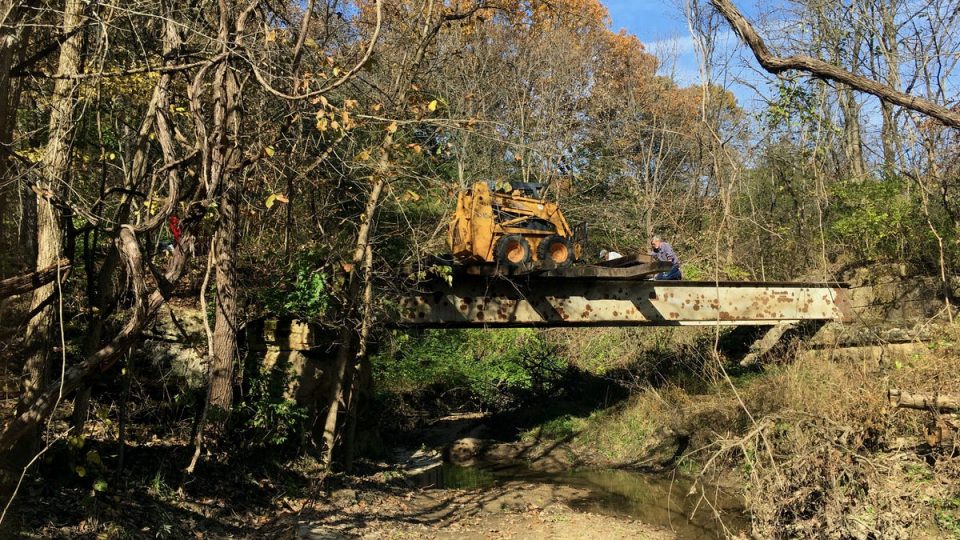
The last element in the resurrection of the bridge then took place over an early November weekend when Keith and a crew of very understanding friends, tackled the demanding task of fitting the bridge timbers into place.
It was an impressive effort by the team, with each member having an assigned function. Paul Zigler manned the measuring tape and chalk line at the pile of timber, marking alignment points for placement in the bridge deck.
Jeff Scott was at the controls of his skid loader, ferrying the timbers out onto the bridge structure and dropping them where they were manhandled and locked into position by Jim Spring and Keith.
By late afternoon of the second day, the bridge deck was complete and Keith could turn to the next task — cutting guide railings from red cedar transmission poles he just happened to have put aside for the project.
