

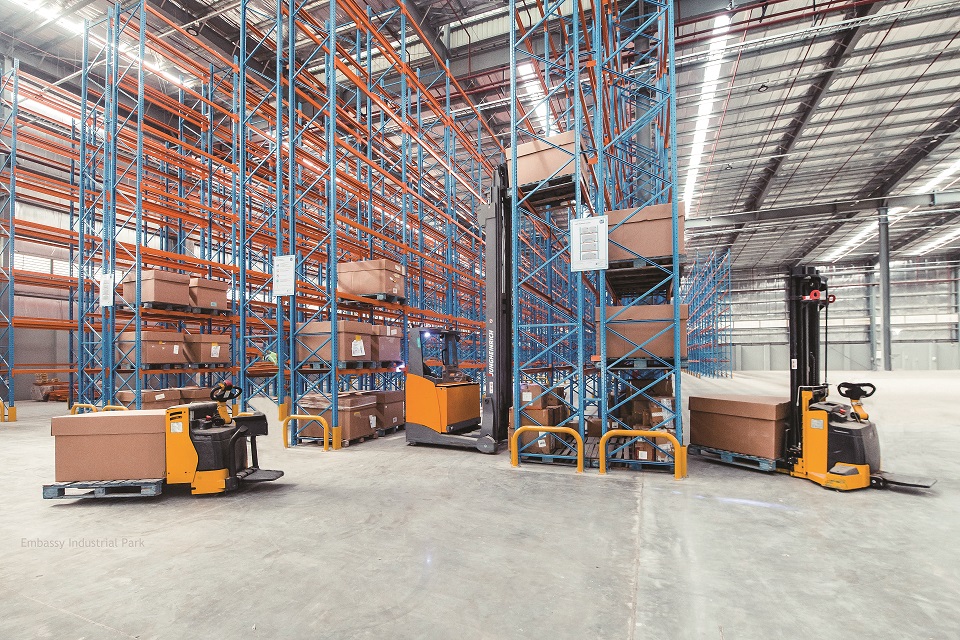
While covid-19 has brought a lull into global businesses, it has acted as a catalyst for the growth of organised retail and e-commerce. This translates into a higher demand for warehousing. The outlook for the industry seems to be positive and some industry reports have forecast a good recovery post Q4 2020 with the industry expected to pick up pace in H2 2021.
The Indian warehousing sector remained bullish in 2019, with the top eight cities – Ahmedabad, Bengaluru, Chennai, Hyderabad, Kolkata, Mumbai Metropolitan Region, NCR Delhi and Pune – witnessing a 15% y-o-y growth in total stock of Grade A & B warehousing space, according to a JLL report.
According to the same report, warehousing absorption is gradually increasing in the tier II cities as well. The cities include Guwahati, Lucknow, Jaipur, Indore, Nagpur, Hosur and Coimbatore. The demand in these cities is primarily driven by e-commerce, 3PL and FMCG occupiers.
With the largest ongoing highway project in India i.e. the North-South-East-West corridor, more industrial locations are expected to come up around the consumption hubs as NS-EW corridor will form a key part of Indian highway network and will connect many important manufacturing, commercial and industrial centres in India.
Rajesh Jaggi, VC, real estate, Everstone, says, “In 2007, we were the first ones to realise the need for organised warehousing in India, and also to cater to companies requiring Grade A industrial and logistics infrastructure. We had the first-mover advantage and pioneered modern industrial and logistics real estate with new generation parks catering to the supply chain needs of players in automotive, e-commerce, FMCG, 3PL and manufacturing, among others. Today, we have a portfolio of 36 mn sq-ft across 35 parks.”
The warehousing property business has been one of the most resilient sectors within the real estate space. With basic structures that are quick to construct, low turnover among occupants, and stable demand, the business has rewarded developers and investors with long term, low risk returns. Ajay James, CEO, Agility Logistics Parks, Asia and Africa at Agility, says, “India has traditionally been a market where firms had small warehouses in each state to minimise taxes. It is only recently with GST implementation that the concept of large Grade A warehouses in strategic hubs emerged. However, given the density of population, consumption across urban and rural areas, multiple manufacturing centres, and transportation time, large warehousing hubs will spread across the country. This is evident in the interest from institutional players who want to move from Tier 1 to Tier 2 cities.”
A valuable asset
In their own way, the government has offered a thrust to the warehousing sector by imparting infrastructure status to the logistics sector. Besides, Make in India, development of multimodal transport networks and initiatives to set up industrial corridors like Delhi Mumbai Industrial Corridor (DMIC), Delhi-Kolkata Industrial Corridor and logistics parks has attracted interest in the asset class. Aditya Virwani, Chief Operating Officer, Embassy Group, says, “The absorption in industrial and warehousing segment has increased from 13.3 mn sq-ft in 2016 to 36.4 mn sq-ft in 2019 on account of increased interest from 3PL/logistics, e-commerce, retail, etc. More than 50% of the total absorption in FY2019 was from Grade A warehouses. Reports say the supply of warehousing space in India is likely to double by 2022 with addition of 200 million sq-ft and attract nearly $10 billion investments over the next 4-5 years.”
For Vaibhav Mittal, business head, Mahindra World City & ORIGINS by MWC at Chennai, the earlier approach of building large warehouses that would cover large areas is now being re-evaluated. “The focus is on establishing multiple, optimally-sized warehouses catering to specific geographies in different parts of the region so that supply disruption is minimised. The idea is to build separate warehouses to cater to the demands of core urban areas within metro cities and peripheral urban locations. This is a gradual, work-in-progress shift that is underway.”
Grade A warehouses are compliant, green rated, technologically advanced and more sustainable, and slowly but steadily bridging the gap between India and the rest of the world. Anshul Singhal, MD & CEO, Welspun One Logistics Parks, says, “Even pre-covid-19, institutional investors had begun investing in warehousing assets globally and in India. In last 2-3 years, they have committed over $5 billion to Indian warehousing real estate alone. The reason it makes for an attractive investment proposition is that along with favourable long-term demand supply dynamics, it is one of the few asset classes that provide attractive development returns and stable long-term rental yields.”
Abhijit Verma, executive director and CEO, Avigna Space, says, “We have a long-term vision for this industry as there are three fundamentals which one needs to have or develop – Capability, Capital, and Clientele. The need for deeper market reach has been highlighted by covid-19 and the lockdown(s). With digitisation, end-consumer want their deliveries faster, and growth of markets in smaller cities, almost every sector providing goods needs to be located strategically to reach users effectively. We are looking at forming a ‘golden circle’ of warehouses to make deep inroads into catchment areas around South India.”
Strata recently concluded three deals in warehousing with investments of Rs 140 crore amid lockdown. Investment for one of the warehousing deals was closed in seven days. Sudarshan Lodha, founder, Strata, says, “Covid-19 has pushed down sentiments in real-estate, but it brought about a shift in the asset allocation of investors parking their funds. Warehousing is a fast emerging sector in the real estate asset class and has caught the attention of PE investors and developers both overseas and back home.”
Build them high
With demand for warehousing increasing, PEB companies are thriving. Mainly pre-engineered buildings, warehouse infrastructure developers are looking for steel building suppliers, who give them convenience of single point solutions like prefabricated walls for periphery and roof top solar. S Krishnakumar, CEO, building solutions, Everest Industries, says, “Growth is coming from major warehousing hubs near Delhi NCR, Mumbai MMR, Pune, Kolkata, Chennai, Bengaluru, Hyderabad and Ahmedabad. We are the only company offering integrated building solutions including rooftop solar and Rapicon wall panels ensuring most efficient, safe, and weather-proof warehouses. Going forward, we foresee the safety mindset will continue. We believe there will be interruptions from time to time at a local level that need to be addressed with superior planning and project management that we are capable of providing.”
Structures with larger spans and greater performance are a need of the hour. Pulin Trivedi, GM, building solutions, Tata BlueScope Steel, says, “A structure which accommodates more with larger spans, is safe, durable, well insulated, fire-proof, incurring minimum maintenance and is easily erected for early revenue generation is critical for the warehousing sector to overcome current challenges, as well as maintain, improve and sustain competitiveness. India will also be a strong contender for manufacturing MNCs seeking relocation and diversification of their distribution outside China. Advanced technologies such as drones and robotics will pave the way. Future warehouse owners will now look at automation with heavy investments in progressive equipment, wider spaces, hygienic and safe working environment, energy efficiency, weather tightness and a long lasting performance. All this is possible with pre-engineered steel structures designed and delivered by us.”
In the early 2000, warehouses were the initial driver for PEB but over the last two decades it has ventured into many other applications for different industry segments. D Raju, MD, Kirby Building Systems & Structures India, says, “Our buildings have always been fabricated by following world-class quality standards as per ISO systems & processes. The plants are certified with ISO 14001:2015 and BS OHSAS 18001:2017. These certifications also consist of the complete project lifecycle right from sales enquiry stage to construction. Covid-19 has impacted the global economy with almost each and every sector feeling the effects. The extent of impact on the PEB sector and the market can only be assessed once the economy gets back to normalcy and the government’s efforts to revive the economy, specially consumer confidence and consumption. Increase in demand for all products and services across the manufacturing sector is crucial as we operate based on the capex of other industry segments which will be spent only when the companies reach their maximum capacity utilisation and go in for expansion.”
Let’s look inside
Material handling forms a critical part to the success of a good warehouse. Grade A warehouses come equipped with latest equipment that can enable faster delivery. Moreover, equipment must be environmentally-friendly and long-lasting as they are used almost 24/7. Jasmeet Singh, associate VP, corporate communications and corporate relations, JCB India, says, “Specifically, about the material handling segment, we are seeing a significant scope for solutions that are safe, productive and versatile. The JCB telescopic handler is a product which combines all these requirements. It is high on manoeuvrability due to a narrow chassis design which allows the machine to navigate through confined areas. With our wide experience in Telehandler technology, we have been able to effectively optimise the engine loading & subsequent fuel consumption, leading to lower maintenance & operating costs. The machine is also fitted with JCB Livelink, and advanced telematics which enables the owner to monitor the machine remotely. Livelink provides real-time information on machine status.”
Understanding the need for contactless operation, JCB India machines now come fitted with a quick hitch attachment coupler. This not only makes attachment changeover easy and fast, but also eliminates the need for multiple instances of human contact.
Since India is moving a notch higher in warehousing, safety is a no-compromise norm. Manojit Acharya, MD, Jungheinrich Lift Truck India, says, “We have added safety measures in our trucks so that they can take care of the safety of machines and operators. Safety sensors like personnel protection system are included in very narrow aisle trucks. Warehouse navigation technology in our very narrow aisle truck along with logistic interface can help us connect with the WMS system of the customer and take care of the efficiency requirements. Automated Guided Vehicles (AGVs) can be used for various standard applications wherein no human intervention is required. Li-Ion technology is playing an important role keeping uptime of our MHE due to their opportunity charging capability.”
There has been a perceptible shift towards products with cleaner, greener and smarter technology in the warehouse equipment segment, especially the changing trends from power front. Anil Lingayat, EVP and business head, Godrej Material Handling, says, “There have been demands for electric battery powered equipment to respond to user needs like enabling the forklift to run longer hours on a battery charge, or enabling users to charge batteries at a convenient time rather than when it needs to be charged. With our new range of Li-ion powered trucks we completely address this need. The recently launched 3-wheel Bravo electric forklift, from 1.6 to 2 tonne capacity, is a classic example. With speeds up to 15kmph, a 25% tighter turning radius than 4-wheel models and lifting heights up to 6 metres, this compact vehicle is the perfect machine to handle goods in tight spaces. Similarly, Godrej SKUtro, the first-of-its-kind mobility-cum-transport solution that was launched last year to address the problem of low productivity and fatigue in employees also uses clean technology.”
Srinivas Garimella, MD, Vega Conveyors and Automation, says, “Automation at warehouses should not be deployed for its sake. There needs to be some relevance. Sometimes, owners deploy high-end automation and it only increases the cost of goods. At a time, when prices need to be brought down, such measures only scale up prices. Having said that, it is important that modern equipment is used at warehouses. Rapid unloading, least turnaround time, improved work environment, shorter RoI, and customised to suit are the hallmarks of our products.”
The New Rising
In all this e-commerce growth, Indian home-grown company, Flipkart, has been working tirelessly to improve the experience for customers. Satyam Choudhary, senior director, Flipkart, says, “We consistently tweak our supply chain to ensure that we reach customers faster than ever before. It is a way of breaking our own record. Recently, we have come up with one more innovation – first “anti-theft” packaging to secure goods from in-transit theft and tampering. Within the e-commerce industry, cases of pilferage especially of electronic goods and high-end mobiles, have been a consistent challenge for e-commerce companies everywhere. This innovation will enable us to squarely tackle issue related to pilferage, while reducing packaging material cost, packing process (IPP) and shipment volumes, giving a competitive edge over other e-commerce players.”
It is also the reason that warehouses must be as modern as possible to safeguard goods. Jaggi says, “The material of choice for constructing warehouses in the US and Europe is seasoned wood, whereas in Asia, warehouse developers prefer the use of steel. In India, very few Grade A developers like IndoSpace follow sustainable construction practices for reducing carbon footprint, including selection of materials and fixtures that embody less energy and water, dust-free environment during construction, designs that promote the use of non-hazardous and recyclable materials, etc. On the other hand, sustainable construction practices are the norm in the US and Europe.”
Warehouses in the US/ Europe (and in China) tend to be larger in size (can go up to 10-12 lakh sq-ft) as compared to India, where typically the size of Grade A units ranges between 50,000 sq-ft- 3 lakh sq-ft. Statutory laws and regulations, and low demand have prohibited the construction of big-box warehouses in India.
Multi-storey warehouses are common in the land constrained markets of Asia than in the Pacific, the US or Europe, where land is abundantly available. Hong Kong, Singapore, Tokyo, and South Korea feature numerous multi-storey warehouses due to high land and construction costs, small site areas, limited industrial land availability, and the accessibility to serve city centre populations.
Moreover, warehouses in the US and Europe are more mechanised and use greater automation and digitisation than Indian warehouses, thereby supporting higher throughputs and efficiency. Whereas in India RFID and WMS are the most used software solutions, warehouses in the US/Europe use advanced technologies like vision picking, augmented reality, and IoT, adds Jaggi.
James argues this saying, “The quality of warehouses in India today is more similar to that in the US, Europe and developed Asian markets. These are facilities with 10+ m clear heights, raised floors with 5+ tonne load-bearing capacity, wide bays, FM2 floor, LED lights, etc., and modern, operationally efficient external infrastructure. The individual facility sizes tend to be smaller in India compared to these other markets. This has primarily been due to local taxes.”
With respect to market demands, Tata BlueScope Steel’s building solutions business offers an integrated experience for anyone willing to set up a distribution centre. From fully engineered solutions such as BUTLER and ECOBUILD that promise a guaranteed leak-proof performance, with best-in-class construction practices – globally renowned for its safety standards, Tata BlueScope Steel enables design optimisation with an assured on-time project delivery, says Trivedi.
Lodha says, “We expect a spurt in warehousing demand of up to 30% in 2021 and beyond and need to start building for it. With supreme yields of 9-11% vis-à-vis offices and other retail spaces, longest lease tenure ranging between 10-15 years and negligible impact of the pandemic, warehousing is one of the safest and most stable asset class in CRE.”
As investors grapple with rebalancing their portfolios to manage risk in a post-covid-19 world, warehousing could be one of the few bright spots. Singhal says, “We have developed the first of its kind Development Management services to select funds, clients, and landowners who wish to continue owning their land while enjoying returns of a fully-compliant Grade A development. This offering serves to unlock large tracts of land that are otherwise not in the market and in prime locations – a possible game changer in the sector.”
To summarise, in India, only about 15% of the total warehouse inventory is Grade A. If we want to cater to the companies thinking of moving out of China and setting up factories in India, our largely unorganised warehousing sector needs to be upgraded at a much faster pace. International best practices in construction, safety, sustainability, mechanisation, digitization, and compliance are the basic expectations of global clients.
